
- Pain that follows one nerve or one joint's nerve supply and has lasted more than 6–12 weeks despite medication, therapy or activity changes
- Neck or back pain from the facet joints, where a diagnostic block is the required step before radiofrequency ablation
- Knee, shoulder, chest-wall, head, tailbone or pelvic pain where we need to confirm the source before committing to ablation or a stimulator
- CRPS or another sympathetically maintained pain, where an early series of blocks paired with physical therapy is standard care
- Patients who cannot have surgery or want to avoid or delay it
Nerve blocks & ablation
Nerve Blocks
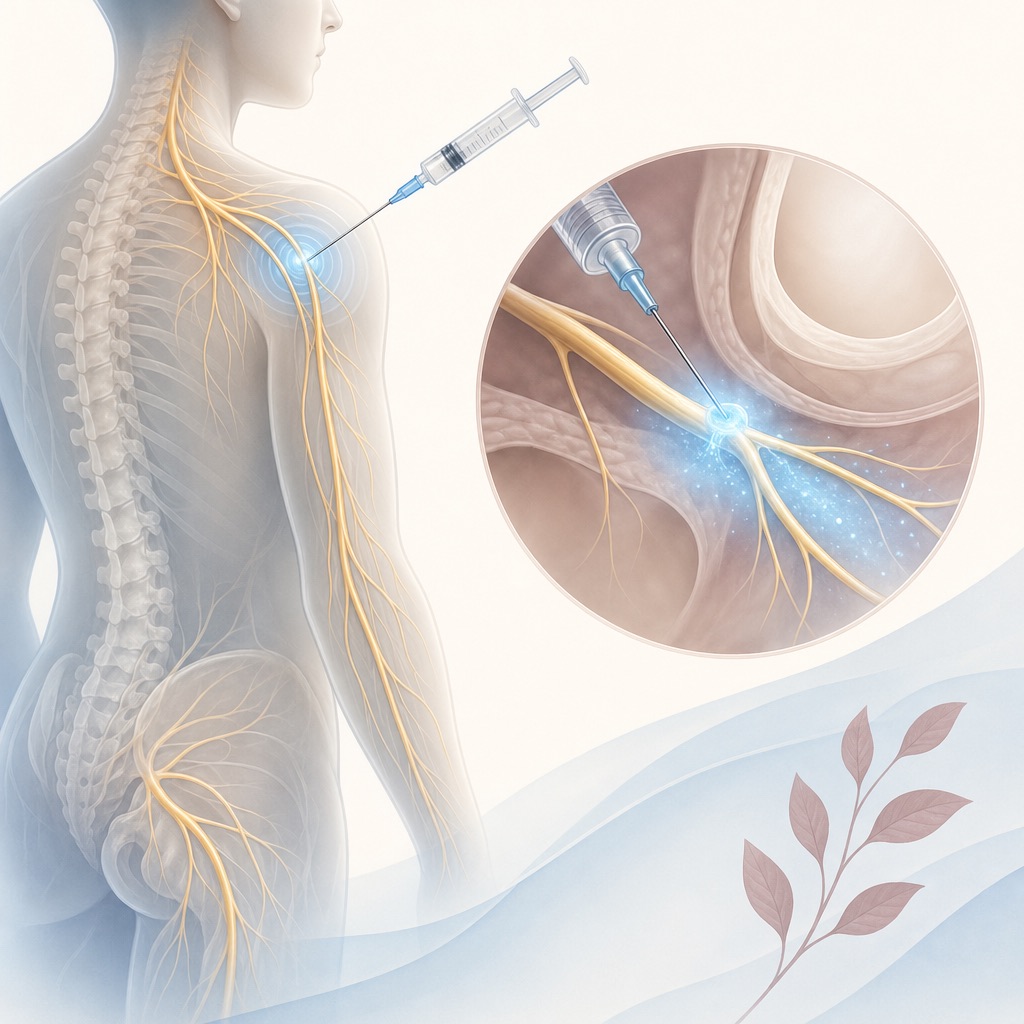
Nerve blocks in Houston: which blocks are a test and which are a treatment, what a positive block means, and how a block leads to RFA.
In short
A nerve block is an injection of local anesthetic, with or without a steroid, placed next to one specific nerve under image guidance. Some blocks are a test: they numb one nerve for a few hours so we can tell whether that nerve is carrying your pain, and a positive result is what qualifies you for radiofrequency ablation. Others are a treatment that quiets an irritated nerve for weeks to months. This page explains the difference and lists every block we perform, with a link to each.
Key facts
| Treats | Nerve-specific pain from the spine (facet joints, nerve roots), knee and shoulder joints, chest wall, back of the head, tailbone and pelvis, and sympathetically maintained pain such as CRPS |
|---|---|
| Test or treatment? | Both, depending on the block. A diagnostic block uses anesthetic only and is meant to wear off in hours. A therapeutic block adds a steroid and is meant to last weeks to months. Every block page on this site says which it is. |
| What counts as a positive test | At least 50% relief of your usual pain that lasts as long as the anesthetic (lidocaine about 1–2 hours; bupivacaine about 4–8 hours). For facet RFA, Medicare and most insurers want two separate blocks with 80% or better relief. |
| Procedure time | 10–30 minutes of needle time; plan on 45–90 minutes in the office |
| Anesthesia | Local anesthetic at the skin. Light sedation is available for deeper blocks; it is kept minimal for diagnostic blocks because the result depends on your honest pain report. |
| Downtime | Home the same day. No driving for 24 hours if sedated or if a limb is numb. Desk work the next day; heavier activity after 2–3 days. |
| When relief starts | Anesthetic works within 5–20 minutes. Steroid takes 2–7 days. |
| How long relief lasts | Diagnostic: hours, on purpose. Therapeutic: typically 2 weeks to 3 months. RFA after a positive block: typically 6–12 months or longer. |
| How often it can be repeated | Steroid blocks: typically no more than 3–4 per year at one site, at least 2 weeks apart. Diagnostic blocks: only as many as needed to make a decision, usually one or two. |
| Insurance | Most blocks are covered when the diagnosis, exam and prior conservative care are documented. Diagnostic blocks before RFA need a completed pain diary. |
Who it is for
- Pain that is widespread, shifting or not tied to any nerve or joint pattern (for example fibromyalgia), which a block cannot test or treat
- Active infection anywhere in the body, or skin infection at the injection site
- A bleeding disorder or blood thinner that cannot be safely paused for the deeper blocks
- Uncontrolled diabetes (blood sugar above roughly 200–250 mg/dL) when a steroid is planned
- A known allergy to the local anesthetic or contrast dye without an alternative
- Pregnancy, for any block that needs fluoroscopy (ultrasound-guided blocks can often still be done)
At a glance
| Procedure | Target | Used for | Test or treatment | Image guidance | Typical relief |
|---|---|---|---|---|---|
| Medial branch block | Medial branch nerves that supply the facet joints (neck or low back) | Facet joint pain: neck or back pain worse with leaning back, no shooting limb pain | Test | Fluoroscopy | Hours, by design. Positive result leads to facet RFA. |
| Facet joint injection | Inside the facet joint itself | A painful facet arthritis flare | Treatment (steroid) | Fluoroscopy | Weeks to a few months |
| Selective nerve root block | One spinal nerve root where it exits the spine | Pinpointing which nerve root causes arm or leg pain; also treats it | Both | Fluoroscopy | Hours as a test; 2–8 weeks or more with steroid |
| Genicular nerve block | Three small sensory nerves around the knee | Knee arthritis pain; pain after knee replacement | Test (before genicular RFA) | Fluoroscopy or ultrasound | Hours as a test; RFA typically 6–12 months |
| Sacroiliac joint injection | The SI joint at the base of the spine | SI joint pain confirmed on exam | Both | Fluoroscopy | Hours as a test; 1–3 months with steroid |
| Occipital nerve block | Greater and lesser occipital nerves at the back of the head | Occipital neuralgia; cervicogenic headache; cluster headache with neurology | Both | Landmark or ultrasound | Days to weeks; sometimes months |
| Intercostal nerve block | The nerve that runs under each rib | Pain after chest surgery, rib fractures, chest-wall shingles pain | Both | Ultrasound or fluoroscopy | Hours as a test; weeks with steroid; RFA or cryo after |
| Suprascapular shoulder nerve block | Suprascapular nerve (sometimes also the axillary nerve) | Chronic shoulder pain from arthritis, rotator cuff disease, frozen shoulder | Both | Ultrasound | Hours as a test; weeks with steroid; RFA or PNS after |
| Stellate ganglion block | Sympathetic nerve cluster at the base of the neck (C6–C7) | CRPS of the arm or hand; arm vascular pain; sympathetic facial pain | Both | Ultrasound or fluoroscopy | Hours to weeks; longer in a series paired with therapy |
| Lumbar sympathetic block | Sympathetic chain in front of the L2–L4 vertebrae | CRPS of the leg or foot; ischemic leg pain; phantom limb pain | Both | Fluoroscopy | Hours to weeks; longer in a series paired with therapy |
| Ganglion impar block | Small nerve cluster in front of the tailbone joint | Coccydynia (tailbone pain); perineal or rectal pain | Both | Fluoroscopy | Weeks to months; RFA after |
| Sphenopalatine ganglion block | Nerve cluster behind the nasal cavity | Cluster headache; some migraine; facial pain (on neurology referral) | Treatment | Transnasal applicator (no imaging) or fluoroscopy | Hours to weeks; usually a series |
| Sympathetic nerve blocks (family) | Stellate, lumbar sympathetic, celiac, hypogastric, impar | CRPS, vascular pain, visceral and pelvic pain | Both | Ultrasound or fluoroscopy | Varies by block; see the sympathetic hub |
| Radiofrequency ablation | The nerve that tested positive on a diagnostic block | Facet, knee (genicular) and SI joint pain after positive blocks | Treatment | Fluoroscopy | Typically 6–12 months; repeatable when pain returns |
Diagnostic versus therapeutic blocks: what is in the syringe
Every block on this site is one of two things, and the difference is what we inject.
A diagnostic block is a test. We inject a small volume of local anesthetic only, usually 0.5–1 mL per nerve, directly on the target nerve. If that nerve is the one carrying your pain, the pain drops sharply within minutes and comes back when the anesthetic wears off. Relief that lasts only a few hours is the point, not a failure. Diagnostic blocks answer one question: is this nerve the source? They do not fix anything, and we say so before the needle goes in.
A therapeutic block is a treatment. We inject anesthetic plus a corticosteroid (usually dexamethasone, triamcinolone or methylprednisolone) around a nerve that is inflamed or irritated. The anesthetic gives immediate relief for a few hours; the steroid takes 2–7 days to work and typically holds for 2 weeks to 3 months. Some blocks, such as the sympathetic blocks used for CRPS, work as a treatment with anesthetic alone because interrupting the nerve for several hours resets an overactive signal.
Why not add steroid to a diagnostic block? Because a steroid can reduce pain for reasons unrelated to the nerve you are testing, which muddies the answer. For the same reason, diagnostic blocks are done with little or no sedation: we need you awake, walking and doing the movements that normally hurt so you can rate your pain honestly.
Gulf Coast Pain & Spine performs these blocks in the office at Houston and Webster, and at Pearland when that office opens in November 2026.
What a positive block means, and what it does not
We ask you to rate your pain before the block and every 30–60 minutes afterward for the rest of the day, while doing the activities that normally provoke it. We give you a simple pain diary to record the numbers.
- Positive: your pain dropped by at least 50% (most guidelines) and stayed down for roughly as long as the anesthetic works: about 1–2 hours for lidocaine, 4–8 hours for bupivacaine. A block that relieves pain for three days is not a diagnostic answer; it is a placebo or steroid effect and we interpret it cautiously.
- Negative: less than 50% relief, or relief in the wrong place. That is useful too. It rules out one source and points us elsewhere, which saves you from an ablation that would not have worked.
Why two blocks? Roughly 25–40% of people report relief from any injection, even saline. For facet joint pain, Medicare and most commercial payers therefore require two medial branch blocks on separate days, each with 80% or better relief, before they will cover radiofrequency ablation. Most other diagnostic blocks require one clearly positive result.
What a positive block gates. A positive medial branch block qualifies you for facet RFA. A positive genicular block leads to genicular RFA. A positive suprascapular, intercostal or occipital block can lead to RFA or a peripheral nerve stimulator trial. A positive sympathetic block for CRPS starts a series of blocks timed with physical therapy. A block is a gate, not a guarantee: ablation relief is typically shorter and less complete than the block itself, and we tell you what to expect based on your specific result.
What happens on procedure day
- Check-in and a short review: your pain score today, the medications you took, your blood-thinner status and, for diabetics, your morning blood sugar. We confirm the exact side and level.
- You lie on the fluoroscopy table or sit for an ultrasound-guided block. Skin is cleaned with chlorhexidine and a small amount of lidocaine numbs the skin, which stings for a few seconds.
- Under live X-ray or ultrasound the needle is guided to the target nerve. For fluoroscopy blocks we inject a drop of contrast dye to confirm the tip is in the right place and not in a blood vessel. Most people feel pressure; a brief zing down the nerve's territory is common and is actually a sign of correct placement.
- The anesthetic (and steroid, for therapeutic blocks) is injected over 10–30 seconds. Total needle time is usually 10–30 minutes even for multiple levels.
- You rest for 15–30 minutes while we check the numbed area and, for a diagnostic block, ask you to try the movements that normally hurt. For sympathetic blocks we measure the skin temperature of your hand or foot.
- You go home with the pain diary and a direct number to call. A driver is required if you were sedated or if an arm or leg is numb or weak.
After the procedure
Day 0. Numbness and relief from the anesthetic for 1–8 hours depending on the drug. Keep your normal activity level so the pain diary reflects real life. Ice the site for 15 minutes at a time if it aches. Do not soak in a bath or pool for 24 hours.
Days 1–3. After a diagnostic block your usual pain returns; this is expected. After a therapeutic block, soreness at the site is common and some people have a short flare of their pain before the steroid takes effect. Diabetics should check blood sugar twice daily for three days; a rise of 50–150 mg/dL is typical after a steroid and usually settles within a week.
Week 1–2. Steroid benefit is usually clear by day 7. This is the window to restart physical therapy or the exercise program that pain had blocked, which is what makes a therapeutic block last.
When we judge the response. Diagnostic blocks are judged the same day from your diary. Therapeutic blocks are judged at 2–3 weeks. Call the same day for fever over 100.4°F, spreading redness at the site, new weakness, or numbness that lasts more than 24 hours.
How often blocks can be repeated
Diagnostic blocks are repeated only when the answer is unclear or when a payer requires a second confirmatory block. Doing the same diagnostic block three or four times has no value.
Therapeutic steroid blocks are limited by the steroid, not the needle. Guidelines from ASIPP and most payers allow up to 3–4 steroid injections per year at one site, spaced at least 2 weeks apart, and only if the previous one gave meaningful relief (typically at least 50% for at least 6–8 weeks). If a block wears off in under a month twice in a row, repeating it is the wrong plan; that is when we move to ablation, a stimulator or a different diagnosis.
Anesthetic-only sympathetic blocks for CRPS follow a different logic: a series of 3–6 blocks over several weeks, each timed the day before a physical therapy session, with the interval stretched out as relief lasts longer.
What the evidence shows
The evidence is strongest for the diagnostic role. Controlled diagnostic blocks are the only validated way to confirm facet joint pain; imaging cannot do it, which is why the ASIPP guidelines and Medicare coverage policies require them before RFA. When two comparative medial branch blocks are positive, facet RFA gives 50% or greater relief for 6–12 months in most treated patients in randomized trials, and the result can be repeated.
For therapeutic blocks the evidence varies by nerve. Occipital nerve blocks have randomized trial support for occipital neuralgia and cluster headache. Suprascapular nerve block has randomized evidence for chronic shoulder pain. Sympathetic blocks for CRPS are supported by decades of clinical use and guideline endorsement, though the trials are small and the effect is clearest when the block is paired with therapy. Intercostal, impar and sphenopalatine blocks rest mainly on case series and small trials. Each block page on this site states its own evidence plainly.
Alternatives and what comes next
Before a block: most patients should have tried 6–12 weeks of activity, physical therapy and non-opioid medication, because those are the treatments that last. After a positive diagnostic block: radiofrequency ablation for facet, genicular and SI joint pain; RFA or peripheral nerve stimulation for occipital, suprascapular and intercostal nerves. After a therapeutic block that helps but keeps wearing off: the same options, or for spine-related nerve pain, epidural steroid injections, spinal cord stimulation or DRG stimulation. After a negative block: a different diagnosis, which is a result, not a dead end. Ask which block we recommend for your pain pattern and whether it is a test or a treatment; the answer should be one or the other, never both at once.
Safety and preparation
- Blood thinners: the hold policy depends on how deep the block is. Following ASRA guidance, superficial blocks (occipital, suprascapular, genicular, intercostal with ultrasound) can often be done without stopping anticoagulants; spine-adjacent and sympathetic blocks (medial branch, nerve root, stellate, lumbar sympathetic, impar) usually require holding warfarin, DOACs such as apixaban or rivaroxaban, clopidogrel or ticagrelor for 2–7 days depending on the drug. Never stop a blood thinner on your own; we coordinate with the prescriber.
- Diabetes: any steroid block raises blood sugar for 1–7 days. We typically postpone a steroid block if your morning glucose is above 200–250 mg/dL or your A1c is above 8–9%. Diagnostic (anesthetic-only) blocks do not affect blood sugar.
- Infection or fever: any active infection, a fever above 100.4°F, or a rash or open skin at the injection site postpones the block. Tell us about any antibiotics you are taking.
- Allergies (contrast, steroid, local anesthetic): true allergy to local anesthetic is rare and we can usually switch drug class. Contrast allergy can be pre-treated or the block done with ultrasound instead of dye.
- Pregnancy: fluoroscopy is avoided; ultrasound-guided blocks can often proceed. Tell us if you could be pregnant.
- Sedation and driving: diagnostic blocks are done with little or no sedation so that your pain rating is valid. If you receive sedation, or if an arm or leg will be numb, you need a driver and should not drive, work or sign documents for 24 hours.
Risks and side effects
- Soreness or bruising at the needle site for 1–3 days
- Temporary numbness or weakness in the nerve's territory for several hours (this is the anesthetic working)
- A short flare of your usual pain for 1–3 days after a steroid block
- Blood sugar rise for 1–7 days after any steroid; facial flushing, trouble sleeping or a racing heart for a day or two
- Vasovagal reaction (lightheadedness, sweating, brief drop in blood pressure) during the procedure
- Prolonged numbness lasting days from local anesthetic spread to a neighboring nerve
- Skin thinning or a pale patch at a superficial steroid injection site, occasionally permanent
- Allergic reaction to contrast dye or local anesthetic
- Infection, including abscess or discitis after spine-adjacent blocks (well under 1 in 1,000 with sterile technique)
- Bleeding or hematoma around a nerve or the spine, more likely on blood thinners
- Nerve injury from direct needle trauma, usually temporary
- Injection into a blood vessel or the spinal fluid, which is why we use contrast and live imaging; block-specific serious risks (pneumothorax for intercostal, Horner's syndrome and seizure for stellate, rectal perforation for impar) are listed on each block's page
Frequently asked questions
Is a nerve block a test or a treatment?
It depends on the block, and we tell you which before you schedule. Anesthetic-only blocks such as the medial branch block are tests: they wear off in hours by design. Blocks that include a steroid are treatments meant to last weeks to months. Some blocks (nerve root, occipital, suprascapular, sympathetic) can be used either way.
How much relief do I need for the block to count as positive?
At least 50% relief of your usual pain for as long as the anesthetic lasts, judged from your pain diary the same day. For facet joint pain most insurers, including Medicare, require two blocks on separate days with 80% or better relief before they cover radiofrequency ablation.
Why did my pain come back the next day?
If it was a diagnostic block, that is exactly what should happen: the anesthetic wore off. The relief you felt for a few hours is the result we needed. If it was a steroid block, the steroid needs 2–7 days to work, and the first few days can include a flare.
Can I have a nerve block while on blood thinners?
Often yes for superficial blocks done under ultrasound; usually no for spine-adjacent or sympathetic blocks, which need the drug held for 2–7 days depending on which one. Bring your exact medication list and we will coordinate a plan with the doctor who prescribes it.
Will I be asleep?
No. Blocks are done under local anesthetic with you awake; light sedation is available for deeper blocks. We keep sedation minimal for diagnostic blocks because the result depends on your honest pain rating.
How many nerve blocks can I have in a year?
Steroid blocks are typically limited to 3–4 per year at one site, at least 2 weeks apart, and only if the last one worked. Diagnostic blocks are done once or twice to reach a decision. If a block keeps wearing off quickly, the right next step is ablation or a stimulator, not another block.
Does a positive block guarantee ablation will work?
No. A positive block makes ablation likely to help, and it is required before insurance will cover it, but ablation relief is usually somewhat less complete than the block. For facet RFA after two positive blocks, most treated patients get at least 50% relief for 6–12 months.
Sources
- Comprehensive Evidence-Based Guidelines for Facet Joint Interventions in the Management of Chronic Spinal Pain (opens in new tab) — American Society of Interventional Pain Physicians (ASIPP)
- Interventional Spine and Pain Procedures in Patients on Antiplatelet and Anticoagulant Medications (Second Edition) (opens in new tab) — American Society of Regional Anesthesia and Pain Medicine (ASRA)
- Facet Joint Interventions for Pain Management: Local Coverage Determination (L38773) (opens in new tab) — Centers for Medicare & Medicaid Services
- Chronic Pain: Information Page (opens in new tab) — National Institute of Neurological Disorders and Stroke (NINDS)
- Radiofrequency denervation for chronic low back pain (Cochrane Review) (opens in new tab) — Cochrane Library
Next step
Request an appointment
Call (832) 916-2075 or request an appointment online. New patients are welcome; the team confirms insurance and referral requirements before scheduling.