
- Pain confined to one nerve's territory that has lasted more than 3–6 months despite medication and therapy
- A diagnostic block of that nerve gave at least 50% relief while the anesthetic was working
- Knee pain after knee replacement or from osteoarthritis when surgery is not an option (genicular or saphenous nerves)
- Chronic shoulder pain from rotator cuff disease or after stroke (suprascapular or axillary nerve)
- Occipital neuralgia or cervicogenic headache that responds to occipital nerve blocks
- Post-amputation (residual limb or phantom) pain, post-thoracotomy or rib pain, post-hernia groin pain, cluneal nerve low back pain
Neuromodulation & implants
Peripheral Nerve Stimulation (PNS): 60-Day and Permanent Systems
Peripheral nerve stimulation for knee, shoulder, occipital, rib and post-amputation pain: which nerves, 60-day vs permanent systems, risks. Houston.
In short
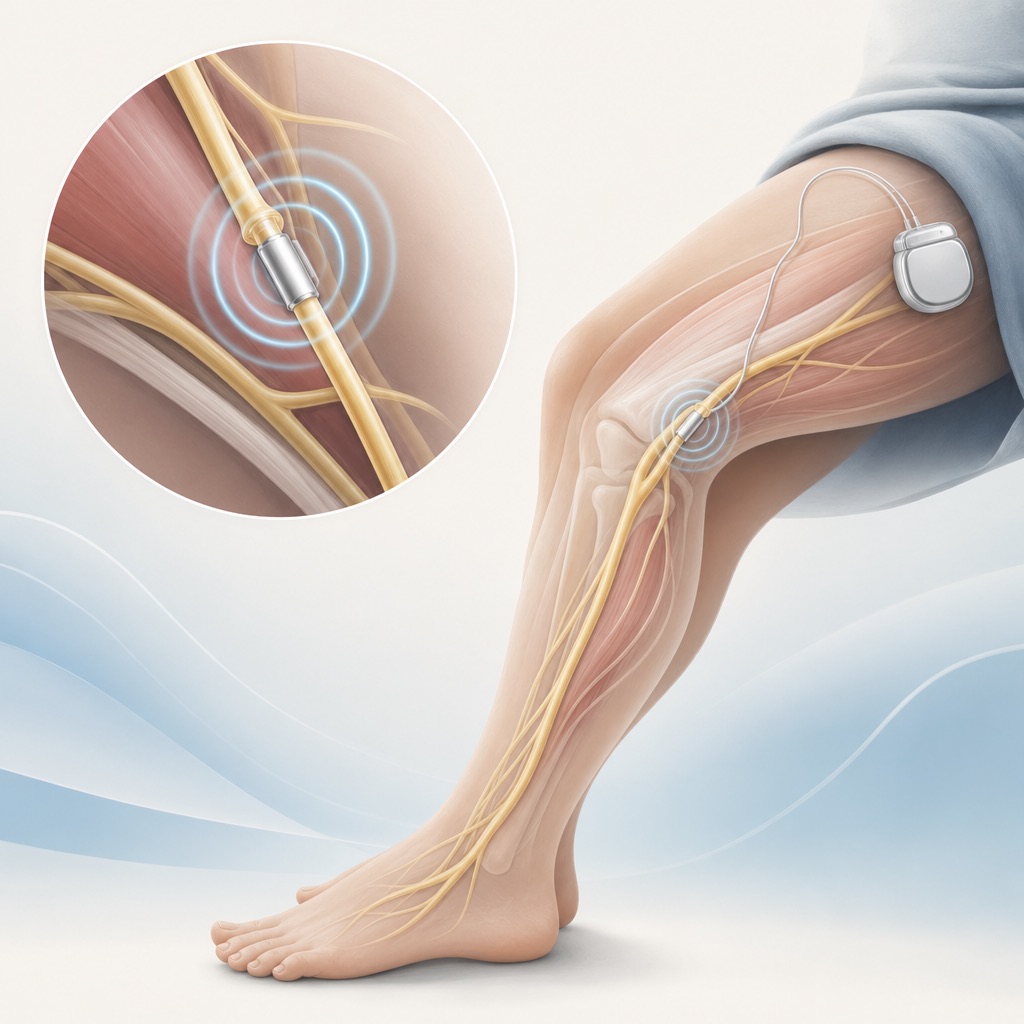
Peripheral nerve stimulation places a thin lead next to one named nerve outside the spine, under ultrasound guidance, and delivers mild electrical pulses that reduce pain in that nerve's territory. It is a treatment, offered after a diagnostic nerve block confirms which nerve is responsible. The main decision is between a temporary 60-day system that is removed afterward and a permanent implant that stays.
Key facts
| Treats | Pain in the territory of one nerve: occipital (back of head), suprascapular (shoulder), genicular and saphenous (knee), peroneal and tibial (leg, foot, amputation stump), cluneal (low back and buttock), intercostal (rib), ilioinguinal (groin) |
|---|---|
| Test or treatment? | Treatment. A diagnostic nerve block beforehand is the test. |
| Two formats | 60-day temporary lead with a wearable external stimulator, removed at day 60; or a permanent implanted lead with an implanted or wearable power source |
| Procedure time | 30–60 minutes, ultrasound-guided, office or procedure room |
| Anesthesia | Local anesthetic; light sedation optional |
| Downtime | Same-day return to light activity; avoid vigorous movement of the area for 1–2 weeks |
| When relief starts | Within days of programming |
| How long relief lasts | Varies. 60-day systems aim for relief that continues after removal; permanent systems provide ongoing stimulation |
| Insurance | Medicare and many commercial plans cover PNS for chronic nerve pain after a positive diagnostic block; some plans classify 60-day systems or specific nerves as investigational |
Who it is for
- Widespread pain or pain that crosses several nerve territories (spinal cord stimulation covers better)
- A diagnostic block that gave no relief, which means the target nerve is wrong
- Active infection, or skin breakdown at the planned lead site
- Blood thinners that cannot be paused for the placement (ultrasound-guided placement carries lower bleeding risk than spinal leads, but the hold still applies for most agents)
- Pregnancy
- Someone unable to manage the wearable stimulator or keep the exit-site dressing clean for 60 days
How peripheral nerve stimulation works, and which nerves we treat
Where spinal cord stimulation treats broad regions from inside the spine, PNS goes to the source: a lead the width of a few hairs is placed within a centimeter of a specific nerve using ultrasound, and a small stimulator delivers pulses that activate the nerve's large touch fibers, which dampens the pain fibers running alongside. Most people feel a comfortable tapping or tingling in the nerve's territory; some programs are felt very little.
Nerves commonly targeted:
- Greater and lesser occipital nerves for occipital neuralgia and cervicogenic headache
- Suprascapular nerve (and sometimes axillary) for chronic shoulder pain, including hemiplegic shoulder pain after stroke
- Genicular and saphenous nerves for knee pain, including persistent pain after knee replacement
- Common peroneal, tibial and sciatic or femoral nerves for leg, foot and post-amputation pain
- Superior and middle cluneal nerves for low back and buttock pain that follows those nerves
- Intercostal nerves for post-thoracotomy, rib fracture and thoracic postherpetic pain
- Ilioinguinal and iliohypogastric nerves for groin pain after hernia repair
The actual decision: 60-day temporary or permanent? A 60-day system uses a fine coiled lead that exits the skin and connects to a wearable stimulator about the size of a matchbox taped to the skin. It is worn for up to 60 days and then pulled out in the office. Its purpose is to reset the pain circuit; a meaningful share of people keep their relief for months after removal, and if pain returns it can be repeated or converted to a permanent system. A permanent implant places a lead that stays, powered either by a small implanted generator or by an external transmitter worn over the site. It suits pain expected to persist, such as post-amputation or occipital pain, and it is the option when a 60-day course helped but did not last. There is no trial-then-implant sequence for the 60-day system: it is the treatment. Permanent systems usually require a short trial (a few days to a week) for insurance. We place both types for Houston, Webster and Pearland (opening November 2026) patients in an outpatient setting.
What happens on procedure day
- A diagnostic block has already been done at an earlier visit and gave at least 50% relief; that visit confirmed the target nerve. Blood thinners have been held as agreed. Bring a driver if sedation is planned.
- You lie or sit in the position that exposes the nerve. The skin is cleaned and numbed; an antibiotic dose is given for permanent implants and by protocol for 60-day leads.
- Under ultrasound, the physician advances a needle to within about a centimeter of the nerve, confirms position by test stimulation (you feel tapping in the right territory, not in the wrong one), and deploys the lead through the needle.
- 60-day system: the lead is secured with a dressing, connected to the wearable stimulator, and programmed before you leave. Permanent system: the lead is anchored and tunneled to a small generator pocket or to a receiver, with one or two small incisions, then programmed.
- Total time is typically 30–60 minutes for a 60-day lead and 60–90 minutes for a permanent implant. You go home the same day with the controller and written instructions.
After the procedure
Day 0: mild soreness at the entry site; the stimulator can be used right away. Keep the dressing dry for the first 48 hours.
Days 1–7: return to desk work and daily activity. Avoid vigorous movement of the treated limb or repeated stretching across the lead path for 1–2 weeks so the lead does not shift. For 60-day systems, you change the site dressing as taught and swap the stimulator's battery on schedule.
Weeks 2–8 (60-day system): the lead stays in place and stimulation continues daily; a check visit at 2–4 weeks adjusts settings. At day 60 the lead is removed in the office in a few seconds. Relief is then judged at 1 and 3 months after removal.
Weeks 2–6 (permanent system): wound check, then programming. Limit lifting or reaching with the treated limb until the wound check.
When to judge the result: for permanent systems, at 3 months of programmed use. For 60-day systems, the honest answer comes 1–3 months after the lead is out.
Call the same day for fever over 100.4 °F, spreading redness, swelling or drainage where the lead exits or at the incision, new weakness or numbness, or pain that is clearly worse rather than better. Go to an emergency room for chest pain, trouble breathing, or signs of a serious infection such as chills with a high fever.
What the evidence shows
Evidence for PNS is smaller and more mixed than for spinal cord stimulation, and it varies by nerve and system. The strongest randomized data are for 60-day stimulation in post-amputation pain: in a 2019 multicenter trial, 67% of people receiving 8 weeks of active stimulation had at least 50% pain relief at the end of treatment versus 14% with placebo, and about 58% still reported at least 50% relief 12 months after the lead was removed. A 2016 randomized trial of a permanent implanted system for chronic peripheral nerve pain showed 38% of treated patients achieving at least 30% relief at 3 months versus 10% of controls. Single-arm studies support occipital, shoulder and knee applications, with relief that is real but often less than trial headlines suggest. Guidance from the American Society of Pain and Neuroscience (2022) and the NACC gives PNS a conditional recommendation for focal peripheral neuropathic pain. Insurance coverage reflects this: most plans cover PNS for chronic nerve pain after a positive diagnostic block, but some classify 60-day systems or particular nerves (for example, knee osteoarthritis) as investigational.
Alternatives and what comes next
Before PNS, the usual sequence is medication, targeted physical therapy, and the diagnostic block itself: an occipital nerve block, suprascapular block, genicular nerve block or intercostal block. For knee or facet-type pain, radiofrequency ablation of the same nerves is an alternative that heats the nerve rather than stimulating it, with 6–12 months of relief per session. If the pain crosses several nerve territories or spreads up a limb, spinal cord stimulation or, for CRPS, DRG stimulation is the better fit. If a 60-day course helps but relief fades, a repeat course or a permanent implant is the next step. See the neuromodulation overview for the comparison.
Safety and preparation
- Blood thinners: most agents are held briefly before lead placement on a schedule agreed with your prescriber; ultrasound-guided peripheral leads carry lower bleeding risk than spinal leads, so the hold may be shorter, but do not stop any drug on your own.
- Infection/fever: active infection or skin breakdown at the lead site postpones the procedure. With a 60-day system the exit site must be kept clean and dry for the full course; tell us if that is not realistic at home or work.
- Diabetes: poor glucose control raises exit-site infection risk; bring recent numbers.
- Pacemaker/ICD: PNS can be used alongside cardiac devices with cardiology coordination and a device check; tell us before scheduling, especially for leads near the chest or shoulder.
- MRI: 60-day systems permit no MRI while the lead is in place and require documentation of any retained fragment afterward. Permanent systems are MRI-conditional or MRI-excluded depending on the device; confirm with your device card before any scan.
- Allergies (local anesthetic, antibiotics, adhesive tape): adhesive sensitivity matters more here than for any other implant, because the stimulator or dressing sits on skin for weeks.
- Sedation and driving: local anesthetic alone allows you to drive home; if sedation is used, bring a driver.
- Pregnancy: tell us if you may be pregnant; the procedure is deferred.
Risks and side effects
- Soreness or bruising at the lead entry site for a few days
- Skin irritation, itching or a rash from the adhesive under the external pulse generator or dressing (60-day and wearable systems)
- Stimulation that feels too strong or off-target until settings are adjusted
- Temporary loss of stimulation if the wearable battery runs down or a connection loosens
- Lead migration with loss of coverage, needing repositioning or replacement
- Lead fracture; with 60-day coiled leads a small fragment can remain under the skin after removal (usually harmless, but it must be documented for future MRI)
- Infection at the exit site or pocket (lower than with spinal implants, typically 1–3%), which can require removing the lead
- Persistent pain or numbness from nerve irritation during placement
- Seroma or pocket discomfort with implanted generators
- Relief that does not outlast the 60-day course
- Direct nerve injury with lasting weakness or numbness in that nerve's territory
- Pneumothorax (collapsed lung) when placing intercostal or nearby leads, or vascular injury near the occipital or suprascapular sites; ultrasound guidance is the main safeguard
- Deep infection spreading along the lead track
- Device heating or displacement if an MRI is performed with a lead or fragment the labeling does not permit
Frequently asked questions
Should I choose the 60-day system or a permanent implant?
The 60-day system is the first choice for most people: it needs no incision, is removed in the office, and often leaves relief that lasts months. A permanent implant makes sense when pain is expected to persist long term, when a 60-day course helped but wore off, or for conditions such as post-amputation and occipital pain where ongoing stimulation is the goal. Some insurers cover one and not the other, which can also decide it.
Do I need a nerve block before PNS?
Yes. A diagnostic block of the target nerve that gives at least 50% relief while the anesthetic works is how we confirm the right nerve, and most insurers require it. If the block does not help, PNS of that nerve is unlikely to help either.
Which nerves can be stimulated?
The nerves we most often treat are the occipital nerves (back of the head), suprascapular (shoulder), genicular and saphenous (knee), peroneal and tibial (leg, foot, amputation stump), cluneal (low back and buttock), intercostal (rib cage) and ilioinguinal (groin). Pain must follow one nerve's territory for PNS to work.
Does the relief last after the 60-day lead comes out?
For many people, yes, though not for everyone. In the post-amputation trial, about 58% still had at least 50% relief a year after the lead was removed. If pain returns, the course can be repeated or converted to a permanent system.
Can I have an MRI?
Not while a 60-day lead is in place. After removal, any retained fragment must be documented so radiology can clear you. Permanent systems are MRI-conditional or MRI-excluded depending on the device; carry your device card and tell the imaging center before scheduling.
Is peripheral nerve stimulation covered by insurance?
Medicare and many commercial plans cover PNS for chronic peripheral nerve pain after a positive diagnostic block and failed conservative care. Some plans classify 60-day systems, or specific uses such as knee osteoarthritis, as investigational. We verify coverage before scheduling; see our insurance page for what to expect.
What does it feel like?
A light tapping or tingling in the territory of the treated nerve, adjustable with a handheld controller. It should never be painful; if it is, the settings are wrong or the lead has moved, and you should call.
Sources
- Percutaneous peripheral nerve stimulation for the treatment of chronic neuropathic postamputation pain: a multicenter, randomized, placebo-controlled trial (opens in new tab) — Regional Anesthesia & Pain Medicine
- Prospective, Multicenter, Randomized, Double-Blinded, Partial Crossover Study to Assess the Safety and Efficacy of the Novel Neuromodulation System in the Treatment of Patients With Chronic Pain of Peripheral Nerve Origin (opens in new tab) — Neuromodulation
- Evidence-Based Clinical Guidelines from the American Society of Pain and Neuroscience for the Use of Implantable Peripheral Nerve Stimulation in the Treatment of Chronic Pain (opens in new tab) — Journal of Pain Research
- The Neurostimulation Appropriateness Consensus Committee (NACC): Recommendations for Spinal Cord and Peripheral Nerve Stimulation (opens in new tab) — North American Neuromodulation Society / Neuromodulation
Next step
Request an appointment
Call (832) 916-2075 or request an appointment online. New patients are welcome; the team confirms insurance and referral requirements before scheduling.