
- Nerve-type pain (burning, shooting, electric) that has lasted more than 6 months and has not responded to medication, physical therapy and injections
- Pain after spine surgery (post-laminectomy syndrome) in the back and legs
- Complex regional pain syndrome of an arm, leg or foot
- Painful diabetic neuropathy of the feet and legs that medications do not control
- Pain limited to one nerve's territory, such as the knee, shoulder, back of the head or a rib space
- People who want to reduce or avoid long-term opioid use
Neuromodulation & implants
Neuromodulation: Spinal Cord, DRG and Peripheral Nerve Stimulation
Spinal cord, DRG and peripheral nerve stimulation compared: who each fits, how the trial works, MRI and battery facts. Interventional pain in Houston.
In short
Neuromodulation uses a small implanted device to deliver mild electrical pulses to the spinal cord, a nerve root, or a peripheral nerve so that fewer pain signals reach the brain. It is a treatment, not a test, and it is reserved for nerve-type pain that has not responded to medication, therapy and injections. Every system is tried first with temporary leads for about a week; only people who get meaningful relief go on to the implant.
Key facts
| Three types | Spinal cord stimulation (SCS), dorsal root ganglion (DRG) stimulation and peripheral nerve stimulation (PNS) |
|---|---|
| Test or treatment? | Treatment. The temporary trial is the test that decides whether the implant is worth doing. |
| Trial length | Typically 5–7 days with external leads (3–10 days depending on payer and device) |
| Success threshold | At least 50% pain relief during the trial, plus better function or sleep, before an implant is scheduled |
| Implant | Outpatient surgery, usually 1–2 hours, home the same day |
| Battery | Rechargeable systems are rated for about 9–10 years; non-rechargeable typically 3–7 years depending on settings |
| MRI | Most current systems are MRI-conditional (allowed under specific scanner settings), not MRI-free |
| Reversible | Yes. A stimulator can be turned off, reprogrammed or removed. |
| Insurance | Covered by Medicare and most commercial plans after a documented trial and a psychological evaluation |
Who it is for
- Pain that has a fixable structural cause (for example, a nerve still being compressed by a disc) that surgery or an injection should address first
- An untreated infection anywhere in the body
- Blood thinners that cannot be paused safely for the trial and implant
- Untreated major depression, active psychosis or an untreated substance use disorder (a psychological evaluation is required by payers for this reason)
- Pregnancy, because the devices have not been studied in pregnancy
- Someone who cannot manage a handheld controller or attend follow-up programming visits
At a glance
| Procedure | Target | Best-fit diagnoses | Trial type | Permanence | MRI status |
|---|---|---|---|---|---|
| Spinal cord stimulation (SCS) | Dorsal columns of the spinal cord (epidural space, usually thoracic) | Post-laminectomy syndrome, leg or arm radicular pain, painful diabetic neuropathy, CRPS with wide coverage needs | Percutaneous epidural leads for 5–7 days, external battery | Permanent implant with battery under the skin; removable | Most current systems MRI-conditional; older systems may not be |
| DRG stimulation | Dorsal root ganglion at one or two spinal levels | CRPS I/II of the lower extremity: foot, knee, groin, hip (FDA-labeled indication) | Percutaneous leads through the foramen for 5–7 days | Permanent implant; removable | MRI-conditional with stricter, device-specific limits |
| Peripheral nerve stimulation (PNS) | One named nerve outside the spine (occipital, suprascapular, genicular, cluneal, intercostal and others) | Pain in one nerve's territory that responds to a diagnostic nerve block | Either a 60-day temporary system (then removed) or a short trial before a permanent lead | 60-day system is temporary by design; permanent versions are removable | Varies by device; temporary systems generally allow no MRI while leads are in |
How stimulation changes pain
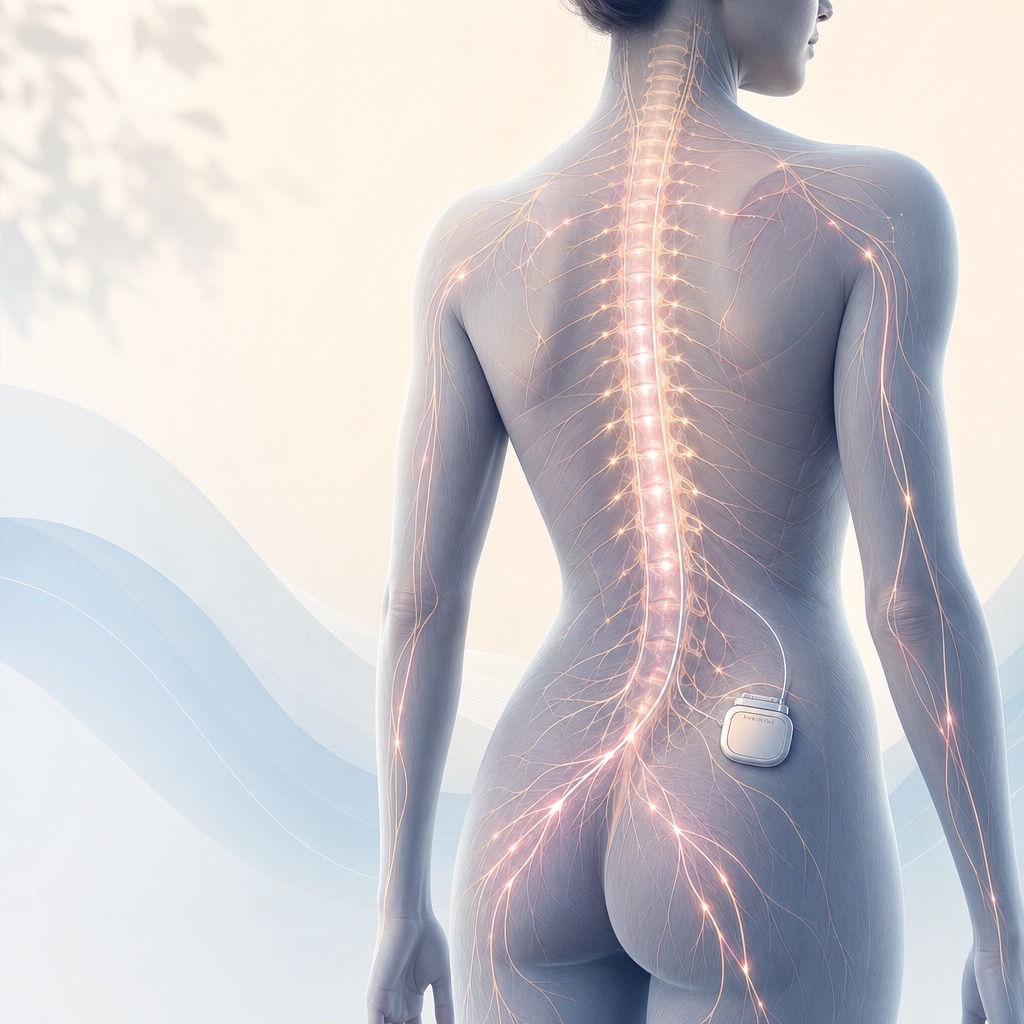
Chronic nerve pain is often a signaling problem rather than an ongoing injury: the nerves keep firing after the tissue has healed, or after surgery has removed the original cause. Neuromodulation places one or two thin leads (insulated wires with contacts on the end) next to the structure carrying those signals and delivers programmed pulses from a battery-powered generator. Depending on the program, you may feel a gentle tingling in place of the pain (paresthesia-based stimulation) or feel nothing at all (high-frequency and burst programs). Either way, the goal is fewer pain signals reaching the brain, better function and less medication. The lead location is what separates the three options.
- Spinal cord stimulation sits in the epidural space over the spinal cord and covers broad areas such as both legs or the low back and leg together.
- DRG stimulation sits on the small cluster of sensory nerve cell bodies where one nerve root exits the spine, so it covers a narrow zone such as a foot or groin.
- Peripheral nerve stimulation sits next to one nerve outside the spine, under ultrasound guidance, for pain confined to that nerve's territory.
Gulf Coast Pain & Spine offers trials and implants in Houston, Webster and Pearland (opening November 2026), with programming follow-up in the office.
Trial first, then implant: how the two-step process works
No stimulator is implanted without a trial. This is a payer requirement and, more importantly, the best predictor of who will do well.
Before the trial. You need a documented diagnosis, records showing that conservative care did not work, recent imaging of the target area (MRI or CT for spinal leads), and a psychological evaluation. Medicare and nearly all commercial plans require the evaluation. It is not a judgment about whether your pain is real; it screens for untreated depression, unrealistic expectations or substance use that predict poor results, and it is often the step that takes longest to schedule.
The trial. In an outpatient procedure room, under light sedation and local anesthetic, the physician places one or two temporary leads through a needle and confirms position with X-ray (fluoroscopy) or ultrasound. The leads exit the skin and connect to a small external battery taped to your back or side. You go home the same day and live as normally as the dressing allows for about 5–7 days, keeping a simple pain and activity diary. You may not shower with the leads in, should avoid bending and twisting, and should not drive during the trial. At the end, the leads are pulled out in the office in a few seconds; no stitches are needed.
Judging success. The standard threshold is at least 50% relief of the target pain, ideally with something concrete to show for it: walking farther, sleeping through the night or needing less medication. Most trials are clear one way or the other.
The implant. If the trial succeeds, the permanent implant is scheduled as a separate outpatient surgery, typically 2–6 weeks later, at a surgery center or hospital. New leads are placed in the same position and connected to a generator about the size of a stopwatch in a pocket under the skin of the upper buttock, flank or abdomen. The procedure takes about 1–2 hours and you go home the same day with a handheld controller.
If the trial fails. Nothing has been implanted, and you are back where you started with useful information. Options include trying a different modality (a DRG or peripheral trial after a failed SCS trial, or the reverse), a different waveform, an intrathecal pump for the right diagnoses, or a renewed focus on medication and rehabilitation. Roughly 1 in 5 to 1 in 4 trials does not meet the threshold, so a failed trial is a normal outcome, not a failure on your part.
What happens on procedure day
- Trial day: arrive with a driver. Blood thinners have been held per the plan agreed with your prescriber, and your skin has been checked for any infection.
- An IV is placed for light sedation and antibiotics. You lie face down (spinal leads) or in the position that exposes the target nerve (peripheral leads); the skin is cleaned and numbed.
- Leads are advanced through a needle under X-ray or ultrasound. For paresthesia-based programs you are woken enough to confirm the tingling overlaps your pain; for paresthesia-free programs position is set by anatomy.
- Leads are secured with dressings and connected to the external trial battery. A device representative or nurse programs it and teaches you the controller before you leave, usually within 1–2 hours of arrival.
- Implant day (separate visit, only after a successful trial): same preparation, deeper sedation or general anesthesia, permanent leads anchored to tissue, generator placed in a skin pocket, two small incisions closed with sutures or glue. Home the same day.
After the implant
Days 0–3: incision soreness at the generator pocket and lead entry site is expected; ice and the prescribed short course of pain medication cover most people. Keep dressings dry until the wound check.
Weeks 1–2: wound check and first programming visit. Stimulation is often started at low levels and adjusted over several visits.
Weeks 1–6: no bending, lifting more than about 5–10 pounds, twisting or raising arms overhead (for cervical leads). This lets scar tissue anchor the leads and is the single most important way to prevent lead migration. Driving resumes when you are off sedating medication and cleared at the wound check, and only with the device settings your programmer approves for driving.
Months 2–3: normal activity, including exercise and travel. This is when to judge the result honestly; programming changes can continue for as long as you have the device.
Long term: rechargeable systems need charging through the skin for roughly an hour every few days to a week; non-rechargeable systems are replaced in a short outpatient procedure when the battery runs down. Carry the device ID card; it tells any hospital what MRI settings, if any, are allowed.
What the evidence shows
Spinal cord stimulation has the strongest evidence base of the three, with randomized trials dating back two decades. High-frequency (10 kHz) stimulation outperformed traditional stimulation for back and leg pain in the SENZA randomized trial and, in the SENZA-PDN trial, produced at least 50% pain relief in 79% of people with painful diabetic neuropathy at 6 months versus 5% with medical management alone; that result led to a specific FDA approval for painful diabetic neuropathy in 2021. In the ACCURATE trial, DRG stimulation beat traditional SCS for lower-limb CRPS (81% versus 56% treatment success at 3 months). Peripheral nerve stimulation has smaller trials and more single-arm studies; evidence is best for post-amputation pain, occipital and shoulder pain. Long-term, real-world results are more modest than trial results everywhere: relief tends to fade somewhat over years, revision procedures for lead problems or battery replacement are common, and roughly 8–10% of implanted systems are eventually removed. The North American Neuromodulation Society's NACC guidelines summarize this evidence and set the patient-selection standards we follow.
Alternatives and what comes next
Before any stimulator, most people have tried nerve pain medications, physical therapy, epidural steroid injections or radiofrequency ablation for the right diagnosis, and, for CRPS, sympathetic blocks. If a diagnostic nerve block gives short-lived relief in one nerve's territory, PNS is the closest match. If you have widespread cancer pain or severe spasticity, an intrathecal pump is the device to discuss instead. If a stimulator works but relief fades years later, options include reprogramming, lead revision or switching modalities. Referring physicians can send imaging and records through Refer a Patient; we handle the trial, psychological evaluation coordination and authorization.
Safety and preparation
- Blood thinners: warfarin, apixaban, rivaroxaban, clopidogrel and similar drugs must be held before both the trial and the implant on a schedule set with the prescribing physician; aspirin for a cardiac stent is decided case by case. Never stop these on your own.
- Infection/fever: any active infection, including urinary, dental or skin infections, postpones the procedure. Tell us about diabetes control (an A1c above about 8 raises infection risk) and any history of MRSA.
- Pacemaker/ICD: stimulators can be implanted alongside cardiac devices, but it requires coordination with your cardiologist and device checks after programming; tell us before the trial.
- MRI: after implant, every MRI needs your device card and a radiology check of the conditional settings. Some older systems and some lead configurations exclude MRI entirely.
- Psychological evaluation: required by payers before authorization; we will refer you and it must be completed before the trial is scheduled.
- Sedation and driving: you need a driver for the trial and implant, may not drive during the trial week, and should not drive afterward until cleared and off sedating medication.
- Pregnancy: the procedure is deferred in pregnancy; tell us if you may be pregnant.
- Allergies (contrast, local anesthetic, antibiotics, adhesives): tell us in advance; tape allergies matter for the trial dressings.
Risks and side effects
- Soreness at the generator pocket and lead sites for 1–3 weeks after implant
- Stimulation that shifts with posture or feels too strong or weak until programming settles (paresthesia-based systems)
- Skin irritation or itching under trial dressings
- Lead migration or fracture requiring a revision procedure (historically about 10% or more with older anchoring; lower with current systems and strict activity limits)
- Infection of the pocket or lead track, typically 2–5%, which usually means removing the whole system and re-implanting later
- Dural puncture with headache during spinal lead placement (about 1% or less)
- Seroma (fluid collection) or persistent pocket pain, sometimes requiring generator relocation
- Loss of effect over time despite reprogramming
- Epidural hematoma or abscess causing spinal cord or nerve compression (weakness, numbness, loss of bladder or bowel control): a surgical emergency, which is why blood thinners are held and infection is ruled out first
- Direct nerve or spinal cord injury during lead placement
- Heating or malfunction if an MRI is performed outside the device's conditional labeling, or if a non-conditional system is scanned
Frequently asked questions
How long does the stimulator trial last, and can I drive during it?
Most trials run 5–7 days. Do not drive during the trial: the leads are held only by dressings, the external battery is taped to you, and turning or bracing can dislodge them. Arrange rides, or plan to work from home if your job allows.
What counts as a successful trial?
At least 50% relief of the pain you are treating, plus a real functional gain such as walking farther, sleeping better or needing less medication. Less than that and we do not recommend the implant, because trial results are the best predictor of long-term results.
Why do I need a psychological evaluation?
Medicare and most commercial insurers require it before authorizing a trial. It looks for untreated depression, anxiety, unrealistic expectations or substance use that lower success rates, and it gives you a chance to ask questions about living with a device. It rarely disqualifies anyone; more often it identifies something worth treating first.
Can I have an MRI with a stimulator?
Usually yes, with conditions. Most current systems are MRI-conditional, meaning scans are allowed only under specific scanner strengths, body regions and settings listed on your device card. That is not the same as MRI-safe. Some older or specific lead configurations exclude MRI entirely. Always tell the imaging center you have an implant before scheduling.
How long does the battery last, and what happens when it runs out?
Rechargeable generators are rated for about 9–10 years and are charged through the skin with a paddle for about an hour every few days. Non-rechargeable generators typically last 3–7 years depending on how much power your program uses, then are replaced in a 30–45 minute outpatient procedure that leaves the leads in place.
What if the trial does not work?
Nothing permanent was placed, so you have lost a week and gained information. About 20–25% of trials do not meet the threshold. Depending on your diagnosis we may suggest a different type of stimulation, a different waveform, an intrathecal pump, or a step back to medication and rehabilitation.
Can the device be removed later?
Yes. Explant is an outpatient procedure. It is done for infection, loss of benefit, a planned MRI the system cannot tolerate, or simply because you no longer want it. Around 8–10% of systems are removed over the years of follow-up.
Which type is right for me: SCS, DRG or PNS?
It depends on where the pain is. Broad areas (both legs, back and leg) favor spinal cord stimulation; a narrow zone such as one foot or the groin from CRPS favors DRG; pain in one named peripheral nerve that a diagnostic block relieves favors PNS. The table above summarizes the differences, and the trial settles the question.
Sources
- The Neurostimulation Appropriateness Consensus Committee (NACC): Recommendations for Spinal Cord and Peripheral Nerve Stimulation (opens in new tab) — North American Neuromodulation Society / Neuromodulation
- Novel 10-kHz High-frequency Therapy (HF10 Therapy) Is Superior to Traditional Low-frequency Spinal Cord Stimulation (SENZA-RCT) (opens in new tab) — Anesthesiology
- Effect of High-frequency (10-kHz) Spinal Cord Stimulation in Patients With Painful Diabetic Neuropathy (SENZA-PDN) (opens in new tab) — JAMA Neurology
- Dorsal root ganglion stimulation yielded higher treatment success rate for CRPS and causalgia at 3 and 12 months (ACCURATE) (opens in new tab) — PAIN
- Spinal Cord Stimulators: Safety Communication and Patient Labeling (opens in new tab) — U.S. Food and Drug Administration
Next step
Request an appointment
Call (832) 916-2075 or request an appointment online. New patients are welcome; the team confirms insurance and referral requirements before scheduling.