
- CRPS (formerly RSD) of an arm or leg, ideally within the first months, when a block can break the cycle and let physical therapy work
- Burning limb pain after a nerve injury, fracture or surgery that comes with color change, swelling, temperature difference or abnormal sweating
- Rest pain from poor circulation in a leg that cannot be revascularized, or non-healing ischemic ulcers
- Phantom limb pain or stump pain after amputation
- Upper-abdominal cancer pain (pancreas, stomach, liver) or pelvic cancer pain that opioids control poorly or with too many side effects
- Tailbone or perineal pain lasting more than 2–3 months
Nerve blocks & ablation
Sympathetic Nerve Blocks
Sympathetic nerve blocks in Houston for CRPS, vascular and visceral pain: stellate, lumbar, celiac, hypogastric and impar blocks compared.
In short
Sympathetic nerve blocks are injections of local anesthetic around the sympathetic nerve chain, the part of the nervous system that controls blood flow, sweating and temperature and that can amplify pain after an injury. They are used for complex regional pain syndrome (CRPS), pain from poor circulation, phantom limb pain and some cancer and pelvic pain. Each block is both a test and a treatment: the first block tells us whether the sympathetic system is driving your pain, and a series of blocks paired with physical therapy is the treatment. This page compares the five blocks in the family and links to each.
Key facts
| Treats | CRPS of the arm or leg; sympathetically maintained pain after nerve injury; ischemic limb pain; phantom limb pain; upper-abdominal cancer pain (celiac); pelvic pain (hypogastric); tailbone and perineal pain (impar) |
|---|---|
| Test or treatment? | Both. The first block is a test: pain relief plus a measurable rise in skin temperature means the pain is sympathetically maintained. A series of blocks timed with physical therapy is the treatment. |
| Sign of a successful block | A rise in skin temperature of at least 1.5–2°C in the hand or foot within 10–20 minutes (or Horner's syndrome for a stellate block). Without it the block did not reach the target and the pain response cannot be judged. |
| Procedure time | 15–30 minutes; 60–90 minutes in the office including temperature monitoring |
| Anesthesia | Local anesthetic at the skin; light sedation for lumbar sympathetic, celiac and hypogastric blocks; minimal for stellate |
| Downtime | Same-day discharge with a driver. Light activity the same evening; physical therapy the next day is part of the plan. |
| When relief starts | Within 10–30 minutes if the pain is sympathetically maintained |
| How long relief lasts | Typically hours to a few days after the first block, lengthening with each block in a series; celiac neurolysis for cancer pain typically 2–6 months |
| How often it can be repeated | For CRPS a series of 3–6 blocks over 4–8 weeks is typical, each 1–2 weeks apart; the interval stretches as relief lasts longer. Blocks that give no lasting benefit after 2–3 are stopped. |
| Insurance | Covered for CRPS and the other diagnoses above with documentation; the temperature record supports the claim |
Who it is for
- Pain with no sympathetic features and no response to a properly performed test block (sympathetically independent pain): further blocks will not help and other treatments are the answer
- Active infection, or a bleeding disorder or blood thinner that cannot be held; these are deep blocks near major vessels
- Recent heart attack, unstable heart rhythm or severe lung disease for a stellate block, which affects heart rate and can rarely cause a pneumothorax
- Uncorrected bowel obstruction or aortic aneurysm at the target level for celiac and hypogastric blocks
- Pregnancy for the fluoroscopy-guided blocks
- Neck pain, low back pain or arthritis pain, none of which sympathetic blocks treat
At a glance
| Block | Target | Used for | Sign of success | Guidance | Typical relief |
|---|---|---|---|---|---|
| Stellate ganglion block | Cervical sympathetic chain at C6–C7, base of the neck | CRPS of the arm or hand; arm vascular pain (Raynaud's, vasospasm); sympathetically maintained facial pain; early shingles pain of the face or arm | Horner's syndrome (droopy lid, small pupil, red eye) plus a warm hand | Ultrasound or fluoroscopy | Hours to days at first; longer in a series with therapy |
| Lumbar sympathetic block | Lumbar sympathetic chain in front of L2–L4 | CRPS of the leg or foot; ischemic leg pain; phantom limb pain; shingles pain of the leg | Warm foot (temperature rise of 1.5–2°C or more) | Fluoroscopy | Hours to days at first; longer in a series; neurolysis for ischemic pain lasts months |
| Celiac plexus block | Nerve web in front of the aorta at T12–L1, upper abdomen | Pancreatic and other upper-abdominal cancer pain; some chronic pancreatitis pain | Relief of deep abdominal pain; warm legs and a drop in blood pressure show spread | Fluoroscopy or CT | Diagnostic block: hours; alcohol neurolysis for cancer pain: typically 2–6 months |
| Superior hypogastric plexus block | Nerve web in front of the L5–S1 junction, pelvis | Pelvic cancer pain; chronic pelvic pain from the bladder, uterus, prostate or rectum after other causes are treated | Relief of deep pelvic pain | Fluoroscopy | Diagnostic block: hours to days; neurolysis for cancer pain: months |
| Ganglion impar block | Single ganglion in front of the tailbone joint | Coccydynia (tailbone pain); perineal, rectal and vaginal pain; pelvic cancer pain | Relief of sitting and perineal pain | Fluoroscopy | Weeks to months; radiofrequency after a positive block |
What sympathetically maintained pain means
The sympathetic nervous system is the automatic wiring that adjusts blood flow, sweating and skin temperature. It is not supposed to carry pain. After some injuries, though, sympathetic nerve fibers and pain fibers become cross-wired: the sympathetic signal that should just narrow a blood vessel instead fires the pain nerves, and the pain in turn drives more sympathetic activity. The result is burning pain with a limb that is cold or hot, swollen, discolored, sweaty or dry, and too tender to touch. This is sympathetically maintained pain, and CRPS is its best-known form.
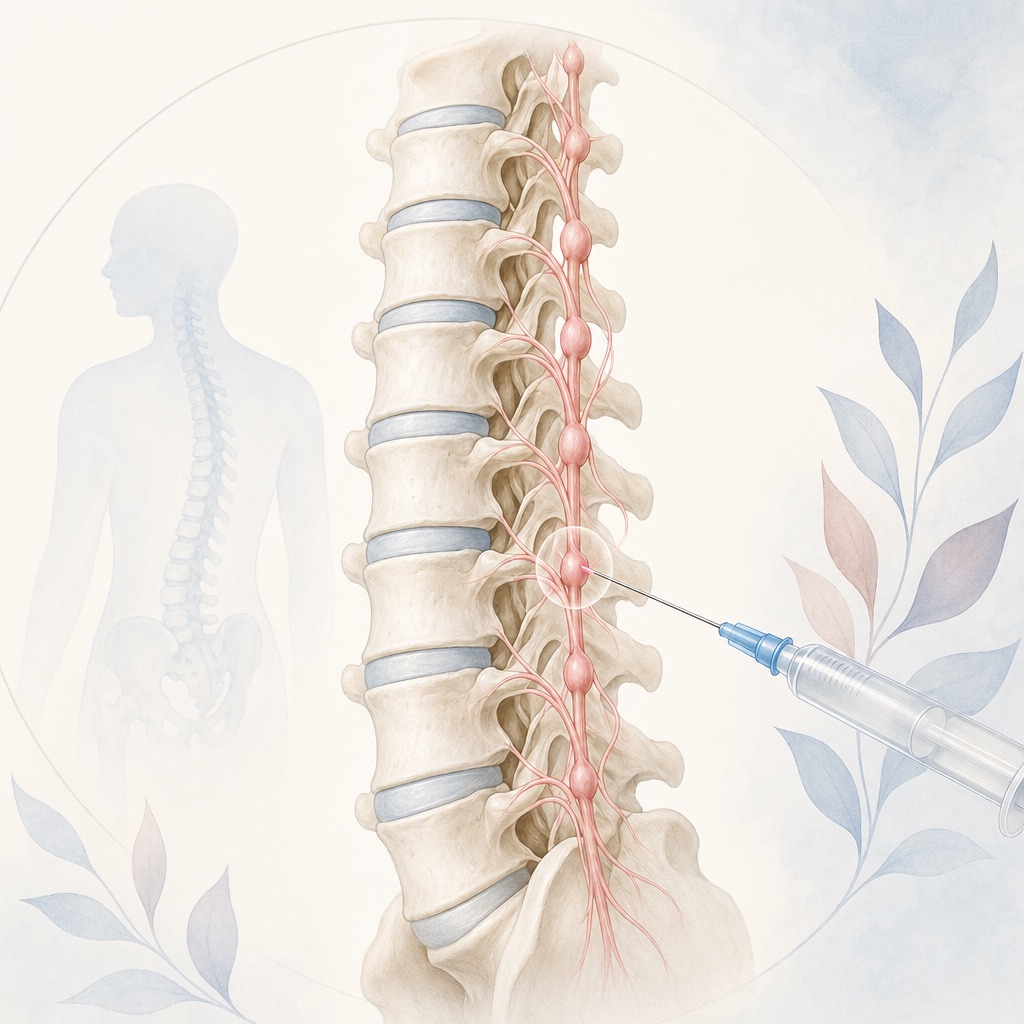
A sympathetic block puts local anesthetic on the sympathetic chain, a string of nerve clusters (ganglia) that runs down each side of the spine. The chain for the arm sits at the base of the neck (stellate ganglion); the chain for the leg sits in front of the L2–L4 vertebrae; the nerves for the abdominal organs, pelvic organs and perineum gather in the celiac plexus, the superior hypogastric plexus and the ganglion impar. Blocking the right level switches off sympathetic output to that region for several hours without numbing the skin or weakening muscles.
Temperature rise is the proof. We tape a skin thermometer to the hand or foot before the block and watch it afterward. When the sympathetic supply is interrupted, blood vessels open and the skin warms by 1.5–2°C or more within 10–20 minutes, often more. That rise is the objective sign the block reached its target. Only then can we interpret your pain score: if the limb warmed and the pain dropped by 50% or more, the pain is sympathetically maintained and a series of blocks is worth doing. If the limb warmed and the pain did not change, the pain is sympathetically independent, and repeating the block would waste your time; the answer then is a different treatment such as DRG stimulation. If the limb did not warm, the block missed and tells us nothing.
Series-of-blocks logic. One block is a test; treatment is a series. For CRPS we typically schedule 3–6 blocks, 1–2 weeks apart, each timed the day before physical therapy so that the therapist can work the limb while the pain is down. Relief usually lasts longer after each block. When relief outlasts the interval, we stretch the interval; when a block gives nothing new after two or three tries, we stop.
Gulf Coast Pain & Spine performs sympathetic blocks in Houston and Webster, and in Pearland when that office opens in November 2026.
What happens on procedure day
- Check-in and a review of your pain score, blood-thinner status and, for stellate blocks, your heart and breathing history. We photograph or measure the limb and tape a skin temperature probe to the hand or foot on both sides.
- You are positioned for the target: on your back with the neck slightly extended for a stellate block, face down for a lumbar sympathetic, celiac, hypogastric or impar block. Blood pressure, pulse and oxygen are monitored throughout.
- The skin is cleaned with chlorhexidine and numbed with lidocaine. Light sedation is given for the deeper blocks; for a stellate block we keep you fully awake so you can tell us right away about any symptoms.
- Under ultrasound or fluoroscopy the needle is guided to the ganglion or plexus. For fluoroscopic blocks a small volume of contrast dye confirms the tip is on the sympathetic chain and not in a vessel, disc or spinal fluid, and the spread is documented.
- A test dose is given, then the anesthetic: about 5–10 mL for a stellate block, 10–20 mL across two or three levels for a lumbar sympathetic block, larger volumes for celiac and hypogastric blocks. For cancer pain, alcohol or phenol may replace anesthetic once a test block has worked.
- We watch the temperature probe and your symptoms for 20–30 minutes. A warm limb (or Horner's syndrome for stellate) confirms the block; then we ask you to move the limb and rate your pain.
- You go home with a driver, a pain and temperature diary, and a physical therapy appointment for the next day when the block is part of a CRPS series.
After the procedure
Day 0. The blocked limb feels warm, flushed and often lighter; for a stellate block the eyelid droops and the eye reddens on that side for 4–8 hours, and your voice may be hoarse. Do not eat or drink until any hoarseness and swallowing difficulty have passed. Low blood pressure and lightheadedness on standing are common after lumbar sympathetic, celiac and hypogastric blocks for a few hours; stand slowly and drink fluids. Use the pain-free window to move the limb gently.
Days 1–3. Physical therapy the day after the block is the core of CRPS treatment: desensitization, weight-bearing and range of motion while the pain is down. Back or flank soreness after a lumbar or celiac block is common; diarrhea for a day or two after a celiac block is expected as the gut's sympathetic supply is interrupted.
Week 1–2. Record how many days the relief lasted and what you could do; that number sets the timing of the next block. Groin pain after a lumbar sympathetic block (genitofemoral neuritis) can appear at this stage and usually settles over weeks.
When we judge the response. The test block is judged the same day from the temperature record and your diary. A series is judged after 2–3 blocks: relief lasting longer each time means continue; no change means stop and switch. Call the same day for fever, severe headache, new weakness, trouble breathing or swallowing that does not resolve, or a swelling in the neck.
What the evidence shows
Sympathetic blocks have been used for CRPS for decades and are endorsed by ASIPP and international CRPS guidelines as part of early treatment, alongside physical therapy and medication. The clinical trial base is honest but thin: a Cochrane review found only small, low-quality randomized trials and could not confirm a long-term effect of local anesthetic sympathetic blockade on its own. What the trials do show is short-term pain relief that lets patients participate in therapy, and observational series consistently report better outcomes when blocks are started early and paired with rehabilitation. The temperature measurement matters because trials that skipped it could not tell a failed block from a failed treatment.
For cancer pain the evidence is stronger: randomized trials and a Cochrane review show that neurolytic celiac plexus block improves pain control and reduces opioid use in pancreatic cancer, with relief typically lasting 2–6 months. Superior hypogastric neurolysis has similar but smaller evidence for pelvic cancer pain. For coccydynia, ganglion impar block evidence comes from case series with high short-term relief rates. For phantom limb and ischemic pain, series report benefit but no large trials exist.
Alternatives and what comes next
For CRPS, blocks are one part of a plan: physical and occupational therapy, a nerve-pain medication, sometimes a short course of oral steroid or a bisphosphonate early on, and management of sleep and mood. If blocks help but keep wearing off, or if the pain proves sympathetically independent, dorsal root ganglion stimulation has the best trial evidence of any device for CRPS of the leg, and spinal cord stimulation is the alternative for the arm or for wider pain. Radiofrequency or chemical neurolysis of the sympathetic chain is used for ischemic leg pain and for cancer pain, and less often for CRPS. For cancer pain, blocks sit alongside oral and intrathecal medication. For tailbone and pelvic pain, the ganglion impar block page explains the path from block to radiofrequency. Ask which block fits your pain and whether we perform the celiac and hypogastric blocks in-office or refer for them.
Safety and preparation
- Blood thinners: sympathetic blocks are deep, near major vessels, and are classified as intermediate-to-high risk under ASRA guidance. Warfarin, DOACs (apixaban, rivaroxaban, dabigatran), clopidogrel, prasugrel and ticagrelor are held for 2–7 days depending on the drug; aspirin is usually held for the neurolytic and deep blocks. We arrange the hold with the prescriber; never stop a blood thinner on your own.
- Diabetes: most sympathetic blocks use anesthetic only, so blood sugar is unaffected. If a steroid is added, expect a rise for 1–7 days.
- Infection or fever: fever above 100.4°F or any active infection postpones the block; deep infection near the spine or major vessels is a serious complication.
- Allergies (contrast, steroid, local anesthetic): fluoroscopic sympathetic blocks rely on contrast dye to confirm safe placement. Tell us about contrast allergy so we can pre-treat or use ultrasound.
- Pregnancy: fluoroscopy-guided sympathetic blocks are deferred; a stellate block under ultrasound is possible. Tell us if you are or could be pregnant.
- Sedation and driving: you need a driver for every sympathetic block, sedated or not, because a warm, heavy or weak limb and low blood pressure are expected for hours. No driving for 24 hours.
- Fasting: no food for 4–6 hours before a stellate block because temporary swallowing difficulty is expected; clear liquids up to 2 hours before. The deeper blocks with sedation follow the same rule.
- Heart and lung disease: tell us about heart rhythm problems, recent heart attack, pacemaker, COPD or a single lung; these change how and whether we do a stellate block.
Risks and side effects
- Expected effects of a successful block: warm, flushed limb for several hours; for stellate blocks a droopy eyelid, small pupil and red eye on that side, hoarseness and a lump-in-the-throat feeling for 4–8 hours
- Low blood pressure and lightheadedness for a few hours after lumbar sympathetic, celiac and hypogastric blocks
- Soreness at the needle site or in the back or flank for 2–5 days
- Diarrhea for 1–3 days after a celiac plexus block
- Groin pain or burning (genitofemoral neuritis) after a lumbar sympathetic block, more common with neurolysis, usually resolving over weeks
- Spread of anesthetic to nearby spinal nerves, causing temporary leg or arm numbness or weakness for hours; a driver and no walking alone until it clears
- Bleeding or hematoma; a neck hematoma after a stellate block can press on the airway and is why we watch you afterward
- Vasovagal reaction; brief slow heart rate during a stellate block
- Injection into an artery (vertebral artery for stellate; lumbar or aortic branches lower down) causing seizure or loss of consciousness within seconds; test doses, contrast and live imaging are the safeguards
- Injection into the spinal fluid or epidural space with high spinal block affecting breathing; pneumothorax with stellate or celiac blocks
- Kidney, ureter or bowel puncture with lumbar sympathetic, celiac or hypogastric blocks; discitis; infection or abscess
- Paraplegia after neurolytic celiac block from spinal cord blood supply injury (reported in well under 1 in 1,000 neurolytic blocks); permanent Horner's syndrome or vocal cord weakness after stellate neurolysis
Frequently asked questions
How do you know the sympathetic block worked?
By temperature. We measure the skin of your hand or foot before and after; a rise of at least 1.5–2°C within 10–20 minutes means the sympathetic supply was blocked. For a stellate block, Horner's syndrome (droopy eyelid, small pupil, red eye) is the equivalent sign. Only after that sign do we score the pain response.
Is a sympathetic block a test or a treatment?
Both. The first block is a test of whether your pain is sympathetically maintained: limb warms and pain drops means yes. A series of 3–6 blocks paired with physical therapy is the treatment for CRPS. For cancer pain the test block is followed by a neurolytic block that lasts months.
How many blocks will I need?
For CRPS, typically 3–6 over 4–8 weeks, each 1–2 weeks apart and timed before physical therapy. If relief lasts longer after each block we keep going and stretch the interval; if two or three blocks give nothing lasting, we stop and switch to a different treatment such as DRG stimulation.
Which block do I need?
It depends on where the pain is: stellate ganglion for the arm, hand or face; lumbar sympathetic for the leg or foot; celiac plexus for upper-abdominal cancer pain; superior hypogastric for pelvic pain; ganglion impar for tailbone and perineal pain. The table on this page compares them.
Why do I need physical therapy the day after?
Because the block alone does not cure CRPS; it opens a window of hours to days when the limb can be moved, loaded and desensitized without the pain fighting back. Therapy in that window is what turns short-term relief into lasting improvement.
What if my limb warms but the pain does not change?
That is a real answer: your pain is sympathetically independent, and more blocks will not help. The next step is usually a different treatment, most often dorsal root ganglion or spinal cord stimulation for CRPS, or medication changes.
Do you do celiac plexus and hypogastric blocks?
These are used mainly for cancer pain and chronic visceral pelvic pain. Ask us whether we perform them in-office for your situation or coordinate them with your oncology team; the page describes them so you know what to expect either way.
Can I drive myself home?
No. Even without sedation, the blocked limb is warm and can feel heavy or weak, and blood pressure can drop for a few hours. Bring a driver and do not drive for 24 hours.
Sources
- Local anaesthetic sympathetic blockade for complex regional pain syndrome (Cochrane Review) (opens in new tab) — Cochrane Library
- Complex Regional Pain Syndrome: Information Page (opens in new tab) — National Institute of Neurological Disorders and Stroke (NINDS)
- Celiac plexus block for pancreatic cancer pain in adults (Cochrane Review) (opens in new tab) — Cochrane Library
- Interventional Spine and Pain Procedures in Patients on Antiplatelet and Anticoagulant Medications (Second Edition) (opens in new tab) — American Society of Regional Anesthesia and Pain Medicine (ASRA)
- Complex regional pain syndrome: practical diagnostic and treatment guidelines, 5th edition (opens in new tab) — Pain Medicine (Oxford Academic)
Next step
Request an appointment
Call (832) 916-2075 or request an appointment online. New patients are welcome; the team confirms insurance and referral requirements before scheduling.