
- Cluster headache patients, referred by neurology, who need an office option to abort attacks or shorten a bout while preventive medication takes effect
- Chronic migraine (15 or more headache days a month) that has not responded well enough to preventive medication, as an add-on the neurologist requests
- Trigeminal neuralgia affecting the cheek and upper jaw, or persistent facial pain after dental, sinus or facial surgery, when medication is not enough
- Headache after a spinal tap or epidural that is severe and has not settled with fluids, caffeine and rest, as a first step before an epidural blood patch
- Patients who want to know whether the SPG is part of their pain pattern before considering longer-lasting SPG procedures
Nerve blocks & ablation
Sphenopalatine Ganglion (SPG) Block
Sphenopalatine ganglion (SPG) block in Houston for cluster headache, some migraine, facial pain and post-spinal headache: technique and series.
In short
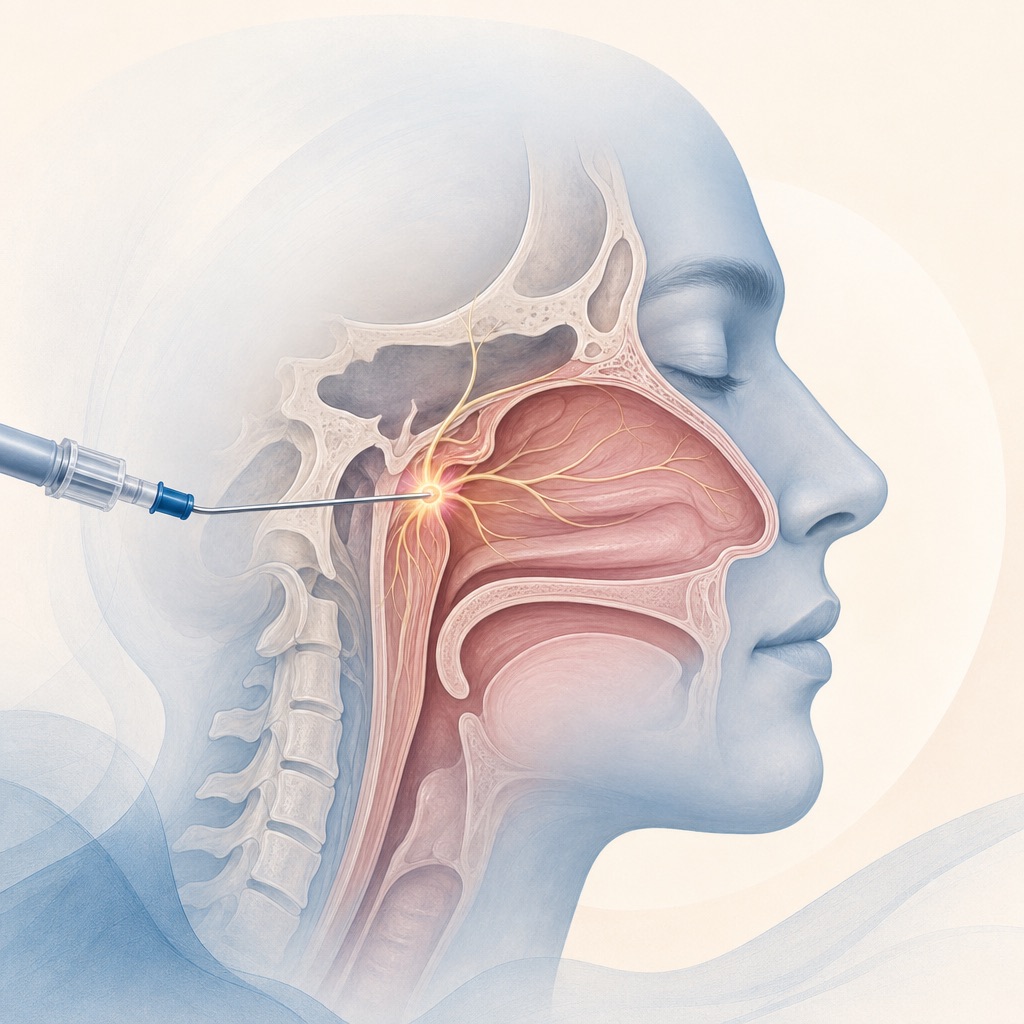
A sphenopalatine ganglion (SPG) block delivers local anesthetic to a cluster of nerves that sits behind the back of the nasal cavity and links the trigeminal (facial sensation), parasympathetic and sympathetic systems that drive many headaches and facial pains. It is used, on referral from your neurologist, for cluster headache, some migraine, trigeminal and atypical facial pain, and headache after a spinal tap or epidural. It is a treatment, not a test. The office version is done through the nose with a soft applicator, takes about 10–20 minutes, needs no needle through the skin, and is usually given as a series.
Key facts
| Treats | Cluster headache (aborting attacks and shortening bouts); chronic migraine and some episodic migraine; trigeminal neuralgia of the second division and atypical facial pain; post-dural-puncture headache; some facial pain after sinus or dental surgery |
|---|---|
| Test or treatment? | Treatment. Relief during the block also tells us the SPG is involved, but we do not use it as a formal diagnostic test. |
| Procedure time | Transnasal: 10–20 minutes including the resting period. Infrazygomatic (needle, under X-ray): about 15 minutes. |
| Anesthesia | None needed; the anesthetic is the treatment. No sedation. |
| Downtime | None. Drive yourself home from a transnasal block; a driver is needed for the X-ray-guided approach if sedated. |
| When relief starts | Within 5–15 minutes for an active headache; over days to weeks for a preventive series |
| How long relief lasts | Hours to days after a single block; in trials of repeated blocks for chronic migraine, benefit built over the 6-week series and lasted about a month after it. Varies. |
| How often it can be repeated | Series typical: twice a week for 6 weeks (12 treatments) for chronic migraine; per attack or per bout for cluster headache; once or twice for post-dural-puncture headache |
| Insurance | Coverage varies; many plans cover it for cluster headache and trigeminal neuralgia and some do not cover the transnasal device version. We verify before starting a series. |
Who it is for
- New or changed headache with fever, stiff neck, vision loss, weakness, confusion or the worst headache of your life; these need emergency evaluation, not a block
- Migraine or cluster headache without a neurologist involved: we do not manage primary headache disorders as a practice and perform SPG blocks only within a neurology-led plan
- Nasal obstruction, recent nasal or sinus surgery, active sinus infection or frequent nosebleeds for the transnasal route
- Allergy to local anesthetics without an alternative
- Blood thinners that cannot be held, for the needle (infrazygomatic) approach
- Headache from medication overuse (painkillers or triptans more than 10–15 days a month), which needs to be addressed first because blocks will not hold
What the sphenopalatine ganglion is and why numbing it can stop a headache
The sphenopalatine (pterygopalatine) ganglion is the largest nerve cluster outside the skull. It sits in a small bony pocket behind the back of the nose, just below the eye socket. Three systems meet there: sensory fibers from the second division of the trigeminal nerve (cheek, upper teeth, palate, nose), parasympathetic fibers that widen blood vessels and produce tearing and a runny nose, and sympathetic fibers. In cluster headache and migraine the parasympathetic output through the ganglion is part of what drives the attack, which is why cluster attacks come with a tearing eye and a blocked nostril on the pain side. Local anesthetic on the ganglion quiets that circuit for a few hours, and repeated blocks appear to dampen it for longer.
Transnasal applicator technique (office). You lie on your back with your head tilted back. A soft, flexible applicator or thin catheter is passed gently along the floor of the nostril to the back of the nasal cavity, where only a thin layer of tissue separates it from the ganglion. Local anesthetic (usually 2–4% lidocaine or 0.5% bupivacaine) is dripped or sprayed onto that spot, 1–2 mL per side, and you stay lying down for 10–15 minutes while it soaks through. No needle passes through the skin, no X-ray is needed, and you can drive yourself home. Both sides are usually treated for migraine; the pain side alone for cluster headache and facial pain.
Infrazygomatic (needle) approach. For a more precise block, or before radiofrequency of the ganglion, a thin needle is passed under fluoroscopy through the cheek below the cheekbone into the pterygopalatine fossa, where contrast dye confirms the position and 1–2 mL of anesthetic is injected directly on the ganglion. This gives a more complete block at the cost of a needle, X-ray, a small risk of bleeding into the cheek, and a driver if sedation is used. It is also the route for pulsed radiofrequency when blocks work but do not last.
Series and frequency. For an active cluster attack or post-dural-puncture headache a single block is given and repeated once if needed. For cluster bouts and chronic migraine the studied protocol is a series: twice a week for 6 weeks, 12 treatments, with the neurologist tracking headache days. For facial pain, blocks are repeated as relief dictates, typically no more often than every 1–2 weeks.
What happens on procedure day
- Check-in and a short review: your headache or facial pain score right now, your neurologist's request, medications taken today, and any nasal problems, nosebleeds or blood thinners.
- You lie on your back on the exam table with a small pillow under your shoulders so your head tilts back. A tissue and a cup are within reach because some anesthetic drains into the throat.
- A drop of lidocaine spray or gel numbs the nostril. The soft applicator is passed slowly along the floor of the nose to the back wall; you feel pressure and fullness, not sharp pain. Tell us if it hurts and we will adjust.
- The anesthetic is delivered, 1–2 mL per side. A bitter taste at the back of the throat and numbness of the palate and upper teeth follow within a minute or two. The applicator stays in place, or is withdrawn and the process repeated, over 10–15 minutes.
- You keep lying back for the soaking period, then sit up slowly. We ask you to rate the headache again before you leave; for an active cluster attack the response is often clear within 15 minutes.
- You go home with a headache diary. No driver is needed for the transnasal block. For the infrazygomatic needle approach the steps are similar but on the fluoroscopy table, with skin cleaning, a lidocaine wheal on the cheek and contrast confirmation.
After the procedure
Day 0. Bitter taste, a numb palate and upper teeth, and a stuffy or runny nose on the treated side last 30 minutes to a few hours. Do not eat or drink hot liquids until the throat numbness has worn off (about 30–60 minutes) to avoid burns or choking. Some lightheadedness on sitting up is common; rest a few minutes. A small amount of blood-tinged mucus is normal. Avoid blowing your nose hard for the rest of the day.
Days 1–3. Relief from a single block often fades over one to a few days. Record headache days, intensity and rescue medication in the diary; your neurologist will use it. Mild nasal irritation can persist for a day or two.
Week 1–2 and through a series. Benefit in a series builds gradually; a first block that does little does not predict the series. Keep preventive medication going as prescribed and limit acute medication to fewer than 10 days a month so the blocks are not undone by rebound headache.
When we judge the response. For an active attack, within 15–30 minutes. For a series, at the midpoint (6 treatments) and the end (12), by headache days per month compared with your baseline. Call the same day for a nosebleed that does not stop with 15 minutes of pressure, fever, facial swelling, or a new severe headache unlike your usual one.
What the evidence shows
For cluster headache, SPG-directed treatment has the best support: the ganglion is a proven target (an implanted SPG stimulator aborted attacks in a randomized sham-controlled trial), and small trials and series of transnasal and infrazygomatic anesthetic blocks show they can abort attacks and shorten bouts; radiofrequency of the ganglion gives longer relief in chronic cluster patients who respond to blocks. For chronic migraine, a randomized sham-controlled trial of repeated transnasal blocks (12 treatments over 6 weeks) reduced headache pain and improved quality of life at the end of the series, with benefit fading over the following month; a smaller trial in acute migraine showed short-term relief. The American Headache Society lists SPG block among the peripheral procedures that can be used within a migraine plan, with the caveat that the evidence is modest and neurology should lead. For post-dural-puncture headache, retrospective series suggested the block could spare some patients an epidural blood patch, but a randomized blinded trial found no difference from placebo at 30 minutes; it is reasonable to try once before a blood patch, not a replacement for it. For trigeminal neuralgia and atypical facial pain, evidence comes from case series and small trials, with pulsed radiofrequency of the ganglion reported to give months of relief in responders. Gulf Coast Pain & Spine offers SPG blocks on neurology referral in Houston and Webster, and in Pearland when that office opens in November 2026; we do not manage migraine or cluster headache as a practice, and your neurologist stays in charge of the plan.
Alternatives and what comes next
For cluster headache the established treatments are high-flow oxygen and injectable sumatriptan for attacks, verapamil and short steroid courses for prevention, and a greater occipital nerve block with steroid, which has stronger trial evidence than SPG block for shortening a bout; many cluster patients get both. For migraine, preventive medication, CGRP-targeted drugs and onabotulinumtoxinA come first, and occipital nerve blocks are the more studied add-on. For facial pain, carbamazepine or oxcarbazepine and neurology evaluation come first; a positive SPG block response can lead to pulsed radiofrequency of the ganglion through the infrazygomatic route, which typically extends relief to months, or, for cluster headache, to referral for SPG stimulation or neurolysis at a headache center. For post-dural-puncture headache that persists after a block, an epidural blood patch is the definitive treatment. If a well-performed SPG block gives no relief, the ganglion is not driving your pain, and the occipital nerves and upper neck or the trigeminal system itself are examined next with your neurologist. Ask us whether we currently offer SPG blocks and which route we recommend for your situation.
Safety and preparation
- Blood thinners: the transnasal block is superficial and can usually be done on aspirin, clopidogrel, warfarin or a DOAC, with a slightly higher nosebleed risk. The infrazygomatic needle approach passes near the maxillary artery and follows ASRA guidance for intermediate-risk procedures, so those drugs are typically held for 2–7 days. Never stop a blood thinner on your own.
- Diabetes: no steroid is used in a standard SPG block, so blood sugar is unaffected.
- Infection or fever: an active sinus infection, cold with nasal congestion, fever above 100.4°F, or cold sores on the nose postpones the block.
- Allergies (contrast, steroid, local anesthetic): no contrast dye is used for the transnasal route; the needle route uses a small amount. Tell us about any reaction to lidocaine or bupivacaine so we can substitute.
- Pregnancy: the transnasal block uses no X-ray and small anesthetic doses and can be done when the neurologist and obstetrician agree; the needle route is deferred. Tell us if you are or could be pregnant.
- Sedation and driving: no sedation is used for the transnasal block and you may drive yourself. If the needle approach is done with sedation, bring a driver.
- Nose and sinus history: tell us about a deviated septum, nasal polyps, prior sinus or nasal surgery, frequent nosebleeds or use of nasal oxygen or CPAP; these may change the route or the side we treat.
- Eating and drinking: eat normally beforehand. Afterward, wait until throat numbness has passed (30–60 minutes) before drinking anything hot.
Risks and side effects
- Bitter taste at the back of the throat and numbness of the palate, upper teeth and nose for 30 minutes to a few hours (expected)
- Nasal stuffiness, runny nose or watery eye on the treated side for a few hours
- Lightheadedness on sitting up; mild nasal irritation or a small amount of blood-tinged mucus for a day
- Brief worsening of headache in the first hour in some patients
- Nosebleed (epistaxis) from the applicator, usually stopping with pressure; more likely on blood thinners or with a deviated septum
- Numbness or tingling of the cheek for hours; lasting numbness of the palate for days
- Throat numbness with choking or coughing if you drink too soon
- Vasovagal reaction with a brief drop in heart rate or blood pressure
- Infection of the nasal passage or sinus after transnasal blocks; abscess or infection of the pterygopalatine fossa after the needle approach
- Bleeding into the cheek (hematoma) from the maxillary artery with the infrazygomatic approach, sometimes with bruising that takes 1–2 weeks to settle
- Local anesthetic toxicity (ringing ears, metallic taste, dizziness, seizure at high doses) from vascular uptake; the volumes used are small and this is very rare
- Injury to the maxillary nerve or the optic pathway with a misplaced needle, described in case reports with the needle approach; contrast and fluoroscopy are the safeguards
Frequently asked questions
Does the SPG block hurt?
Most people describe pressure and fullness in the nose, then a bitter taste and a numb palate. It is not painful for the majority; a numbing spray goes in first. The needle version through the cheek involves a small skin sting and pressure under the cheekbone.
Is it a test or a treatment?
A treatment. Relief during the block also tells us the ganglion is part of your headache or facial pain, which guides whether pulsed radiofrequency of the ganglion is worth considering, but we do not perform it as a formal diagnostic test the way we do medial branch or genicular blocks.
Do you treat migraine or cluster headache?
Not as a practice. We do not manage primary headache disorders; we provide SPG blocks and occipital nerve blocks when your neurologist asks for them as part of a plan they lead. Come with a referral and a current headache diary.
How many blocks will I need?
It depends on the reason. One block, repeated once if needed, for an active cluster attack or a post-spinal headache. A series of 12 over 6 weeks for chronic migraine or a cluster bout, following the studied protocol. For facial pain, as relief dictates, typically no more than every 1–2 weeks.
Why do I taste something bitter?
A small amount of the anesthetic drains from the back of the nose into the throat. The bitter taste and numb palate confirm the medication reached the right area and wear off within an hour or two. Wait to drink hot liquids until the numbness is gone.
Will it stop a headache after my epidural or spinal tap?
Sometimes. Older series suggested the block could spare some patients a blood patch, but a randomized blinded trial found it was no better than placebo at 30 minutes. It is reasonable to try once because it is quick and low-risk; if the headache persists, an epidural blood patch is the definitive treatment.
Can I drive home?
Yes, after the transnasal block; there is no sedation and no X-ray. Sit up slowly and wait a few minutes in case of lightheadedness. If the needle approach is done with sedation, you need a driver.
What if the block does nothing?
Then the sphenopalatine ganglion is not driving your pain. That points your neurologist and us toward the occipital nerves, the upper neck, or the trigeminal system itself, each of which has its own treatment.
Sources
- A Double-Blind, Placebo-Controlled Study of Repetitive Transnasal Sphenopalatine Ganglion Blockade as Acute Treatment for Chronic Migraine (opens in new tab) — Headache (American Headache Society journal)
- The Sphenopalatine Ganglion: Anatomy, Pathophysiology, and Therapeutic Targeting in Headache (opens in new tab) — Headache (American Headache Society journal)
- Sphenopalatine ganglion block for the treatment of postdural puncture headache: a randomised, blinded, clinical trial (opens in new tab) — British Journal of Anaesthesia
- Cluster Headache: Information Page (opens in new tab) — National Institute of Neurological Disorders and Stroke (NINDS)
- Interventional Spine and Pain Procedures in Patients on Antiplatelet and Anticoagulant Medications (Second Edition) (opens in new tab) — American Society of Regional Anesthesia and Pain Medicine (ASRA)
Next step
Request an appointment
Call (832) 916-2075 or request an appointment online. New patients are welcome; the team confirms insurance and referral requirements before scheduling.