
Persistent pain
Chronic Pain
Chronic pain lasting over 3 months needs a real diagnosis and plan. Gulf Coast Pain & Spine in Houston explains the first visit and non-opioid-first care.
Chronic pain is pain that lasts longer than 3 months, past the time an injury would normally have healed. It affects roughly 1 in 5 U.S. adults, and in about 1 in 12 it limits work or daily life most days. Gulf Coast Pain & Spine starts by finding the treatable sources of your pain, then builds a plan that combines targeted procedures, non-opioid medication, physical therapy, and, where needed, psychology and sleep care.
Key facts
| What it is | Pain lasting more than 3 months, whether from an identified source (arthritis, a nerve, a disc) or from a nervous system that has become over-sensitive |
|---|---|
| Most common causes | Low back and neck pain, osteoarthritis, nerve damage (neuropathy, sciatica), pain after surgery, headache; often more than one at once |
| Typical course | Rarely disappears on its own after a year, but most people improve meaningfully with a structured plan; function improves before pain scores do |
| See a specialist when | Pain has lasted more than 3 months, is limiting work, sleep or activity, or has not responded to primary-care treatment |
| Treatments we offer | Image-guided injections and nerve blocks, radiofrequency ablation, spinal cord and peripheral nerve stimulation, non-opioid medication management, coordinated PT and psychology referral |
When to get emergency care
Go to an emergency room or call 911 if you have:
- New loss of bowel or bladder control, or numbness in the groin or inner thighs
- Sudden weakness in a leg or arm, or a foot that drags
- Pain with fever, chills, or a recent infection, especially if you have had a recent spine procedure or use IV drugs
- Chest pain, shortness of breath, or pain with sweating and nausea
- Thoughts of harming yourself. Call or text 988 (Suicide and Crisis Lifeline) any time
- An accidental overdose or extreme drowsiness after taking pain medication; give naloxone if available and call 911
Chronic pain and depression often travel together. Telling us about low mood is part of treating the pain, not a separate problem.
What chronic pain is, and when it becomes its own condition
Pain is supposed to be an alarm. Acute pain protects you while an injury heals, then fades. Chronic pain is pain that continues beyond 3 months, which is longer than most tissue takes to heal. The International Association for the Study of Pain and the World Health Organization now classify it in two ways:
- Chronic secondary pain: pain is a symptom of another condition that is still present, such as knee osteoarthritis, a compressed nerve root, spinal stenosis, or diabetic neuropathy. Treating the source can change the pain.
- Chronic primary pain: pain has become a condition in its own right. The original injury may have healed, or no single cause can be found, yet the pain persists and is often accompanied by poor sleep, fatigue, low mood, and reduced activity. Fibromyalgia and some cases of chronic low back pain fall here.
Most patients we see have some of both. A worn facet joint may be a real, treatable pain source, and years of pain may also have made the nervous system more reactive. A good plan addresses both.
Chronic pain is common: CDC surveys estimate about 21 percent of U.S. adults live with it, and about 7 to 8 percent have high-impact chronic pain that restricts work or life activities on most days. Gulf Coast Pain & Spine treats these patients in Houston, Webster and Pearland (opening November 2026).
Central sensitization, explained simply
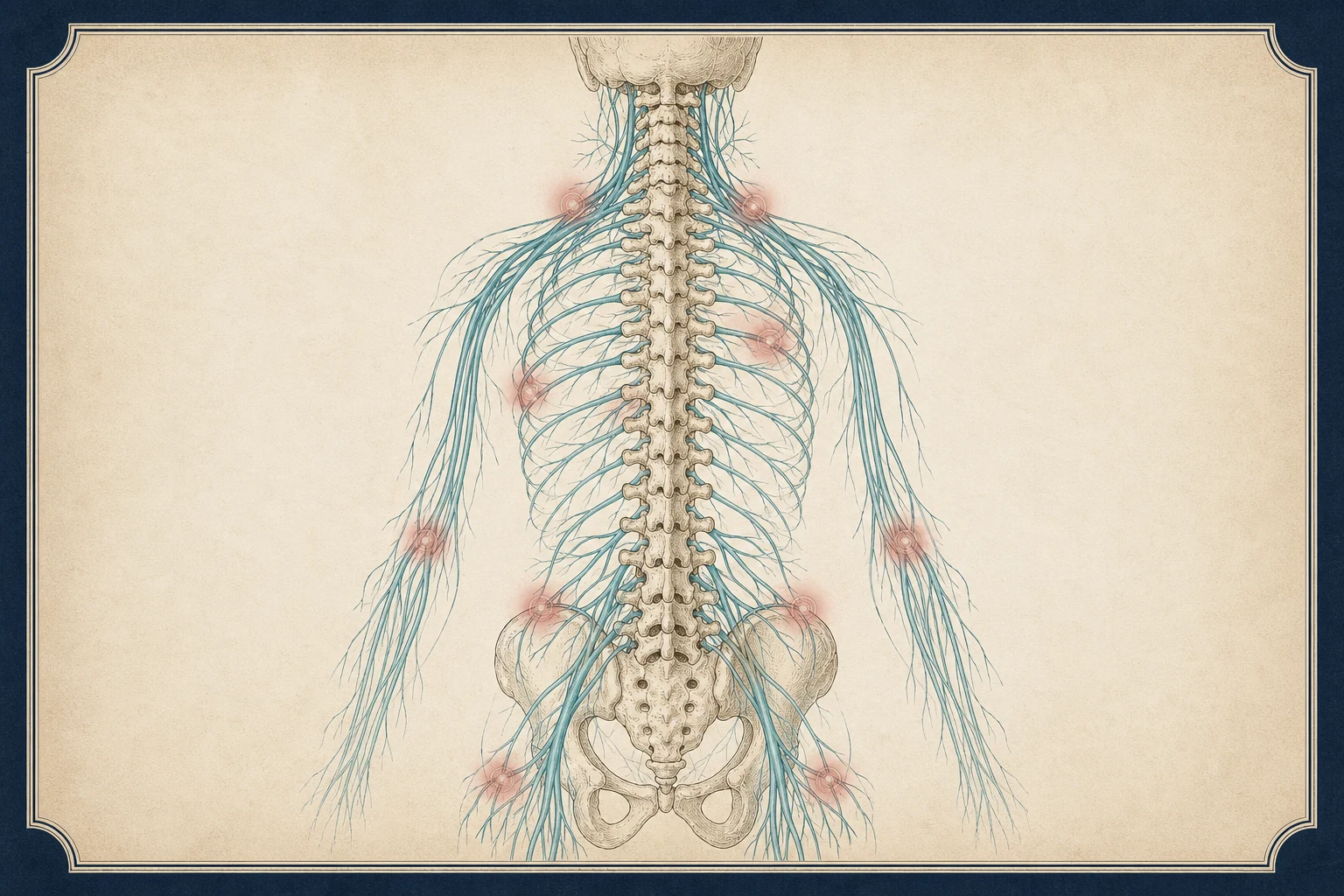
Nerves and the spinal cord learn. When pain signals arrive day after day, the spinal cord and brain turn up their volume: the same input produces a bigger response, and normally harmless input (light touch, mild pressure, cold) can start to hurt. This is called central sensitization. It is a real change in how the nervous system processes signals, not imagination and not weakness.
Signs that sensitization is part of your picture include pain that has spread beyond the original area, tenderness to light touch, pain that flares out of proportion to activity, and poor sleep and fatigue alongside the pain. Sensitization does not mean nothing can be done. It means the plan needs to include things that quiet the nervous system (graded exercise, sleep repair, certain medications such as duloxetine or gabapentinoids, and pain psychology) in addition to procedures aimed at the original source.
Common underlying sources of chronic pain we treat include low back pain from facet joints or discs, neck pain, osteoarthritis of the knee, hip or shoulder, sciatica and other nerve root pain, peripheral neuropathy, pain after spine surgery, and complex regional pain syndrome.
What chronic pain does beyond the pain
Persistent pain rarely stays in its lane. Over months it typically brings:
- Sleep disruption: trouble falling or staying asleep, which lowers pain thresholds the next day and creates a cycle
- Deconditioning: avoiding movement to prevent flares, which weakens muscles and makes the next attempt at activity hurt more
- Mood changes: depression and anxiety occur in roughly a third to a half of people with chronic pain and make pain harder to treat if left alone
- Medication drift: accumulating prescriptions from several providers without a clear plan
Chronic pain differs from a flare of an acute problem in an important way: a flare usually has a trigger and settles within days to weeks. If your pain has a daily baseline that has not changed for months, or if flares are becoming more frequent and less predictable, you have crossed into chronic pain and a different approach is needed.
What a first visit includes
Plan on 45 to 60 minutes. A first visit with us is a diagnostic visit, not a procedure visit. It includes:
- Your story, organized. When and how pain started, where it is now, what makes it better and worse, what has been tried (injections, surgery, therapy, medications) and what each did. Bring records, imaging reports and discs, and a complete medication list.
- A physical exam focused on the likely pain generators: spine range of motion and provocation tests, joint exam, nerve testing (strength, reflexes, sensation), and pressure over specific structures such as facet joints, the sacroiliac joint, or greater trochanter.
- Imaging review. We read your existing MRI, CT or X-rays ourselves and match them to your exam. Imaging that does not match your symptoms is not treated. New imaging is ordered only when it would change the plan.
- Screening for contributors: sleep (including sleep apnea questions), mood, and function using short validated questionnaires.
- Medication and safety review, including a check of the Texas Prescription Monitoring Program, which Texas law requires before any controlled substance is prescribed.
- A written plan with the working diagnosis, the first two or three steps, and what success would look like (for example, walking 20 minutes, returning to work, sleeping through the night).
Diagnostic nerve blocks are often the next step when the exam narrows the source to a structure that can be tested, such as the facet joints (medial branch blocks) or the sacroiliac joint.
Treatment options, in order
The practice is non-opioid-first. Opioids are not the starting point for chronic non-cancer pain, in line with the 2022 CDC Clinical Practice Guideline, and any controlled-substance decision is made by the physician after evaluation and records review under the policies described on our medication management page. Most chronic pain plans combine several of the steps below rather than moving through them one at a time.
- Education and a movement plan
Understanding what is and is not damaged, pacing, and a graded home or supervised exercise program. Physical therapy is coordinated around any procedures we do. Learn more →
- Non-opioid medication
NSAIDs (oral or topical), acetaminophen, duloxetine or other SNRIs, gabapentin or pregabalin for nerve pain, tricyclics at low dose for sleep and pain, topical lidocaine or capsaicin. Started one at a time with a clear stop rule if no benefit in 4 to 8 weeks. Learn more →
- Pain psychology and sleep care
Cognitive behavioral therapy for pain and treatment of insomnia or sleep apnea reduce pain intensity and improve function in trials. We refer to psychologists and sleep medicine and keep them in the loop.
- Targeted injections and diagnostic blocks
Epidural steroid injections for nerve root pain, joint injections, and diagnostic medial branch or sacroiliac blocks to confirm a source before ablation. Learn more →
- Radiofrequency ablation
For confirmed facet, sacroiliac or knee (genicular) pain, a heat lesion of the small sensory nerve typically gives 6 to 12 months of relief and can be repeated. Learn more →
- Neuromodulation
Spinal cord stimulation, dorsal root ganglion stimulation or peripheral nerve stimulation for nerve pain that has not responded to the above. Always preceded by a temporary trial; you proceed to an implant only if the trial gives at least 50 percent relief. Learn more →
What you can do now
- Move daily, gently, and consistently. Ten minutes of walking twice a day beats one hard session a week. Increase by about 10 percent per week.
- Protect sleep. Fixed wake time, no screens in the last hour, bedroom cool and dark. If you snore or wake unrefreshed, tell us; untreated sleep apnea worsens pain.
- Keep a simple pain and activity log for two weeks before your visit. It makes patterns visible and shortens the diagnosis.
- Consolidate your medications. One list, one pharmacy. Bring every bottle to the first visit.
- Ask for help with mood early. Depression makes pain louder; treating it is part of pain care.
To get started, see our new patient information. Referring physicians can use the referral page.
Frequently asked questions
Do you prescribe opioids for chronic pain?
The practice is non-opioid-first. Opioids are not the starting treatment for chronic non-cancer pain, and any controlled-substance decision is made by the physician after a full evaluation and review of your records, under a signed agreement with Texas Prescription Monitoring Program checks and urine drug testing. Details are on our medication management page.
Does chronic pain mean nothing else can be done?
No. It means the plan needs to be broader. Most patients who have had pain for years still have identifiable, treatable sources (a facet joint, a nerve root, an arthritic knee), and the nervous-system sensitization that comes with long-term pain responds to exercise, sleep repair, certain medications and psychology.
Will I need an MRI?
Only if it would change the plan. We start by reviewing any imaging you already have. New imaging is ordered when the exam points to a problem that imaging can confirm and that we would treat differently depending on the result, such as a suspected nerve root compression before an epidural injection.
What is central sensitization and is it real?
It is a measurable change in how the spinal cord and brain process pain signals after long exposure to pain, so that normal signals feel painful and painful signals feel worse. It is real, it is common in chronic pain, and it is treatable, though the treatments (graded activity, sleep, duloxetine or gabapentinoids, CBT) differ from those for a mechanical source.
How long does a first visit take, and will I have a procedure the same day?
Plan on 45 to 60 minutes. The first visit is for diagnosis and planning. Procedures are scheduled separately so we can check blood thinners, insurance authorization, and preparation.
Do you treat fibromyalgia?
Yes, as a diagnosis to confirm and coordinate rather than to inject. Injections and opioids are not indicated for fibromyalgia itself. See our fibromyalgia page for the criteria and what treatment involves.
What if I have several pain problems at once?
That is typical. We rank them by which is limiting you most and which has the clearest treatable target, then work through them in order. Treating one source well often lowers the overall pain volume enough that the others become more manageable.
Sources
- CDC Clinical Practice Guideline for Prescribing Opioids for Pain, 2022 (opens in new tab) — Centers for Disease Control and Prevention
- Chronic Pain Among Adults, United States, 2019-2021 (opens in new tab) — Centers for Disease Control and Prevention (MMWR)
- Pain (opens in new tab) — National Institute of Neurological Disorders and Stroke
- IASP Terminology: Pain, Central Sensitization (opens in new tab) — International Association for the Study of Pain
Request an appointment
Call (832) 916-2075 or request an appointment online. New patients are welcome; the team confirms insurance and referral requirements before scheduling.