
- Pain that persists in the back and legs after spine surgery (post-laminectomy syndrome, also called failed back surgery syndrome)
- Chronic radicular pain in a leg or arm from nerve root injury that is not fixable with further surgery
- Painful diabetic peripheral neuropathy of the feet and legs not controlled by medication (10 kHz stimulation is FDA-approved for this)
- Complex regional pain syndrome of a limb, especially with wide or shifting pain areas
- Chronic nerve pain of the trunk or limbs after at least 6 months of conservative care including medication, therapy and injections
- People who want to reduce reliance on opioids
Neuromodulation & implants
Spinal Cord Stimulation (SCS): Trial and Implant
Spinal cord stimulation for pain after back surgery, sciatica and diabetic neuropathy: the 5–7 day trial, implant, recovery and risks. Houston pain care.
In short
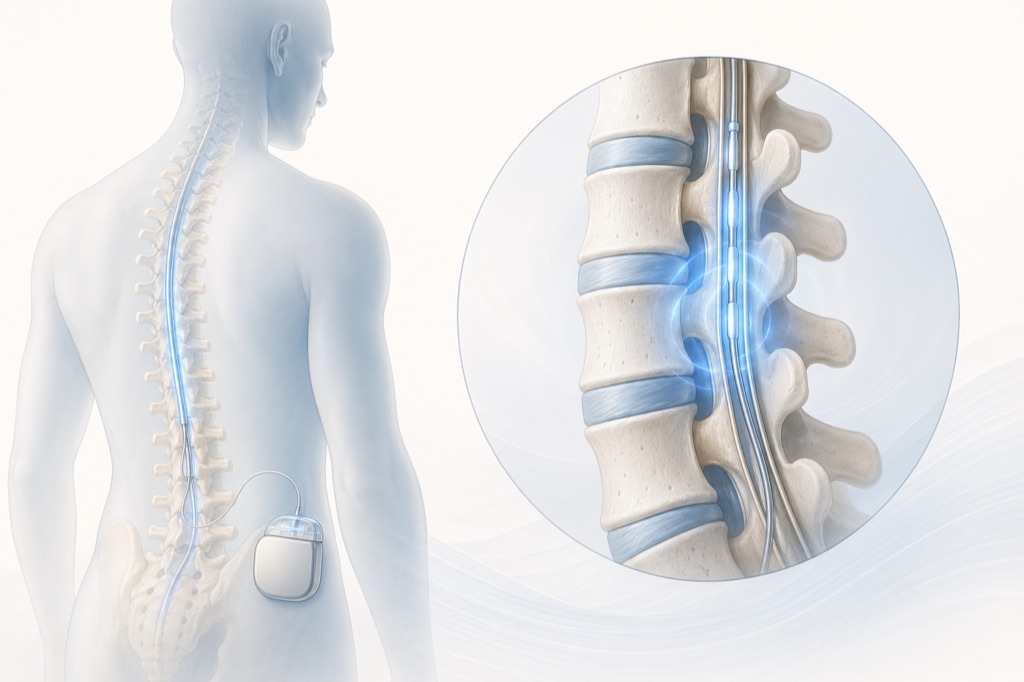
Spinal cord stimulation places thin leads in the epidural space over the spinal cord and delivers programmed electrical pulses that reduce the pain signals reaching the brain. It is a treatment for chronic nerve pain of the back, legs or arms that has outlasted surgery, injections and medication. It is done in two steps: a temporary trial of about a week, then, only if the trial gives at least 50% relief, an outpatient implant.
Key facts
| Treats | Post-laminectomy syndrome, radicular (sciatica-type) pain, painful diabetic neuropathy, complex regional pain syndrome, other chronic nerve pain of the trunk and limbs |
|---|---|
| Test or treatment? | Treatment. The trial week is the test. |
| Procedure time | Trial: 45–90 minutes. Implant: 1–2 hours, outpatient. |
| Anesthesia | Local anesthetic with light IV sedation for the trial; deeper sedation or general anesthesia for the implant |
| Downtime | Trial: light activity, no driving, for 5–7 days. Implant: no bending, lifting or twisting for about 6 weeks. |
| When relief starts | Within hours to days of programming; judged over the trial week |
| How long relief lasts | Years for most responders, with some fading over time; programming and revision extend it |
| Repeat / replacement | Battery replaced every 3–7 years (non-rechargeable) or ~9–10 years (rechargeable); leads usually stay |
| Insurance | Covered by Medicare and most commercial plans after failed conservative care, a psychological evaluation and a successful trial |
Who it is for
- Untreated infection anywhere in the body, or skin infection near the planned lead or generator site
- Anticoagulation that cannot be held safely (for example, a recent stent or mechanical valve), because bleeding into the epidural space can compress the spinal cord
- Active psychiatric instability: untreated major depression, active psychosis, or an untreated substance use disorder
- Pregnancy (devices are not studied in pregnancy; the procedure is deferred)
- Severe spinal stenosis or scar at the planned lead level that leaves no room for a lead, or spinal instability needing surgery instead
- Mainly mechanical or joint-type pain rather than nerve pain, which responds poorly
How spinal cord stimulation works
Pain signals from the legs, back and arms travel up the spinal cord through the dorsal columns. SCS leads sit in the epidural space just behind those columns (for leg and back pain, usually at the T8–T10 level; for arm pain, in the neck). A generator under the skin sends programmed pulses through the leads. Older, paresthesia-based programs replace the pain with a tingling you can feel and that must overlap the painful area; newer paresthesia-free programs (high-frequency 10 kHz, burst and some closed-loop systems) work without any sensation, which makes positioning less critical and lets the device run while you drive or sleep. Current generators offer several waveforms, so programming can be changed after implant without another surgery. Trials and implants are performed for Houston, Webster and Pearland (opening November 2026) patients in an outpatient setting.
The realistic goal is a 50% or greater reduction in pain that holds up over years, better walking and sleep, and less medication. It does not repair a disc, fuse a joint or restore a damaged nerve, and it works best when the pain is clearly nerve-type rather than mechanical.
Why two visits. The trial and the implant are separate procedures on separate days, and that is deliberate. The trial leads are placed through a needle with no incision and come out through the skin, so they can be removed in the office in seconds if the week goes badly. The implant needs incisions, anchoring and a generator pocket, and it is only worth doing once the trial has shown that stimulation reaches your pain. Payers require the trial for the same reason. Between the two visits we review your diary, confirm the program that worked, and finish the authorization so nothing is placed on a guess.
What happens on procedure day
- Trial visit (visit one). Arrive with a driver; blood thinners have been held per the agreed schedule. An IV is placed for antibiotics and light sedation. Skin is checked for infection.
- Lying face down under X-ray, the physician numbs the skin, passes one or two leads through a needle into the epidural space and steers them to the target level. For paresthesia programs you confirm the tingling covers your pain; for 10 kHz or burst programs lead position is set anatomically.
- Leads are taped and connected to an external battery worn on a belt. A programmer sets the initial program and teaches you the controller. Most people leave 1–2 hours after arriving and keep a pain and activity diary for 5–7 days.
- End of trial. Leads are removed in the office in seconds (no stitches). We review your diary: at least 50% relief with a functional gain means the implant is recommended.
- Implant visit (visit two, typically 2–6 weeks later at a surgery center or hospital). Under sedation or general anesthesia, permanent leads are placed and anchored, tunneled under the skin, and connected to a generator in a pocket over the upper buttock or flank. Two incisions are closed with sutures or glue. Home the same day.
After the procedure
Trial week: keep the dressings dry (no showers or baths; sponge bathe), avoid bending, twisting, lifting and reaching overhead, and do not drive. Call if the dressing soaks through, you have fever, or the stimulation pattern suddenly changes, which can mean a lead moved.
Implant, days 0–3: incision pain at the pocket and lead site is the main complaint; ice, acetaminophen and a short course of prescribed pain medication are typical. Walking is encouraged from day one.
Weeks 1–2: wound check and first programming session. Sutures, if any, come out around 10–14 days.
Weeks 1–6: no bending at the waist, no lifting more than about 5–10 pounds, no twisting, no reaching overhead (cervical leads), no swimming or soaking. These limits give scar tissue time to fix the leads in place. Desk work can resume within days; physical jobs wait for clearance at about 6 weeks.
Months 2–3: normal activity. Programming visits continue as needed. Judge the long-term result at 3 months, not at 3 days.
Ongoing: charge a rechargeable system as instructed (usually about an hour every few days). Carry your device card. Contact us before any MRI, surgery, or if you become pregnant.
What the evidence shows
SCS is one of the better-studied interventions in pain medicine. In the SENZA-RCT (2015), 10 kHz stimulation produced at least 50% back-pain relief in 79% of patients at 12 months versus 51% with traditional stimulation, and it did so without paresthesia. In SENZA-PDN (2021), people with painful diabetic neuropathy randomized to 10 kHz SCS plus medical management had a 79% responder rate at 6 months compared with 5% for medical management alone, with improvements in neurological exam findings in a subset; the FDA approved 10 kHz SCS specifically for painful diabetic neuropathy in July 2021. Earlier trials (PROCESS, 2007) showed traditional SCS outperforming medical management for post-laminectomy leg pain. Results in routine practice are somewhat lower than in trials, relief can fade over years, and revision surgery for lead or battery issues is common. The North American Neuromodulation Society's NACC guidelines summarize the evidence and selection criteria this page follows.
Alternatives and what comes next
If your pain is confined to one foot, the groin or a knee from CRPS, DRG stimulation may fit better than SCS. If it follows one named peripheral nerve, peripheral nerve stimulation is the closer match. If further decompression or fusion is realistic, that comes first; SCS is for pain that surgery cannot fix or that persists afterward. For widespread cancer pain, an intrathecal pump may be more appropriate. If a trial fails, we look at a different waveform or modality, or return to medication and rehabilitation. Read the neuromodulation overview for the side-by-side comparison, and Procedure Day for general preparation.
Safety and preparation
- Blood thinners: apixaban, rivaroxaban, warfarin, clopidogrel, ticagrelor, enoxaparin and similar drugs are held before the trial and the implant on a schedule agreed with your cardiologist or prescriber (typically 2–7 days depending on the drug). Do not stop them on your own. Aspirin for a stent is decided case by case.
- Infection/fever: any active infection, including urinary, dental or skin infections, postpones the procedure. Bring recent diabetes numbers; an A1c above about 8 raises infection risk and may delay the implant.
- Diabetes: blood sugar control in the weeks around the implant matters for wound healing; the antibiotic and sedation do not require skipping your usual medications, but tell us what you take.
- Pacemaker/ICD: SCS can coexist with cardiac devices, but implant and programming require coordination with your cardiologist and a device check afterward. Tell us before the trial is scheduled.
- MRI: after implant, every MRI needs your device card and the imaging center's confirmation that your exact lead and generator combination is MRI-conditional under their scanner settings. Some configurations exclude MRI entirely.
- Psychological evaluation: required by payers before authorization and completed before the trial.
- Allergies (contrast, local anesthetic, antibiotics, adhesive tape): tell us in advance.
- Sedation and driving: bring a driver for both visits, do not drive during the trial week, and do not drive after the implant until cleared and using a program approved for driving.
- Pregnancy: tell us if you may be pregnant; the procedure is deferred.
Risks and side effects
- Pocket and incision soreness for 1–3 weeks after the implant
- Positional changes in stimulation strength with paresthesia-based programs (lying down often feels stronger)
- Temporary back stiffness or muscle spasm from lying prone during lead placement
- Skin irritation from trial dressings or tape
- Lead migration requiring reprogramming or a revision procedure (historically 10% or more with percutaneous leads; lower with modern anchors and strict 6-week activity limits)
- Infection of the generator pocket or lead track (typically 2–5%), usually treated by removing the system and re-implanting months later
- Dural puncture during lead placement with spinal headache (about 1% or less)
- Lead fracture, connector failure or generator malfunction needing revision
- Seroma or persistent pain at the generator pocket
- Loss of effect over time (tolerance) despite reprogramming
- Epidural hematoma or epidural abscess compressing the spinal cord, presenting as new leg weakness, numbness, or loss of bladder or bowel control: an emergency requiring immediate imaging and surgery. Holding blood thinners and screening for infection are the main safeguards.
- Direct spinal cord or nerve root injury during lead placement, with lasting weakness or numbness (very rare)
- Device heating or damage from an MRI done outside the system's conditional labeling
Frequently asked questions
What is the difference between the trial and the implant?
The trial uses temporary leads that come out through the skin to an external battery, lasts 5–7 days, and is removed in the office. The implant is a separate outpatient surgery, done only if the trial gave at least 50% relief, that places permanent leads and a generator entirely under the skin.
Will I feel the stimulation?
That depends on the program. Traditional (paresthesia-based) settings replace pain with a tingling that must cover the painful area. High-frequency 10 kHz and burst settings are paresthesia-free: you feel nothing, and the device runs continuously, including while driving and sleeping. Most current generators can do both, and we can change programs after implant.
Is spinal cord stimulation approved for diabetic neuropathy?
Yes. Based on the SENZA-PDN trial, the FDA approved 10 kHz spinal cord stimulation in 2021 for painful diabetic neuropathy of the lower limbs that has not responded to medication. Medicare and most commercial plans cover it after a successful trial.
How long can I not bend, lift or twist after the implant?
About 6 weeks. Keep lifting under 5–10 pounds, avoid bending at the waist and twisting, and avoid reaching overhead if the leads are in your neck. This protects the leads while scar tissue anchors them; lead migration is the most common reason for a second surgery.
Can I have an MRI afterward?
Most current systems are MRI-conditional: scans are allowed only under the scanner strength, body region and settings on your device card, and the device must be set to MRI mode first. That is not the same as MRI-safe, and some lead and generator combinations exclude MRI entirely. Tell any imaging center about your implant before booking.
What if the trial does not work?
Nothing has been implanted. About 1 in 5 trials does not reach the 50% threshold. Depending on your diagnosis we may suggest a different waveform, DRG or peripheral nerve stimulation, an intrathecal pump, or a return to medication and rehabilitation.
How long does the battery last?
Rechargeable generators are rated for about 9–10 years and are charged through the skin roughly every few days. Non-rechargeable generators last about 3–7 years depending on the program, then are replaced in a 30–45 minute outpatient procedure that leaves the leads in place.
Can the stimulator be removed?
Yes. Explant is an outpatient procedure, done for infection, loss of benefit, an MRI the system cannot tolerate, or personal preference. Roughly 8–10% of systems are removed over long-term follow-up.
Sources
- The Neurostimulation Appropriateness Consensus Committee (NACC): Recommendations for Spinal Cord and Peripheral Nerve Stimulation (opens in new tab) — North American Neuromodulation Society / Neuromodulation
- Novel 10-kHz High-frequency Therapy (HF10 Therapy) Is Superior to Traditional Low-frequency Spinal Cord Stimulation (SENZA-RCT, 12-month results) (opens in new tab) — Neurosurgery
- Effect of High-frequency (10-kHz) Spinal Cord Stimulation in Patients With Painful Diabetic Neuropathy (SENZA-PDN) (opens in new tab) — JAMA Neurology
- Spinal Cord Stimulators: Safety Communication and Patient Labeling (opens in new tab) — U.S. Food and Drug Administration
- Spinal cord stimulation versus conventional medical management for neuropathic pain (PROCESS trial) (opens in new tab) — PAIN
Next step
Request an appointment
Call (832) 916-2075 or request an appointment online. New patients are welcome; the team confirms insurance and referral requirements before scheduling.