
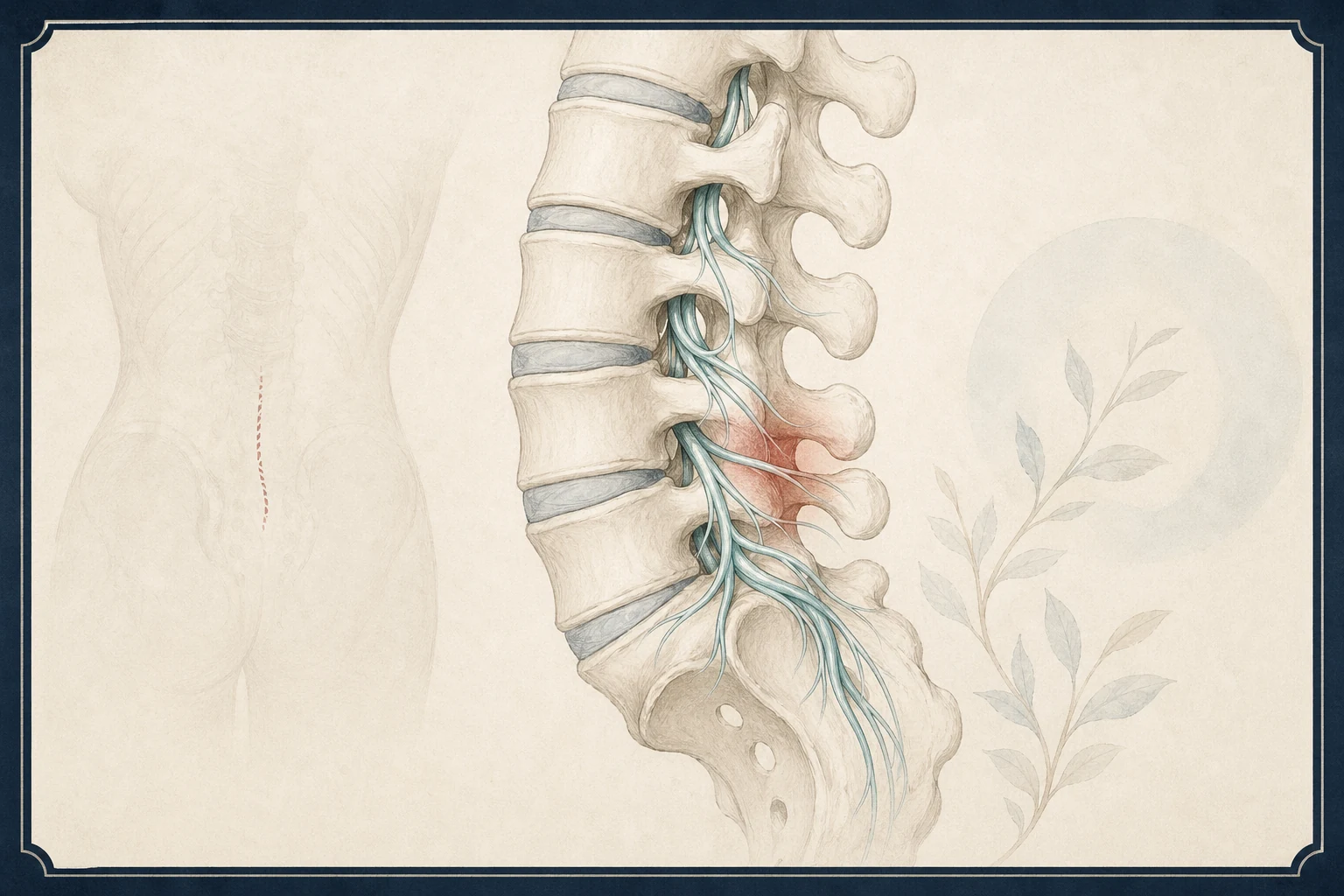
Pain after spine surgery
Failed Back Surgery Syndrome (Post-Laminectomy Syndrome)
Still in pain after back surgery? Houston pain specialists explain the five common causes, when to call your surgeon, and options from injections to SCS.
Failed back surgery syndrome, which doctors also call post-laminectomy syndrome, means back or leg pain that continues or returns after spine surgery even though the operation itself went as planned. It happens after roughly 10 to 40 percent of lumbar surgeries, depending on the procedure. The name is misleading: the surgery usually did what it was meant to do, and something else is now generating pain. Our job is to find that something, treat it without another operation whenever possible, and, when pain is nerve-based and stubborn, offer spinal cord stimulation with a trial first so you know it works before anything is implanted.
Key facts
| What it is | Persistent or recurrent back, neck, arm or leg pain after spine surgery (discectomy, laminectomy, fusion) once healing is complete, usually meaning pain still present or returning 3 to 6 months after the operation. |
|---|---|
| Most common causes | Recurrent disc herniation, adjacent segment disease, epidural scar tissue (fibrosis), hardware-related pain or failed fusion, and pain from the facet or SI joints next to the surgery. |
| Typical course | Surgical soreness fades over 6 to 12 weeks. Pain that is unchanged at 3 months, or that returns after a good period, is unlikely to resolve on its own and should be worked up. |
| See a specialist when | Your surgeon has confirmed there is no new structural problem to fix, or you have been told a second surgery is not advised, and pain still limits daily life. |
| Treatments we offer | Epidural and caudal steroid injections, facet and SI joint diagnostics and radiofrequency ablation, spinal cord stimulation and DRG stimulation, medication and physical therapy coordination. |
When to get emergency care
Call your surgeon's office the same day, or go to an emergency room if you cannot reach them, if you have:
- Fever over 100.4°F, chills, or redness, swelling, warmth or drainage at the incision at any point in the first 3 months (possible surgical site or deep infection)
- New weakness in a leg or foot, a new foot drop, or numbness that is spreading (possible nerve compression from a recurrent disc, hematoma or hardware)
- New loss of bladder or bowel control or numbness in the groin and inner thighs; this is cauda equina syndrome and needs an emergency room immediately
- Sudden severe pain after a fall or twist, a popping sensation, or a change in how your back or neck looks (possible hardware failure, fracture or loss of alignment)
- Severe headache that is worse when upright and better lying flat in the weeks after surgery (possible spinal fluid leak)
In the first 3 months after surgery your surgeon should be the first call for any new or worsening symptom. We are the right next step once structural and surgical causes have been ruled out or the surgeon has said another operation is not advised.
What failed back surgery syndrome actually means
The term is older than it deserves to be. It does not mean the surgeon failed, and it does not mean nothing can be done. It is a label for a patient whose spine surgery is healed but whose pain did not go away, came back, or changed. Newer literature calls it persistent spinal pain syndrome type 2 (PSPS-2), which is more accurate but not yet the term people search for.
How common it is depends on the operation. After a single-level discectomy for sciatica, most people do well and perhaps 10 to 15 percent have meaningful ongoing pain. After lumbar fusion, especially multilevel fusion or fusion for back pain without leg symptoms, the number is higher, with published estimates of 20 to 40 percent. Neck surgeries are included too, though less often.
The important idea is that persistent pain after surgery almost always has a specific cause. Finding it is the work of the first visit.
The five causes we look for
- Recurrent or residual disc herniation. After a discectomy, disc material can herniate again through the same weak spot, most often in the first year. Reported recurrence rates run about 5 to 15 percent. Leg pain returning in the same pattern as before surgery, sometimes after a specific lift or twist, is the clue.
- Adjacent segment disease. A fusion stops motion at one level, so the levels above and below take more load and wear faster. Symptomatic breakdown of an adjacent level develops at roughly 2 to 3 percent per year after fusion, so a patient 10 years out has a meaningful chance of new stenosis or disc disease one level up. The pain is new, often at a slightly different level or side than the original.
- Epidural fibrosis (scar tissue). Every surgery leaves scar in the epidural space. In some people that scar tethers or encases the nerve root and causes burning leg pain that does not follow position the way a disc does. MRI with contrast distinguishes scar from a recurrent disc. Scar cannot be cut out successfully, so it is managed rather than removed.
- Hardware and fusion problems. Screws and rods can loosen, irritate a nerve root if positioned close to it, or become painful as the bone around them changes. A fusion that did not fully knit (pseudarthrosis) produces motion and pain at the operated level. Flexion-extension X-rays or a CT scan show this, and this cause is one that may need the surgeon again.
- Facet and SI joint pain. A fusion transfers load to the joints next to it. Facet joint pain above a fusion and sacroiliac joint pain below a fusion to the sacrum are among the most common and most treatable causes, and both are frequently missed because they are not the level that was operated on.
A sixth possibility is that the original diagnosis was incomplete: the surgery fixed one problem while another, such as hip arthritis or peripheral neuropathy, was contributing all along.
Symptoms and what they point to
The pattern of pain narrows the list quickly.
- Leg pain in the same distribution as before surgery, returning after a pain-free interval: recurrent disc or scar tissue.
- Leg pain in a new distribution or on the other side: adjacent segment disease or a different nerve root.
- Burning, constant leg pain not much affected by position, sometimes with sensitivity to light touch: nerve injury or fibrosis, sometimes neuropathic pain that behaves more like CRPS.
- Back pain worse with standing and leaning back, better sitting: facet joints above the fusion.
- One-sided low buttock pain, worse rolling in bed or standing from a chair: SI joint.
- Deep midline pain with activity, especially after fusion: pseudarthrosis or hardware.
- Leg pain with walking that eases when you sit or lean on a cart: new spinal stenosis at an adjacent level.
How we diagnose it
Records first. We ask for your operative report, pre-operative imaging and any imaging since. Knowing exactly what was done, at which levels, and what the surgeon saw is worth more than a new scan.
Examination. Strength, reflexes and sensation in each nerve root, straight-leg raise and femoral stretch tests, facet loading, SI joint provocation tests, and hip and gait assessment. We also screen for signs of neuropathic pain such as allodynia.
Imaging. MRI with and without gadolinium contrast is the standard for a patient who has had surgery, because contrast separates scar tissue (which enhances) from a recurrent disc (which does not). CT shows fusion status and hardware position. Flexion-extension X-rays look for instability. If fusion failure or hardware trouble is suspected, we send those findings to the surgeon.
Diagnostic blocks. When facet or SI joints are suspected, a medial branch block or SI joint block tells us whether that joint is the source. These are tests: relief lasts hours, and that response decides whether radiofrequency ablation is worthwhile. A selective nerve root block can confirm which nerve root is generating leg pain when MRI is unclear.
Treatment options, in order
Once structural problems needing surgery are excluded, treatment follows the cause. Most patients use several of these together.
- Rehabilitation and medication
Structured physical therapy that rebuilds core and hip strength and addresses fear of movement; nerve-pain medication such as gabapentin, pregabalin or duloxetine for burning leg pain; short anti-inflammatory courses for joint pain. We take a defined stance on opioids, explained on our medication management page. Learn more →
- Epidural and caudal steroid injections
For leg pain from a recurrent disc, adjacent-level stenosis or scar tissue. In a post-surgical spine the epidural space is altered, so we often use a caudal approach from the tailbone or a transforaminal approach at the affected level. Relief typically starts within 2 to 7 days and lasts weeks to months; we limit them to about 3 to 4 per year. Learn more →
- Facet or SI joint radiofrequency ablation
For patients whose diagnostic block confirms a facet or SI joint source. A heat lesion of the small sensory nerves typically gives 6 to 12 months of relief and can be repeated when the nerves regrow. Learn more →
- Spinal cord stimulation (SCS), trial first
The best-studied treatment for persistent nerve-related leg pain after surgery. A temporary lead is placed through a needle and worn for about 5 to 7 days. If your pain drops by at least 50 percent during the trial, and function improves, you qualify for a permanent implant; if it does not, the lead is simply removed. In randomized trials, SCS beat continued medical management for leg pain, and newer high-frequency and burst systems relieve back pain as well as leg pain in a majority of patients. Learn more →
- Dorsal root ganglion (DRG) stimulation
A variation of SCS that targets one nerve root's ganglion. It is most useful when pain is confined to one area such as a foot, groin or knee, and for CRPS-like pain after surgery. It is FDA-approved for CRPS of the lower limb and used for focal post-surgical nerve pain; coverage for that use varies by insurer. Learn more →
- Referral back to surgery
If we find a recurrent disc with progressive weakness, a failed fusion, loose hardware or unstable adjacent segment, we send you back to your surgeon or arrange a second opinion. Revision surgery has lower success rates than a first operation, so we reserve that referral for structural findings that clearly match the symptoms.
What you can do now
- Gather your operative report, all imaging (with the discs, not just the reports) and a list of every injection and medication tried. This shortens the workup by weeks.
- Walk daily. Deconditioning after surgery makes every cause of pain worse and is the one factor entirely in your control.
- Keep a simple diary: where the pain is, what makes it worse, and whether it is the same pain you had before surgery or a new one. That single distinction steers the evaluation.
- Do not stop prescribed nerve-pain medications abruptly; talk with us about tapering or changing them.
- If you are on opioids from your surgeon, bring the prescription record; we will discuss a plan rather than an automatic continuation.
We see patients with pain after spine surgery at our Houston and Webster offices and, from November 2026, in Pearland.
Frequently asked questions
Does failed back surgery syndrome mean my surgery was done wrong?
Almost never. The term describes the outcome, not the technique. Most cases come from a recurrent disc, wear at the next level, scar tissue, joint pain next to the fusion, or a problem that was never part of the original diagnosis. The surgery usually fixed what it was meant to fix.
How long after surgery should I wait before seeing a pain specialist?
Post-operative soreness improves steadily over 6 to 12 weeks. If pain is no better at 3 months, or if it comes back after a good period, ask your surgeon to check for structural problems and then see us. You do not need to wait a year.
Should I have a second surgery?
Only for a clear structural cause that matches your symptoms, such as a recurrent disc with weakness, a failed fusion or loose hardware. Revision surgery succeeds less often than a first operation, and outcomes drop further with each additional surgery. For nerve pain without a fixable cause, spinal cord stimulation has better evidence than a repeat operation.
What is the spinal cord stimulator trial and what counts as success?
A thin lead is placed in the epidural space through a needle under X-ray and connected to an external battery for about a week while you go about normal life. Success is at least 50 percent pain reduction plus better function and sleep. Roughly 70 to 85 percent of good candidates pass the trial. If you do not, the lead comes out in the office and nothing is implanted.
Can scar tissue be removed?
Surgically removing epidural scar creates more scar and is rarely done. Scar-related nerve pain is managed with epidural (often caudal) steroid injections, nerve-pain medication, and, when it persists, spinal cord or DRG stimulation.
Why did my pain move lower and to one side after my fusion?
That pattern often means the sacroiliac joint, which takes extra load once L5-S1 is fused. It is one of the most common and most treatable causes of pain after fusion and is confirmed with exam tests and a diagnostic block. See our SI joint pain page.
Will I be on opioids for life?
That is not our goal or our usual practice. Persistent post-surgical pain responds better to targeted injections, nerve-pain medications, rehabilitation and, when needed, stimulation than to long-term opioids, and long-term opioid use carries its own risks. Our medication management page explains our approach.
Sources
- Failed back surgery syndrome: definition, epidemiology and demographics (Thomson S, 2013) (opens in new tab) — British Journal of Pain / PubMed Central
- Spinal cord stimulation versus conventional medical management for neuropathic pain: the PROCESS randomised trial (Kumar K et al., 2007) (opens in new tab) — Pain / PubMed
- Novel 10-kHz high-frequency therapy is superior to traditional low-frequency spinal cord stimulation: the SENZA-RCT (Kapural L et al., 2015) (opens in new tab) — Anesthesiology / PubMed
- Dorsal root ganglion stimulation yielded higher treatment success rate for CRPS and causalgia: the ACCURATE study (Deer TR et al., 2017) (opens in new tab) — Pain / PubMed
- Back Pain: information page (opens in new tab) — National Institute of Neurological Disorders and Stroke (NINDS)
Request an appointment
Call (832) 916-2075 or request an appointment online. New patients are welcome; the team confirms insurance and referral requirements before scheduling.