
Spine pain
Spinal Stenosis
Spinal stenosis causes leg heaviness with walking that eases when you sit. How it differs from poor circulation, cervical warning signs, and Houston care.
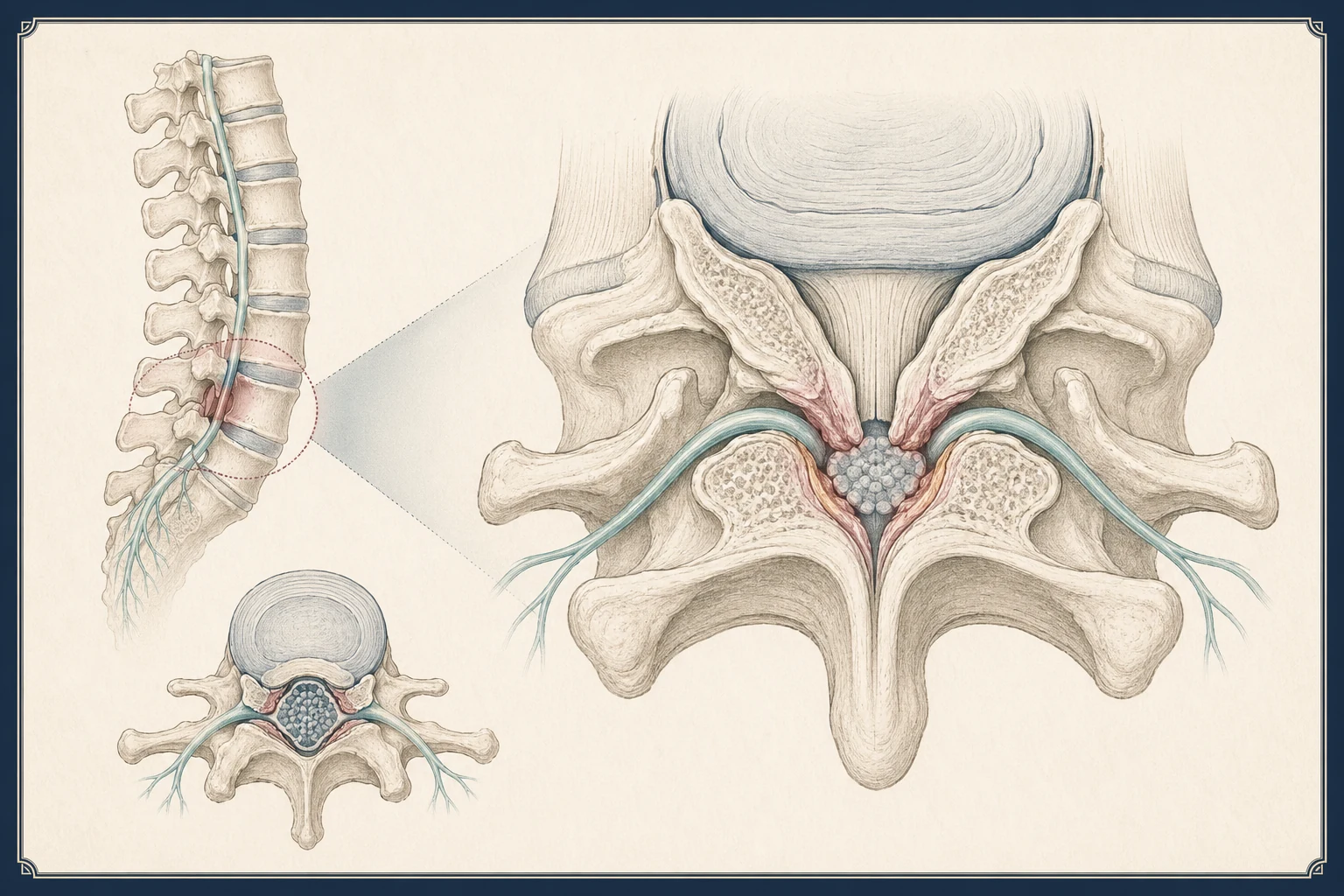
Spinal stenosis is narrowing of the spinal canal or the openings where nerves exit, usually from decades of disc flattening, joint enlargement and ligament thickening. In the low back it causes leg heaviness, cramping or numbness that comes on with walking or standing and eases with sitting or leaning forward. In the neck it can press on the spinal cord itself and affect hand coordination and balance. Gulf Coast Pain & Spine measures how far you can walk, separates stenosis from the circulation problems that mimic it, and treats it with epidural injections, coordinated therapy and timely surgical referral, at its Houston and Webster offices and, from November 2026, in Pearland.
Key facts
| What it is | Narrowing of the central canal, the lateral recess or the foramen (nerve exit) by bone spurs, thickened ligamentum flavum, bulging discs and enlarged facet joints. Most common at L4–5, then L3–4 and L5–S1; in the neck, C5–6 and C6–7. |
|---|---|
| Most common causes | Age-related degeneration (by far the most common; symptoms typically begin after 60), degenerative spondylolisthesis, congenitally narrow canal, and prior surgery or fracture. |
| Typical course | Slowly progressive but variable. In studies following people without surgery, about one-third improve, one-third stay the same and one-third worsen over several years. Rapid neurological decline is uncommon in the low back but is the main risk in the neck. |
| See a specialist when | Walking distance is shrinking, leg symptoms limit daily activity, or there is any numbness, weakness, hand clumsiness or balance change. |
| Treatments we offer | Epidural steroid injections (interlaminar, transforaminal, caudal), coordinated flexion-based physical therapy, medication review, and surgical referral when walking tolerance or neurological signs call for it. |
When to get emergency care
Seek emergency care or call 911 if you have any of these:
- Numbness in the groin or inner thighs, difficulty starting or stopping urine, or loss of bowel or bladder control. Severe lumbar stenosis can cause cauda equina syndrome, which needs surgery within hours.
- Leg weakness that is getting worse over days, a foot that drags or slaps, or falls.
- For cervical stenosis: new hand clumsiness, trouble with buttons, handwriting or picking up coins, dropping objects, or a change in walking or balance. These are signs of spinal cord compression (myelopathy), which can become permanent.
- An electric shock sensation down the spine or into the limbs when you bend your neck forward.
- Fever or chills with spine pain, or a history of cancer with new spine pain.
People with cervical stenosis should avoid neck manipulation and high-risk neck positions, and should tell any surgeon or anesthesiologist about it before a procedure that involves positioning the neck.
What spinal stenosis is
The spinal canal is a tunnel formed by the vertebrae, discs, facet joints and ligaments. The spinal cord runs through it in the neck and mid back; below about the first lumbar vertebra the cord ends and the canal carries a bundle of nerve roots, the cauda equina. Stenosis is any narrowing of that tunnel or of the side openings (foramina) where individual nerve roots exit.
The narrowing builds up slowly. Discs flatten with age and bulge into the canal. The facet joints at the back enlarge as they wear. The ligamentum flavum, which lines the back of the canal, thickens and buckles inward. Each change takes a little space; together, over decades, they can reduce the canal to half its original size. Some people are born with a narrower canal and develop symptoms earlier. Degenerative spondylolisthesis, where one vertebra slips forward on the next (most often L4 on L5, most often in women over 60), narrows the canal further and is present in a large share of people who eventually need surgery.
Stenosis on an MRI is common and often silent. Moderate or severe lumbar stenosis is found in about one in five adults over 60 without symptoms. The diagnosis is made by the combination of symptoms, walking tolerance and imaging, never by imaging alone.
Symptoms: lumbar versus cervical
Lumbar stenosis: neurogenic claudication. The hallmark is leg symptoms that depend on posture and activity. After walking or standing for a while, the legs feel heavy, tired, crampy, numb or weak, often in both legs, from the buttocks down. Sitting down, bending forward, or leaning on a shopping cart relieves the symptoms within minutes, because flexion opens the canal. Walking downhill or down stairs, which arches the back, is harder than walking uphill. Many people can ride a bicycle for miles but cannot walk two blocks. Back pain is often present but is usually less limiting than the legs. When the narrowing is in a foramen, it produces one-sided sciatica-type pain instead.
Neurogenic versus vascular claudication. Blocked arteries in the legs (peripheral arterial disease) also cause leg pain with walking, and in a population with high rates of diabetes and smoking the two frequently coexist. The distinction matters because the treatments are completely different. Vascular claudication is a cramping pain in the calves (sometimes thighs or buttocks) that starts after a fixed, reproducible distance, stops within a couple of minutes of standing still without needing to sit or bend, is worse walking uphill, and is not affected by posture; riding a bike provokes it just as walking does. The feet may be cool or pale, hair may be sparse on the shins, and the pulses at the ankle are weak. Neurogenic claudication needs flexion to settle, takes longer to ease, and comes with numbness and heaviness more than cramping. When there is doubt, an ankle-brachial index (a simple blood pressure comparison at the ankle and arm) screens for arterial disease and takes ten minutes.
Cervical stenosis. Narrowing in the neck can pinch a nerve root, causing arm pain in a specific pattern (cervical radiculopathy), or compress the spinal cord itself, causing cervical myelopathy. Myelopathy is insidious: hands feel clumsy, buttons and handwriting become difficult, objects get dropped, walking becomes stiff or unsteady, and there may be urinary urgency, all often with little neck pain. It tends to progress in steps rather than improve, and it is the one form of stenosis where waiting carries real risk.
How we diagnose it
The history usually makes the diagnosis: legs that give out with walking and recover with sitting, in someone over 60. The exam is often surprisingly normal at rest, which is characteristic. We check strength, reflexes and sensation in the legs (and arms, for the neck), look for a wide-based gait, and test the ankle pulses. Pain with arching backward that eases with bending forward supports lumbar stenosis. For the neck we look for brisk reflexes, a Hoffmann sign in the fingers, slowed finger tapping and gait change, any of which triggers an urgent MRI.
Walking tolerance is the measurement that matters. We ask how far you can walk before the legs stop you, in blocks, minutes or store aisles, and we track that number at every visit. It is the most meaningful measure of severity and of whether a treatment is working, more than pain scores and far more than the MRI. A self-paced walking test in the hallway gives a baseline.
MRI is ordered when symptoms limit walking or daily life, when there are neurological findings, or before an injection. It shows the levels involved and how tight the narrowing is; CT myelography is used when MRI is not possible. Because stenosis is so common on imaging, the MRI is interpreted against the symptoms, not the other way round. Vascular testing (ankle-brachial index, sometimes arterial ultrasound) is ordered whenever the pattern suggests arterial disease or when the two may coexist, which in patients with diabetes is often. EMG is used when peripheral neuropathy, which also causes numb feet, may be contributing.
Treatment options, in order
Lumbar stenosis is a slow, mechanical problem, so treatment is judged by walking distance over months rather than pain scores over days. Cervical myelopathy is the exception and follows a surgical path.
- Activity, flexion-based exercise and medication
Stationary cycling, walking with a cart or rollator, pool walking, and exercises that keep the spine in gentle flexion. NSAIDs if safe for you; gabapentin or pregabalin for burning leg symptoms in some people. Opioids do not improve walking and are not recommended. Learn more →
- Physical therapy
A supervised program of flexion exercises, hip and core strengthening, and walking progression. In a randomized trial, physical therapy produced similar improvement in function at two years to decompression surgery in patients who agreed to be randomized. Learn more →
- Epidural steroid injection
Interlaminar, transforaminal or caudal placement of steroid to reduce inflammation around the compressed roots. Relief typically begins within 2–7 days. The honest evidence: for stenosis, the LESS trial found that adding steroid to epidural anesthetic gave only a small extra benefit at 6 weeks, and the effect fades over months. Injections are worth trying for a leg-pain flare or to extend walking through a specific period; they do not open the canal, and repeated injections are limited to 3–4 per year. Learn more →
- Surgical referral: decompression, with fusion when there is instability
Laminectomy removes the bone and ligament narrowing the canal; a fusion is added when there is spondylolisthesis or instability. In the SPORT stenosis trial, patients treated surgically had substantially greater improvement in pain and function at two and four years than those treated without surgery. Thresholds below. Learn more →
- Spinal cord stimulation
For persistent leg nerve pain after decompression, or for people who cannot have surgery and have leg pain rather than pure walking limitation. Learn more →
When surgery becomes the right choice
Lumbar stenosis surgery is elective in most cases and the decision belongs to the patient. We recommend a surgical opinion when:
- Walking tolerance has fallen to a level that limits daily life (for many people, under two or three blocks) despite 3–6 months of exercise, medication and at least one injection.
- Neurological findings are present or progressing: weakness, a foot drop, or sensory loss that is worsening.
- Degenerative spondylolisthesis is present with symptoms that are not responding, since these patients did particularly well with surgery in trials.
- Cauda equina symptoms develop; this is an emergency, not an elective referral.
Cervical stenosis with myelopathy is different: once cord compression is producing symptoms, surgery is the recommended treatment for anyone with moderate or severe myelopathy or with progression, because the goal is to prevent further loss rather than to recover what is already lost. Injections do not treat myelopathy. We arrange surgical referral promptly and coordinate any interim needs.
Newer less invasive options for lumbar stenosis, such as percutaneous ligament decompression and interspinous spacers, exist for specific anatomy. Ask which approach we recommend for you and whether these are an option in your case.
What you can do now
- Ride a stationary bike or walk in a pool. Both keep the spine flexed and let you build fitness that walking cannot.
- Walk with a cart or rollator. Leaning forward on a handle opens the canal; most people can double their distance this way. It is not giving in; it is the same principle the surgery uses.
- Sit before the legs give out, not after. Plan routes around benches.
- Sleep with knees bent over a pillow, or on your side with knees drawn up.
- Manage the things that also damage nerves and vessels: blood sugar, blood pressure, cholesterol and smoking. Diabetes and arterial disease multiply the walking limitation from stenosis.
- Keep a walking log: how far, how long, what stopped you. Bring it to every visit; it is how we judge whether treatment is working.
Frequently asked questions
Why does sitting or leaning forward relieve spinal stenosis?
Bending forward stretches the ligamentum flavum flat and pulls the facet joints apart, which opens the canal by a measurable amount. Standing and arching backward does the opposite. This is why a shopping cart helps, why cycling is easier than walking, and why walking downhill is harder than uphill.
How do I know if my leg pain is stenosis or poor circulation?
Stenosis pain needs sitting or bending to settle and is worse walking downhill; circulation pain stops within a minute or two of standing still, is worse uphill, and is usually a cramp in the calves. Cycling provokes vascular pain but not stenosis. Weak ankle pulses point to circulation. Many people, especially with diabetes, have both, and an ankle-brachial index test sorts it out.
Will spinal stenosis get worse?
Slowly, in some people. Studies following patients without surgery for several years find about a third improve, a third stay the same and a third worsen. Sudden neurological decline is uncommon in the low back. Cervical stenosis that is compressing the cord (myelopathy) is the form that tends to progress and is treated surgically sooner.
Do epidural injections work for spinal stenosis?
Modestly and temporarily. They reduce inflammation around the compressed nerves and can improve leg symptoms and walking for weeks to a few months, which is useful for a flare or a specific period, such as a trip. The largest trial found only a small added benefit from the steroid itself at six weeks. Injections do not widen the canal.
When should I consider surgery for spinal stenosis?
When walking is limited to a distance that interferes with daily life despite 3–6 months of exercise, medication and injections, when there is weakness or progressive numbness, or when a slipped vertebra (spondylolisthesis) is causing symptoms. Surgery relieves leg symptoms and improves walking in most patients who meet these criteria. Cauda equina symptoms or cervical myelopathy call for prompt surgical referral rather than a trial of waiting.
Can I have spinal stenosis without back pain?
Yes, commonly. The leg heaviness and numbness with walking are the defining symptoms, and many people have little or no back pain. Cervical stenosis with myelopathy is often nearly painless, which is why hand clumsiness and balance change should never be dismissed as aging.
Is walking good or bad for spinal stenosis?
Good, within your tolerance. Walking maintains fitness and does not damage the spine. Stop and sit when the legs start to go rather than pushing through, use a cart or poles to stay slightly flexed, and add cycling or pool walking to build endurance without provoking symptoms.
Sources
- Lumbar Spinal Stenosis (opens in new tab) — American Academy of Orthopaedic Surgeons, OrthoInfo
- Diagnosis and Treatment of Degenerative Lumbar Spinal Stenosis: Evidence-Based Clinical Guidelines (opens in new tab) — North American Spine Society
- A Randomized Trial of Epidural Glucocorticoid Injections for Spinal Stenosis (LESS trial) (opens in new tab) — New England Journal of Medicine, 2014
- Surgical versus Nonsurgical Therapy for Lumbar Spinal Stenosis (SPORT) (opens in new tab) — New England Journal of Medicine, 2008
- Cervical Spondylotic Myelopathy (Spinal Cord Compression) (opens in new tab) — American Academy of Orthopaedic Surgeons, OrthoInfo
Request an appointment
Call (832) 916-2075 or request an appointment online. New patients are welcome; the team confirms insurance and referral requirements before scheduling.