
- Arm pain that follows a nerve-root pattern (into the shoulder blade, upper arm, forearm or specific fingers), with or without numbness or tingling, lasting more than 4–6 weeks
- MRI showing a disc herniation or foraminal narrowing at the level that matches the symptoms
- Pain that is limiting sleep, work or physical therapy
- Patients hoping to avoid or delay neck surgery, or who are not surgical candidates
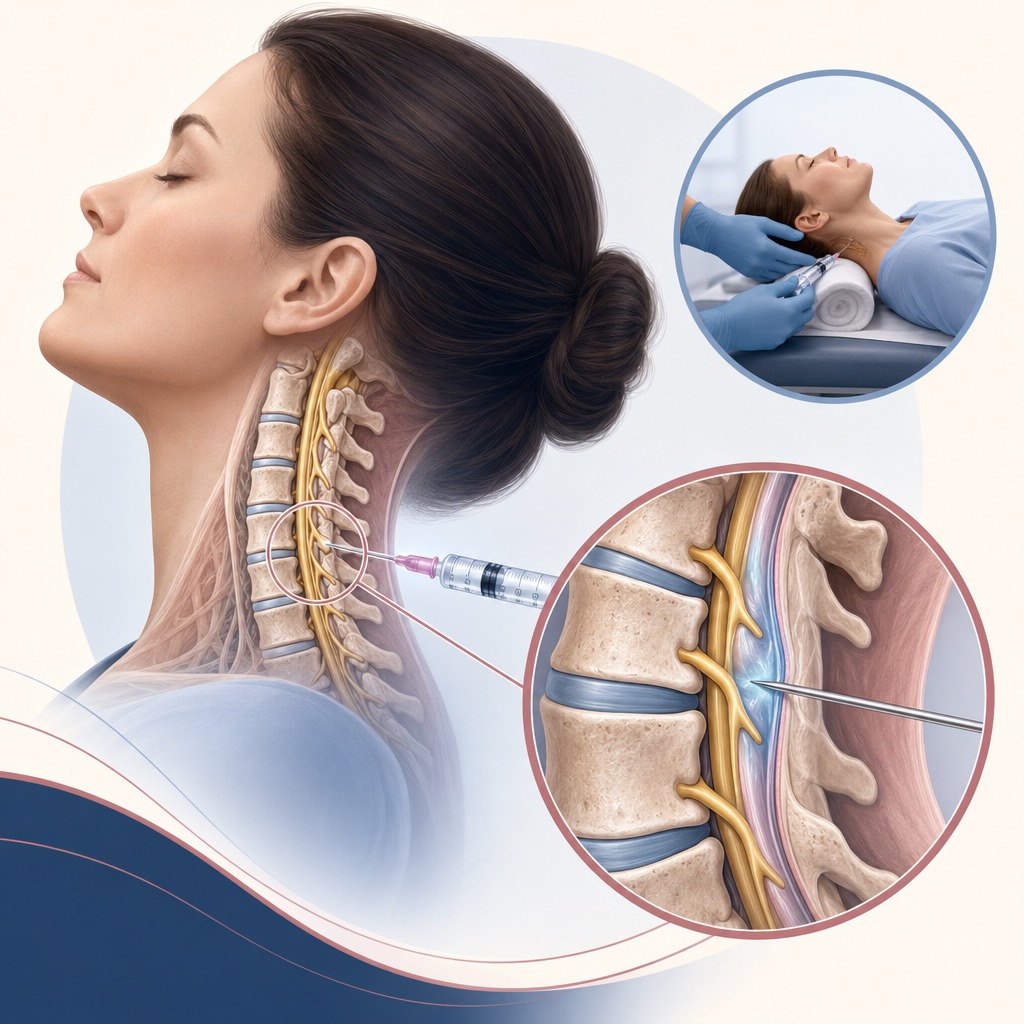
Spine injection
Cervical Epidural Steroid Injection
Cervical epidural steroid injection in Houston for arm nerve pain: how it is done safely (C7–T1, dexamethasone, contrast), relief timeline and risks.
In short
A cervical epidural steroid injection delivers anti-inflammatory steroid into the epidural space of the neck to reduce arm pain, numbness and tingling caused by a pinched or inflamed cervical nerve root (cervical radiculopathy). It is a treatment, not a test. Relief typically begins within 2–7 days and lasts weeks to months. Because the spinal cord sits close to the needle path in the neck, this injection has stricter safety rules than a lumbar epidural, and this page explains exactly what those rules are and why.
Key facts
| Treats | Arm pain, numbness or tingling from a cervical disc herniation or foraminal stenosis (cervical radiculopathy); less useful for neck pain alone |
|---|---|
| Test or treatment? | Treatment. It reduces inflammation around the irritated nerve root |
| Procedure time | 10–15 minutes of needle time; about 60–90 minutes at the office |
| Anesthesia | Local anesthetic; light sedation only, so you can report any unusual symptoms during the injection |
| Downtime | Rest the day of the injection; back to normal activity the next day |
| When relief starts | Typically 2–7 days, sometimes up to 2 weeks |
| How long relief lasts | Weeks to months; a recent disc herniation often needs only 1–2 injections |
| How often it can be repeated | Only if the first injection helped; typically no more than 3–4 spinal steroid injections per year, at least 2 weeks apart |
| Insurance | Covered by Medicare and most plans for radicular arm pain with matching MRI after conservative care |
Who it is for
- Neck pain alone without arm symptoms; facet joints or muscles are the more likely source, and the evidence for epidural steroid in axial neck pain is weak
- Signs of spinal cord compression (myelopathy): clumsy hands, trouble walking, balance loss, or bladder changes. This needs a surgical evaluation, not an injection
- Severe central canal stenosis at C7–T1 with no room for the needle, on MRI review
- Blood thinners that cannot be paused, or a bleeding disorder
- Active infection or fever, uncontrolled diabetes, or a steroid injection within the past 2 weeks
- Pregnancy, because fluoroscopy uses X-ray
How a cervical epidural steroid injection works
The nerve roots in the neck leave the spinal canal through small side openings and travel down the arm. A disc herniation or bone spur at C5–6 or C6–7 (the two most common levels) inflames the root and produces the shooting arm pain, tingling and weakness of cervical radiculopathy. Steroid placed in the epidural space bathes the inflamed root and turns the inflammation down while the body reabsorbs disc material over the following weeks. The injection does not remove the disc or bone spur; it makes the nerve less angry while it recovers, which is often all a recent herniation needs.
Compared with the low back, the cervical epidural space is narrow (only a few millimeters) and the spinal cord lies immediately in front of it. That anatomy is why every step of this injection is designed around safety.
How we do this injection safely
In 2014 the FDA added a warning to the labels of injectable corticosteroids describing rare but serious neurologic events after epidural injection, including stroke, paralysis and death. Almost all of those events involved particulate (crystal-containing) steroid injected through a transforaminal (side) approach in the neck, where it can enter a small artery that feeds the spinal cord. The Multisociety Pain Workgroup, a coalition of pain, spine and radiology organizations, then published safeguards that are now standard practice. We follow them:
- Interlaminar approach at C7–T1. The needle enters from the back at the C7–T1 (or T1–T2) level, where the epidural space is widest and the cord has the most room, even when the problem is higher up at C5–6. The medication spreads upward to the target level.
- Non-particulate steroid. We use dexamethasone, a steroid that dissolves fully and cannot block an artery, rather than a particulate steroid.
- Contrast confirmation under live fluoroscopy. A small amount of X-ray dye is injected first and watched in real time to confirm the medication is in the epidural space and not in a blood vessel or the spinal fluid. We also use a technique (loss of resistance) that detects the epidural space before the needle can go deeper.
- MRI review before the injection. We measure the space available at C7–T1 on your images. If it is too tight, we choose a different level or a different treatment.
- Light sedation only. You stay awake enough to tell us if you feel anything unusual (electric pain in the arm, a headache, dizziness). Heavy sedation removes that safety signal, so we avoid it.
These steps take a rare risk and make it rarer. They do not make it zero, and that is why we also tell every patient which symptoms to report afterward.
What happens on procedure day
- Check-in: we confirm your blood-thinner hold, glucose if you are diabetic, allergies, and that you have a driver. You sign consent and we review your MRI together.
- Positioning: you lie face down with your forehead on a padded rest, arms at your sides, so the neck is slightly flexed and the C7–T1 space opens up. The skin is cleaned and draped.
- Numbing: lidocaine is injected in the skin and deeper tissue at the base of the neck. Most people feel pressure rather than sharp pain after this.
- Needle placement: under live X-ray in two views, the physician advances a thin needle between the laminae at C7–T1 and identifies the epidural space by loss of resistance, then injects contrast to confirm epidural spread.
- Injection: dexamethasone with a small amount of saline or dilute local anesthetic is injected slowly. You may feel pressure in the neck or shoulders for a few seconds. Tell us immediately about any sharp arm pain, headache or dizziness.
- Recovery: you rest 20–30 minutes while we check arm strength and sensation, then your driver takes you home.
After the procedure, and symptoms to report
Day 0. Rest. The neck may feel sore and the arms slightly heavy for a few hours. Do not drive. Ice the injection site 15 minutes at a time. Eat normally and take your usual medications.
Days 1–3. Return to work and light activity. Some people have a temporary flare of neck or arm pain for 1–3 days before the steroid takes effect; flushing, poor sleep and a higher blood sugar are common for a few days.
Week 1–2. Most of the benefit arrives. Start or resume physical therapy while the nerve is less inflamed. We ask you to rate your arm pain at 2 weeks; if it has dropped by half or more, we do not repeat the injection until pain returns.
Report these right away (call us, or go to the emergency room after hours):
- New or worsening weakness in either arm or hand, or in the legs
- A severe headache, especially one that is worse sitting up and better lying down (possible dural puncture) or one with neck stiffness and fever (possible infection)
- Numbness spreading beyond the original area, trouble walking or balance changes, or bladder or bowel changes
- Fever over 100.4 °F, or redness, swelling or drainage at the injection site
- Difficulty swallowing or breathing, or a swelling in the neck
What the evidence shows
Cervical interlaminar epidural injections have been studied less than lumbar injections, but the direction of the evidence is consistent. The ASIPP 2021 epidural guidelines rate the evidence for cervical interlaminar injections in disc herniation and radiculitis as Level II (moderate), based on randomized trials in which roughly 7 in 10 patients had significant improvement at 1–2 years with repeated injections, and weaker for neck pain without arm symptoms. Trials comparing local anesthetic alone with local anesthetic plus steroid found smaller differences than most patients expect, which suggests the injection itself, not only the steroid, contributes to relief.
The safety record is what most patients ask about. Large case series of interlaminar cervical injections done with fluoroscopy, contrast and non-particulate steroid report serious complications on the order of well under 1 in 1,000. The catastrophic events behind the FDA warning were concentrated in cervical transforaminal injections with particulate steroid, a technique we do not use.
Natural history matters too: most cervical radiculopathy from a soft disc herniation improves within 3–6 months without surgery. The injection is a bridge through that period, and about 3 in 4 patients treated this way avoid surgery.
Alternatives and what comes next
For mild arm pain, a short course of anti-inflammatories or a nerve-pain medication, a home exercise program and time are reasonable first steps; see medication management. If the injection helps and later wears off, it can be repeated within the yearly limit. If two well-placed injections do not help, or weakness is progressing, we refer to a spine surgeon; anterior cervical discectomy and fusion or disc replacement are effective for a matching herniation. If the pain is mostly in the neck rather than the arm, cervical medial branch blocks and radiofrequency ablation address the facet joints, and trigger point injections address muscle pain. For low-back and leg symptoms see lumbar epidural steroid injections. Cervical epidural injections are performed at our Houston and Webster offices, and in Pearland when that office opens in November 2026.
Safety and preparation
- Blood thinners: a cervical epidural is a high bleeding-risk procedure because a small clot can press on the spinal cord. Warfarin, apixaban, rivaroxaban, dabigatran, clopidogrel, prasugrel, ticagrelor, enoxaparin and (in most cases) aspirin are paused for 1–7 days depending on the drug, always in coordination with the prescribing physician. Never stop a blood thinner on your own, and tell us about supplements such as fish oil, vitamin E, ginkgo and garlic.
- Diabetes: expect blood sugar to run higher for 1–3 days, sometimes up to a week. Check more often, keep taking your medication, and call if readings stay above 300. We may postpone if your glucose is very high on the day.
- Infection or fever: any fever, active infection (urinary, dental, skin, respiratory) or current antibiotic course means we reschedule.
- Allergies (contrast, steroid, local anesthetic): tell us about any reaction to iodine or X-ray dye, cortisone products, lidocaine or dental numbing. Contrast is essential to this injection's safety, so allergy pre-medication is arranged in advance rather than skipping contrast.
- Pregnancy: fluoroscopy uses X-ray; tell us if you are or could be pregnant.
- Sedation and driving: sedation is kept light on purpose so you can report symptoms. You still need an adult driver on the day, whether or not you have sedation, because the neck and arms can feel heavy afterward. If sedation is planned, nothing to eat for 6 hours or drink for 2 hours beforehand.
- Imaging: a recent cervical MRI (or CT myelogram) is required before this injection so the space at C7–T1 can be measured; bring the disc or have us request it.
- Recent steroids: a steroid injection anywhere in the body within 2 weeks, or a course of oral prednisone, usually means we wait.
Risks and side effects
- Neck soreness at the injection site for 1–3 days
- Temporary flare of neck or arm pain for 24–72 hours
- Facial flushing, trouble sleeping, a racing feeling, or a rise in blood sugar for a few days
- Light-headedness or a vasovagal reaction during the procedure
- Arm heaviness or tingling for a few hours if local anesthetic is used
- Dural puncture headache (worse upright, better lying flat), reported in roughly 1 in 100 or fewer interlaminar cervical injections
- Bleeding or bruising at the site
- Allergic reaction to contrast dye, steroid or local anesthetic
- Transient increase in blood pressure, mood change or menstrual irregularity from the steroid
- No benefit
- Spinal cord injury from direct needle contact, or from an epidural hematoma or abscess pressing on the cord; this is the reason for the C7–T1 approach, loss-of-resistance technique, blood-thinner management and sterile preparation
- Stroke, paralysis or death from steroid or air entering an artery that supplies the spinal cord or brain, the events behind the FDA 2014 label warning; nearly all reported cases involved particulate steroid via a transforaminal approach, which we do not use; we inject only non-particulate dexamethasone with contrast confirmation
- Infection: epidural abscess or meningitis
- Nerve root injury with persistent arm numbness, weakness or pain
- Seizure or heart rhythm disturbance from local anesthetic entering a blood vessel
- Bone density loss with frequent repeated steroid over years
Frequently asked questions
How long does a cervical epidural steroid injection last?
Relief typically lasts weeks to a few months. For a recent disc herniation, one or two injections often carry a person through the 3–6 month window in which most herniations settle on their own, and no further injections are needed. Relief from a chronic bone-spur narrowing tends to be shorter.
Is a cervical epidural injection dangerous?
Serious complications are rare when the injection is done the way major pain and spine societies recommend: interlaminar approach at C7–T1, non-particulate steroid, live fluoroscopy with contrast, and light sedation. The FDA 2014 warning that patients read about online concerned events that were concentrated in a different technique (transforaminal injection of particulate steroid) that we do not use in the neck. Ask us to walk through the safeguards; every patient should hear them before consenting.
Why is the needle placed at C7–T1 when my problem is at C5–6?
The epidural space is widest and the spinal cord has the most room at C7–T1. Medication injected there spreads upward and reaches C5–6 and C6–7 reliably, so we get the benefit at the target level without placing the needle where the space is tightest.
What symptoms should I report after a cervical epidural?
Call us the same day for new arm or hand weakness, a severe headache (especially one that is worse sitting up), fever, neck stiffness, spreading numbness, trouble walking, bladder changes, difficulty swallowing or breathing, or redness and drainage at the site. After hours, go to the emergency room for weakness, severe headache with fever, or breathing or swallowing trouble.
How many cervical epidural injections can I have?
Typically no more than 3–4 spinal steroid injections in a year, at least 2 weeks apart, and only repeated when the previous one clearly helped. Many people need just one or two.
Will a cervical epidural help neck pain without arm pain?
Usually not much. Neck pain without arm symptoms is more often from the facet joints or muscles, and the evidence for epidural steroid in that setting is weak. Cervical medial branch blocks, radiofrequency ablation or trigger point injections are better matched to that pattern.
Can I drive myself home?
No. Plan on an adult driver for this injection even if you decline sedation; neck soreness and arm heaviness afterward make driving unsafe on the day.
Sources
- FDA Drug Safety Communication: FDA requires label changes to warn of rare but serious neurologic problems after epidural corticosteroid injections (2014) (opens in new tab) — U.S. Food and Drug Administration
- Safeguards to Prevent Neurologic Complications after Epidural Steroid Injections: Consensus Opinions from a Multidisciplinary Working Group (2015) (opens in new tab) — Anesthesiology / Multisociety Pain Workgroup
- Comprehensive Evidence-Based Guidelines for Epidural Interventions in the Management of Chronic Spinal Pain (2021) (opens in new tab) — American Society of Interventional Pain Physicians (ASIPP)
- Cervical Epidural Steroid Injections: coverage recommendations (opens in new tab) — North American Spine Society (NASS)
- Interventional Spine and Pain Procedures in Patients on Antiplatelet and Anticoagulant Medications (2018) (opens in new tab) — American Society of Regional Anesthesia and Pain Medicine (ASRA)
Next step
Request an appointment
Call (832) 916-2075 or request an appointment online. New patients are welcome; the team confirms insurance and referral requirements before scheduling.