
- Low back or neck pain for 3 months or more that is worse with extension (arching), twisting, prolonged standing or looking up, and tender over the joints
- Pain that stays in the back, buttock or thigh (or neck, shoulder and upper back) without true nerve-root pain, numbness or weakness in the leg or arm
- Failure of at least 4–6 weeks of conservative care (activity changes, anti-inflammatories, physical therapy)
- Imaging that shows facet arthritis or is unremarkable; MRI findings are common in people without pain, so the block matters more than the picture
- Neck pain after a whiplash injury, where the facet joints are the most common source
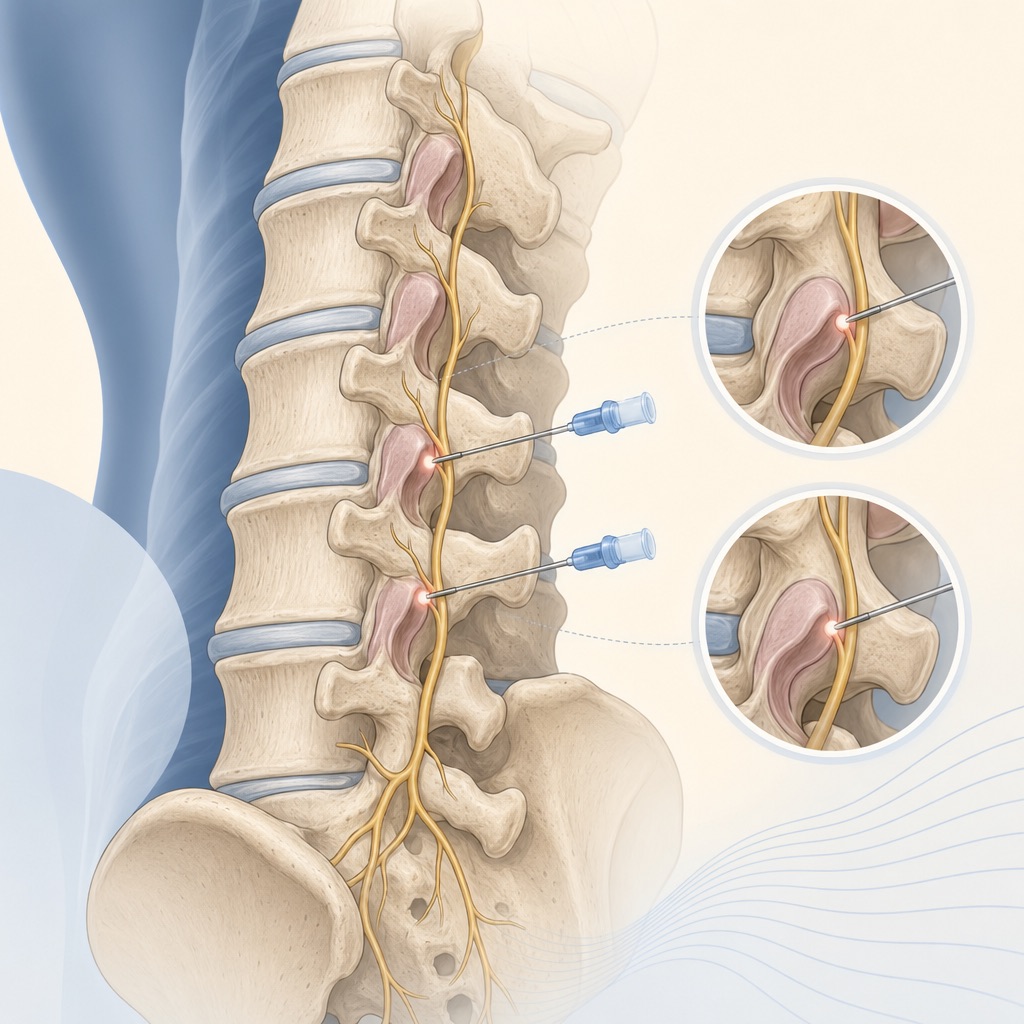
Diagnostic nerve block
Medial Branch Blocks (Diagnostic Facet Block)
Medial branch block in Houston: the diagnostic test for facet joint pain before radiofrequency ablation. Relief lasts hours on purpose; two blocks needed.
In short
A medial branch block is a test, not a treatment. Under X-ray guidance, a few drops of local anesthetic are placed on the tiny medial branch nerves that carry pain from the facet joints of the spine. If your usual back or neck pain drops sharply for the next few hours and then returns, the facet joints are the source and you are a candidate for radiofrequency ablation, which can quiet those same nerves for 6–12 months or longer. Relief from the block itself is meant to last hours, not weeks.
Key facts
| Tests for | Facet joint pain in the low back or neck: one-sided or two-sided pain that is worse with arching backward, twisting or prolonged standing, without leg or arm nerve pain |
|---|---|
| Test or treatment? | A test. It identifies whether the facet joints are the pain source; it is not intended to give lasting relief |
| Procedure time | 10–20 minutes for 2–3 levels on one or both sides; about 60 minutes at the office |
| Anesthesia | Local anesthetic in the skin only; sedation is avoided or kept minimal so the result is reliable |
| Downtime | None beyond the day; most people return to work the same or next day |
| When relief starts | Within 15–30 minutes |
| How long relief lasts | 1–2 hours with lidocaine, 4–8 hours with bupivacaine; then the pain returns, as expected |
| How often it is done | Two separate blocks, usually 1–4 weeks apart, each with at least 80% relief, are typically required before radiofrequency ablation is approved |
| Insurance | Covered by Medicare and most plans as a diagnostic step toward radiofrequency ablation; limited to about two diagnostic sessions per spine region per year |
Who it is for
- Leg or arm pain that dominates over back or neck pain, with a matching disc or stenosis on imaging; an epidural or nerve root block fits better
- Patients who cannot reliably keep a pain diary for the afternoon (heavy sedation, significant cognitive impairment)
- Active infection, fever, or a skin infection over the injection site
- Blood thinners that cannot be managed for the procedure, or a bleeding disorder
- Pregnancy, because fluoroscopy uses X-ray
- Patients who would not proceed to radiofrequency ablation even if the test is positive; the test has no purpose on its own
How a medial branch block works
Each facet joint, the small paired joint at the back of every spinal level, is supplied by two medial branch nerves, one from the level above and one from its own level. These nerves are purely sensory: they carry pain from the joint capsule and supply a small muscle, and nothing else. That is what makes them ideal targets. Numbing them does not affect strength, sensation in the legs or arms, or the nerves that run to the rest of the body.
A medial branch block places about 0.3–0.5 mL of local anesthetic on each target nerve where it crosses a fixed bony landmark, using fluoroscopy to find that landmark exactly. To test the L4–L5 joint, for example, we block the L3 and L4 medial branches; to test two joints on one side we block three nerves. The small volume is deliberate, so the anesthetic does not spread to other structures and give a false answer.
Then the test begins. If the facet joints are your pain source, your usual pain should fall by 80% or more within 30 minutes and stay down until the anesthetic wears off. If they are not, nothing much happens. Either result is useful. A positive block means radiofrequency ablation of those same nerves has a good chance of giving months of relief; a negative block means we look elsewhere, most often the disc, the SI joint or the hip.
Why relief is short, why we need two blocks, and why we limit sedation
Relief lasts hours on purpose. A medial branch block contains no steroid and is not meant to fix anything. Patients sometimes feel discouraged when the pain comes back that evening; it should. Pain that vanishes and then returns as the anesthetic fades is the clearest positive result there is.
Two blocks, at least 80% relief each. A single block gives a false-positive result in roughly 1 in 3 people, because of placebo response, anesthetic spreading beyond the target, or a good day. Medicare and most commercial insurers therefore require two separate blocks, on different days, each with at least 80% relief lasting about as long as the anesthetic, before they will approve radiofrequency ablation. Some commercial plans accept 50%; we follow the stricter rule because it predicts ablation success better. We often use a short-acting anesthetic (lidocaine) for one block and a longer-acting one (bupivacaine) for the other, so the relief duration should differ in a way that matches the drug; that pattern is itself evidence the result is real.
Minimal sedation. Sedation blurs pain perception, which produces false positives, and a false positive leads to an ablation that will not work. We use local anesthetic in the skin and keep any sedation to the lightest level, or none. Take your regular scheduled medications, but no extra pain medication the morning of the block.
The pain diary. We give you a sheet to rate your usual pain every hour for 6–8 hours after the block, and to note when it returns. Do the things that normally hurt during that window. Bring the sheet back; insurers ask for it, and so do we.
What happens on procedure day
- Check-in: we record your baseline pain score and location, confirm blood-thinner and allergy details, and hand you the pain diary. Wear loose clothing; there is no fasting unless light sedation is planned.
- Positioning: face down on the fluoroscopy table for lumbar blocks, or face down with a forehead rest for cervical blocks. The skin is cleaned and draped. Typically 2–3 levels on one or both sides are done in one session.
- Numbing: a small amount of lidocaine in the skin at each entry point. Most people describe pressure from this point on.
- Needle placement: a thin needle is guided under live X-ray to the bony groove where each medial branch crosses, and its position is confirmed in two views. A tiny amount of contrast may be used to be sure the anesthetic will not spread into a vessel.
- Injection: 0.3–0.5 mL of local anesthetic at each nerve. The whole injection phase takes a few minutes.
- Testing: after 15–30 minutes we re-check your pain and ask you to bend, twist or extend the way that normally hurts. You then go home (with a driver if any sedation was used) and continue rating pain hourly.
After the block
First 6–8 hours. This is the test window. Move normally, do the activities that usually trigger your pain, and rate it every hour on the diary. Do not take extra pain medication during this period unless you must; if you do, write it down.
That evening. Expect your usual pain to return, sometimes a little stronger than baseline for a day. Soreness at the needle sites for 1–2 days is normal; ice helps.
Next 1–4 weeks. If the first block was positive, we schedule the confirmatory second block. If both are positive, we request authorization for radiofrequency ablation, which is usually scheduled 2–4 weeks later. If the first block is clearly negative, we do not repeat it; we move on to the next likely source.
Call us for fever over 100.4 °F, redness or drainage at the sites, or new weakness or numbness that lasts beyond the evening.
What the evidence shows
Facet joints account for roughly 15–45% of chronic low back pain and about half of chronic neck pain in studies using controlled diagnostic blocks; the proportion rises with age. No exam finding or imaging test identifies them reliably, which is why guidelines from ASIPP, the multi-society facet consensus (Cohen and colleagues, 2020), and Medicare coverage policies all name controlled medial branch blocks as the reference standard for diagnosing facet pain.
The accuracy question is well studied. A single uncontrolled block carries a false-positive rate of about 25–45% in the lumbar spine and similar in the neck. Requiring two concordant blocks lowers that substantially, and patients selected with two blocks at a high relief threshold have the best ablation outcomes: in the classic lumbar series by Dreyfuss and colleagues, about 6 in 10 patients selected this way had at least 90% relief a year after ablation. By contrast, the MINT trials (2017), which selected patients with a single block at a 50% threshold, found little benefit from ablation, a result widely attributed to loose selection. The lesson is that the block is only as useful as the rigor with which it is done and read.
Medial branch blocks are not a treatment. Some patients report relief lasting days or weeks after a block, and a small body of research has explored repeated therapeutic blocks, but insurers do not cover them for that purpose and the effect is unreliable. Intra-articular facet joint injections with steroid are the therapeutic option, and payers do not accept their result as a qualifying test for ablation.
Alternatives and what comes next
Two positive blocks lead to radiofrequency ablation of the same medial branches, which typically gives 6–12 months or more of relief and can be repeated when the nerves regrow. A negative block sends the work-up toward the disc (epidural steroid injection or discography when indicated), the SI joint, the hip, or muscle (trigger point injections). For neck pain, cervical blocks and ablation follow the same logic; see neck pain. Read facet joint syndrome for the condition itself. Medial branch blocks are performed at our Houston and Webster offices, and in Pearland when that office opens in November 2026.
Safety and preparation
- Blood thinners: medial branch blocks are low bleeding-risk procedures, and many patients can continue aspirin and some other agents. Tell us everything you take (warfarin, apixaban, rivaroxaban, dabigatran, clopidogrel, ticagrelor, enoxaparin, aspirin) and we will decide with your prescriber whether any hold is needed. Do not stop a blood thinner on your own.
- Diabetes: no steroid is used, so blood sugar is not affected. Eat and take your diabetes medication normally.
- Infection or fever: we reschedule if you have a fever, an active infection, or a skin problem over the injection sites.
- Allergies (contrast, steroid, local anesthetic): tell us about any reaction to lidocaine, bupivacaine, dental numbing or X-ray dye. No steroid is used in a diagnostic block.
- Pregnancy: fluoroscopy uses X-ray; tell us if you are or could be pregnant.
- Sedation and driving: sedation is avoided or minimal so the test is accurate. Without sedation you may drive yourself unless you prefer not to; with any sedation, bring an adult driver.
- Pain medication on the day: take your usual scheduled medications, but no extra or as-needed pain medication the morning of the block, and none during the 6–8 hour diary window unless necessary (write it down if you do).
- Pain diary: bring the completed sheet to your follow-up or send a photo of it; insurers require documented relief from both blocks before approving ablation.
Risks and side effects
- Soreness or bruising at the needle sites for 1–2 days
- Temporary numbness of a small patch of skin, or a feeling of weakness in the back muscles, for a few hours
- A short rebound increase in pain for a day after the anesthetic wears off
- Light-headedness or a vasovagal reaction during the procedure
- Bleeding at the site
- Allergic reaction to local anesthetic or contrast
- Temporary leg or arm numbness if anesthetic spreads toward a spinal nerve root; resolves within hours
- A false-positive or false-negative result, the main practical risk, which the two-block rule and minimal sedation are designed to reduce
- Infection at the site or, very rarely, deeper infection
- Nerve injury from the needle
- Spinal anesthesia or dural puncture if anesthetic enters the spinal fluid (very unlikely with the small volume and fluoroscopic confirmation)
- Seizure or heart rhythm disturbance from local anesthetic entering a blood vessel (very unlikely at these volumes)
- For cervical blocks: injection into the vertebral artery, avoided by imaging in two planes and contrast when needed
Frequently asked questions
What is a medial branch block?
It is a diagnostic injection that numbs the small medial branch nerves carrying pain from the facet joints of the spine. If your usual pain drops by 80% or more for a few hours, the facet joints are confirmed as the source and radiofrequency ablation of those nerves becomes an option. The block is a test, not a treatment.
How long does a medial branch block last?
One to two hours with lidocaine, four to eight hours with bupivacaine. The pain is expected to return that evening; the return of pain as the anesthetic wears off is part of a positive result. The block contains no steroid.
Why do I need two medial branch blocks before radiofrequency ablation?
A single block is falsely positive in roughly one in three people. Medicare and most insurers require two blocks on separate days, each with at least 80% relief lasting about as long as the anesthetic, because patients selected this way have much better ablation results. The second block is a confirmation, not a repeat treatment.
What is the difference between a medial branch block and a facet injection?
A medial branch block numbs the nerves outside the joint and is a test. A facet injection places steroid inside the joint and is a treatment. Insurers do not accept relief from a facet injection as the qualifying test for radiofrequency ablation, so if ablation is the goal, medial branch blocks are the right first step.
Can I be sedated for a medial branch block?
We recommend against it, or keep it minimal. Sedation dulls pain perception and produces false-positive results, which leads to ablations that do not work. The block is done with skin numbing and takes about 15 minutes; most patients find it very tolerable.
What should I do during the hours after the block?
Move normally and do the activities that usually bring on your pain, such as standing, bending backward or twisting, so the test is meaningful. Rate your pain every hour on the diary sheet for 6–8 hours and write down when the pain returns. Avoid extra pain medication during that window.
What happens if the medial branch block doesn't work?
A negative block is useful: it tells us the facet joints are not the main source and we avoid an ablation that would not have helped. We then look at the disc, SI joint, hip or muscles, depending on your exam and imaging.
Sources
- Consensus practice guidelines on interventions for lumbar facet joint pain from a multispecialty, international working group (2020) (opens in new tab) — Regional Anesthesia & Pain Medicine (Cohen SP, et al.)
- Comprehensive Evidence-Based Guidelines for Facet Joint Interventions in the Management of Chronic Spinal Pain (2020) (opens in new tab) — American Society of Interventional Pain Physicians (ASIPP)
- Facet Joint Interventions for Pain Management: Local Coverage Determination (opens in new tab) — Centers for Medicare & Medicaid Services (Medicare Coverage Database)
- Efficacy and validity of radiofrequency neurotomy for chronic lumbar zygapophysial joint pain (Dreyfuss P, et al., 2000) (opens in new tab) — Spine
- Effect of Radiofrequency Denervation on Pain Intensity Among Patients With Chronic Low Back Pain: The MINT Randomized Clinical Trials (2017) (opens in new tab) — JAMA
Next step
Request an appointment
Call (832) 916-2075 or request an appointment online. New patients are welcome; the team confirms insurance and referral requirements before scheduling.