
- Leg pain (sciatica) that runs below the knee, with numbness, tingling or weakness in a nerve-root pattern, lasting more than 4–6 weeks despite medication and activity changes
- MRI or CT showing a disc herniation or stenosis at the level that matches your symptoms
- Pain severe enough to limit walking, sleep or physical therapy, where a few months of relief would change what you can do
- Leg pain from spinal stenosis that comes on with standing and walking (neurogenic claudication), especially if surgery is not wanted or not an option
- Patients who want to avoid or delay surgery, or who need to be more comfortable before a planned procedure
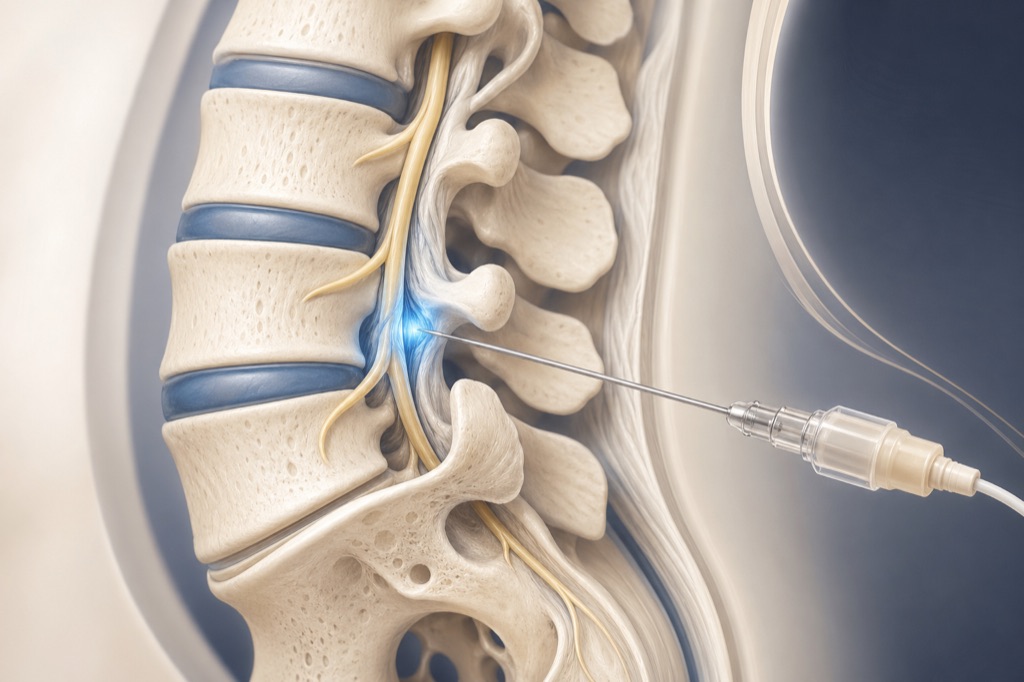
Spine injection
Epidural Steroid Injections (Lumbar ESI)
Lumbar epidural steroid injections in Houston for sciatica and spinal stenosis: interlaminar vs transforaminal, relief in 2–7 days, risks, limits per year.
In short
An epidural steroid injection places anti-inflammatory steroid next to an irritated spinal nerve, using X-ray guidance, to reduce leg or arm pain coming from a herniated disc or spinal stenosis. It is a treatment, not a test: relief usually begins within 2–7 days and lasts weeks to months, which is often enough time to get through the worst of a sciatica flare and back into physical therapy. This page covers the lumbar (low back) injection and the choice between the interlaminar and transforaminal approaches; cervical and caudal injections have their own pages.
Key facts
| Treats | Sciatica and other radicular (nerve-root) pain from a herniated disc, foraminal or central spinal stenosis, or disc degeneration; works less well for back pain alone |
|---|---|
| Test or treatment? | Treatment. The steroid reduces inflammation around the nerve; it does not diagnose the source |
| Procedure time | 10–20 minutes of needle time; plan about 60–90 minutes at the office |
| Anesthesia | Local anesthetic in the skin; light IV sedation is optional |
| Downtime | Rest the day of the injection; most people return to work and normal activity the next day |
| When relief starts | Steroid effect typically at 2–7 days, sometimes up to 2 weeks; any numbness from the local anesthetic wears off within hours |
| How long relief lasts | Weeks to several months; varies with the cause (disc herniations often respond best) |
| How often it can be repeated | Only if the first injection helped; typically no more than 3–4 steroid injections per year in the spine, spaced at least 2 weeks apart |
| Insurance | Covered by Medicare and most plans for radicular pain that matches imaging, usually after 4–6 weeks of conservative care |
Who it is for
- Back pain alone without leg symptoms: the evidence for epidural steroid in axial back pain is weak, and a facet, SI joint or disc evaluation is usually the better path
- Signs of cauda equina syndrome (new bladder or bowel loss, saddle numbness) or rapidly worsening weakness: this needs urgent surgical evaluation, not an injection
- Active infection anywhere in the body, or fever within the past few days
- Blood thinners that cannot be safely paused, or a bleeding disorder
- Uncontrolled diabetes (very high glucose) or a steroid injection of any kind within the last 2 weeks
- Known allergy to the contrast dye, steroid or local anesthetic without a workable alternative
- Pregnancy, because fluoroscopy uses X-ray
How an epidural steroid injection works
Spinal nerves leave the spinal canal through small openings on each side of the spine. When a disc bulges into that space or arthritis narrows it, the nerve root becomes inflamed and swollen, and that inflammation, more than pressure alone, produces the burning, shooting leg pain of sciatica. The epidural space is the thin fat-filled layer that surrounds the nerve roots inside the canal. Placing a small dose of corticosteroid there bathes the inflamed root directly, at a concentration no oral medication can match.
The steroid is a slow-acting anti-inflammatory. It does not shrink the disc or widen the canal. What it does is turn down the chemical irritation so the nerve can settle while the body reabsorbs disc material over the following weeks and months, a process that happens on its own in most disc herniations. That is why the injection works best for a recent flare of nerve pain and less well for years-old stenosis or for back pain without leg symptoms.
Every injection is done under fluoroscopy (live X-ray) with contrast dye. The contrast shows the physician that the medication is spreading along the target nerve and, just as important, that the needle is not in a blood vessel or in the fluid space around the spinal cord.
Interlaminar vs transforaminal: which approach and why
There are three ways into the lumbar epidural space. The choice depends on where your pain comes from, your anatomy and any prior surgery.
- Transforaminal (TFESI). The needle is guided to the opening where one specific nerve root exits, and medication is delivered to the front of the epidural space where the disc meets the nerve. This is the most targeted approach and the one we usually choose for one-sided sciatica from a disc herniation or foraminal narrowing at a single level. A transforaminal injection with a small volume of local anesthetic can also be used as a selective nerve root block to confirm which level is generating the pain.
- Interlaminar. The needle passes between the bony plates (laminae) at the back of the spine into the midline epidural space. Medication spreads across both sides and over one to two levels. This suits central spinal stenosis, symptoms in both legs, or multilevel disease. It carries a slightly higher chance of a dural puncture headache than the transforaminal route, and the medication is less concentrated at any single nerve.
- Caudal. The needle enters through the sacral hiatus at the very bottom of the spine. It is the safest route for a dural puncture and the usual choice after lumbar fusion or laminectomy, where scar or hardware blocks the other approaches, but it is the least targeted. See caudal steroid injection.
For neck and arm pain the approach is different and the safety rules are stricter; read cervical epidural steroid injection. We perform epidural injections at our Houston and Webster offices, and in Pearland when that office opens in November 2026.
What happens on procedure day
- Check-in and review: we confirm your blood-thinner plan, glucose (if diabetic), allergies and any changes in symptoms, and you sign consent. Bring a driver if you chose sedation.
- Positioning: you lie face down on the fluoroscopy table with a pillow under the abdomen. Your back is cleaned with antiseptic and draped. An IV is placed only if sedation is planned.
- Numbing: the skin and deeper tissue over the target are numbed with lidocaine. Most people describe pressure rather than sharp pain from this point on.
- Needle placement: using live X-ray, the physician guides a thin needle to the transforaminal or interlaminar target, then injects a small amount of contrast dye to confirm the spread pattern and rule out a blood vessel.
- Injection: a mix of steroid (dexamethasone for transforaminal injections, or a longer-acting steroid for interlaminar) and a small dose of local anesthetic is injected slowly. You may feel a brief pressure or a reproduction of your usual leg pain that fades within seconds.
- Recovery: you rest 15–30 minutes while we check your legs for strength and sensation, then go home. Total office time is usually 60–90 minutes.
After the procedure
Day 0. Take it easy. Your leg may feel numb, heavy or briefly weak for a few hours from the local anesthetic, so do not drive that day. You can eat normally, ice the injection site for 15 minutes at a time, and take your usual medications. Some people feel a temporary increase in back pain that evening.
Days 1–3. Return to work and light activity. A steroid flare (a sharp uptick in pain for 24–72 hours) happens in a small number of people and settles on its own. Facial flushing, trouble sleeping and a higher blood sugar are common for a few days. The steroid effect usually starts to build during this window.
Week 1–2. This is when most of the benefit arrives. Resume or start physical therapy and home exercise; the injection creates a window for rehab, not a replacement for it.
Judging the response. We ask you to rate the change at 2 weeks. If leg pain has dropped by half or more, we let the injection run its course and repeat only when pain returns. If there is little change at 2 weeks, a second injection with the same technique is unlikely to work and we look at the diagnosis instead.
Call us for a fever over 100.4 °F, a headache that is worse sitting up and better lying flat, new weakness in either leg, new bladder or bowel trouble, or redness and drainage at the site.
What the evidence shows
Epidural steroid injections are among the most studied procedures in pain medicine, and the honest summary is this: they reliably help radicular (nerve-root) leg pain in the short term, they help axial back pain very little, and they do not change whether someone eventually needs surgery.
- In a well-designed randomized trial of transforaminal injections for sciatica from a disc herniation (Ghahreman 2010), about half of patients had at least 50% relief one month after a steroid injection, compared with roughly one in five or fewer after local anesthetic or saline.
- The 2020 Cochrane review of epidural corticosteroids for lumbosacral radicular pain found a small short-term reduction in leg pain and disability compared with placebo; the authors judged the average effect modest, which matches what we see: some people get dramatic relief, others get little.
- For spinal stenosis, the LESS trial (New England Journal of Medicine, 2014) found that adding steroid to a lidocaine epidural gave minimal extra benefit at 6 weeks. Injections can still be worthwhile for stenosis flares, but expectations should be lower than for a disc herniation.
- The ASIPP 2021 epidural guidelines rate the evidence as Level I (strongest) for lumbar disc herniation and radiculitis with both interlaminar and transforaminal approaches, and weaker for axial pain and post-surgery pain.
Repeated steroid exposure has real costs: bone density loss, adrenal suppression and, in diabetics, glucose swings. That is why guidelines and most insurers limit steroid injections to roughly 3–4 per year, and why we only repeat an injection that clearly worked.
Alternatives and what comes next
Most sciatica improves within 6–12 weeks with or without an injection, so a short course of anti-inflammatories, a nerve-pain medication and guided exercise is a reasonable first step for milder symptoms. Read medication management for how we handle medications.
If an epidural injection helps and then wears off, a repeat injection is reasonable within the yearly limit. If leg pain persists beyond two well-placed injections, or weakness is progressing, we refer to a spine surgeon for a decompression discussion; a selective nerve root block can confirm the level first. If the pain turns out to be mainly in the back rather than the leg, medial branch blocks and radiofrequency ablation address facet joints, and SI joint injections address the sacroiliac joint. For pain that continues after spine surgery, see post-laminectomy syndrome and spinal cord stimulation.
Safety and preparation
- Blood thinners: tell us at scheduling if you take warfarin, apixaban, rivaroxaban, dabigatran, clopidogrel, prasugrel, ticagrelor, enoxaparin or daily aspirin. Epidural injections are considered higher bleeding-risk procedures, and most of these medications are paused for 1–7 days depending on the drug. We coordinate the hold with your prescribing physician or cardiologist; never stop a blood thinner on your own.
- Diabetes: the steroid can raise blood sugar for several days. Check your glucose more often for a week, keep taking your diabetes medication, and call if readings stay above 300. We may postpone the injection if your glucose is very high on the day.
- Infection or fever: we do not inject if you have a fever, an active infection anywhere (including urinary, dental or skin), or are on antibiotics for one. Reschedule when it has cleared.
- Allergies (contrast, steroid, local anesthetic): tell us about any reaction to iodine contrast dye, X-ray dye, cortisone, lidocaine or dental numbing. We can pre-medicate or use a different agent.
- Pregnancy: the procedure uses X-ray. Tell us if you are or could be pregnant; we will test or postpone.
- Sedation and driving: if you choose IV sedation, do not eat for 6 hours or drink for 2 hours beforehand, and bring an adult driver. Even without sedation, leg numbness after the injection makes driving unsafe that day, so plan for a ride.
- Recent steroids: a steroid injection anywhere in the body (joint, epidural, trigger point) within the past 2 weeks, or a course of oral prednisone, usually means we wait.
- Imaging: bring or have us request your MRI or CT report and images; we plan the level and approach from them.
Risks and side effects
- Soreness at the injection site for 1–3 days
- Temporary increase in pain (steroid flare) for 24–72 hours
- Facial flushing, warmth, trouble sleeping, mild anxiety or a racing feeling for a few days
- Blood sugar rise for 1–3 days (occasionally up to a week) in people with diabetes
- Temporary leg numbness, heaviness or weakness for a few hours from the local anesthetic
- Vasovagal reaction (light-headedness, sweating) during the procedure
- Dural puncture headache (a headache that is worse upright), in under 1 in 100 interlaminar injections; treatable with fluids, caffeine and, if needed, a blood patch
- Bleeding or bruising at the site
- Allergic reaction to contrast dye, steroid or local anesthetic
- Menstrual irregularity, or a short period of adrenal suppression, after repeated steroid doses
- Water retention, mood change or elevated blood pressure for several days
- No benefit
- Epidural hematoma (a blood clot pressing on nerves), which is why blood thinners are managed carefully; needs urgent surgery if it occurs
- Infection: epidural abscess, meningitis or discitis
- Nerve root injury with persistent numbness, weakness or pain
- Spinal cord injury or stroke from injection of particulate steroid into a spinal artery, reported almost entirely with transforaminal injections; we use non-particulate dexamethasone, live fluoroscopy and contrast for every transforaminal injection to prevent this
- Bone density loss and fracture risk with frequent, repeated steroid injections over years
Frequently asked questions
How long does an epidural steroid injection last?
Relief typically lasts weeks to several months. For a fresh disc herniation, one or two injections often carry a person through the natural healing window of 6–12 weeks and no further injections are needed. For chronic stenosis, relief is often shorter, on the order of 1–3 months. The local anesthetic in the injection wears off within hours; the steroid is what provides the lasting effect.
How many epidural steroid injections can you have in a year?
Guidelines and most insurers limit steroid injections in the spine to about 3–4 per year, spaced at least 2 weeks apart, and only repeated when the previous injection gave meaningful relief. The limit exists because of cumulative steroid effects on bone, blood sugar and the adrenal glands. There is no benefit in a fixed 'series of three' if the first injection did not work.
Does an epidural steroid injection hurt?
Most people feel a pinch and burn from the numbing medicine, then pressure. When the needle reaches the target you may feel a brief reproduction of your usual leg pain for a few seconds; that is expected and tells us we are in the right place. Light IV sedation is available if you are anxious, but many patients do it with local anesthetic only so they can drive themselves home after a short wait, provided their leg is not numb.
What is the difference between a transforaminal and an interlaminar epidural?
A transforaminal injection targets one nerve root where it exits the spine and delivers medication to the front of the epidural space next to the disc; it is the usual choice for one-sided sciatica. An interlaminar injection enters the midline from the back and spreads across both sides; it is better for central stenosis or pain in both legs. Both are done with fluoroscopy and contrast.
How soon can I go back to work after an epidural injection?
Most people return to desk work the next day and to physical work within 2–3 days. Avoid driving, heavy lifting and strenuous exercise on the day of the injection. If you had sedation, no work or driving that day.
What if the epidural steroid injection doesn't work?
If there is no improvement at 2 weeks, repeating the same injection rarely helps. We re-examine whether the nerve root is really the source, sometimes with a selective nerve root block, look at whether the pain is facet, SI joint or muscular instead, and, for persistent nerve pain with a matching MRI, refer for a surgical opinion.
Will an epidural injection fix my herniated disc?
No. The steroid reduces inflammation around the nerve; it does not remove or shrink the disc. Most herniations are gradually reabsorbed by the body over months, and the injection buys comfort during that time. If a herniation is large and causing progressive weakness, surgery is the treatment that removes it.
Can I take my pain medication before the injection?
Yes, take your usual medications, including pain medication, with a sip of water. The exceptions are blood thinners, which are managed in advance, and (if you have sedation) nothing to eat for 6 hours beforehand. Do not take extra pain medication the morning of the injection.
Sources
- Epidural corticosteroid injections for lumbosacral radicular pain (Cochrane Review, 2020) (opens in new tab) — Cochrane
- A Randomized Trial of Epidural Glucocorticoid Injections for Spinal Stenosis (LESS trial, 2014) (opens in new tab) — New England Journal of Medicine
- Comprehensive Evidence-Based Guidelines for Epidural Interventions in the Management of Chronic Spinal Pain (2021) (opens in new tab) — American Society of Interventional Pain Physicians (ASIPP)
- Safeguards to Prevent Neurologic Complications after Epidural Steroid Injections: Multisociety Pain Workgroup consensus (2015) (opens in new tab) — Anesthesiology / Multisociety Pain Workgroup
- Interventional Spine and Pain Procedures in Patients on Antiplatelet and Anticoagulant Medications (2nd ed., 2018) (opens in new tab) — American Society of Regional Anesthesia and Pain Medicine (ASRA)
Next step
Request an appointment
Call (832) 916-2075 or request an appointment online. New patients are welcome; the team confirms insurance and referral requirements before scheduling.