
- Pain centered over one or both SI joints (below the beltline, off to one side, often pointed to with one finger) that may spread to the buttock, groin or upper thigh
- At least three positive SI provocation tests on exam (distraction, compression, thigh thrust, FABER, Gaenslen, sacral thrust)
- Pain for 6 weeks or more that has not settled with activity changes, anti-inflammatories and physical therapy
- New low back pain after a lumbar fusion, where the SI joint is a common overlooked source
- SI pain that began during or after pregnancy, or with a leg-length difference or hip problem that loads the joint unevenly
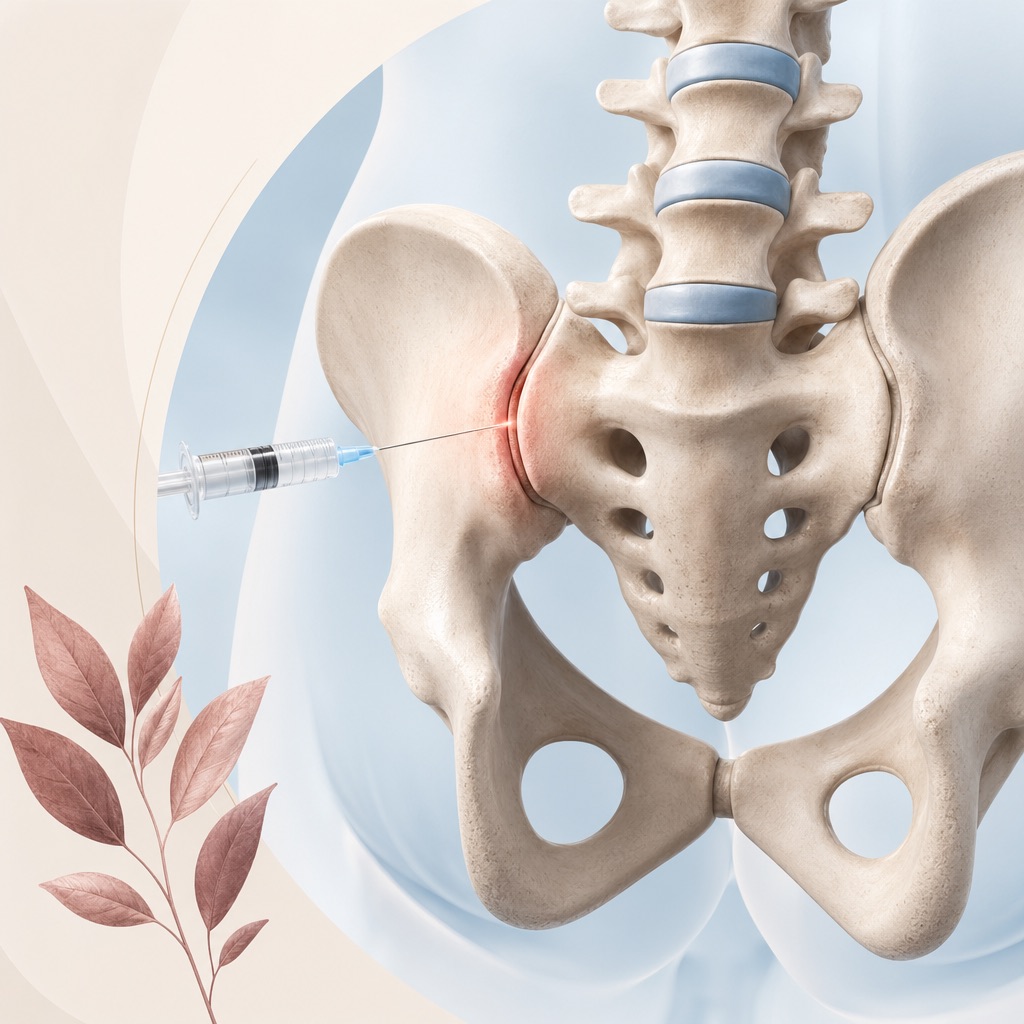
SI joint
Sacroiliac (SI) Joint Injections
Sacroiliac joint injection in Houston: how we confirm SI pain with provocation tests and an image-guided block, then treat it with steroid, RFA or fusion.
In short
A sacroiliac joint injection places local anesthetic, usually with steroid, inside the SI joint under X-ray guidance. It is both a test and a treatment: the anesthetic phase over the first few hours tells us whether the SI joint is truly the source of your low back and buttock pain, and the steroid phase, beginning at 2–7 days, can reduce inflammation in the joint for weeks to months. A positive test is also the gateway to longer-lasting options, sacroiliac lateral-branch radiofrequency ablation and, for a small number of patients, SI joint fusion.
Key facts
| Treats / tests | Low back, buttock and upper-thigh pain from the sacroiliac joint, including after lumbar fusion, after pregnancy, and from wear-related SI arthritis |
|---|---|
| Test or treatment? | Both. The anesthetic tells us whether the joint is the source; the steroid treats it |
| Procedure time | 10–15 minutes; about 60 minutes at the office |
| Anesthesia | Local anesthetic in the skin; sedation avoided or minimal so the diagnostic result is reliable |
| Downtime | Rest the day of the injection; normal activity the next day |
| When relief starts | Diagnostic phase within 15–30 minutes; steroid effect at 2–7 days |
| How long relief lasts | Anesthetic relief 1–8 hours; steroid relief typically weeks to 3 months, sometimes longer |
| How often it can be repeated | Typically no more than 3–4 steroid injections in the joint per year, and only if the previous one helped; diagnostic blocks are usually one or two |
| Insurance | Covered by Medicare and most plans when at least three SI provocation tests are positive and image guidance is used; most plans limit the number per year |
Who it is for
- Back pain above the L5 level, or true sciatica below the knee with numbness and weakness, which point to the spine rather than the SI joint
- Groin pain with a stiff, painful hip on exam; the hip joint should be assessed first
- Inflammatory sacroiliitis (ankylosing spondylitis and related conditions) suspected from morning stiffness, young onset or inflammatory blood tests, which needs rheumatology care, though an injection can still be used for a flare
- Active infection, fever, or a skin infection over the joint
- Blood thinners that cannot be managed, uncontrolled diabetes if steroid is planned, or pregnancy (X-ray)
How an SI joint injection works
The sacroiliac joints connect the sacrum, the triangular bone at the base of the spine, to the pelvis on each side. They are strong, tightly bound by ligaments, and move only a few millimeters, but they carry the entire load of the upper body into the legs. Wear, injury, pregnancy, and the extra stress that follows a lumbar fusion can all make one of them painful. SI joint pain accounts for roughly 15–30% of chronic low back pain, and it is missed easily because it mimics the spine and the hip.
The injection does two jobs. Under fluoroscopy, a thin needle is guided into the lower third of the joint, where the joint space opens toward the back, and a small amount of contrast dye is injected to confirm the needle is inside the joint. Then local anesthetic, with or without steroid, is injected. Over the next several hours, the anesthetic answers the diagnostic question: if your usual pain, including pain with standing, walking and rolling over, drops by at least 75% and then returns as the anesthetic wears off, the joint is confirmed as the source. When steroid is included, a second phase of relief begins at 2–7 days and can last weeks to months.
Image guidance is not optional. Studies of injections done by feel show the needle enters the joint in only about 1 in 5 attempts; the rest land in the ligaments or muscle, where an injection tells us nothing and treats nothing. Every SI injection at our practice is done under fluoroscopy with contrast confirmation.
How we tell SI pain from spine or hip pain
The three sources overlap, so we build the case from several pieces rather than one test.
- Where you point. SI pain is felt below the L5 level, just inside and below the bony bump at the back of the pelvis (the Fortin finger sign). Facet and disc pain sit higher and more central; hip joint pain is usually felt in the groin or the front of the thigh.
- Provocation tests. Six exam maneuvers stress the SI joint: distraction, compression, thigh thrust, FABER (Patrick's test), Gaenslen and sacral thrust. When three or more reproduce your pain, the chance that a diagnostic block will be positive is high (roughly 9 in 10 sensitivity and 8 in 10 specificity in the best studies). When fewer than three are positive, the SI joint is unlikely to be the cause and we look elsewhere before injecting.
- What it is not. Pain that shoots below the knee with numbness or weakness is usually a nerve root (sciatica). Pain that is worse with arching backward and twisting, above the pelvis, is more often the facet joints. Groin pain with a stiff hip on rotation is the hip, and a hip injection may be the right test instead.
- Imaging. X-ray, CT and MRI show SI arthritis in many people without pain and look normal in many people with SI pain, so imaging is used to exclude fracture, infection, tumor and inflammatory sacroiliitis rather than to make the diagnosis.
- The block. The diagnostic injection is the final piece. A clearly positive block plus a positive exam makes the diagnosis; a negative block sends us back to the spine or hip.
What happens on procedure day
- Check-in: we record your baseline pain (0–10) and what makes it worse, confirm blood-thinner, glucose and allergy details, and give you a pain diary for the afternoon. Take your usual medications but no extra pain medication that morning.
- Positioning: face down on the fluoroscopy table with a pillow under the hips. The skin over the buttock is cleaned and draped. Sedation is avoided or kept minimal.
- Numbing: lidocaine in the skin and tissue over the lower part of the joint.
- Needle placement: under live X-ray, angled to open the back of the joint, a thin needle is advanced into the lower third of the SI joint. A small contrast injection shows dye outlining the joint, confirming placement.
- Injection: 1–2 mL of local anesthetic, with steroid if this is a treatment injection, is injected slowly. Pressure deep in the buttock during the injection is normal and fades quickly.
- Testing and recovery: after 15–30 minutes we ask you to walk, stand on one leg and roll on the table if those normally hurt, and record your pain. You go home with a driver and rate pain hourly for 6 hours.
After the procedure
First 6 hours. The diagnostic window. Move normally, do the things that usually hurt, and rate your pain every hour on the diary. If anesthetic spreads out of the joint to the nearby sacral nerves or sciatic nerve, the leg can feel numb, heavy or weak for a few hours; this is expected, it is why you need a driver, and it resolves on its own. Do not drive until the leg feels normal.
That evening and days 1–3. The usual pain returns as the anesthetic wears off, sometimes a little stronger for a day. Soreness at the site is common. If steroid was given, expect a possible short flare, flushing, poor sleep and higher blood sugar for a few days before relief builds.
Week 1–2. Steroid relief is usually apparent. Resume physical therapy focused on hip and core strength and pelvic stability; an SI belt is useful for some people during this period.
Judging the response. We review the diary at follow-up. At least 75% relief during the anesthetic window is a positive diagnostic result. At 2–3 weeks we ask how much lasting relief the steroid gave. Both answers decide the next step.
Call us for fever over 100.4 °F, redness or drainage at the site, leg weakness or numbness that lasts beyond the day, or new bladder or bowel changes.
What the evidence shows
As a diagnostic tool, the SI joint block is the reference standard for SI joint pain in the guidelines of ASIPP, the North American Spine Society and the International Society for the Advancement of Spine Surgery, and its accuracy depends on strict technique: image guidance, contrast confirmation, a small anesthetic volume so it does not spread to the spinal nerves, and a high relief threshold (most guidelines and insurers use 75%; some accept 50%). A single block has a false-positive rate of roughly 20%, so when the result will determine surgery, two concordant blocks are usually required.
As a treatment, steroid injected into the joint has fair evidence for short-term relief. Randomized trials and case series show that most patients with a positive block get weeks to a few months of relief from intra-articular steroid, with a minority getting 6 months or more; ASIPP rates the evidence as Level II–III. Relief is more durable in inflammatory sacroiliitis than in wear-related pain.
For lasting relief the evidence favors moving on rather than repeating injections indefinitely. Sham-controlled trials of cooled SI lateral-branch radiofrequency ablation found roughly half of patients with at least 50% relief at 3–6 months versus about 1 in 8 with sham, and randomized trials of minimally invasive SI fusion versus continued non-surgical care showed large, sustained improvement in carefully selected patients. The diagnostic block is what selects those patients.
Alternatives and what comes next
A positive block with good but temporary steroid relief has three paths. The injection can be repeated within the yearly limit if relief lasted months. If relief keeps fading, SI lateral-branch radiofrequency ablation targets the small nerves behind the joint and typically gives 6–12 months of relief, repeatable when it wears off. For patients with at least 75% relief on two diagnostic blocks, six or more months of failed conservative care and ablation, and disabling pain, SI joint fusion is the surgical option. A negative block redirects the work-up to the facet joints, the disc (epidural steroid injection) or the hip. Throughout, hip and core strengthening and, for post-pregnancy pain, pelvic floor therapy remain the foundation. SI joint injections are performed at our Houston and Webster offices, and in Pearland when that office opens in November 2026.
Safety and preparation
- Blood thinners: SI joint injections are low-to-intermediate bleeding-risk procedures. Many patients continue aspirin; other agents (warfarin, apixaban, rivaroxaban, dabigatran, clopidogrel, ticagrelor, enoxaparin) are continued or briefly paused case by case with your prescriber. Never stop a blood thinner on your own.
- Diabetes: if steroid is planned, blood sugar typically rises for 1–3 days; check more often and call if readings stay above 300. A diagnostic block without steroid does not affect glucose.
- Infection or fever: we reschedule for fever, active infection, or any skin problem over the buttock.
- Allergies (contrast, steroid, local anesthetic): tell us about reactions to X-ray dye, cortisone, lidocaine or dental numbing; contrast is essential to confirm joint placement, so allergy pre-medication is arranged in advance.
- Pregnancy: the procedure uses X-ray; tell us if you are or could be pregnant. Post-pregnancy SI pain is common and can be treated once you are no longer pregnant.
- Sedation and driving: sedation is avoided or minimal so the diagnostic result is reliable, but you still need an adult driver because the leg can be numb or weak for a few hours.
- Pain medication on the day: take your usual scheduled medications but no extra pain medication the morning of the injection or during the 6-hour diary window unless necessary.
- Recent steroids: a steroid injection anywhere in the body within 2 weeks, or a course of oral prednisone, usually means we wait if steroid is planned.
Risks and side effects
- Soreness or bruising deep in the buttock for 1–3 days
- Leg numbness, heaviness or weakness for a few hours if anesthetic spreads to the sacral or sciatic nerves
- A brief rebound of pain after the anesthetic wears off
- Temporary flare of pain, flushing, poor sleep or a rise in blood sugar for a few days when steroid is used
- Light-headedness or a vasovagal reaction during the procedure
- Bleeding or a small hematoma at the site
- Allergic reaction to contrast, steroid or local anesthetic
- Injection landing outside the joint despite guidance, giving an unclear result
- Menstrual irregularity, mood change or blood pressure rise from the steroid
- No benefit
- Septic arthritis of the SI joint or an abscess
- Sciatic nerve injury or persistent nerve irritation from needle or medication spread
- Local anesthetic toxicity if a larger dose enters a blood vessel (unlikely at these volumes)
- Bone density loss with frequent repeated steroid over years
- Needle passing through the front of the joint into the pelvis, avoided by fluoroscopy in the correct plane
Frequently asked questions
How long does an SI joint injection last?
The anesthetic gives 1–8 hours of relief on the day, which is the diagnostic part. The steroid effect begins at 2–7 days and typically lasts weeks to about 3 months, sometimes longer. If relief keeps wearing off, radiofrequency ablation of the nerves behind the joint gives longer relief, typically 6–12 months.
How do I know if my pain is from the SI joint?
SI pain sits below the beltline, off to one side, and is often pointed to with one finger just inside the bony bump at the back of the pelvis. It is worse with standing on one leg, climbing stairs, rolling over in bed and getting out of a car. On exam, three or more positive provocation tests make the SI joint likely, and an image-guided diagnostic injection confirms it.
Why do I need X-ray guidance for an SI injection?
Because the joint is deep and narrow, an injection done by feel enters the joint only about 1 time in 5. An injection that lands in the ligaments or muscle cannot test the joint or treat it. Fluoroscopy with contrast dye confirms the needle is inside the joint every time.
Why is my leg numb after an SI joint injection?
Local anesthetic can leak out of the joint onto the nearby sacral nerve roots or the sciatic nerve, numbing or weakening the leg for a few hours. It is expected, it wears off on its own, and it is the reason you need a driver on the day.
What is the difference between an SI joint injection and a lateral branch block?
An SI joint injection places medication inside the joint. A lateral branch block numbs the small nerves behind the joint that radiofrequency ablation would treat. Both are used as tests; some insurers require a lateral branch block specifically before approving SI ablation.
Can an SI joint injection be repeated?
Yes, typically up to 3–4 steroid injections in the joint per year, and only if the previous one gave meaningful relief. When relief keeps fading, we recommend moving to ablation or, for a small number of patients, SI fusion rather than repeating injections indefinitely.
Is SI joint pain common after a spinal fusion?
Yes. A lumbar fusion transfers load to the joints below it, and SI joint pain is one of the most common causes of new low back pain in the years after a fusion. The exam and injection are the same, and SI fusion is sometimes the eventual treatment.
Sources
- Diagnosis of sacroiliac joint pain: validity of individual provocation tests and composites of tests (Laslett M, et al., 2005) (opens in new tab) — Manual Therapy
- Comprehensive Evidence-Based Guidelines for Facet Joint Interventions in the Management of Chronic Spinal Pain (2020; includes sacroiliac joint interventions) (opens in new tab) — American Society of Interventional Pain Physicians (ASIPP)
- Sacroiliac Joint Injections and Fusion: coverage recommendations (opens in new tab) — North American Spine Society (NASS)
- Randomized placebo-controlled study evaluating lateral branch radiofrequency denervation for sacroiliac joint pain (Cohen SP, et al., 2008) (opens in new tab) — Anesthesiology
- Sacroiliac joint pain: a comprehensive review of epidemiology, diagnosis, and treatment (Cohen SP, et al., 2013) (opens in new tab) — Expert Review of Neurotherapeutics
Next step
Request an appointment
Call (832) 916-2075 or request an appointment online. New patients are welcome; the team confirms insurance and referral requirements before scheduling.