
- SI joint pain confirmed by at least three positive provocation tests and at least 75% relief on two separate image-guided diagnostic SI joint blocks (some payers accept 50% on one block; we use the stricter standard)
- At least 6 months of non-surgical care without lasting benefit: physical therapy, anti-inflammatories, activity changes, SI joint injections and, in most cases, lateral-branch radiofrequency ablation
- Pain severe enough to limit walking, work or sleep, with a pain score typically 5 or higher out of 10
- Imaging (X-ray, CT or MRI) that shows no other explanation for the pain and no tumor, fracture or infection at the joint
- SI joint pain after a lumbar fusion, or documented SI joint disruption after trauma or pregnancy
SI joint surgery
Sacroiliac (SI) Joint Fusion
Minimally invasive SI joint fusion in Houston: yes, it is surgery. Who qualifies, lateral vs posterior approaches and evidence, recovery and risks.
In short
Yes, this is surgery. Minimally invasive sacroiliac joint fusion places implants across the SI joint, through one or two small incisions, to stop the painful micro-motion of a joint that has been proven to be the pain source. It is reserved for the small group of patients whose SI pain has been confirmed with two positive diagnostic blocks and who have not gotten lasting relief from at least six months of non-surgical care, including physical therapy, injections and usually radiofrequency ablation. Done in patients who meet the criteria, it has some of the strongest randomized-trial evidence of any spine procedure; done in patients who do not, it fails. Selection is the whole job.
Key facts
| Treats | Chronic sacroiliac joint pain or instability confirmed by exam and diagnostic blocks, including SI pain after lumbar fusion, when non-surgical care has failed |
|---|---|
| Test or treatment? | Treatment, and a surgical one. The tests (provocation exam and two diagnostic SI blocks) come first |
| Procedure time | About 45–90 minutes in the operating room |
| Anesthesia | General anesthesia for the lateral approach; general or deep sedation for the posterior approach |
| Downtime | Home the same day or after one night; protected weight bearing with a walker or crutches for about 3 weeks after a lateral fusion; desk work at 1–3 weeks; full activity at 3–6 months |
| When relief starts | Many patients notice the original SI pain is different within days, but surgical soreness dominates for 2–6 weeks; judge the result at 3 months |
| How long relief lasts | Intended to be permanent; trials show sustained improvement at 2–5 years in most patients who met the selection criteria |
| How often it can be repeated | Not repeated on the same joint except for a revision (about 3–5% in published series); the opposite joint can be fused later if it becomes painful |
| Insurance | Medicare and most commercial plans cover lateral minimally invasive SI fusion with documented criteria; coverage of posterior and allograft techniques varies by plan and some consider them investigational |
Who it is for
- SI pain that has not been confirmed with diagnostic blocks, or blocks with borderline relief; fusion of a joint that is not the pain source does not help
- Pain that also comes from the lumbar spine or hip that has not been addressed; a fusion cannot treat a disc, facet or hip problem
- Inflammatory sacroiliitis (for example ankylosing spondylitis), which is treated medically
- Active infection, uncontrolled diabetes, severe osteoporosis (implants need bone to hold), or a smoker unwilling to stop, since smoking impairs fusion
- Untreated depression, anxiety or an active workers' compensation or litigation dispute are not absolute bars but are known to lower success rates, and we address them first
Is this surgery? Yes. Here is what that means
Minimally invasive SI fusion is a real operation, done in an operating room under general anesthesia or deep sedation, with implants that stay in the body permanently. "Minimally invasive" describes the incision (one or two, each about an inch), the tissue disturbance (muscle is spread rather than cut) and the recovery (days to weeks rather than months), not the seriousness of the decision. Once the joint is fused it cannot be un-fused, and while the implants can be revised, that is a second operation. We spend more time deciding whether a patient should have this procedure than doing it.
The goal is to stop the abnormal movement of a joint that has become a pain generator. Over 6–12 months bone grows across the joint and through or around the implants, locking it. Because the SI joint normally moves only a few millimeters, losing that motion has little effect on how you walk or bend.
Lateral vs posterior approaches, and what the evidence says about each
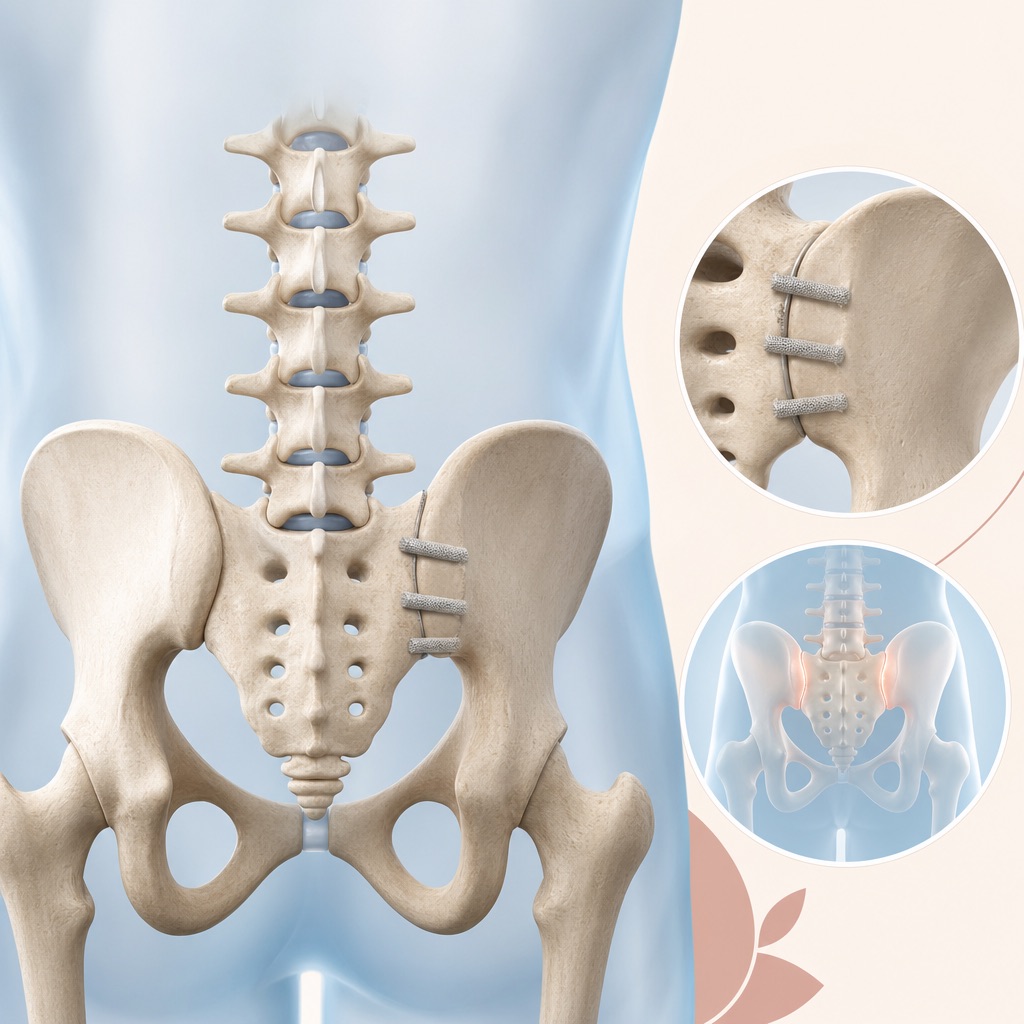
Lateral approach with triangular titanium implants. Through a small incision on the side of the buttock, three triangular titanium implants are placed across the joint from the ilium into the sacrum under fluoroscopy or navigation. The triangular shape resists rotation, and the porous or rough titanium surface encourages bone to grow onto it. This is the technique with the strongest evidence. Two randomized controlled trials compared it with continued non-surgical management: INSITE (148 patients in the United States) found that 82% of fused patients met a success threshold at 6 months versus 26% of non-surgical patients, with pain scores falling by about 50 points on a 100-point scale and disability improving substantially; the European iMIA trial (103 patients) found a 44-point pain improvement after fusion versus 6 points with non-surgical care at 6 months, with results maintained at 2 years. Five-year follow-up of the trial patients shows durable improvement in most. The North American Spine Society and most insurers cover this approach when candidacy criteria are met.
Posterior approach with allograft or implant. Through a small incision in the middle of the buttock, the joint is entered from the back and a bone allograft dowel or a small implant is placed into the joint space to promote fusion, often with bone graft material. This technique disturbs even less tissue, can be done under sedation, and allows walking without restriction almost immediately. Its evidence is weaker: published data are prospective and retrospective case series without a randomized comparison to non-surgical care, and long-term fusion rates are less well documented. Some insurers cover it; others classify posterior or allograft SI fusion as investigational. We tell patients this difference plainly and let it inform the choice.
Which do we use? The approach, the implant system and the setting (ambulatory surgery center or hospital) depend on your anatomy, bone quality, prior surgery and insurance, and on which of our physicians performs the procedure; ask us at your consultation which approach we recommend for you and where it would be done. Some patients are referred to a spine surgeon for the lateral procedure. Our practice evaluates candidates for SI fusion at our Houston and Webster offices, and in Pearland when that office opens in November 2026.
What happens on procedure day
- Before the day: pre-operative clearance from your primary physician, blood work, a stop date for blood thinners and nicotine, and a review of the CT scan used to plan implant size and position. You are told when to stop eating and drinking.
- Arrival and anesthesia: at the surgery center or hospital you meet the anesthesia team, an IV is placed, and general anesthesia (lateral) or deep sedation (posterior) is given. Antibiotics are given before the incision.
- Positioning and imaging: you are placed face down. Fluoroscopy, and in some cases navigation, is set up to view the sacrum and pelvis in several planes.
- The procedure: for a lateral fusion, a 1–2 inch incision on the side of the buttock, a guide pin across the joint confirmed on imaging, then three implants placed along it. For a posterior fusion, a small midline-buttock incision, the joint prepared, and the allograft or implant placed. Imaging confirms position before closing.
- Closure and recovery: the incision is closed with absorbable sutures and a dressing. You wake in recovery, usually walk with a walker or crutches the same day with a physical therapist, and go home the same day or the next morning.
Recovery timeline and weight-bearing limits
Days 0–3. Surgical soreness in the buttock and incision area, managed with ice, scheduled anti-inflammatory or acetaminophen, and a short opioid prescription if needed. Walk short distances several times a day. Keep the dressing dry until we say otherwise.
Weeks 1–3 (lateral approach). Protected weight bearing: put only partial weight through the operated side, using a walker or crutches, for about 3 weeks, so the implants are not loaded before bone begins to grow. No bending, lifting more than 10–15 pounds, or twisting. Desk work from about 1–2 weeks if pain allows; driving when off opioids and able to brake comfortably, usually 1–2 weeks. Posterior fusions typically allow weight bearing as tolerated from day one, with the same lifting limits.
Weeks 3–6. Progress to full weight bearing without the walker. A follow-up visit with X-rays at about 2 and 6 weeks. Begin formal physical therapy for hip and core strength around week 4–6.
Months 3–6. Return to physical work and sport, typically at 3 months for moderate activity and 6 months for heavy lifting or impact. Judge the result at 3 months, when surgical pain has settled.
Months 6–12. Fusion consolidates; a CT scan at 6–12 months confirms bone bridging when needed. Implants are titanium and generally MRI-compatible under standard conditions; carry your implant card.
Call us for fever over 101 °F, wound redness, drainage or opening, calf pain or swelling, chest pain or shortness of breath, new leg weakness or numbness, or bladder or bowel changes.
What the evidence shows, and its limits
For lateral titanium fusion in patients selected with diagnostic blocks, the evidence is Level I: two randomized trials against non-surgical care (INSITE and iMIA), a large single-arm trial (SIFI), and five-year follow-up data, all showing substantial and durable improvement in pain and disability and low revision rates (about 3–5% over several years). Non-surgical patients in those trials who later crossed over to fusion improved similarly. The main criticisms are that the comparison was against non-surgical care rather than a sham operation, and that industry funded the trials. Both are fair, and both are typical of surgical evidence.
For posterior and allograft techniques, the evidence is Level III–IV: case series showing improvement, without a randomized comparison. That does not mean they do not work; it means we cannot yet say how well, and payers reflect that uncertainty.
Across techniques, the predictors of a good result are the same: a clearly positive diagnostic block, no unaddressed spine or hip pain source, adequate bone quality, no smoking, and realistic expectations. Patients who meet the criteria do well in about 8 in 10 cases; patients who do not are the ones who fill the online forums with regret.
Alternatives and what comes next
Before fusion, every candidate has had SI joint injections and, in most cases, SI lateral-branch radiofrequency ablation, which gives 6–12 months of relief and can be repeated. For some patients, repeating ablation every year is a reasonable long-term plan instead of surgery. Pelvic and hip strengthening, an SI belt and weight management help many patients enough to avoid an operation. If SI fusion is chosen and succeeds, the other side occasionally becomes painful over the following years and is evaluated the same way. If pain persists after fusion, we re-evaluate the spine and hip, check the implants with CT, and consider spinal cord stimulation for persistent nerve-type pain. See SI joint pain for the condition itself.
Safety and preparation
- Blood thinners: this is a high bleeding-risk procedure. Warfarin, apixaban, rivaroxaban, dabigatran, clopidogrel, prasugrel, ticagrelor, enoxaparin and in most cases aspirin are stopped 2–7 days before surgery depending on the drug, in coordination with your cardiologist or prescribing physician, who also decides whether bridging is needed. Never stop them on your own. Stop fish oil, vitamin E, ginkgo and other supplements 1 week before.
- Diabetes: an HbA1c below about 8% is usually required before elective fusion, because high glucose raises infection risk and slows bone healing. Bring your recent value; we may ask your primary physician to help lower it first.
- Infection or fever: any active infection (urinary, dental, skin) or fever postpones surgery. Report any skin problem over the buttock. You will be asked to shower with an antiseptic wash before surgery.
- Allergies (contrast, steroid, local anesthetic): tell us about reactions to anesthetics, antibiotics, latex, adhesives, contrast dye and metals (titanium allergy is very rare but ask if you have a known metal sensitivity).
- Pregnancy: elective fusion is not done during pregnancy; tell us if you are or could be pregnant.
- Sedation and driving: this is general anesthesia or deep sedation. Nothing to eat after midnight (clear liquids per the anesthesia team's instructions), an adult must drive you home and stay with you the first night, and no driving until you are off opioids and can brake comfortably, usually 1–2 weeks.
- Smoking and nicotine: nicotine in any form (cigarettes, vaping, patches, gum) impairs bone fusion. Most surgeons require you to stop at least 4 weeks before and 3 months after surgery, and some test for it.
- Bone health: a DEXA scan may be ordered if you are over 65 or have risk factors, because osteoporosis affects implant hold and fusion.
- Medical clearance: a pre-operative visit with your primary physician or cardiologist, blood work, and an EKG for most patients over 50.
- Planning imaging: a CT scan of the pelvis is used to size and position implants and to check for anatomy that would make the procedure unsafe.
Risks and side effects
- Surgical pain at the incision and buttock for 2–6 weeks
- Bruising and swelling around the incision
- Temporary numbness of skin near the incision
- Nausea, grogginess or a sore throat from anesthesia for a day
- Difficulty sleeping on the operated side for several weeks
- Wound infection needing antibiotics (roughly 1–2%)
- Hematoma at the surgical site
- Implant malposition needing repositioning
- Persistent or incomplete relief because pain was also coming from the spine or hip
- Delayed or incomplete fusion (non-union), more likely in smokers and with osteoporosis
- Increased low back pain from added load on the lumbar spine, or new pain in the opposite SI joint over the following years
- Blood clot in the leg (DVT), reduced by early walking
- Nerve injury: an implant placed into a sacral foramen or too close to the L5 or S1 nerve root can cause leg pain, numbness or weakness and may require revision surgery; navigation and multi-plane imaging are used to prevent this
- Deep infection involving the implants, requiring removal
- Major blood vessel injury in the pelvis (very rare)
- Pulmonary embolism
- Fracture of the sacrum or ilium during implant placement, especially with osteoporosis
- Revision surgery, reported in about 3–5% of patients within a few years in published series, most often for implant position or non-union
- Anesthesia complications, including heart or breathing problems in patients with significant medical conditions
Frequently asked questions
Is SI joint fusion major surgery?
It is real surgery under general anesthesia or deep sedation with permanent implants, but it is far less invasive than a lumbar fusion: one or two small incisions, 45–90 minutes, home the same day or after one night, and walking with a walker the same day. The decision, not the operation, is the serious part, which is why candidacy is confirmed with two diagnostic blocks first.
How do I know if I qualify for SI fusion?
Typically: three or more positive SI provocation tests on exam, at least 75% relief on two separate image-guided diagnostic SI blocks, at least 6 months of failed non-surgical care including injections and usually radiofrequency ablation, no other unaddressed spine or hip pain source, adequate bone quality, and no active infection or nicotine use. Insurers check the same list.
What is the recovery time for SI joint fusion?
For a lateral fusion: partial weight bearing with a walker or crutches for about 3 weeks, desk work at 1–3 weeks, driving when off opioids (usually 1–2 weeks), moderate activity at 3 months and heavy activity at 6 months. Posterior fusions usually allow full weight bearing right away with the same lifting limits. Bone fusion takes 6–12 months to complete.
What is the success rate of SI joint fusion?
In the two randomized trials of lateral titanium fusion, about 8 in 10 patients who met the criteria had a successful result at 6 months, with pain scores falling by roughly half and improvement maintained at 2–5 years. Success depends heavily on selection; results in patients whose SI pain was not confirmed by blocks are much worse.
Which is better, lateral or posterior SI fusion?
The lateral approach with triangular titanium implants has randomized-trial evidence and broad insurance coverage. The posterior approach is less invasive with faster weight bearing, but its evidence comes from case series and coverage varies. Which is right for you depends on anatomy, bone quality, prior surgery, insurance and the physician performing it; we will tell you which we recommend and why.
Will I be able to bend and walk normally after SI fusion?
Yes. The SI joint normally moves only a few millimeters, so fusing it has little effect on walking, bending or sitting. Most patients report that movement is easier, not harder, once the pain is gone.
Can I have an MRI after SI fusion?
The implants are titanium and generally MRI-compatible under standard conditions. Keep your implant card and tell the imaging center which system was used.
Does insurance cover SI joint fusion?
Medicare and most commercial plans cover minimally invasive lateral SI fusion when the candidacy criteria are documented. Coverage of posterior and allograft techniques varies, and some plans consider them investigational. We verify your specific benefits before scheduling; see our insurance page.
Sources
- Two-Year Outcomes from a Randomized Controlled Trial of Minimally Invasive Sacroiliac Joint Fusion vs. Non-Surgical Management for Sacroiliac Joint Dysfunction (INSITE; Polly DW, et al., 2016) (opens in new tab) — International Journal of Spine Surgery
- Randomized Trial of Sacroiliac Joint Arthrodesis Compared with Conservative Management for Chronic Low Back Pain Attributed to the Sacroiliac Joint (iMIA; Dengler J, et al., 2019) (opens in new tab) — Journal of Bone and Joint Surgery
- International Society for the Advancement of Spine Surgery Policy 2020 Update: Minimally Invasive Surgical Sacroiliac Joint Fusion (for Chronic Sacroiliac Joint Pain): Coverage Indications, Limitations, and Medical Necessity (opens in new tab) — ISASS
- Percutaneous Sacroiliac Joint Fusion: coverage recommendations (opens in new tab) — North American Spine Society (NASS)
- Sacroiliac joint pain: a comprehensive review of epidemiology, diagnosis, and treatment (Cohen SP, et al., 2013) (opens in new tab) — Expert Review of Neurotherapeutics
Next step
Request an appointment
Call (832) 916-2075 or request an appointment online. New patients are welcome; the team confirms insurance and referral requirements before scheduling.