
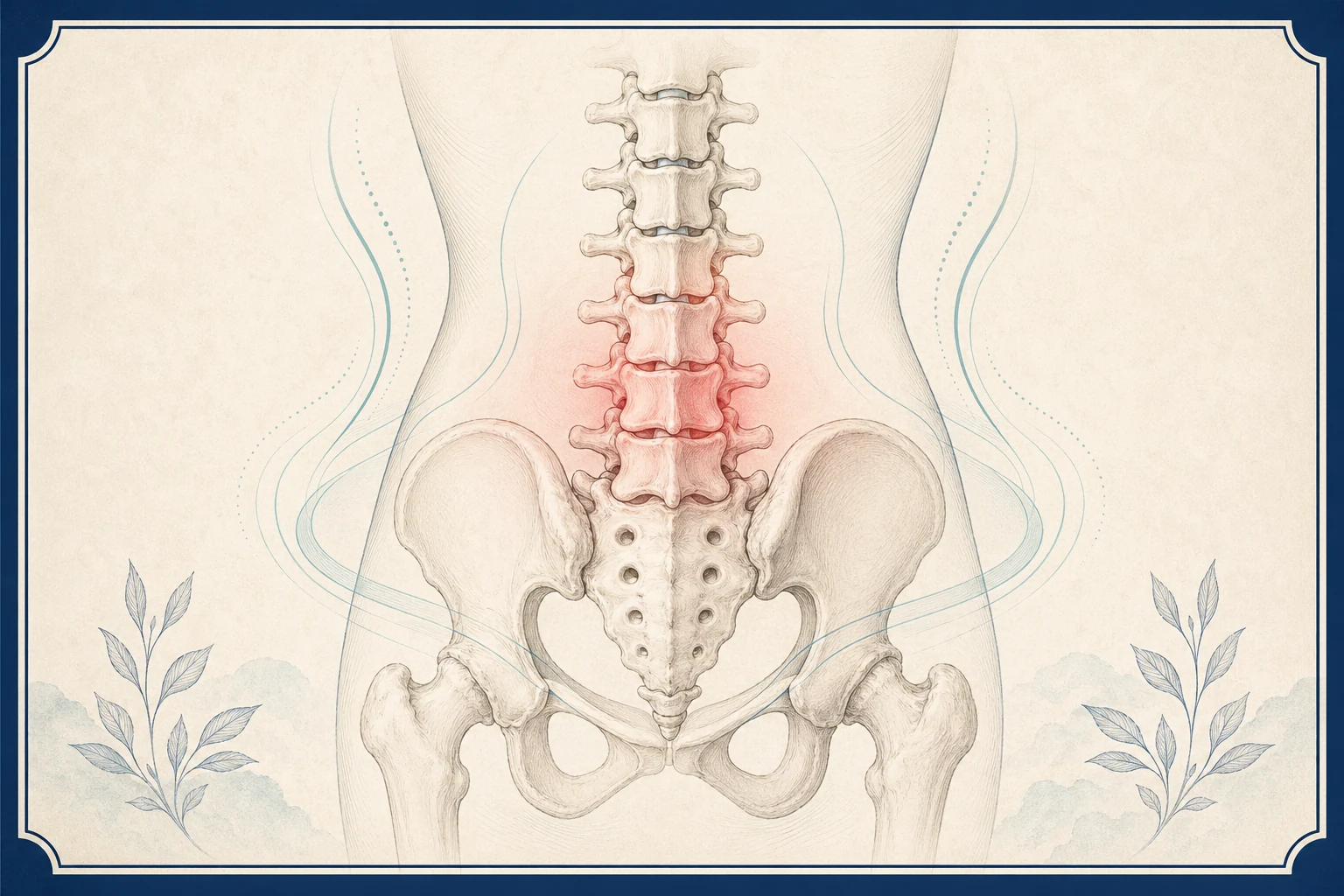
Spine pain
Lower Back Pain
Disc, facet, SI joint or muscle: each low back pain source has its own pattern. Red flags, weeks 1–6 guidance, and how Houston specialists find the cause.
Low back pain is the most common reason adults see a pain specialist, and most episodes settle within six weeks on their own. When pain lasts longer, the source is usually one of four structures: the disc, the facet joints, the sacroiliac (SI) joint or the muscles, and each one has a recognizable pattern. Gulf Coast Pain & Spine sorts out which structure is driving your pain with an exam, targeted imaging when it is needed, and diagnostic blocks, then treats that structure directly at its Houston and Webster offices and, from November 2026, in Pearland.
Key facts
| What it is | Pain between the bottom of the ribs and the buttock crease. It may spread to the buttock or thigh; pain that runs below the knee is usually a nerve problem, covered under sciatica. |
|---|---|
| Most common causes | Muscle or ligament strain (most acute episodes), disc-related pain, facet joint arthritis, SI joint dysfunction, spinal stenosis, and vertebral compression fractures in older adults. |
| Typical course | About 90% of acute episodes improve substantially within 6 weeks. Recurrence is common. Pain lasting more than 12 weeks is called chronic and rarely resolves without a specific diagnosis. |
| See a specialist when | Pain has lasted more than 6 weeks despite activity and medication, it keeps returning, it limits work or sleep, or it comes with leg symptoms. |
| Treatments we offer | Physical therapy coordination, medication review, epidural steroid injections, medial branch blocks and radiofrequency ablation, SI joint injections, trigger point injections, kyphoplasty, and spinal cord stimulation for pain that persists after surgery. |
When to get emergency care
Go to an emergency room or call 911 if your back pain comes with any of these:
- Numbness in the groin, inner thighs or around the rectum ("saddle" numbness), trouble starting or stopping urine, or loss of bowel or bladder control. These are signs of cauda equina syndrome, which needs surgery within hours.
- New weakness in one or both legs, a foot that drags or slaps when you walk, or weakness that is getting worse.
- Fever, chills or night sweats with back pain, especially if you have diabetes, a recent infection, a recent spine procedure, or use injected drugs. This can mean a spinal infection.
- Back pain after a fall, car accident or other significant trauma, or a minor fall if you are over 65 or have osteoporosis.
- A history of cancer with new back pain, unexplained weight loss, or pain that is worst at night and does not ease with rest.
New back pain after age 50 with no clear cause, or in anyone with osteoporosis or long-term steroid use, should be evaluated promptly even without the signs above.
What lower back pain is, and why the source matters
The lumbar spine has five vertebrae, five discs, ten small facet joints at the back, two sacroiliac joints where the spine meets the pelvis, and the muscles and ligaments that hold it all together. Any of these can hurt, and they hurt in different ways. A muscle strain and a facet joint problem can both feel like "my lower back is killing me," but the treatment for one does nothing for the other.
That is why a good evaluation does not stop at "low back pain." It asks which structure is generating the pain. Roughly 85% of acute low back pain is labeled nonspecific because no single structure can be identified, and that is fine for pain that will resolve in a few weeks. For pain that has lasted months, the label is not good enough. Studies using diagnostic blocks in people with chronic low back pain find the facet joints responsible in about 15–45% of cases, the disc in about 25–40%, and the SI joint in about 15–30%, with overlap between them.
The four common sources and how they behave
Muscle and ligament strain. The most common cause of a sudden episode. Pain is broad, achy, and often starts after lifting, twisting, a long drive, or unusual activity. It is worst in the first 2–3 days and fades over 1–3 weeks. It does not travel down the leg and does not cause numbness.
Disc-related (discogenic) pain. The disc is a cushion between vertebrae; its outer wall can tear or a herniation can press on a nerve. Disc pain sits in the center of the low back, is worse with sitting, bending forward, coughing or sneezing, and often eases with standing or walking. When the disc irritates a nerve root, pain shoots below the knee: that is sciatica, and it is a different problem with a different treatment path. See herniated disc and degenerative disc disease.
Facet joint pain. The facets are small joints at the back of each vertebra, and they wear like any joint. Facet pain is off to one or both sides of the spine, worse with arching backward, twisting, standing for long periods, and first thing in the morning. It often refers to the buttock or back of the thigh but rarely goes past the knee. Sitting and bending forward usually feel better. Facet pain cannot be diagnosed on an MRI; it is confirmed with a medial branch block. See facet joint syndrome.
Sacroiliac (SI) joint pain. The SI joints sit low, below the belt line, where the spine meets the pelvis. Pain is one-sided, over the dimple at the top of the buttock, and patients often point to it with one finger. It is worse rising from a chair, rolling over in bed, climbing stairs, or standing on one leg. It can mimic sciatica by referring to the groin or thigh. See SI joint pain.
Other causes to keep in mind: spinal stenosis (leg heaviness with walking, relieved by sitting), vertebral compression fractures (sudden severe pain in an older adult or someone with osteoporosis), and, rarely, infection, tumor, or inflammatory arthritis such as ankylosing spondylitis.
Symptom patterns that point to a source
Where the pain sits, what makes it worse, and whether it travels are the three clues that separate the sources. Use this as a starting point, not a diagnosis.
- Center of the low back, worse sitting and bending, better standing: disc.
- One or both sides of the spine, worse arching back and twisting, stiff in the morning: facet joints.
- Low, one-sided, at the top of the buttock, worse getting up from a chair or rolling in bed: SI joint.
- Broad ache after activity, better within days: muscle strain.
- Shooting pain below the knee, with tingling or numbness: nerve root (sciatica).
- Leg heaviness or cramping after walking a set distance, relieved by sitting or leaning on a cart: spinal stenosis.
Many people have more than one source. Disc degeneration and facet arthritis often occur together at the same level, which is one reason a single treatment sometimes helps only partly.
How we diagnose it
The visit starts with your story: when the pain began, what you were doing, what makes it worse, whether it travels, and what has already been tried. The physical exam checks your range of motion (pain with extension points to the facets; pain with flexion points to the disc), tenderness over the facet joints or SI joint, strength and reflexes in the legs, straight-leg raise for nerve irritation, and a set of SI joint provocation tests. Three or more positive SI tests makes SI joint pain considerably more likely.
Imaging is not ordered on the first visit for most people. Guidelines from the American College of Physicians and the American College of Radiology recommend against routine X-rays or MRI in the first 6 weeks of back pain unless there are red flags, because degenerative findings are present in most adults without pain and can lead to unnecessary treatment. We order an MRI when pain has persisted beyond 6 weeks, when there are nerve symptoms, when a red flag is present, or when we are planning an injection that needs a map.
Diagnostic blocks are the definitive test for facet and SI pain. Neither shows reliably on imaging. If your pattern suggests facet pain, we numb the small medial branch nerves that carry facet sensation; if pain drops by 80% or more for the length of the anesthetic on two separate occasions, the facets are confirmed and you are a candidate for radiofrequency ablation. If the pattern suggests the SI joint, a numbing injection into the joint under X-ray guidance serves the same purpose.
Treatment options, in order
Treatment follows the diagnosis and moves from least to most invasive. For most people the first six weeks are about staying active and letting the episode pass; procedures come into play when pain persists and a specific source has been identified.
- Weeks 1–6: stay active, treat the pain
Keep moving. Bed rest beyond a day or two slows recovery. Short courses of NSAIDs such as ibuprofen or naproxen (if your kidneys and stomach allow), heat, and gradual return to normal activity are the evidence-based first steps. Muscle relaxants can help for a few nights of sleep. Opioids are not recommended for acute low back pain. Learn more →
- Physical therapy and home exercise
If pain persists past 2–4 weeks, a structured program that builds core and hip strength and corrects the movements that aggravate your pain. We coordinate with your therapist so the program matches the suspected source. Learn more →
- Epidural steroid injection
For disc-related pain with nerve irritation or stenosis. Steroid placed in the epidural space around the inflamed nerve. Relief typically begins within 2–7 days and can last weeks to months; limited to about 3–4 per year. Learn more →
- Medial branch block, then radiofrequency ablation
For facet joint pain. The block is a test; if it confirms the facets twice, ablation uses heat to quiet the nerves for typically 6–12 months or longer, and can be repeated when the nerves regrow. Learn more →
- SI joint injection, SI ablation, or SI fusion
For confirmed SI joint pain. A steroid injection can give weeks to months of relief; lateral branch radiofrequency ablation for longer-lasting relief; minimally invasive SI fusion for the small group with proven SI pain that keeps returning. Learn more →
- Trigger point injections
For a clear muscular component with tight, tender bands in the low back or gluteal muscles, done in the office and paired with stretching. Learn more →
- Kyphoplasty
For a painful vertebral compression fracture that is not improving within a few weeks, cement stabilization of the fractured bone. Learn more →
- Spinal cord stimulation or surgical referral
Stimulation is for pain that persists after spine surgery or nerve pain that has not responded to other measures. Surgery is referred for progressive weakness, cauda equina symptoms, unstable fractures, or severe stenosis that limits walking despite treatment. Learn more →
What you can do now
- Keep moving. Walking is the single best activity for an acute episode. Aim for short walks several times a day rather than one long one.
- Avoid the two-day bed rest trap. Rest for a day if you must, then get up. People who stay in bed longer recover more slowly.
- Use heat for muscle pain, ice for the first 48 hours after an injury. Either is fine if it helps; neither changes the long-term course.
- Take NSAIDs on a schedule for a few days rather than only when pain spikes, if your doctor has said they are safe for you.
- Change positions often. If sitting hurts, stand or walk every 20–30 minutes. If standing hurts, sit or lean forward.
- Keep a simple diary: what you were doing when it hurt, and what eased it. This is the most useful information you can bring to your first visit.
- Do not stop working if you can modify tasks. Staying at work, with lighter duty if needed, predicts a better recovery. If your pain started at work, see work injuries and workers' compensation.
Frequently asked questions
How long should I wait before seeing a specialist for low back pain?
If there are no red flags, six weeks of staying active with over-the-counter pain relief is reasonable, because most episodes resolve in that time. See a specialist sooner if pain shoots below the knee, if it is your third or fourth episode in a year, or if it is stopping you from working or sleeping.
Do I need an MRI for low back pain?
Usually not at first. MRI findings such as disc bulges and degeneration are present in most adults over 40 without any pain, so an early MRI often creates worry without changing treatment. We order one when pain persists past six weeks, when there are nerve symptoms or red flags, or to plan a procedure.
What is the difference between facet pain and disc pain?
Facet pain is worse arching backward, twisting and standing, and is often stiff in the morning. Disc pain is worse sitting, bending forward and coughing, and often eases with standing. Facet pain is confirmed by a numbing block; disc pain is supported by MRI and the pattern of symptoms.
Can the SI joint cause pain that feels like sciatica?
Yes. SI joint pain refers to the buttock, groin and back of the thigh and is one of the most common reasons an epidural injection fails to help. The difference is that SI pain rarely goes below the knee and does not cause true numbness or weakness. Three or more positive provocation tests on exam plus relief from a diagnostic SI injection makes the diagnosis.
Will an injection fix my back permanently?
No injection is permanent. A steroid injection reduces inflammation for weeks to months, which creates a window to rebuild strength and change the habits that provoke the pain. Radiofrequency ablation lasts longer, typically 6–12 months or more, and can be repeated. Long-term control comes from combining the procedure with exercise and activity changes.
Is it safe to exercise with low back pain?
Yes, and it is recommended. Walking, swimming and gentle stretching are safe for almost everyone. Avoid heavy lifting and the specific movement that reproduces your pain until it settles. If any exercise causes leg numbness or weakness, stop and get evaluated.
Do you prescribe opioids for back pain?
Not as a first-line or routine treatment. Guidelines do not support opioids for acute or chronic low back pain because the risks outweigh the benefits for most people. Our approach is to identify and treat the source. See our medication management policy for what we do prescribe and the rules around controlled substances.
Sources
- Low Back Pain Fact Sheet (opens in new tab) — National Institute of Neurological Disorders and Stroke (NIH)
- Noninvasive Treatments for Acute, Subacute, and Chronic Low Back Pain: A Clinical Practice Guideline (2017) (opens in new tab) — American College of Physicians
- Low Back Pain (opens in new tab) — American Academy of Orthopaedic Surgeons, OrthoInfo
- Comprehensive Evidence-Based Guidelines for Facet Joint Interventions in the Management of Chronic Spinal Pain (2020) (opens in new tab) — American Society of Interventional Pain Physicians
- ACR Appropriateness Criteria: Low Back Pain (opens in new tab) — American College of Radiology
Request an appointment
Call (832) 916-2075 or request an appointment online. New patients are welcome; the team confirms insurance and referral requirements before scheduling.