
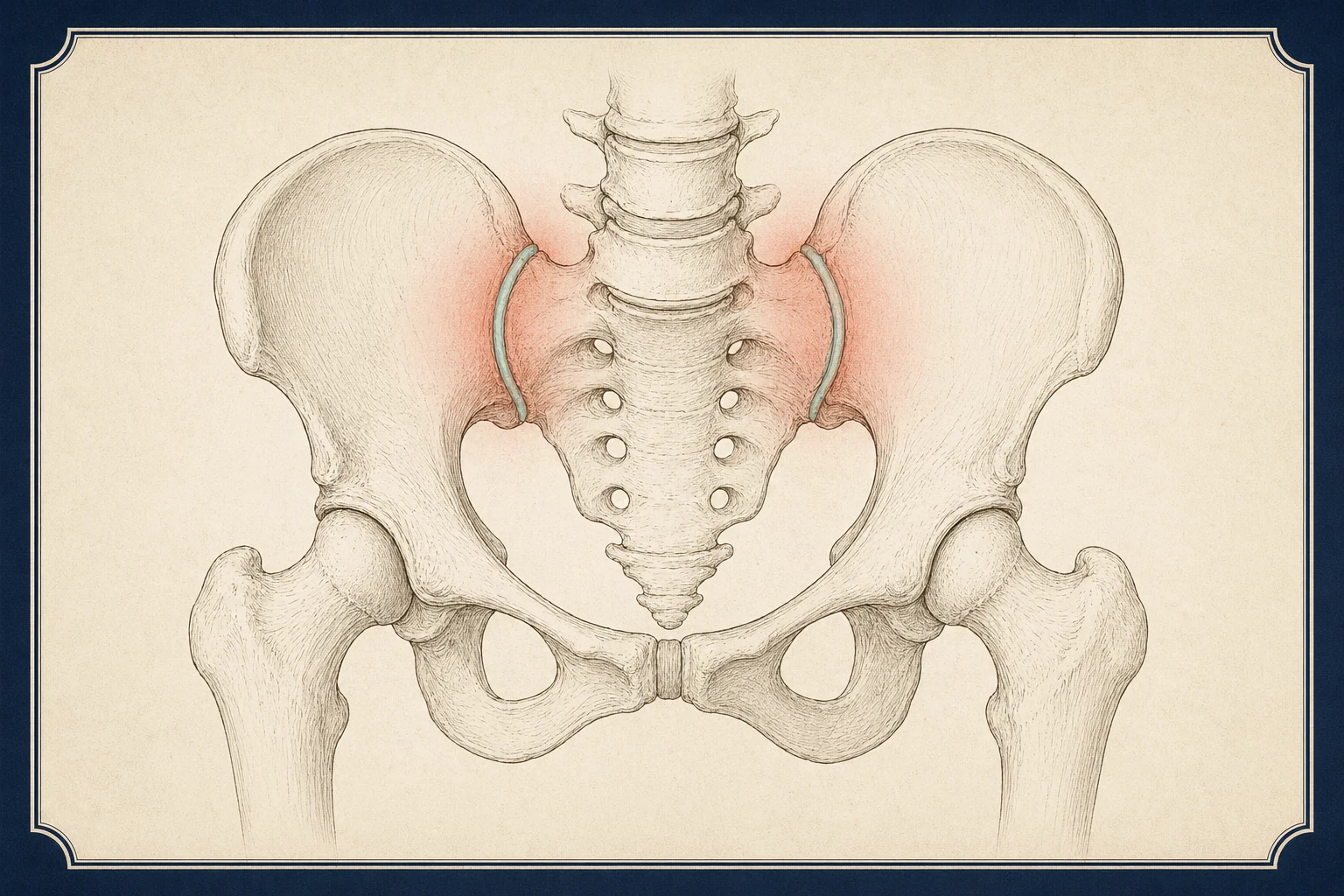
Low back and pelvis
SI Joint Pain (Sacroiliac Joint Dysfunction)
SI joint pain causes one-sided low back and buttock pain. How Houston pain specialists confirm it with exam tests and a diagnostic block, then treat it.
The sacroiliac (SI) joints connect the base of your spine to the pelvis. When one becomes painful, you feel it low and to one side, in the buttock and upper hip, sometimes running into the back of the thigh. The SI joint causes roughly 15 to 30 percent of chronic low back pain and is missed often because MRI looks normal. We confirm it with a set of exam tests and, when needed, a numbing injection into the joint, then treat it with targeted injections, radiofrequency ablation of the nerves that supply it, or, for a small number of patients, SI joint fusion.
Key facts
| What it is | Pain from one of the two sacroiliac joints, where the sacrum meets the pelvis. Usually one-sided, below the belt line, pointing to the dimple over the joint. |
|---|---|
| Most common causes | Ligament strain or joint wear, prior lumbar fusion, pregnancy and childbirth, uneven leg length or gait, a fall onto the buttock. Inflammatory sacroiliitis is a separate rheumatologic condition. |
| Typical course | A sprain-type flare usually settles in 2 to 6 weeks. Pain that persists past 3 months rarely resolves without treating the joint directly. |
| See a specialist when | Buttock pain lasts more than 6 weeks, rolling in bed or standing from a chair is painful, or back pain returned or shifted lower after spine surgery. |
| Treatments we offer | Diagnostic and therapeutic SI joint injections, SI lateral branch radiofrequency ablation, physical therapy coordination and, for the right candidate, minimally invasive SI joint fusion. |
When to get emergency care
Go to an emergency room or call 911 if you have:
- New loss of bladder or bowel control, or numbness in the groin or inner thighs (possible cauda equina syndrome; this comes from the spine, not the SI joint, but the pain can feel similar)
- Fever, chills or feeling generally ill with buttock or pelvic pain, especially with diabetes, a recent infection, IV drug use or a weakened immune system (possible joint infection)
- Sudden severe pain after a fall, car accident or, in older adults, even a minor slip, with inability to bear weight (possible pelvic or sacral fracture)
- Pain with unexplained weight loss, a history of cancer, or pain that is worst at night and does not change with position
Separate but important: if you are under 45 and have had buttock or low back pain for more than 3 months with morning stiffness lasting over 30 minutes that improves with exercise, ask us or your primary care physician about a rheumatology referral. That pattern suggests inflammatory sacroiliitis (axial spondyloarthritis), which is treated with medication, not injections alone.
What the SI joint is and why it hurts
You have two sacroiliac joints, one on each side, where the triangular sacrum at the bottom of the spine locks into the two pelvic bones. They move only a few millimeters, held by some of the strongest ligaments in the body. Their job is to transfer the weight of your upper body into your legs every time you stand, walk or climb.
Pain starts when that transfer becomes uneven. The ligaments get strained, the joint surfaces become irritated, and the small nerve branches around the back of the joint (the lateral branches of S1 to S3 and the L5 dorsal ramus) begin to fire. Because those nerves overlap with the ones from the lower lumbar spine, SI joint pain is routinely mistaken for a disc problem or sciatica.
Studies that use a numbing injection as the reference standard find the SI joint is the true source in about 15 to 30 percent of people with chronic low back pain, and in a higher share of people whose pain persists after lumbar fusion.
Common causes
- After lumbar fusion. Fusing the L5-S1 level stops motion there, so the SI joint below it absorbs more load. Studies report the SI joint as the pain source in roughly a third of patients with continued low back pain after fusion to the sacrum, often appearing months to a few years after surgery. The pain is usually lower and more to one side than the original back pain was.
- Pregnancy and postpartum. Hormones loosen the pelvic ligaments in the third trimester and the added weight sits directly over the joints. About one in five pregnant women has pelvic girdle pain, and most improve within 3 months of delivery. When it does not, the SI joint is usually the reason. We evaluate and treat postpartum patients; during pregnancy we coordinate with your obstetrician and lean on physical therapy and a pelvic support belt rather than injections.
- Trauma. A fall onto the buttock, a rear-end collision with the foot braced on the brake, or a misstep off a curb can sprain the joint.
- Uneven loading. A leg-length difference, scoliosis, hip arthritis that changes your gait, or a hip replacement that changed limb length.
- Joint wear. The SI joints develop arthritis with age like any other joint, though X-ray changes alone do not prove the joint is the source of pain.
- Inflammatory sacroiliitis. Ankylosing spondylitis and related conditions inflame the SI joints, usually in people under 45, often on both sides. This is a different disease that needs a rheumatologist.
Symptoms and how it differs from look-alikes
Most people with SI joint pain point with one finger to the spot just inside the back of the pelvic bone, about the level of the dimples above the buttocks. That finger-point sign (the Fortin finger test) is a useful clue. The pain is usually one-sided, dull or sharp, and can spread into the buttock, groin, or back of the thigh, but rarely below the knee.
Typical triggers: rolling over in bed, standing up from a chair or car seat, climbing stairs, standing on one leg to dress, and long periods of standing or sitting on the painful side.
- Versus a lumbar disc or sciatica: disc pain is usually central or in the low back itself, worse with bending forward and coughing, and true sciatica runs below the knee, often with numbness or weakness. SI pain does not cause weakness.
- Versus facet joint pain: facet pain sits higher, over the spine, and is worse with leaning back and twisting.
- Versus hip joint pain: hip arthritis is felt in the groin and front of the thigh and worsens with hip rotation. See hip pain.
- Versus piriformis syndrome: deep buttock pain with sitting and tingling into the leg, but tenderness is in the muscle belly, not the joint line.
How we diagnose it
No single image or exam finding proves SI joint pain, so we use a layered approach.
Provocation tests. We perform a standard set of maneuvers that stress the joint: distraction, thigh thrust, compression, sacral thrust, Gaenslen's and FABER. Three or more positive tests, with pain reproduced in the usual spot, predicts a positive diagnostic block with about 90 percent sensitivity and 78 percent specificity in published studies. Fewer than three positive tests makes the joint an unlikely source and turns our attention back to the spine or hip.
Imaging. X-rays or a prior MRI help rule out fracture, tumor, infection, hip arthritis and lumbar problems. Imaging of the SI joint itself is often normal even when the joint is painful, so a normal MRI does not rule the diagnosis out. If your history suggests inflammatory sacroiliitis, we order MRI of the SI joints with STIR sequences and blood work (CRP, HLA-B27) and refer to rheumatology.
Diagnostic SI joint block. This is a test. Under fluoroscopic X-ray guidance we place a small amount of local anesthetic directly into the joint. If your usual pain drops by at least 75 percent for the duration of the anesthetic, the joint is confirmed as the pain source. Most insurers and pain-medicine guidelines require this confirmation before radiofrequency ablation or fusion. Details are on our SI joint injection page.
Treatment options, in order
Treatment moves from the least invasive step to the most, and each step tells us something about the next. Most patients never need more than the first two.
- Conservative care (first 6 weeks)
Physical therapy focused on core and gluteal strengthening and pelvic alignment, a sacroiliac support belt for pregnancy-related or hypermobile joints, activity changes, and short courses of NSAIDs or acetaminophen. A shoe lift if leg length differs by more than about a centimeter. See how we coordinate physical therapy. Learn more →
- SI joint injection (diagnostic, then therapeutic)
A fluoroscopy-guided injection of local anesthetic confirms the joint as the source. A steroid added to the same injection typically gives relief for weeks to a few months. We generally limit steroid injections to 3 or 4 per year in one joint. Learn more →
- SI lateral branch radiofrequency ablation
For pain that comes back after a confirmed diagnostic block, we heat-lesion the small sensory nerves along the back of the joint. Studies of cooled radiofrequency report roughly half of patients with at least 50 percent relief at 6 months, with relief typically lasting 6 to 12 months and repeatable when it fades. This is a treatment, not a test. Learn more →
- Minimally invasive SI joint fusion
For people with at least 6 months of pain, a confirmed diagnostic block, failed conservative care and injections, and no other explanation, a surgeon places implants across the joint through a small incision to stop its motion. Randomized trials show large improvements in pain and function compared with continued nonsurgical care, but it is surgery with real risks and insurance requires strict criteria. Our SI fusion page explains candidacy and coverage. Learn more →
What you can do now
- Keep moving. Walking on level ground is usually well tolerated; avoid running, deep lunges and single-leg loading until pain settles.
- Sleep with a pillow between your knees on your side, or under your knees on your back, to unload the pelvis.
- Stand up by leaning forward and pushing evenly with both legs rather than twisting out of a chair.
- A sacroiliac belt worn low around the pelvis during standing activities often reduces pain within days, especially postpartum.
- Bring any lumbar MRI, X-rays, surgical reports and injection records to your visit; the surgical report matters most if you have had a fusion.
Gulf Coast Pain & Spine evaluates and treats SI joint pain at our Houston and Webster offices, and in Pearland when that office opens in November 2026.
Frequently asked questions
How do I know if my back pain is really SI joint pain?
The strongest clues are pain you can point to with one finger just inside the back of the pelvic bone, pain that is one-sided and stays above the knee, and pain when rolling in bed or standing from a chair. Three or more positive provocation tests on exam, then at least 75 percent relief from a numbing injection into the joint, confirm it.
My MRI was normal. Can the SI joint still be the problem?
Yes. MRI of the lumbar spine does not show the SI joint well, and even dedicated SI imaging is often normal in people whose joint is clearly the source on a diagnostic block. Normal imaging is common in SI joint pain.
I had a lumbar fusion and my pain came back lower and to one side. Is that the SI joint?
Often, yes. Fusing L5-S1 transfers extra load to the SI joint, and studies find it is the pain source in about a third of patients with persistent pain after fusion to the sacrum. It usually shows up months to a few years after surgery. We start with provocation tests and a diagnostic block rather than assuming the surgery failed. See also our page on pain after spine surgery.
Can SI joint pain from pregnancy be treated?
During pregnancy we rely on physical therapy, a pelvic support belt and activity changes, coordinated with your obstetrician. After delivery, most pelvic girdle pain resolves within 3 months. If it does not, we evaluate the SI joint the same way as anyone else, and injections become an option once you have discussed timing with your obstetrician, including if you are breastfeeding.
How long does an SI joint steroid injection last?
The numbing medicine wears off within hours; that short window is the diagnostic part. Steroid relief usually starts within 2 to 7 days and typically lasts several weeks to a few months. It varies. If relief is good but short, radiofrequency ablation is the next step rather than repeated steroid injections.
What is the difference between SI joint pain and sacroiliitis?
Sacroiliitis means inflammation of the SI joint. It is sometimes used loosely for any SI pain, but in medicine it usually means inflammatory arthritis such as ankylosing spondylitis. That is more likely if you are under 45, have had symptoms over 3 months, wake with stiffness lasting more than 30 minutes, and feel better with exercise. Those patients need a rheumatologist and disease-modifying medication.
Does SI joint fusion work?
In randomized trials of minimally invasive fusion versus nonsurgical care, most fusion patients reported substantial pain reduction that held at 2 years. It is real surgery, though, with risks of nerve irritation, implant problems and infection, and insurers require a confirmed diagnostic block, at least 6 months of failed nonsurgical treatment and imaging that rules out other causes. It is the last step, not the first.
Sources
- Sacroiliac joint pain: a comprehensive review of epidemiology, diagnosis and treatment (Cohen SP et al., 2013) (opens in new tab) — Expert Review of Neurotherapeutics / PubMed
- Evidence-based diagnosis and treatment of the painful sacroiliac joint (Laslett M, 2008) (opens in new tab) — Journal of Manual and Manipulative Therapy / PubMed Central
- The sacroiliac joint: a potential cause of pain after lumbar fusion to the sacrum (Katz V et al., 2003) (opens in new tab) — Journal of Spinal Disorders and Techniques / PubMed
- An update of comprehensive evidence-based guidelines for interventional techniques in chronic spinal pain (2013) (opens in new tab) — American Society of Interventional Pain Physicians (ASIPP)
- Randomized controlled trial of minimally invasive sacroiliac joint fusion versus nonsurgical management (INSITE, Polly DW et al., 2016) (opens in new tab) — International Journal of Spine Surgery / PubMed Central
Request an appointment
Call (832) 916-2075 or request an appointment online. New patients are welcome; the team confirms insurance and referral requirements before scheduling.