
Nerve pain
Sciatica (Lumbar Radiculopathy)
Sciatica is nerve root pain shooting from the low back down the leg; most cases improve in 6–12 weeks. Warning signs, mimics, and treatment in Houston.
Sciatica is pain that travels from the low back or buttock down the leg, usually below the knee, along the path of a compressed or inflamed spinal nerve root. A herniated disc is the cause in most people under 50; spinal stenosis is more common after that. Most cases improve substantially within 6–12 weeks without surgery. Gulf Coast Pain & Spine confirms which nerve is involved, rules out the conditions that imitate sciatica, and uses targeted epidural injections to shorten the painful stretch while the nerve recovers, at its Houston and Webster offices and, from November 2026, in Pearland.
Key facts
| What it is | Irritation or compression of one of the lumbar or sacral nerve roots (most often L5 or S1) that produces shooting pain, tingling or numbness down the leg. It is a symptom pattern, not a diagnosis by itself. |
|---|---|
| Most common causes | Herniated lumbar disc (about 90% of cases under age 50), lumbar spinal stenosis, foraminal narrowing from degeneration or spondylolisthesis, and, less often, a synovial cyst or tumor. |
| Typical course | About 75% of people are substantially better within 6–12 weeks. Roughly one in three still has some leg symptoms at one year. Pain usually improves before numbness does. |
| See a specialist when | Leg pain is severe or has lasted more than 4–6 weeks despite activity and medication, there is any weakness, or pain is keeping you from work or sleep. |
| Treatments we offer | Transforaminal and interlaminar epidural steroid injections, selective nerve root blocks, caudal injections, coordinated physical therapy, medication review, and surgical referral when the criteria are met. |
When to get emergency care
Go to an emergency room or call 911 if you have leg pain with any of these:
- Numbness in the groin, inner thighs or around the rectum, trouble starting or stopping urine, or loss of bowel or bladder control. This is cauda equina syndrome. Outcomes depend on decompression within 24–48 hours.
- A foot you cannot lift (foot drop), a foot that slaps or drags when you walk, or weakness that is getting worse over hours or days. Progressive weakness is the main reason sciatica needs urgent surgical evaluation.
- Sciatica on both sides at once, or numbness in both legs.
- Fever or chills with back and leg pain, especially with diabetes or a recent spine procedure.
- A history of cancer with new back and leg pain, or unexplained weight loss.
Mild weakness that is stable, such as slightly less push-off in the big toe, is common with sciatica and is usually followed closely rather than operated on. Weakness that is worsening is different.
What sciatica is
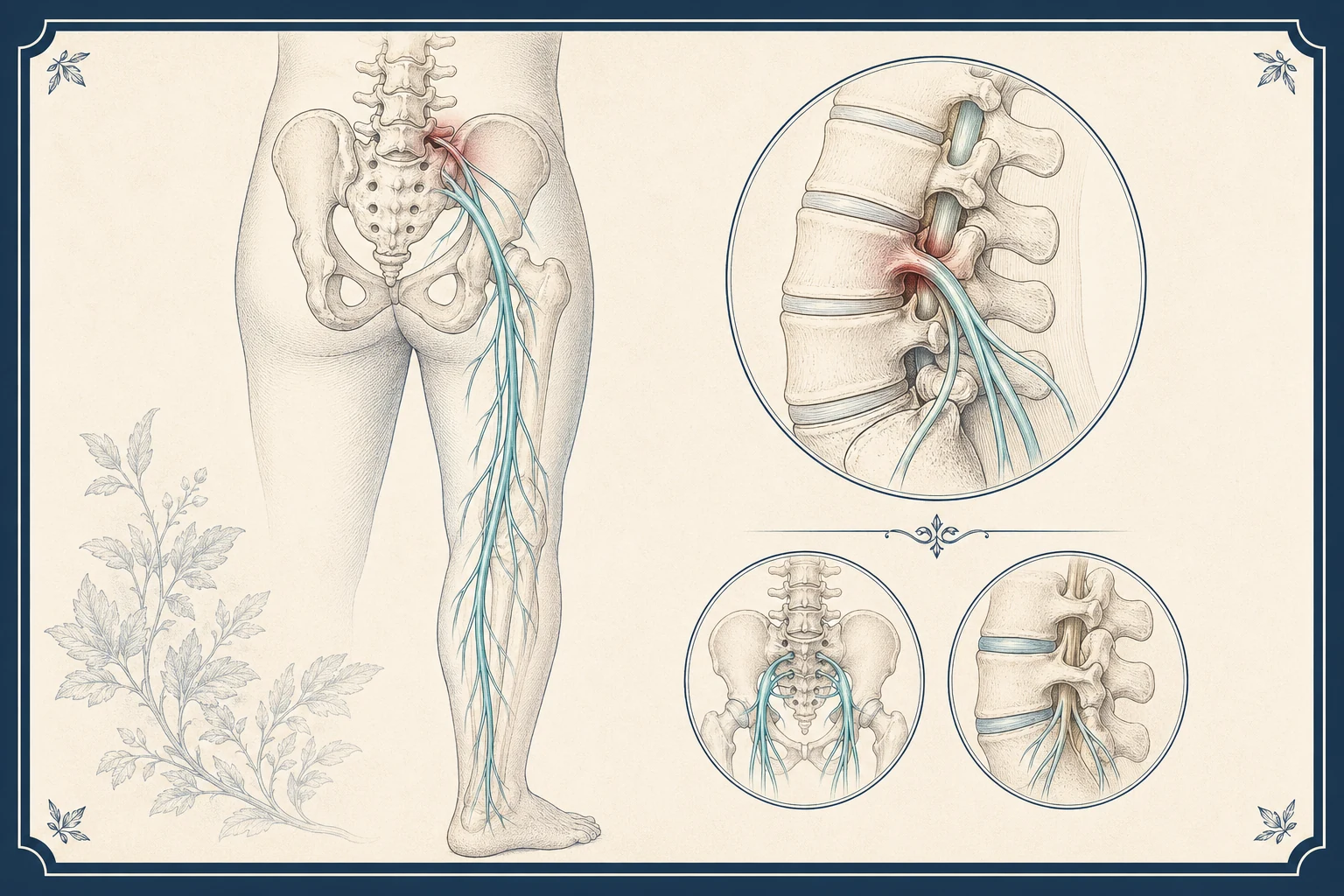
The sciatic nerve is the largest nerve in the body. It forms from the L4, L5, S1, S2 and S3 nerve roots as they leave the spine, runs through the buttock, and travels down the back of the leg before splitting at the knee. "Sciatica" describes pain along that path. In almost every case the problem is not the sciatic nerve itself but one of its roots at the spine, where a disc or bone narrowing is pressing on it or where leaked disc material has set off inflammation. The medical term for this is lumbar radiculopathy.
Two things make nerve root pain different from ordinary back pain. First, the leg usually hurts more than the back. Second, the pain follows a map. Each nerve root supplies a specific strip of skin and specific muscles: the L4 root reaches the inner shin, L5 the outer calf and top of the foot into the big toe, S1 the back of the calf and the outer foot into the small toes. The exact path of your pain tells the physician which root is involved, and that is where the treatment is aimed.
Causes, and what mimics sciatica
Herniated disc. The most common cause. The disc's soft center pushes through its outer wall and presses on or inflames the adjacent nerve root, most often at L4–5 (L5 root) or L5–S1 (S1 root). Herniated disc material shrinks over months; the larger the herniation, the more likely it is to resorb. See herniated disc.
Spinal stenosis and foraminal narrowing. In people over 50, bone spurs, thickened ligament and bulging discs narrow the canal or the opening (foramen) where the nerve exits. This sciatica tends to be worse with standing and walking and better sitting. See spinal stenosis.
Spondylolisthesis. One vertebra slipped forward on the one below, pinching the nerve as it exits.
Conditions that imitate sciatica are common and lead to failed treatment when missed:
- SI joint pain refers to the buttock and back of the thigh but rarely below the knee and never causes true numbness or weakness. See SI joint pain.
- Piriformis syndrome, in which the piriformis muscle deep in the buttock irritates the sciatic nerve after it leaves the spine. Pain is centered in the buttock, worse with prolonged sitting and with hip rotation, and the back is not painful. The MRI of the spine is often normal.
- Hip osteoarthritis causes groin and front-of-thigh pain, worse with rotating the hip, and a limp; it does not go below the knee. See hip pain.
- Greater trochanteric pain (gluteal tendinopathy) hurts on the outside of the hip, worse lying on that side.
- Peripheral neuropathy causes numbness in both feet in a stocking pattern rather than one leg along a root. See peripheral neuropathy.
- Vascular claudication from blocked leg arteries causes calf cramping with walking that stops when you stand still.
Symptoms
Sharp, burning or electric pain that starts in the buttock or low back and runs down the back or side of one leg, usually below the knee. Tingling or numbness along the same strip. Pain that worsens with sitting, bending forward, coughing, sneezing or straining, because those raise pressure on the disc and nerve. Some people find walking easier than sitting; with stenosis it is the reverse. Weakness, if present, is usually in lifting the big toe or foot (L5) or pushing off with the calf (S1).
Natural history. Sciatica from a disc herniation follows a fairly predictable course. Pain is worst in the first 2–4 weeks, then improves; about 75% of people are substantially better by 6–12 weeks, and most herniations have shrunk on repeat imaging within 6–12 months. Numbness and mild weakness resolve more slowly than pain and occasionally persist. In the SPORT trial, which compared surgery with nonoperative care for disc herniation, both groups improved substantially over two years; surgery relieved pain faster, and the difference narrowed with time. That is why, for most people, the goal is to get through the painful window comfortably and safely rather than to rush to surgery.
How we diagnose it
The history and exam make the diagnosis in most cases. We map exactly where the pain and numbness go, test strength in the hip, knee, ankle and toes, check the knee and ankle reflexes (a reduced ankle reflex points to S1), and perform a straight-leg raise: lifting the straight leg between 30 and 70 degrees that reproduces leg pain, not just back tightness, is the classic sign of nerve root tension. We also examine the hip, the SI joint and the piriformis so a mimic is not treated as sciatica.
MRI is ordered when sciatica has lasted more than 6 weeks, when there is weakness, when a red flag is present, or when an injection is being planned, because the injection must be aimed at the right level. An MRI is not needed in the first weeks for typical sciatica that is improving. When the MRI shows changes at more than one level, a selective nerve root block numbs one root at a time to identify which one is producing the pain; that is a test, and the answer decides where any further treatment or surgery is directed. EMG and nerve conduction studies are used when the picture is unclear, for instance to separate an L5 radiculopathy from a peroneal nerve problem at the knee.
Treatment options, in order
Treatment is staged to the calendar. The first weeks are about controlling pain while the nerve settles; injections come in when pain is severe or is not improving on schedule; surgery is reserved for the specific situations where it clearly outperforms everything else.
- Weeks 1–4: activity and medication
Stay as active as pain allows; walking is better than bed rest. NSAIDs such as naproxen or ibuprofen for 1–2 weeks if safe for you. A short oral steroid taper gives a modest short-term benefit for some people. Gabapentin and pregabalin are often prescribed but the evidence for sciatica is weak. Opioids are not recommended beyond a few days of severe pain. Learn more →
- Physical therapy
Directional exercises that move pain out of the leg and toward the back (centralization), nerve gliding, and progressive walking. Started in the first 2–3 weeks once the acute spasm eases. Learn more →
- Transforaminal epidural steroid injection
Steroid delivered under X-ray guidance directly to the inflamed nerve root at the level the MRI and exam identify. Relief typically begins within 2–7 days. Studies show a clear benefit for leg pain over the following weeks to a few months, which is often enough to get through the painful window; it does not shrink the herniation. Usually limited to 3–4 per year, with a repeat only if the first helped. Learn more →
- Interlaminar or caudal epidural injection
Alternatives when the target level is hard to reach through the foramen, when more than one level is involved, or after prior surgery. Learn more →
- Surgical referral: microdiscectomy or decompression
We refer when there is progressive or significant weakness, cauda equina symptoms, or severe leg pain that has not responded after 6–12 weeks of the steps above with an MRI that matches. In those situations surgery relieves leg pain faster and more reliably than continued injections, with most patients home the same day. Learn more →
- Spinal cord or dorsal root ganglion stimulation
For leg nerve pain that persists after surgery or when surgery is not an option. Learn more →
What you can do now
- Walk. Short, frequent walks on flat ground. Sitting is usually the worst position for disc-related sciatica, so limit long drives and desk stretches to 20–30 minutes at a time.
- Find your relief position. Many people get relief lying on their back with knees bent over pillows, or lying on the side with the painful leg on top and a pillow between the knees.
- Avoid bending and lifting during the first few weeks; hinge at the hips and knees when you must.
- Use heat on the low back and buttock to relax the muscles that tighten around the nerve.
- Take NSAIDs on a schedule for a week or two rather than only when pain spikes, if your doctor has said they are safe.
- Watch for the warning signs above, particularly any change in bladder control or a foot that is getting weaker. Test it: can you stand on your heels and on your toes?
Frequently asked questions
How long does sciatica last?
Most people are substantially better within 6–12 weeks. Pain usually eases before tingling and numbness do. About one in three still has some leg symptoms at one year, though usually much milder. Sciatica from stenosis tends to be more chronic than sciatica from a disc herniation.
Does a herniated disc heal on its own?
Often, yes. The body breaks down and absorbs leaked disc material over months. Larger herniations, which sound worse, are actually the most likely to shrink: about two-thirds of extrusions regress on repeat MRI. This is why waiting is a real strategy for many people, as long as there is no weakness.
Will an epidural injection cure my sciatica?
No. It reduces inflammation around the nerve so the pain drops while the herniation shrinks on its own. Relief typically starts in 2–7 days and lasts weeks to months. Roughly half of people get meaningful relief from the first injection. It does not remove the herniation or prevent a future one.
When does sciatica need surgery?
Progressive weakness, cauda equina symptoms, or severe leg pain that has not responded after 6–12 weeks of medication, therapy and injections with a matching MRI. Surgery is faster at relieving leg pain, but for people without weakness, results at one to two years are similar to nonoperative care, so it is a choice rather than a requirement.
Is it sciatica or piriformis syndrome?
Piriformis syndrome centers in the buttock, is worse with sitting and with hip rotation, and the back is not painful; the spine MRI is usually normal. True sciatica usually involves the back as well as the leg, follows a specific nerve root map, and shows a matching disc or stenosis on MRI.
Can I exercise with sciatica?
Yes, and walking is encouraged. Avoid heavy lifting, deep forward bending and sit-ups until the leg pain settles. Exercises that move pain from the leg toward the back are a good sign; anything that pushes pain further down the leg should be stopped.
What is a foot drop and why is it urgent?
Foot drop is weakness in lifting the front of the foot, so it drags or slaps when you walk. It usually means the L5 nerve root is significantly compressed. Weakness that is worsening is the main reason for prompt surgical evaluation, because nerve recovery is better when compression is relieved early.
Sources
- Sciatica (opens in new tab) — American Academy of Orthopaedic Surgeons, OrthoInfo
- Surgical vs Nonoperative Treatment for Lumbar Disk Herniation: The Spine Patient Outcomes Research Trial (SPORT) (opens in new tab) — JAMA, 2006
- Surgery versus Prolonged Conservative Treatment for Sciatica (opens in new tab) — New England Journal of Medicine, 2007
- Epidural corticosteroid injections for lumbosacral radicular pain (opens in new tab) — Cochrane Database of Systematic Reviews, 2020
- Low Back Pain Fact Sheet (opens in new tab) — National Institute of Neurological Disorders and Stroke (NIH)
Request an appointment
Call (832) 916-2075 or request an appointment online. New patients are welcome; the team confirms insurance and referral requirements before scheduling.