
- CRPS type I (without a defined nerve injury) or type II (after a nerve injury) affecting a foot, ankle, knee, groin or hip
- Pain confined to one or two dermatomes, where spinal cord stimulation would be hard to steer or would cover too much
- People whose SCS trial produced tingling in the wrong place or that shifted with posture
- Focal nerve pain after hernia repair, knee replacement or foot surgery in which a diagnostic nerve root block gave relief (off-label; coverage varies)
- At least 6 months of conservative care including nerve pain medication, physical therapy and sympathetic blocks for CRPS
Neuromodulation & implants
Dorsal Root Ganglion (DRG) Stimulation
DRG stimulation targets one nerve root for CRPS of the foot, knee or groin where SCS covers poorly. Trial, implant, MRI limits and risks. Houston, TX.
In short
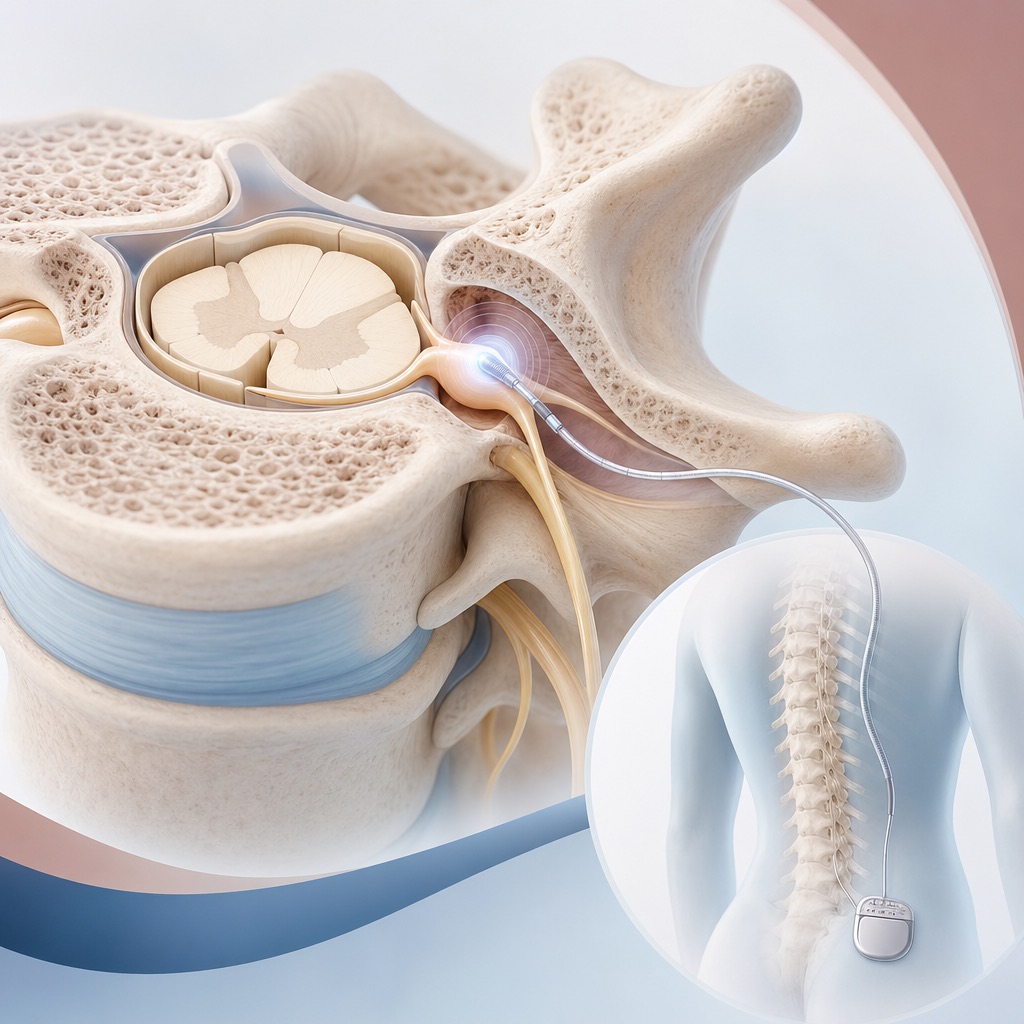
Dorsal root ganglion stimulation places a small lead on the cluster of sensory nerve cells where one nerve root leaves the spine, so it can quiet pain in a narrow area such as a foot, knee or groin. It is a treatment, tried first with temporary leads for about a week, and its FDA-labeled use is complex regional pain syndrome (CRPS) types I and II of the lower limb. It is chosen over spinal cord stimulation when the pain is focal, in a spot SCS covers poorly, or when stimulation needs to stay steady with movement.
Key facts
| Treats | CRPS type I or II of the lower extremity (foot, ankle, knee, groin, hip); focal nerve pain of one dermatome |
|---|---|
| Test or treatment? | Treatment. The trial week is the test. |
| Labeled indication | FDA-approved (2016) for moderate-to-severe chronic pain of the lower limbs in adults with CRPS I or II |
| Trial | Percutaneous leads through the spinal foramen for typically 5–7 days |
| Procedure time | Trial 60–90 minutes; implant 1.5–2.5 hours, outpatient |
| Anesthesia | Local with light sedation (trial); sedation or general anesthesia (implant) |
| Downtime | No bending, lifting or twisting for about 6 weeks after implant |
| MRI | MRI-conditional with stricter, device-specific limits than most SCS systems; confirm before any scan |
| Insurance | Covered by Medicare and most commercial plans for CRPS after a psychological evaluation and a successful trial; coverage for other diagnoses varies |
Who it is for
- Widespread or bilateral pain, where SCS covers better
- Untreated infection, or blood thinners that cannot be held
- Severe foraminal stenosis, prior fusion or hardware at the target level that blocks the lead path
- Active psychiatric instability or untreated substance use disorder (a psychological evaluation is required)
- Pregnancy
- Someone who will need frequent MRI of the body region the device labeling excludes
Why DRG instead of spinal cord stimulation
The dorsal root ganglion (DRG) is a small bundle of sensory nerve cell bodies sitting in the bony opening (foramen) where each nerve root exits the spine. Every pain signal from a specific strip of skin and deep tissue, called a dermatome, passes through its DRG before reaching the spinal cord. In CRPS the DRG itself becomes hyperexcitable and helps sustain the pain. Placing a lead directly on it gives two advantages over spinal cord stimulation:
- Focal coverage. One lead covers one dermatome. The foot (L5 and S1), the knee (L3 and L4) and the groin (L1 and L2) are hard for SCS to reach without also stimulating the whole leg; DRG stimulation reaches them precisely. Two to four leads are used for larger areas.
- Posture-independent stimulation. There is very little spinal fluid between the lead and the DRG, so stimulation does not surge when you lie down or fade when you stand, a common complaint with paresthesia-based SCS. Energy needs are also lower.
The cost is a more technical procedure: each lead is steered through the foramen under X-ray using a curved sheath, which takes more time and skill than placing an SCS lead in the epidural space, and MRI labeling is more restrictive. Trials and implants are available to Houston, Webster and Pearland (opening November 2026) patients through the practice.
Evidence and coverage statement: DRG stimulation is FDA-approved for lower-limb CRPS I and II based on the ACCURATE randomized trial, and Medicare and most commercial plans cover it for that indication after failed conservative care, a psychological evaluation and a successful trial. Use for other focal nerve pain (post-surgical groin, knee or foot pain, phantom limb pain) is off-label with smaller studies; coverage for those diagnoses varies and may be denied.
What happens on procedure day
- Trial visit. Arrive with a driver; blood thinners held per plan; skin checked for infection or CRPS-related swelling at the lead entry site. IV antibiotics and light sedation are given.
- Lying face down under X-ray, the physician numbs the skin and advances a needle into the epidural space, then uses a steerable sheath to guide a thin lead out through the foramen so its contacts rest on the DRG. This is repeated for each target level (typically 1–2 for the trial, up to 4 for an implant).
- Stimulation is tested: you should feel a light tingling, or nothing, in exactly the painful zone. Leads are secured with dressings and connected to an external trial battery. You leave 1–2 hours after arriving.
- Trial week of typically 5–7 days with a pain and activity diary; no driving, bending or bathing. Leads are removed in the office at the end.
- Implant visit (separate, only after at least 50% relief). Under sedation or general anesthesia, permanent leads are placed at the same levels, anchored, tunneled and connected to a small generator in a pocket over the upper buttock or flank. Home the same day.
After the procedure
Trial week: keep dressings dry, move gently, do not drive, and note relief, walking tolerance and sleep each day. Call for fever, a soaked dressing, or a sudden change in the stimulation pattern.
Implant, days 0–3: incision soreness at the generator and lead sites; some people have temporary nerve root irritation with a brief flare of pain along the treated dermatome, which usually settles within days.
Weeks 1–2: wound check and first programming. DRG programs usually run at very low amplitude; small adjustments make big differences.
Weeks 1–6: no bending at the waist, lifting more than about 5–10 pounds or twisting. Lead migration matters more with DRG leads than SCS leads because a shift of a few millimeters can move the contacts off the ganglion.
Months 2–3: resume normal activity and CRPS rehabilitation (desensitization, graded loading). Judge the result at 3 months.
Ongoing: keep your device card, contact us before any MRI or surgery, and continue the physical therapy program; stimulation works best as a way to make rehabilitation possible.
What the evidence shows
The ACCURATE trial (2017) randomized 152 people with CRPS I or causalgia (CRPS II) of the lower extremity to DRG stimulation or traditional spinal cord stimulation. Treatment success, defined as at least 50% pain relief without a new neurological deficit, was 81% with DRG versus 56% with SCS at 3 months and 74% versus 53% at 12 months, and DRG stimulation produced less positional variation and less unwanted stimulation outside the painful area. That trial is the basis for the 2016 FDA approval. Longer-term registry data show relief holding for many but not all patients, with revision rates similar to SCS. Evidence for uses beyond lower-limb CRPS (post-surgical groin pain, foot pain, upper-limb CRPS) consists of smaller series and is considered off-label. The North American Neuromodulation Society's NACC guidance recommends DRG stimulation as a first-line neuromodulation option for lower-extremity CRPS.
Alternatives and what comes next
Before DRG stimulation, most people with CRPS have had a course of lumbar sympathetic blocks (or stellate ganglion blocks for the arm) paired with physical therapy, plus nerve pain medication. If pain spreads beyond one or two dermatomes, spinal cord stimulation is the better fit; if it follows a single peripheral nerve such as the saphenous or peroneal, peripheral nerve stimulation may be simpler. A failed DRG trial does not close the door on an SCS trial, and vice versa. The neuromodulation overview compares all three side by side.
Safety and preparation
- Blood thinners: held before the trial and the implant on a schedule agreed with your prescriber (typically 2–7 days depending on the drug); never stop them on your own.
- Infection/fever: any active infection postpones the procedure. CRPS skin changes at the planned entry site are examined at the pre-procedure visit.
- Diabetes: bring recent glucose and A1c numbers; poor control raises infection risk and can delay the implant.
- Pacemaker/ICD: DRG systems can coexist with cardiac devices with cardiology coordination and a device check after programming; tell us before scheduling.
- MRI: DRG systems carry stricter, device-specific MRI conditions than most spinal cord stimulators, and labeling has changed across device generations. Before any MRI, the imaging center must verify your exact system's conditions from your device card. If you expect to need regular MRI of the spine or pelvis, raise it before the trial.
- Psychological evaluation: required by payers before authorization and completed before the trial.
- Sedation and driving: bring a driver for both visits; do not drive during the trial week or until cleared after the implant.
- Allergies (contrast, local anesthetic, antibiotics, tape): tell us in advance.
- Pregnancy: the procedure is deferred if you may be pregnant.
Risks and side effects
- Incision and pocket soreness for 1–3 weeks
- Brief increase in pain or tingling along the treated dermatome from nerve root irritation during placement, usually settling within days
- Skin irritation from dressings during the trial
- Lead migration or fracture requiring revision; DRG leads are small and a few millimeters of movement can lose coverage
- Infection of the pocket or lead track (typically 2–5%), usually requiring removal of the system
- Dural puncture with spinal headache (the lead passes through the epidural space near the nerve root sleeve)
- Persistent nerve root irritation or new numbness in the dermatome
- Generator pocket pain or seroma
- Loss of effect over time
- Epidural hematoma or abscess with nerve compression (new weakness, numbness, bladder or bowel changes): an emergency; blood-thinner holds and infection screening are the safeguards
- Nerve root or spinal cord injury during lead steering, with lasting deficit
- Device heating or damage if MRI is performed outside the device's conditional labeling
Frequently asked questions
What is DRG stimulation approved for?
The FDA approved DRG stimulation in 2016 for moderate-to-severe chronic pain of the lower limbs in adults with complex regional pain syndrome type I or II. Use for other focal nerve pain is off-label, and insurance coverage for those uses varies.
Why would I have DRG stimulation instead of a spinal cord stimulator?
Because your pain is focal. Spinal cord stimulation is hard to steer into the foot, knee or groin without covering the whole leg, and its sensation changes with posture. DRG leads sit on the one or two nerve roots that supply the painful area, so coverage is precise and steady when you move. In the ACCURATE trial DRG beat SCS for lower-limb CRPS.
Is the procedure harder than a spinal cord stimulator?
Technically, yes. Each lead is steered out through the bony opening of the spine onto the ganglion using a curved sheath under X-ray, which takes more time and precision than placing a lead in the epidural space. For you it feels similar: light sedation, a trial of about a week, then an outpatient implant if the trial succeeds.
Can I have an MRI with a DRG stimulator?
Only under the specific conditions on your device card, which are stricter than for most spinal cord stimulators and depend on the device generation and where the leads are. Always tell the imaging center you have a DRG system before scheduling, and contact us if a scan is being planned.
What does the trial feel like?
At the very low settings DRG uses, most people feel a faint tingling in exactly the painful area, or nothing at all with pain relief. Because the lead sits on the ganglion, the sensation does not jump when you change position the way traditional SCS can.
Does insurance cover DRG stimulation?
Medicare and most commercial plans cover it for lower-limb CRPS after failed conservative care, a psychological evaluation and a successful trial. For other diagnoses, coverage varies and may be denied; we check before the trial.
What if the trial fails?
Nothing has been implanted. Depending on the pain pattern, a spinal cord stimulation trial, peripheral nerve stimulation, or further sympathetic blocks and rehabilitation are the usual next steps.
Sources
- Dorsal root ganglion stimulation yielded higher treatment success rate for complex regional pain syndrome and causalgia at 3 and 12 months: a randomized comparative trial (ACCURATE) (opens in new tab) — PAIN
- Premarket Approval P150004: Axium Neurostimulator System (DRG stimulation) (opens in new tab) — U.S. Food and Drug Administration
- The Neurostimulation Appropriateness Consensus Committee (NACC): Recommendations on Best Practices for DRG Stimulation (opens in new tab) — North American Neuromodulation Society / Neuromodulation
- Complex Regional Pain Syndrome (opens in new tab) — National Institute of Neurological Disorders and Stroke
Next step
Request an appointment
Call (832) 916-2075 or request an appointment online. New patients are welcome; the team confirms insurance and referral requirements before scheduling.