
- Leg pain from a lower lumbar disc or stenosis in someone who has had a laminectomy, fusion or hardware at the levels an interlaminar needle would need to cross
- Symptoms in both legs or at more than one lower lumbar level, where broad spread is an advantage
- Pain after back surgery (post-laminectomy syndrome) where scar tissue is thought to be irritating nerve roots
- Patients at higher risk from a dural puncture, or who had a dural puncture headache with an earlier interlaminar injection
- Older patients with severe central stenosis where the interlaminar space is closed
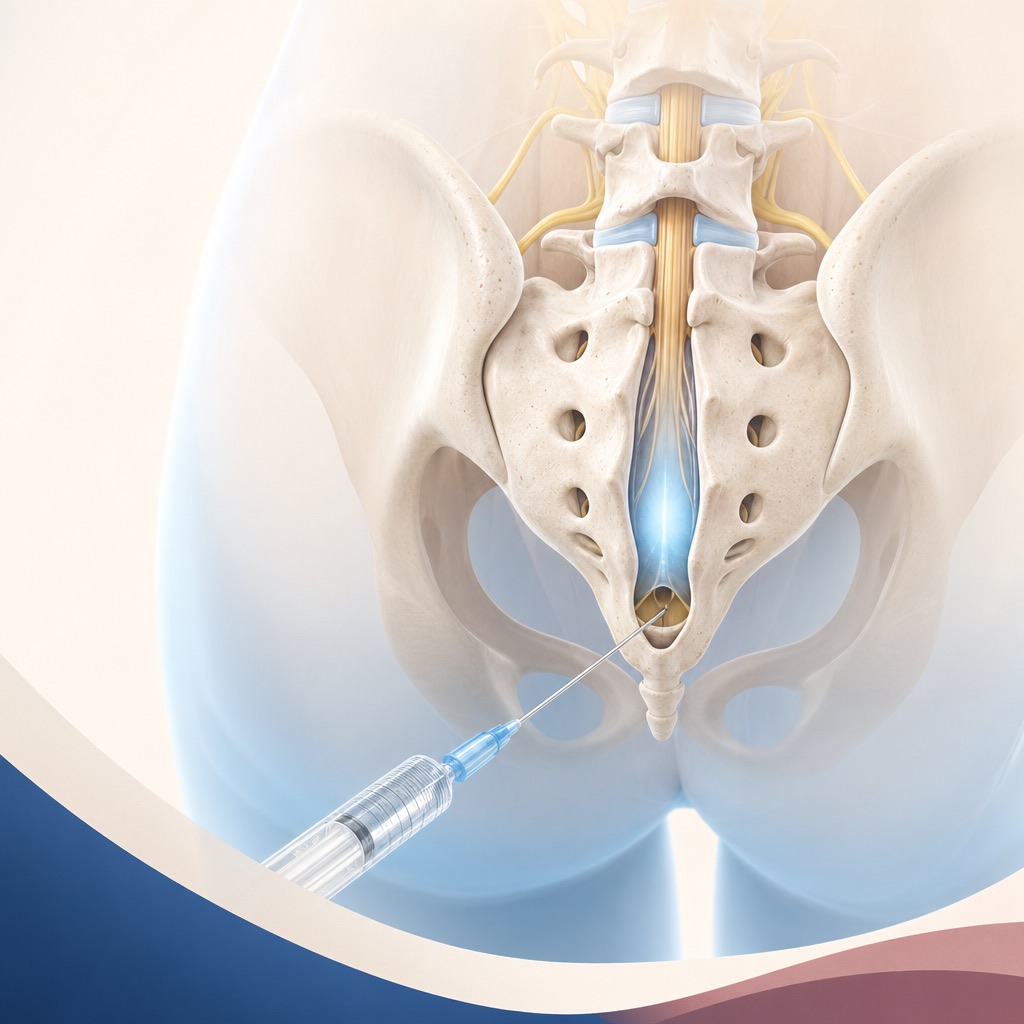
Spine injection
Caudal Epidural Steroid Injection
Caudal epidural steroid injection in Houston: why this route is chosen after back surgery, how it compares with other epidural approaches, and risks.
In short
A caudal epidural steroid injection reaches the lowest part of the epidural space through the sacral hiatus, a small natural opening at the base of the tailbone, rather than between the vertebrae. It is a treatment, not a test, used for leg pain or low-back-and-leg pain from a disc, stenosis or scar tissue at L4, L5 or S1, and it is the route we choose most often when previous back surgery makes the other approaches difficult. Relief typically starts within 2–7 days and lasts weeks to months.
Key facts
| Treats | Radicular leg pain from L4–S1 disc herniation, stenosis or post-surgical scar; multilevel or bilateral lower lumbar symptoms |
|---|---|
| Test or treatment? | Treatment. Not used to identify which nerve is the source |
| Procedure time | 10–15 minutes of needle time; about 60 minutes at the office |
| Anesthesia | Local anesthetic at the tailbone; light IV sedation optional |
| Downtime | Rest the day of the injection; normal activity the next day |
| When relief starts | Typically 2–7 days; the larger anesthetic volume can numb the legs for a few hours first |
| How long relief lasts | Weeks to months; varies with the cause |
| How often it can be repeated | Only if it helped; typically no more than 3–4 spinal steroid injections per year, at least 2 weeks apart |
| Insurance | Covered by Medicare and most plans for radicular pain matching imaging after conservative care; the same rules as other epidurals |
Who it is for
- One-sided sciatica from a single upper-lumbar level (L2–L3), where a transforaminal injection is more targeted and the caudal medication may not reach
- Back pain alone without leg symptoms
- Skin infection, pilonidal cyst or open wound over the tailbone
- Signs of cauda equina syndrome or rapidly worsening weakness, which need urgent surgical evaluation
- Blood thinners that cannot be paused, active infection, uncontrolled diabetes, or pregnancy
At a glance
| Approach | Where the needle enters | Best for | Targeting | Dural puncture risk | Typical volume |
|---|---|---|---|---|---|
| Caudal | Sacral hiatus at the tailbone | Post-surgical spine; bilateral or multilevel L4–S1 pain; high dural-puncture risk | Least targeted; spreads over several levels | Lowest (dural sac ends above the entry point) | 10–20 mL |
| Interlaminar | Between the laminae at the back of the spine, midline | Central stenosis; both legs; multilevel disease | Moderate; spreads over 1–2 levels, both sides | Low but highest of the three (under 1 in 100) | 3–6 mL |
| Transforaminal | At the opening where one nerve root exits | One-sided sciatica from a single disc or foraminal narrowing | Most targeted; front of the epidural space at one nerve | Very low | 2–4 mL |
How a caudal injection works, and why we choose it
The spinal canal continues below the lumbar spine into the sacrum, a triangular bone made of five fused vertebrae. At the bottom of the sacrum is a small gap covered only by a ligament, the sacral hiatus. A needle passed through that gap enters the sacral canal, which is the bottom of the same epidural space that surrounds the lumbar nerve roots. Medication injected there flows upward and reaches the S1, L5 and, with enough volume, the L4 nerve roots.
Four features of this route decide when we use it:
- It avoids surgical scar and hardware. After a laminectomy or fusion, the interlaminar window is often filled with scar or covered by rods and screws, and the normal tissue layers that a needle relies on are gone. The sacral hiatus is untouched by lumbar surgery, so a caudal injection is usually the most reliable way to reach the lower epidural space in a post-surgical spine.
- It has the lowest dural-puncture risk of any epidural approach. The dural sac, which holds spinal fluid, ends around the S2 level in most adults, above the point where the caudal needle enters. A dural puncture headache after a caudal injection is unusual.
- It is the least targeted approach. Medication spreads across both sides and several levels rather than concentrating at one nerve. That is a strength for multilevel or bilateral symptoms and a weakness for one-sided pain at a single level, where a transforaminal injection puts more steroid exactly where it is needed.
- It uses a larger volume. To carry steroid up to L4–L5, we inject 10–20 mL of dilute local anesthetic and saline with the steroid, versus 2–4 mL in a transforaminal injection. The larger volume also gently separates scar from nerve roots, which is thought to be part of the benefit after surgery.
Small veins run throughout the sacral canal, and the needle enters one of them in roughly 1 in 10 caudal injections. Steroid or anesthetic injected into a vein is wasted at best and unsafe at worst. That is why we inject contrast dye first under live fluoroscopy: if the dye streaks away in a vessel instead of outlining the epidural space, we reposition the needle before injecting anything else. Without X-ray guidance, the needle misses the sacral canal in about 1 in 4 attempts, so this injection is never done blind.
Caudal vs interlaminar vs transforaminal
The table below is how we explain the choice. In short: transforaminal for one nerve, interlaminar for the middle, caudal for the bottom of the spine and for spines that have been operated on. For neck symptoms the rules are different; see cervical epidural steroid injection. We perform caudal injections at our Houston and Webster offices, and in Pearland when that office opens in November 2026.
What happens on procedure day
- Check-in: we confirm your blood-thinner hold, glucose if diabetic, allergies, and your driver. You sign consent.
- Positioning: you lie face down with a pillow under the hips and the feet turned slightly inward, which opens the sacral hiatus. The skin over the tailbone is cleaned with antiseptic and draped.
- Numbing: lidocaine is injected in the skin over the sacral hiatus. This is the sharpest part, and it lasts a few seconds.
- Needle placement: under live X-ray from the side, the physician passes a thin needle through the ligament covering the sacral hiatus into the sacral canal, then injects contrast to confirm epidural spread and to make sure the needle is not in a vein.
- Injection: 10–20 mL of steroid diluted in saline and low-concentration local anesthetic is injected slowly over a minute or two. Pressure in the tailbone, buttocks or down the legs during the injection is normal and fades quickly.
- Recovery: you rest 20–30 minutes while we check leg strength and sensation; the larger anesthetic volume can make the legs feel heavy for a few hours, so your driver takes you home.
After the procedure
Day 0. Rest at home. The legs may feel heavy, warm or numb for 2–6 hours; walk with care and do not drive. Ice the tailbone area 15 minutes at a time. Eat and take usual medications normally.
Days 1–3. Return to work and light activity. A short flare of pain, flushing, poor sleep and higher blood sugar are common for a few days while the steroid takes effect.
Week 1–2. Most of the benefit arrives. Resume physical therapy and walking. We ask you to rate your leg pain at 2 weeks: a 50% or greater drop means the injection did its job and we repeat it only when pain returns; little change means we re-examine the diagnosis rather than repeating.
Call us for fever over 100.4 °F, a headache that is worse sitting up, new leg weakness, new bladder or bowel trouble, or redness and drainage at the tailbone.
What the evidence shows
The caudal route has been studied in several randomized trials, most of them by ASIPP investigators, in disc herniation, spinal stenosis, discogenic pain and post-surgery pain. In those trials roughly 6–7 in 10 patients maintained at least 50% relief over two years with repeated injections (on average 4–6 injections over the two years), and the ASIPP 2021 epidural guidelines rate the evidence as Level I for disc herniation and Level II for stenosis, post-surgery syndrome and axial discogenic pain. The 2020 Cochrane review, which pooled all lumbar epidural routes, found a small average short-term benefit for leg pain and disability.
Head-to-head, transforaminal injections deliver more steroid to a single nerve root and tend to give somewhat better short-term relief for one-sided radicular pain; caudal and interlaminar injections perform similarly for broader symptoms. The caudal route's main advantage is not superior relief but reliable access and safety in spines that other approaches cannot reach.
Steroid limits apply exactly as for other epidurals: repeated doses affect bone density, blood sugar and the adrenal glands, so we do not exceed roughly 3–4 spinal steroid injections a year and never repeat one that did not help.
Alternatives and what comes next
For one-sided leg pain at a single level in an unoperated spine, a transforaminal epidural is usually the first choice, and a selective nerve root block can identify the level if it is unclear. If caudal injections help but keep wearing off after back surgery, and the pain remains mainly nerve pain in the legs, a spinal cord stimulation trial is the next step with the best evidence in post-laminectomy syndrome. If the pain is mostly in the back, medial branch blocks (facet joints) or SI joint injections test other sources, since the SI joint is a common source of pain after lumbar fusion. If two well-placed injections fail and the MRI shows compression that matches your symptoms, we refer back to your surgeon.
Safety and preparation
- Blood thinners: epidural injections are treated as higher bleeding-risk procedures. Warfarin, apixaban, rivaroxaban, dabigatran, clopidogrel, prasugrel, ticagrelor and enoxaparin are paused for 1–7 days depending on the drug, in coordination with the prescribing physician. Do not stop them on your own.
- Diabetes: blood sugar typically rises for 1–3 days, sometimes up to a week. Check more often, keep taking your medication, and call if readings stay above 300.
- Infection or fever: we reschedule if you have a fever, an active infection anywhere, a current antibiotic course, or any skin problem (boil, rash, pilonidal cyst) over the tailbone.
- Allergies (contrast, steroid, local anesthetic): tell us about reactions to iodine or X-ray dye, cortisone, lidocaine or dental numbing; contrast is needed to detect vein placement, so allergy pre-medication is arranged rather than skipped.
- Pregnancy: the procedure uses X-ray; tell us if you are or could be pregnant.
- Sedation and driving: bring an adult driver whether or not you choose sedation, because leg heaviness for a few hours is common with this injection. If sedated, nothing to eat for 6 hours or drink for 2 hours beforehand.
- Recent steroids: a steroid injection anywhere in the body within 2 weeks, or a course of oral prednisone, usually means we wait.
- Prior surgery: bring your operative report if you have had lumbar surgery, so we know where hardware and scar are.
Risks and side effects
- Soreness or bruising at the tailbone for 1–3 days
- Leg heaviness, warmth or numbness for 2–6 hours from the larger anesthetic volume
- Temporary flare of pain for 24–72 hours
- Flushing, trouble sleeping, or higher blood sugar for a few days
- Pressure or fullness in the buttocks or legs during the injection
- Injection into a sacral vein (detected by contrast and corrected before medication is given) with a small bruise
- Vasovagal reaction during the procedure
- Allergic reaction to contrast, steroid or local anesthetic
- Temporary difficulty urinating for a few hours from anesthetic spread to the sacral nerves
- Dural puncture headache: rare with this route because the dural sac ends above the needle, but possible if the sac extends unusually low
- No benefit, particularly for one-sided single-level pain where the medication spreads away from the target
- Infection: epidural abscess or meningitis
- Epidural hematoma pressing on the sacral or lumbar nerves; blood thinners are managed to prevent this
- Local anesthetic toxicity (seizure, heart rhythm change) if a larger volume enters a vein undetected; contrast and slow injection are the safeguards
- Nerve root injury with persistent numbness, weakness or bowel or bladder change
- Needle passing through the front of the sacrum into the rectum or pelvis, avoided with lateral fluoroscopy
- Bone density loss and adrenal suppression with frequent repeated steroid over years
Frequently asked questions
What is a caudal epidural steroid injection?
It is an epidural steroid injection given through the sacral hiatus, a small opening at the base of the tailbone, instead of between the lumbar vertebrae. Medication flows upward into the lower epidural space to reach the S1, L5 and L4 nerve roots.
Why did my doctor choose a caudal injection instead of a regular epidural?
Usually because of previous back surgery: scar tissue and hardware make the interlaminar route unreliable, but the sacral hiatus is untouched. Other reasons are symptoms in both legs or at several levels, a prior dural puncture headache, or very tight central stenosis. For one-sided pain at a single level we usually prefer a transforaminal injection instead.
How long does a caudal steroid injection last?
Relief typically starts in 2–7 days and lasts weeks to months. In trials of post-surgical and stenosis pain, patients who responded needed on average 2–3 injections a year to maintain relief. We repeat only when the previous injection clearly helped.
Does a caudal injection hurt?
The numbing injection at the tailbone stings for a few seconds. After that most people feel pressure in the tailbone and buttocks, sometimes spreading down the legs, while the larger volume goes in. Light IV sedation is available.
Why do my legs feel heavy after a caudal injection?
The injection uses 10–20 mL of fluid that includes dilute local anesthetic. It bathes the sacral and lower lumbar nerves and can make the legs feel heavy, warm or numb for 2–6 hours. This is expected, it is why you need a driver, and it wears off on its own.
Is a caudal injection safer than other epidurals?
It has the lowest chance of a dural puncture headache and, because the needle never comes near the spinal cord, it avoids the cord-related risks of cervical injections. It has its own risks, chiefly injecting into a sacral vein, which is why we always use fluoroscopy and contrast. Overall serious complications are rare with all three lumbar approaches.
Can I have a caudal injection if I have a spinal fusion?
Yes. That is one of the most common reasons to choose it. Fusion hardware sits above the sacral hiatus and does not block the caudal route.
Sources
- Comprehensive Evidence-Based Guidelines for Epidural Interventions in the Management of Chronic Spinal Pain (2021) (opens in new tab) — American Society of Interventional Pain Physicians (ASIPP)
- Epidural corticosteroid injections for lumbosacral radicular pain (Cochrane Review, 2020) (opens in new tab) — Cochrane
- Lumbar Epidural Steroid Injections: coverage recommendations (opens in new tab) — North American Spine Society (NASS)
- Safeguards to Prevent Neurologic Complications after Epidural Steroid Injections (2015) (opens in new tab) — Anesthesiology / Multisociety Pain Workgroup
- Interventional Spine and Pain Procedures in Patients on Antiplatelet and Anticoagulant Medications (2018) (opens in new tab) — American Society of Regional Anesthesia and Pain Medicine (ASRA)
Next step
Request an appointment
Call (832) 916-2075 or request an appointment online. New patients are welcome; the team confirms insurance and referral requirements before scheduling.