
- Leg or arm pain in a nerve-root pattern where the MRI shows disc or stenosis at two or more levels and it is unclear which one is causing the pain
- Symptoms that do not match the imaging (for example, an L5 pain pattern with a herniation that looks more like L4), before a surgeon commits to a level
- A surgeon has asked for confirmation of the level before a one-level discectomy, foraminotomy or fusion
- Nerve pain at a level where a standard transforaminal epidural would otherwise be used, so the same injection can do both jobs
- Post-surgical spines where scar makes the pain pattern confusing
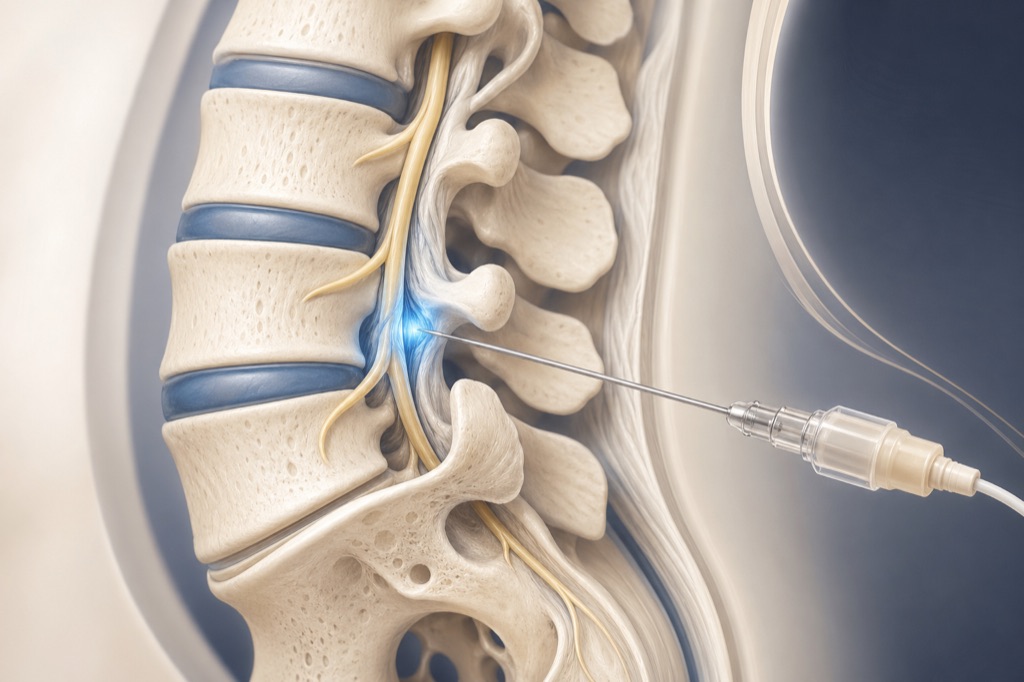
Spine injection
Selective Nerve Root Block (SNRB)
Selective nerve root block in Houston: a diagnostic injection that confirms which spinal nerve causes leg or arm pain before surgery, and can treat it.
In short
A selective nerve root block is an X-ray-guided injection of a small amount of local anesthetic, with or without steroid, around one specific spinal nerve as it exits the spine. Its main job is diagnostic: if numbing that one nerve takes your leg or arm pain away for a few hours, we know which nerve, and which level, is responsible, which is exactly the information a surgeon needs before a decompression. When steroid is added it also works as a treatment, the same as a transforaminal epidural steroid injection, with relief that starts in 2–7 days and lasts weeks to months.
Key facts
| Treats / tests | Identifies the nerve root (for example L5 vs S1, or C6 vs C7) responsible for radicular pain when MRI shows more than one possible level or imaging and symptoms do not match; with steroid, treats that root |
|---|---|
| Test or treatment? | Both. Anesthetic alone is a test; anesthetic plus steroid is a test and a treatment |
| Procedure time | 10–15 minutes per level; about 60–90 minutes at the office |
| Anesthesia | Local anesthetic in the skin; sedation is kept minimal so your pain report is reliable |
| Downtime | Rest the day of the injection; normal activity the next day |
| When relief starts | Diagnostic phase: within 15–30 minutes. Steroid phase (if added): 2–7 days |
| How long relief lasts | Diagnostic relief lasts 1–6 hours on purpose; steroid relief weeks to months |
| How often it can be repeated | A diagnostic block is usually done once per level; steroid injections are limited to about 3–4 spinal steroid injections per year |
| Insurance | Covered by Medicare and most plans as a diagnostic or therapeutic transforaminal injection when there is radicular pain with a matching exam |
Who it is for
- Back or neck pain without leg or arm symptoms; the nerve root is not the likely source
- Clear single-level findings that match the symptoms, where a therapeutic epidural or surgery can proceed without a separate test
- Patients who cannot reliably rate their pain over the next 6 hours (heavy sedation, severe cognitive impairment)
- Signs of cauda equina syndrome or spinal cord compression, which need urgent surgical evaluation
- Active infection, uncontrolled diabetes (if steroid is planned), blood thinners that cannot be paused, or pregnancy
How a selective nerve root block works
Each spinal nerve root leaves the canal through its own opening (foramen) and supplies a predictable strip of skin and set of muscles. When an MRI shows disease at several levels, or when the pain pattern and the images disagree, the question becomes: which nerve is actually hurting? Physical exam and MRI answer it correctly most of the time, but not always, and operating on the wrong level is a failure nobody can undo.
A selective nerve root block answers the question directly. Under live fluoroscopy, a thin needle is guided to the outer edge of the foramen where one nerve root exits, contrast dye is injected to outline that single nerve, and then a very small volume (about 0.5–1 mL) of local anesthetic is injected. The volume is deliberately tiny so the anesthetic stays on one root and does not spread to its neighbors, which is what makes the block "selective". You then rate your usual leg or arm pain over the next several hours. If it drops by 70–80% or more while the anesthetic is active, that root is the pain generator. If it barely changes, the source is elsewhere and the surgeon has been saved from operating on the wrong level.
If steroid (dexamethasone) is added, the same injection becomes a transforaminal epidural steroid injection and can treat the inflamed root for weeks to months. The trade-off is that a larger, steroid-containing injection spreads more widely and makes the diagnostic answer a little less clean, so we choose the version that fits the question being asked.
What the relief pattern tells us
- Pain gone within 30 minutes, back in 1–6 hours: a positive diagnostic block. The level is confirmed. If steroid was included, expect a second wave of relief over the next 1–2 weeks.
- Pain gone for hours and also much better at 2 weeks: the root is confirmed and the steroid worked; we may not need to do anything else for now.
- Little or no change during the anesthetic window: a negative block. This nerve is probably not the main source, even if the MRI looks abnormal there. We block a different level on another day or reconsider the diagnosis (facet joint, SI joint, hip, peripheral nerve).
- Numbness in the leg but pain unchanged: the nerve was blocked but is not the cause; also a negative result.
A positive block predicts a good surgical result more reliably than a negative block predicts a bad one, so we interpret the result together with your exam and imaging rather than in isolation. We keep a written pain score sheet from the procedure room through the evening; it is worth more than memory.
What happens on procedure day
- Check-in: we record your baseline pain (0–10) and where it is, confirm blood-thinner and glucose plans, and give you a pain diary sheet for the afternoon. Take your normal medications but no extra pain medication that morning.
- Positioning: face down on the fluoroscopy table for lumbar levels; for cervical levels we use an interlaminar or ultrasound-assisted approach at the practice's discretion. The skin is cleaned and draped.
- Numbing: lidocaine in the skin and tissue over the target foramen.
- Needle placement: under live X-ray the needle is advanced to the lower edge of the foramen, next to the exiting nerve. A small contrast injection outlines the nerve root and confirms the needle is not in a vessel. You may feel a brief zing of your usual pain when the needle is close; tell us, because reproducing your pain supports the diagnosis.
- Injection: 0.5–1 mL of local anesthetic, with or without dexamethasone, is injected slowly. We repeat the pain rating 15–30 minutes later and ask you to walk and bend the way that normally hurts.
- Recovery and diary: you rest 15–30 minutes while we check leg or arm strength, then go home with your driver and rate pain hourly for the next 6 hours.
After the procedure
Day 0. Fill in the pain diary hourly for 6 hours; note when the pain returns. The leg or arm may feel numb or weak for a few hours; do not drive. Do the activities that usually bring on your pain (within reason) so the test is meaningful, then rest.
Days 1–3. Soreness at the site is common. If no steroid was given, expect your usual pain to be back; that is the test working as intended. If steroid was given, a temporary flare for 1–3 days is possible before relief builds.
Week 1–2. Bring or send the diary. We review it with you, and with your surgeon if one is involved, at a follow-up visit or call. If steroid was included, rate your response at 2 weeks.
Call us for fever over 100.4 °F, a headache worse when upright, new or persistent weakness, bladder or bowel changes, or redness and drainage at the site.
What the evidence shows
Selective nerve root blocks are widely used for surgical planning, and the North American Spine Society supports their diagnostic use when imaging is equivocal or multilevel. Studies of diagnostic accuracy report that a positive block correctly identifies the symptomatic level in most patients and that patients selected for surgery on the basis of a positive block do well; the weakness in the literature is that the anesthetic can spread to adjacent roots or into the epidural space if the volume is too large, which is why the volume is kept to about 1 mL and confirmed with contrast. Systematic reviews (for example Datta and colleagues, Pain Physician) rate the diagnostic evidence as fair rather than strong, and we say the same to patients: it is a useful test that adds to, and does not replace, the exam and MRI.
As a treatment, the steroid version is a transforaminal epidural steroid injection and inherits that evidence base: Level I evidence for disc herniation with radiculitis in the ASIPP 2021 guidelines, with a small-to-moderate short-term benefit in the Cochrane review. Because the transforaminal route passes near small arteries, we use only non-particulate dexamethasone, live fluoroscopy and contrast for every injection.
Alternatives and what comes next
When imaging and symptoms match at a single level, a standard epidural steroid injection is simpler and gives the same treatment benefit. Electrodiagnostic testing (EMG and nerve conduction studies) is another way to localize a nerve root and is often ordered alongside a block. A positive block followed by good steroid relief may be all that is needed for a recent disc herniation; a positive block with short-lived relief supports surgical decompression at that level, and we send the result to your surgeon. A negative block redirects the work-up toward facet joints, the SI joint, the hip or a peripheral nerve. We perform selective nerve root blocks at our Houston and Webster offices, and in Pearland when that office opens in November 2026.
Safety and preparation
- Blood thinners: this is a transforaminal injection and is managed like an epidural. Warfarin, apixaban, rivaroxaban, dabigatran, clopidogrel, prasugrel, ticagrelor and enoxaparin are paused for 1–7 days depending on the drug, in coordination with the prescribing physician. Do not stop them on your own.
- Diabetes: if steroid is planned, expect a blood sugar rise for 1–3 days; check more often and call if readings stay above 300. For an anesthetic-only diagnostic block, glucose is not affected.
- Infection or fever: we reschedule for fever, active infection or a current antibiotic course.
- Allergies (contrast, steroid, local anesthetic): tell us about any reaction to X-ray dye, cortisone, lidocaine or dental numbing. Contrast is essential to a selective block, so allergy pre-medication is arranged in advance.
- Pregnancy: the procedure uses X-ray; tell us if you are or could be pregnant.
- Sedation and driving: sedation is kept minimal or avoided so your pain ratings are trustworthy. You still need an adult driver because the leg or arm may be numb or weak for hours.
- Pain medication on the day: take your usual scheduled medications but no extra or as-needed pain medication the morning of the block; it would mask the result.
- Imaging: a recent MRI or CT is required; the block is planned level by level from it.
Risks and side effects
- Soreness at the injection site for 1–3 days
- Temporary numbness, tingling or weakness in the leg or arm for a few hours (the intended effect of the anesthetic)
- Brief reproduction of your usual pain when the needle nears the nerve
- Temporary flare of pain for 24–72 hours if steroid is included
- Flushing, poor sleep or a rise in blood sugar for a few days if steroid is included
- Bleeding or bruising at the site
- Vasovagal reaction during the procedure
- Allergic reaction to contrast, steroid or local anesthetic
- Dural puncture with headache, if the needle enters the sleeve of spinal fluid around the nerve
- An inconclusive result because the anesthetic spread to more than one root
- Nerve root injury with persistent numbness, weakness or pain
- Spinal cord injury or stroke from particulate steroid entering a radicular artery, the reason we use only non-particulate dexamethasone with contrast confirmation; at the L1–L3 levels a spinal-cord artery can run through the foramen, so these levels are approached with extra care
- Epidural hematoma or abscess
- Seizure or heart rhythm disturbance from local anesthetic entering a blood vessel (very unlikely with the tiny volume used)
Frequently asked questions
What is the difference between a selective nerve root block and an epidural steroid injection?
They use the same route (transforaminal) but for different purposes. A selective nerve root block injects a very small volume of anesthetic around one nerve to find out whether that nerve is the pain source; the relief is meant to be short. An epidural steroid injection uses a larger volume with steroid to treat inflammation for weeks to months. A block with steroid added does both.
How long does relief from a selective nerve root block last?
The diagnostic relief lasts 1–6 hours, depending on the anesthetic used, and that short duration is the point. If steroid was included, a second phase of relief begins in 2–7 days and lasts weeks to months.
Why do I need a nerve root block before surgery?
When the MRI shows problems at more than one level, or the images and your symptoms disagree, a surgeon wants to be sure which nerve is responsible before removing bone or disc. A positive block at one level gives that confidence; a negative block prevents an operation on the wrong level.
What counts as a positive nerve root block?
Most physicians and surgeons look for at least 70–80% relief of your usual pain during the anesthetic window, with the pain returning as the anesthetic wears off. Numbness without pain relief, or relief that appears only days later, does not count as a positive diagnostic result.
Does a selective nerve root block hurt?
The skin numbing stings briefly. When the needle nears the nerve you may feel a brief electric jolt of your usual pain for a second or two; that is expected and actually helpful. The injection itself is a small volume and is over quickly. We avoid deep sedation so the test remains accurate.
Can a nerve root block be done in the neck?
Yes, with additional safeguards, because the cervical foramen contains the vertebral artery and small spinal-cord arteries. Depending on the level and your anatomy we may use a modified approach and we never inject particulate steroid in the neck. Read the cervical epidural steroid injection page for the safety rules we follow.
Sources
- Diagnostic Selective Nerve Root Blocks: coverage recommendations (opens in new tab) — North American Spine Society (NASS)
- Diagnostic utility of selective nerve root blocks in the diagnosis of lumbosacral radicular pain: a systematic review (opens in new tab) — Pain Physician (Datta S, et al.)
- Comprehensive Evidence-Based Guidelines for Epidural Interventions in the Management of Chronic Spinal Pain (2021) (opens in new tab) — American Society of Interventional Pain Physicians (ASIPP)
- Safeguards to Prevent Neurologic Complications after Epidural Steroid Injections (2015) (opens in new tab) — Anesthesiology / Multisociety Pain Workgroup
Next step
Request an appointment
Call (832) 916-2075 or request an appointment online. New patients are welcome; the team confirms insurance and referral requirements before scheduling.