
- Groin or deep front-of-hip pain with stiffness, worse with walking, getting out of a car and putting on socks, and X-ray or MRI showing hip arthritis or a labral tear
- Outer hip pain and tenderness over the bony point of the hip, worse lying on that side or climbing stairs (greater trochanteric pain syndrome), that has not settled with 6 weeks of exercise and activity changes
- Front-of-hip pain or a snapping sensation with hip flexion from the iliopsoas tendon
- Uncertainty about whether groin or buttock pain is coming from the hip or the spine, where the response to a hip joint injection helps decide
- Patients who want to delay hip replacement, or who need to be comfortable enough to do physical therapy
Joint & soft tissue
Hip Injections: Joint, Bursa and Tendon
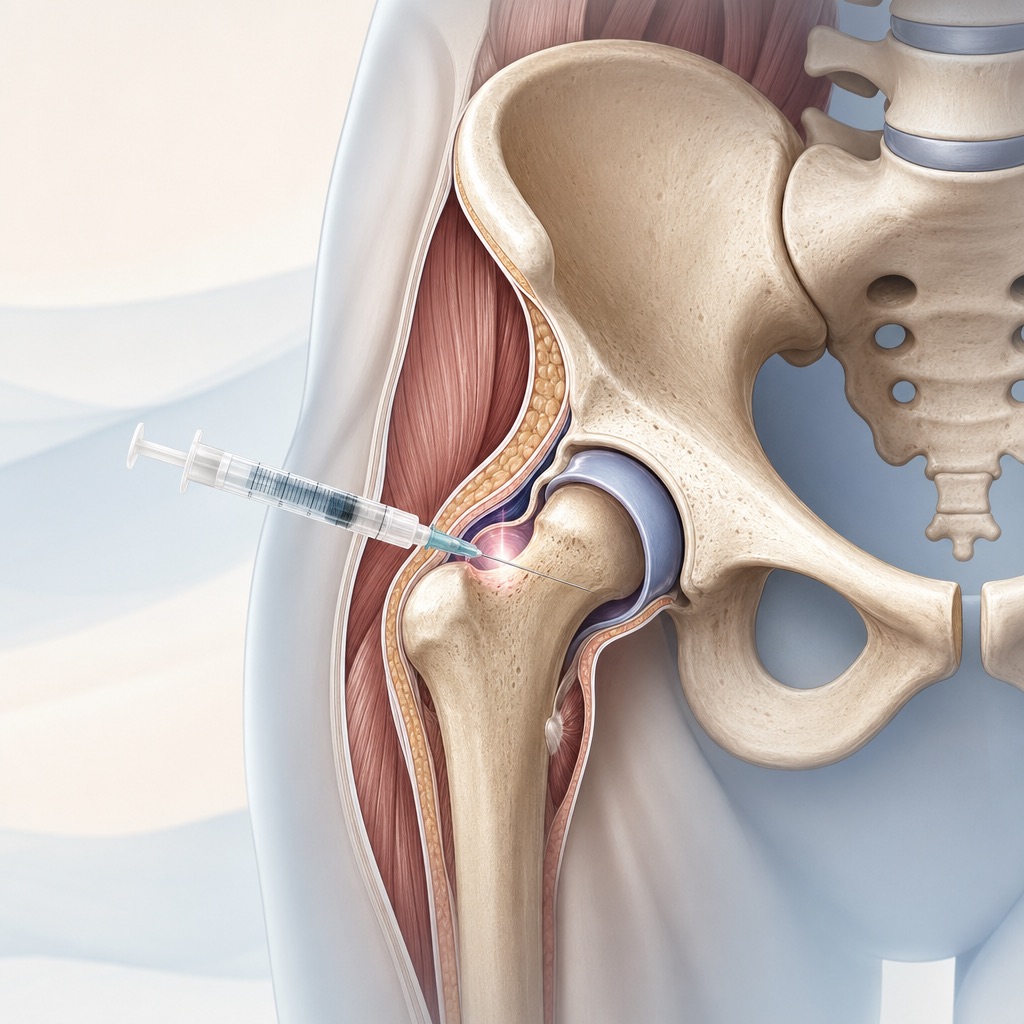
Image-guided hip injections in Houston: steroid into the hip joint for arthritis, trochanteric bursa and gluteal tendon injections for outer hip pain.
In short
Hip injections treat three different problems that patients all call "hip pain": arthritis inside the hip joint (felt in the groin), pain on the outer hip from the trochanteric bursa and gluteal tendons, and pain at the front of the hip from the iliopsoas tendon. Each has its own target, and the hip joint itself is deep enough that it can only be injected reliably with fluoroscopy or ultrasound. These are treatments, and the first joint injection also tells us whether the hip, rather than the spine, is the source. Steroid relief typically starts within 1–3 days and lasts 4–12 weeks.
Key facts
| Treats | Hip osteoarthritis and labral irritation (joint); greater trochanteric pain syndrome, gluteal tendinopathy and trochanteric bursitis (outer hip); iliopsoas tendinitis or bursitis (front of hip) |
|---|---|
| Test or treatment? | Treatment. A joint injection with local anesthetic also tests whether the hip joint is the pain source rather than the low back |
| Procedure time | 10–15 minutes; joint injections are scheduled in the procedure room, bursa and tendon injections can be done at an office visit |
| Anesthesia | Local anesthetic in the skin; no sedation |
| Downtime | Rest for 24–48 hours; after a joint injection the leg may feel numb or weak for a few hours, so plan a driver |
| When relief starts | Steroid: 1–3 days, sometimes up to a week |
| How long relief lasts | Joint: typically 4–12 weeks. Bursa and tendon: often 1–3 months, sometimes longer |
| How often it can be repeated | Steroid no more than 3–4 per site per year, at least 3 months apart, and only if the previous injection helped; fewer for tendons |
| Insurance | Covered by Medicare and most plans with a documented diagnosis; image guidance for the hip joint is covered |
Who it is for
- A hip replacement scheduled within the next 3 months: a steroid injection in that window raises the risk of infection in the new joint
- An existing hip replacement, unless the injection is arranged with the surgeon
- A hot, swollen, feverish hip or inability to bear weight after a fall, which need urgent evaluation for infection or fracture
- Skin infection over the injection site
- Uncontrolled diabetes, a steroid injection in any joint within the past 3 months, or a bleeding disorder that cannot be managed
- Pregnancy, if fluoroscopy would be needed (ultrasound is an alternative)
Three targets, three different problems
Intra-articular (inside the hip joint). The hip is a deep ball-and-socket joint under thick muscle, and true joint pain is felt in the groin or deep at the front of the hip, sometimes in the thigh or knee. Steroid injected into the joint settles the inflamed lining and typically gives 4–12 weeks of relief for osteoarthritis or labral irritation. Because the joint is deep, a blind injection misses it most of the time; we inject under fluoroscopy with contrast confirmation or under ultrasound, every time. The injection has a second use: if your groin or buttock pain disappears for a few hours while the anesthetic is working, the hip is the source; if it does not, the pain is more likely coming from the spine or SI joint. That distinction ("hip-spine syndrome") is one of the most common puzzles in pain medicine.
Trochanteric bursa and gluteal tendons (outer hip). Pain and tenderness over the bony bump on the side of the hip has traditionally been called bursitis, but ultrasound and MRI studies show that most of it is actually tendinopathy of the gluteus medius and minimus tendons where they attach to the bone, with the bursa inflamed secondarily. Read hip pain for the condition. A steroid injection into the bursa under ultrasound gives good short-term relief in most patients and lets them start the strengthening exercises that fix the underlying tendon problem. We avoid injecting steroid directly into the tendon, which can weaken it, and we do not repeat bursa steroid indefinitely for the same reason. For tendon-dominant cases that keep recurring, PRP has reasonable evidence, though it is self-pay.
Iliopsoas tendon and bursa (front of hip). The iliopsoas is the main hip flexor; its tendon and bursa can become inflamed with overuse, after hip replacement, or with a snapping hip. An ultrasound-guided injection of steroid around the tendon confirms the diagnosis and settles the pain, usually alongside stretching and strengthening.
Hip injections are performed at our Houston and Webster offices, and in Pearland when that office opens in November 2026.
What happens on procedure day
- Check-in: we confirm your blood-thinner plan, glucose if diabetic, allergies, any planned hip replacement and any recent steroid injection. For a joint injection, confirm you have a driver.
- Positioning: on your back for a joint or iliopsoas injection; on your side for a bursa or gluteal tendon injection. The skin is cleaned with antiseptic and draped.
- Guidance: for the joint, fluoroscopy is angled to show the front of the joint and the needle path along the femoral neck, away from the femoral nerve and vessels, or ultrasound shows the same path in real time. For bursa and tendon injections, ultrasound identifies the exact target.
- Numbing: lidocaine in the skin and the deeper tissue along the needle path.
- Injection: for the joint, a thin needle is advanced to the femoral neck, a small amount of contrast confirms it is inside the capsule, and steroid with local anesthetic is injected; a feeling of fullness in the groin is normal. For the bursa or tendon, the medication is spread over the target under ultrasound.
- After: a bandage and a few minutes of observation. After a joint injection we check your leg strength before you leave with your driver; after bursa and tendon injections most people drive themselves.
After the procedure
Day 0. Rest. After a joint injection the local anesthetic can spread toward the femoral nerve and make the thigh feel numb, heavy or weak, with a limp, for 2–6 hours; walk with care, use a rail on stairs, and do not drive until the leg feels normal. Note whether your usual groin pain is gone during this window; that is the diagnostic information. Ice 15 minutes at a time.
Days 1–3. The anesthetic wears off and the usual pain returns before the steroid takes effect; a steroid flare for 24–48 hours is possible. Flushing, poor sleep and a higher blood sugar are common for a few days. Avoid heavy loading of the hip for 48 hours.
Week 1–2. Steroid relief is established. Start or resume physical therapy: for outer hip pain, gluteal strengthening is the actual treatment and the injection is what makes it possible; for joint arthritis, strengthening and weight management slow the decline.
Judging the response. Rate the change at 2 weeks and 6 weeks. Relief of 50% or more for 4 weeks or longer justifies repeating when it wears off, within the yearly limit. Relief of only days means we look at other options.
Call us for a hip that becomes hot, swollen or much more painful 2–7 days after the injection, fever, drainage at the site, or weakness in the leg that persists beyond the day.
What the evidence shows
Hip joint steroid. Randomized trials show that intra-articular steroid relieves hip osteoarthritis pain for several weeks to about 3 months compared with placebo, with most benefit in the first 2 months. Accuracy matters: studies of landmark-guided hip injections report the joint is entered in well under half of attempts, while fluoroscopic and ultrasound-guided injections are accurate in more than 9 in 10. The American College of Rheumatology 2019 osteoarthritis guideline strongly recommends image guidance for hip joint injection and conditionally recommends against PRP in the hip, where the evidence is weak; it also recommends against hyaluronic acid (gel) injections in the hip, which some clinics offer and we do not perform. A small number of patients have developed rapidly progressive hip osteoarthritis or bone collapse after steroid injection, and the risk appears higher with repeated or high-dose injections; we use the lowest effective dose and do not repeat an injection that gave little relief.
Greater trochanteric pain syndrome. Steroid injection gives good relief at 1–3 months in most patients, but by 12 months outcomes are similar to exercise alone, and a well-designed randomized trial (Mellor and colleagues, BMJ 2018) found that an education-plus-exercise program beat steroid injection at 12 months. A separate trial (Fitzpatrick and colleagues, 2018) found PRP superior to steroid for gluteal tendinopathy at 12 weeks and 2 years. Our approach follows those results: steroid to break the pain cycle, exercise to fix it, PRP for stubborn tendon cases that can self-pay.
Before hip replacement. Large registry studies show that a steroid injection into the hip within 3 months of a hip replacement raises the risk of infection in the new joint, and orthopedic guidance is to wait at least 3 months; some surgeons prefer longer for the hip.
Alternatives and what comes next
For hip arthritis, exercise, weight management and anti-inflammatory medication remain the base, and hip replacement is the definitive treatment when pain becomes disabling; nothing we inject prevents it, provided steroid is avoided for 3 months beforehand. If the hip joint injection does not relieve groin or buttock pain, the spine or SI joint is the more likely source and the work-up shifts to an epidural steroid injection, medial branch blocks or an SI joint injection. For outer hip pain that keeps recurring after steroid, PRP or a structured tendon-loading program with a physical therapist is the next step. Compare medications and joints on the joint injections hub.
Safety and preparation
- Blood thinners: hip injections are low bleeding-risk procedures and most patients continue aspirin and other blood thinners. Tell us what you take; a hold is arranged only in specific cases with your prescriber. Never stop a blood thinner on your own.
- Diabetes: steroid raises blood sugar for 1–3 days, occasionally up to a week. Check more often, keep taking your medication, and call if readings stay above 300. We may postpone if your glucose is very high on the day.
- Infection or fever: we reschedule for fever, an active infection anywhere, or a skin problem over the hip. A hot, swollen hip with fever is evaluated for infection before any injection.
- Allergies (contrast, steroid, local anesthetic): tell us about reactions to X-ray dye, cortisone, lidocaine or dental numbing; contrast is used to confirm joint placement under fluoroscopy, so ultrasound can be used instead if you have a contrast allergy.
- Pregnancy: tell us if you are or could be pregnant; joint injections can be done under ultrasound without X-ray.
- Sedation and driving: no sedation is used. After a hip joint injection bring an adult driver, because the leg may be numb or weak for a few hours. After bursa, gluteal tendon or iliopsoas injections most people drive themselves.
- Planned hip replacement: tell us the date. No steroid is injected into the hip joint within 3 months of a planned replacement, and we notify your surgeon of any injection.
- Existing hip replacement: we do not inject an artificial hip joint except in coordination with the surgeon; iliopsoas injections after replacement are done under ultrasound with the surgeon's knowledge.
- Recent steroids: a steroid injection into any joint within 3 months, or an epidural or oral steroid course within 2 weeks, usually means we wait.
Risks and side effects
- Soreness at the site for 1–2 days
- Thigh numbness, heaviness or weakness with a limp for 2–6 hours after a joint injection
- Steroid flare: increased pain for 24–48 hours in a small number of people
- Blood sugar rise for 1–3 days, sometimes up to a week, in people with diabetes
- Facial flushing, poor sleep or a racing feeling for a day or two
- Skin thinning, lightening or a dimple of fat loss at the site, more likely with bursa injections in thin patients
- Bruising or bleeding into the joint or bursa
- Allergic reaction to contrast, steroid or local anesthetic
- Temporary worsening of a limp or hip weakness for a day
- No benefit, or relief lasting only days
- Septic arthritis of the hip, which needs same-day treatment
- Rapidly progressive osteoarthritis or collapse of the femoral head after steroid injection, reported in a small number of patients and more likely with repeated or high-dose injections
- Gluteal tendon tear or weakening after repeated steroid near the tendon
- Femoral nerve or vessel injury from the needle, avoided with image guidance along the femoral neck
- Increased infection risk in a subsequent hip replacement when steroid is given within 3 months of surgery
- Cartilage loss with frequent repeated steroid over years
Frequently asked questions
How long does a hip injection last?
A steroid injection into the hip joint typically gives 4–12 weeks of relief, starting within 1–3 days. Bursa injections for outer hip pain often last 1–3 months, and sometimes longer once exercise takes over. Relief of only a few days means the injection is not the right tool and we look at other options.
Why does my hip injection need X-ray or ultrasound?
The hip joint is deep under thick muscle and cannot be felt from the surface. Injections done by feel enter the joint in well under half of attempts, and medication outside the joint neither helps nor tells us anything. Fluoroscopy with contrast dye or ultrasound confirms the needle is inside the joint every time.
Why is my leg numb and weak after a hip injection?
The local anesthetic in a joint injection can spread forward toward the femoral nerve, which supplies the thigh muscles. The thigh can feel numb or heavy and you may limp for 2–6 hours. It wears off on its own; it is the reason we ask for a driver and for care on stairs.
Is my pain from my hip or my back?
Hip joint pain is usually felt in the groin or deep at the front of the hip and is worse with putting on shoes, getting out of a car and rotating the leg. Back and SI joint pain are more often felt in the buttock and can run down the leg. When it is unclear, a hip joint injection with local anesthetic settles it: if the pain vanishes for a few hours, the hip is the source.
Can I get a hip injection before a hip replacement?
Not within about 3 months of the surgery date. A steroid injection in that window raises the risk of infection in the new joint, and most surgeons will delay the operation if one has been given. Tell us the planned date before any injection.
Is hip bursitis really bursitis?
Usually not on its own. Most outer hip pain is tendinopathy of the gluteal tendons where they attach to the bone, with the bursa inflamed secondarily. Steroid settles the pain in the short term; strengthening the gluteal muscles is what makes it stay away, and PRP is an option for tendon problems that keep recurring.
How many hip injections can I have?
No more than 3–4 steroid injections per site per year, at least 3 months apart, and only when the previous one gave meaningful relief. For the joint, repeated steroid has been linked to accelerated arthritis in a small number of patients, so we treat the limit as a ceiling.
Sources
- 2019 American College of Rheumatology/Arthritis Foundation Guideline for the Management of Osteoarthritis of the Hand, Hip, and Knee (opens in new tab) — American College of Rheumatology
- Education plus exercise versus corticosteroid injection use versus a wait and see approach on global outcome and pain from gluteal tendinopathy: prospective, single blinded, randomised clinical trial (Mellor R, et al., 2018) (opens in new tab) — BMJ
- The Effectiveness of Platelet-Rich Plasma Injections in Gluteal Tendinopathy: A Randomized, Double-Blind Controlled Trial Comparing a Single Platelet-Rich Plasma Injection With a Single Corticosteroid Injection (Fitzpatrick J, et al., 2018) (opens in new tab) — American Journal of Sports Medicine
- Intra-articular hip injection and early revision surgery following total hip arthroplasty: is there a connection? Registry and database evidence (opens in new tab) — Journal of Bone and Joint Surgery / AAOS
- Rapidly progressive osteoarthritis of the hip after intra-articular corticosteroid injection (opens in new tab) — Radiology / Skeletal Radiology (review literature)
Next step
Request an appointment
Call (832) 916-2075 or request an appointment online. New patients are welcome; the team confirms insurance and referral requirements before scheduling.