
- Osteoarthritis of the hip, knee, shoulder or ankle with pain that limits walking, sleep or exercise despite oral medication and activity changes
- Bursitis or tendon pain around a joint (trochanteric bursa and gluteal tendons at the hip, subacromial bursa at the shoulder, pes anserine bursa at the knee)
- Frozen shoulder (adhesive capsulitis) in the painful early phase, where steroid speeds recovery
- A flare of gout, rheumatoid or psoriatic arthritis in one joint, alongside the rheumatology plan
- Patients who want to delay or avoid joint replacement, or who need to be more comfortable for physical therapy
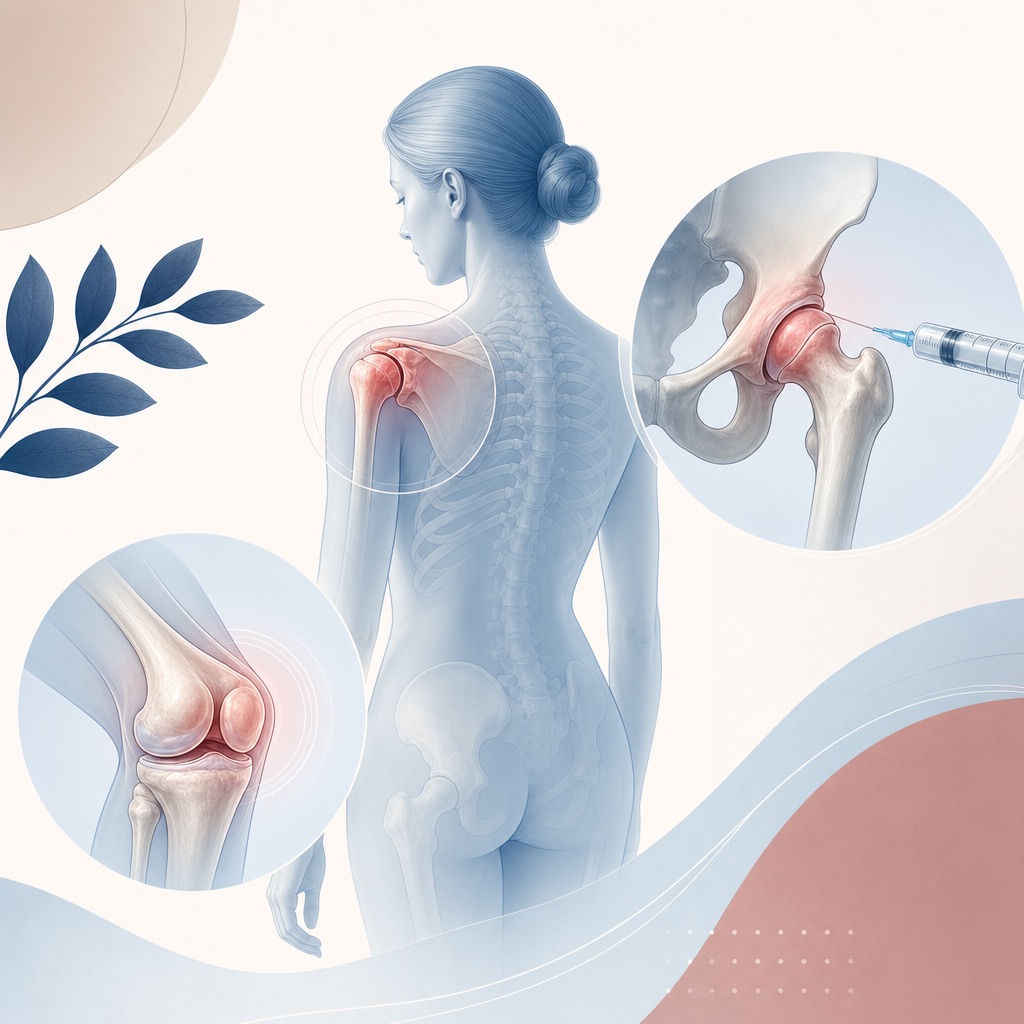
Joint & soft tissue
Joint Injections: Hip, Knee, Shoulder and Ankle
Image-guided joint injections in Houston for hip, knee, shoulder and ankle: steroid vs PRP, how long relief lasts, how often, and the joint-replacement rule.
In short
A joint injection places medication directly inside an arthritic or inflamed joint, or into the bursa or tendon next to it, to reduce pain and let you move and exercise. The two medications we use are corticosteroid (fast, reliable, short-lived) and platelet-rich plasma (your own concentrated platelets, self-pay, evidence fair for knee arthritis and some tendons). These are treatments; the first injection also has diagnostic value when relief confirms which joint is the source. This hub covers what is common to every joint and links to the detailed hip and knee pages.
Key facts
| Treats | Osteoarthritis, bursitis and tendon pain of the hip, knee, shoulder, ankle and foot; flares of inflammatory arthritis |
|---|---|
| Test or treatment? | Treatment. Relief from the first injection also helps confirm the joint as the pain source |
| Procedure time | 5–15 minutes; usually done at an office visit |
| Anesthesia | Local anesthetic in the skin; no sedation |
| Downtime | Rest the joint for 24–48 hours; most people return to work the same or next day |
| When relief starts | Steroid: 1–3 days, sometimes up to a week. PRP: 4–8 weeks |
| How long relief lasts | Steroid: typically 4–12 weeks. PRP: 6–12 months in responders |
| How often it can be repeated | Steroid: no more than 3–4 per joint per year, at least 3 months apart. PRP: 1–3 injections per course |
| Insurance | Steroid injections are covered. PRP is not covered and is self-pay |
Who it is for
- A hot, red, swollen joint with fever, which could be infection or crystal arthritis and must be tested (joint fluid analysis) before any steroid is given
- A joint replacement planned within the next 3 months: a steroid injection in that window raises the risk of infection in the new joint, and most surgeons will postpone the operation
- An existing joint replacement (injecting an artificial joint carries infection risk and is done only by, or with, the surgeon)
- Skin infection over the joint
- Uncontrolled diabetes, a steroid injection in any joint within the past 3 months, or a bleeding disorder or blood thinners that cannot be managed
- Pregnancy, if fluoroscopy is needed (ultrasound guidance is an alternative for most joints)
At a glance
| Joint | What we inject | Image guidance | Typical relief | Notes |
|---|---|---|---|---|
| Hip: joint, trochanteric bursa/gluteal tendons, iliopsoas | Steroid; PRP for gluteal tendinopathy (self-pay) | Fluoroscopy or ultrasound required for the joint; ultrasound for bursa and tendons | Steroid 4–12 weeks; bursa injections often longer | Leg may be numb or weak for hours after a joint injection; no steroid within 3 months of hip replacement |
| Knee: joint, pes anserine bursa | Steroid; PRP (self-pay) | Ultrasound recommended; landmark injection misses about 1 in 3 | Steroid 4–12 weeks; PRP 6–12 months in responders | Repeated steroid linked to cartilage loss; genicular block/RFA when injections fade |
| Shoulder: glenohumeral joint, subacromial bursa, AC joint | Steroid | Ultrasound | Steroid 4–12 weeks; frozen shoulder often longer | Rotator cuff tendon itself is not injected with steroid (tendon weakening); suprascapular block for persistent pain |
| Ankle and foot: tibiotalar, subtalar, midfoot joints; plantar fascia | Steroid (limited for plantar fascia) | Ultrasound or fluoroscopy | Steroid 4–12 weeks | Repeated plantar fascia steroid risks rupture; not for Achilles tendon |
Steroid vs PRP: what each does
Corticosteroid (triamcinolone, methylprednisolone, betamethasone) is a powerful anti-inflammatory. Injected into an arthritic joint it settles the inflamed lining within days and gives most people 4–12 weeks of relief, sometimes longer. It does not rebuild cartilage, and the relief fades as inflammation returns. Repeated steroid injections carry costs: a rise in blood sugar for several days in diabetics, thinning of skin or fat at the site, and, with frequent knee injections over years, a small measurable loss of cartilage. That is why we limit steroid to 3–4 injections per joint per year, at least 3 months apart, and stop repeating an injection that gives less than 4–6 weeks of relief.
Platelet-rich plasma (PRP) is prepared from your own blood, spun to concentrate platelets and growth factors, and injected into the joint or tendon. The evidence is fair for knee osteoarthritis and for some tendon problems, weak elsewhere, and PRP is not covered by insurance. Relief in responders begins at 4–8 weeks and can last 6–12 months. Read PRP injections for the full evidence and coverage picture before choosing it.
What about gel shots? Hyaluronic acid (gel shot) injections are another option some clinics offer for the knee; we do not perform them, and the evidence for them is mixed (AAOS 2021 recommends against routine use).
Why we use image guidance
A needle placed by feel often misses the hip joint and misses the shoulder and knee joints more often than physicians like to admit (about 1 in 3 knee injections done blind land outside the joint). Medication outside the joint gives little relief and tells us nothing about the diagnosis. We use ultrasound or fluoroscopy for hip joint injections every time, and ultrasound for shoulder, ankle and most knee injections, so the medication goes where it is meant to and the response can be trusted. Fluoroscopy uses a small amount of contrast dye to confirm the needle is inside the joint; ultrasound shows the needle and the medication spreading in real time without radiation.
Two rules that matter: diabetes and planned joint replacement
Do not have a steroid injection within about 3 months of a planned joint replacement. Large database studies show that a steroid injection into a hip or knee in the 3 months before replacement raises the risk of infection in the new joint, and orthopedic surgeons and the American Academy of Orthopaedic Surgeons advise waiting at least 3 months (some surgeons prefer longer for the hip). If a replacement is being scheduled, tell us the date before any injection, and tell your surgeon about every injection you have had, PRP included.
Diabetes. A steroid injection into a large joint raises blood sugar for 1–3 days and occasionally up to a week, sometimes by 100 points or more in people on insulin. Check your glucose more often for a week, keep taking your medication, and call if readings stay above 300. We may postpone if your glucose is very high on the day, and we use the lowest effective steroid dose. PRP does not affect blood sugar.
Joint injections are performed at our Houston and Webster offices, and in Pearland when that office opens in November 2026.
What happens on procedure day
- Check-in: we confirm your blood-thinner plan, glucose if diabetic, allergies, any planned joint replacement, and any recent steroid injection. Most joint injections are done at a regular visit; hip joint injections are scheduled in the procedure room.
- Positioning: lying or sitting so the joint is relaxed and accessible; the skin is cleaned with antiseptic.
- Guidance: ultrasound or fluoroscopy identifies the joint space, bursa or tendon and the safest needle path away from nerves and vessels.
- Numbing: a small amount of lidocaine in the skin, or a cold spray for small superficial joints.
- Injection: the needle is guided into the target and the medication injected. For a swollen joint, fluid is drawn off first, which itself relieves pressure. A brief feeling of fullness in the joint is normal.
- After: a small bandage, a few minutes of observation, and home. No driver is needed except after a hip joint injection, when the leg may be numb or weak for a few hours.
After the procedure
Day 0. Rest the joint. Ice 15 minutes at a time. The local anesthetic may give a few hours of relief that then fades; that early relief is useful diagnostic information, so note it.
Days 1–3. A steroid flare, a temporary increase in pain for 24–48 hours, affects a small number of people and settles with ice and anti-inflammatories. Relief from steroid usually begins in this window. Avoid heavy loading of the joint for 48 hours.
Week 1–2. Return to physical therapy and your exercise program; the injection is meant to create a window for strengthening, which is what makes relief last. PRP takes longer, so judge it at 4–8 weeks.
Judging the response. Steroid: rate the change at 2 weeks and again at 6 weeks. Relief of 50% or more lasting 4–6 weeks or longer justifies repeating when it wears off, within the yearly limit. Relief of a few days only means the injection is not the right tool for this joint.
Call us for a joint that becomes hot, red, swollen or much more painful 2–7 days after the injection, fever, or drainage at the site; joint infection after injection is rare but must be treated the same day.
What the evidence shows
Steroid. A Cochrane review of intra-articular corticosteroid for knee osteoarthritis found moderate short-term pain relief lasting a few weeks, fading by 3 months. For the hip, a randomized trial found steroid superior to placebo at 2 months. For shoulder pain from bursitis or frozen shoulder, steroid speeds recovery in the first months. Against these benefits, a randomized trial of knee steroid every 3 months for 2 years (McAlindon and colleagues, JAMA 2017) found more cartilage loss than placebo and no lasting pain advantage, which is the basis for our repeat limits.
PRP. Several randomized trials show PRP at least as good as the lubricant injections it was compared against at 6–12 months for knee osteoarthritis, but the largest placebo-controlled trial (RESTORE, JAMA 2021) found no advantage over saline at 12 months. The ACR recommends against PRP for knee and hip osteoarthritis; the AAOS rates the evidence as limited. Tendon evidence (tennis elbow, gluteal tendinopathy) is somewhat stronger.
Image guidance. Ultrasound-guided injections are more accurate than landmark injections in every joint studied, and more accurate placement correlates with better relief.
Alternatives and what comes next
Exercise, weight management, bracing and oral or topical anti-inflammatories remain the foundation of osteoarthritis care, and injections work best alongside them. When injections give shorter and shorter relief, the next steps depend on the joint: for the knee, a genicular nerve block and genicular radiofrequency ablation can give 6–12 months of relief without surgery; for the shoulder, a suprascapular nerve block is the equivalent; for the hip, a surgical opinion about replacement. Joint replacement remains the definitive treatment for end-stage arthritis, and nothing we inject prevents it, provided steroid is avoided in the 3 months beforehand. Detailed pages: hip injections, knee injections, PRP; conditions: joint pain, shoulder pain, knee pain, hip pain.
Safety and preparation
- Blood thinners: joint injections are low bleeding-risk procedures and most patients continue aspirin and other blood thinners. Tell us what you take (warfarin, apixaban, rivaroxaban, dabigatran, clopidogrel, ticagrelor, enoxaparin); a hold is arranged only in specific cases and always with your prescriber. Never stop a blood thinner on your own.
- Diabetes: steroid raises blood sugar for 1–3 days, occasionally up to a week. Check more often, keep taking your medication, and call if readings stay above 300. We may postpone if your glucose is very high on the day. PRP does not affect glucose.
- Infection or fever: we do not inject a joint if you have a fever, an active infection anywhere, or a skin problem over the joint. A hot, red, swollen joint is tested for infection or crystals before any steroid.
- Allergies (contrast, steroid, local anesthetic): tell us about reactions to cortisone, lidocaine, dental numbing or X-ray dye.
- Pregnancy: tell us if you are or could be pregnant; ultrasound guidance avoids X-ray for most joints.
- Sedation and driving: no sedation is used. You can drive yourself after most joint injections; after a hip joint injection bring a driver, since the leg may be numb or weak for a few hours.
- Planned joint replacement: tell us the date. No steroid injection is given into a joint within 3 months of its planned replacement.
- Recent steroids: a steroid injection into any joint within the past 3 months, or an epidural or oral steroid course within 2 weeks, usually means we wait.
- Existing joint replacement: we do not inject an artificial joint except in coordination with the surgeon.
Risks and side effects
- Soreness at the injection site for 1–2 days
- Steroid flare: increased joint pain for 24–48 hours in a small number of people
- Blood sugar rise for 1–3 days, sometimes up to a week, in people with diabetes
- Facial flushing, trouble sleeping or a racing feeling for a day or two after steroid
- Temporary numbness or weakness near the joint from the local anesthetic for a few hours
- Skin thinning, lightening or a dimple of fat loss at the injection site after steroid, more likely with superficial injections
- Bruising or bleeding into the joint, particularly on blood thinners
- Allergic reaction to local anesthetic, steroid or contrast
- Menstrual irregularity, mood change or blood pressure rise from the steroid
- No benefit
- Joint infection (septic arthritis), estimated at roughly 1 in 3,000 to 1 in 50,000 injections; needs same-day treatment
- Tendon rupture when steroid is injected into or repeatedly near a tendon (Achilles, patellar, rotator cuff, plantar fascia)
- Accelerated joint damage (rapidly progressive osteoarthritis or bone collapse) reported after hip and knee steroid injections in a small number of patients
- Cartilage loss with frequent repeated steroid injections over years
- Nerve or blood vessel injury from the needle, prevented with image guidance
- Increased risk of infection in a subsequent joint replacement when steroid is given within 3 months of surgery
Frequently asked questions
How long does a cortisone shot last in a joint?
Typically 4–12 weeks for an arthritic hip or knee, sometimes longer for bursitis or frozen shoulder. Relief starts in 1–3 days. If a steroid injection helps for only a few days, repeating it is not worthwhile and a different approach is needed.
How many cortisone shots can you have in a joint?
No more than 3–4 per joint per year, at least 3 months apart, and only when the previous one gave meaningful relief. Frequent steroid injections over years are linked to cartilage loss in the knee and to bone damage in the hip, so we treat the limit as a ceiling rather than a schedule.
Can I get a steroid injection if I am having a knee or hip replacement soon?
Not within about 3 months of the surgery date. A steroid injection in that window raises the risk of infection in the new joint, and most surgeons will delay the operation if one has been given. Tell us and your surgeon about the timing before any injection.
Do joint injections raise blood sugar?
Steroid injections do, typically for 1–3 days and occasionally up to a week, sometimes substantially in people on insulin. Check your glucose more often, keep taking your diabetes medication, and call us if readings stay above 300. PRP does not affect blood sugar.
Is PRP better than cortisone?
For knee osteoarthritis, PRP has matched or beaten the lubricant injections it was compared against at 6–12 months in several trials, but the largest placebo-controlled trial found no advantage over saline, and PRP is not covered by insurance. For some tendon problems the evidence is somewhat stronger. Cortisone works faster and more predictably in the short term. See our PRP page for a full, honest comparison.
Why does my joint injection need ultrasound or X-ray?
Because needles placed by feel miss the joint often, especially the hip (most of the time) and the knee (about 1 in 3). Medication outside the joint gives little relief and makes the result impossible to interpret. Guidance makes the injection accurate and the response meaningful.
Sources
- Management of Osteoarthritis of the Knee (Non-Arthroplasty): Evidence-Based Clinical Practice Guideline (2021) (opens in new tab) — American Academy of Orthopaedic Surgeons (AAOS)
- 2019 American College of Rheumatology/Arthritis Foundation Guideline for the Management of Osteoarthritis of the Hand, Hip, and Knee (opens in new tab) — American College of Rheumatology
- Effect of Intra-articular Triamcinolone vs Saline on Knee Cartilage Volume and Pain in Patients With Knee Osteoarthritis: A Randomized Clinical Trial (McAlindon TE, et al., 2017) (opens in new tab) — JAMA
- Intra-articular corticosteroid for knee osteoarthritis (Cochrane Review, 2015) (opens in new tab) — Cochrane
Next step
Request an appointment
Call (832) 916-2075 or request an appointment online. New patients are welcome; the team confirms insurance and referral requirements before scheduling.