
- Shoulder pain lasting more than 3 months from arthritis, a rotator cuff tear or frozen shoulder, despite physical therapy, medication and at least one steroid injection into the joint
- Patients who are not candidates for shoulder replacement or rotator cuff repair, or who want to avoid or delay surgery
- Pain that persists after shoulder surgery, including after a shoulder replacement, once the surgeon has ruled out infection, loosening or a new tear
- Frozen shoulder where pain blocks the stretching program that is needed to regain motion
- Candidates for suprascapular radiofrequency ablation or a peripheral nerve stimulator, who need a positive block first
Nerve blocks & ablation
Suprascapular Nerve Block for Shoulder Pain
Ultrasound-guided suprascapular nerve block in Houston for chronic shoulder pain from arthritis, rotator cuff or frozen shoulder; then RFA or PNS.
In short
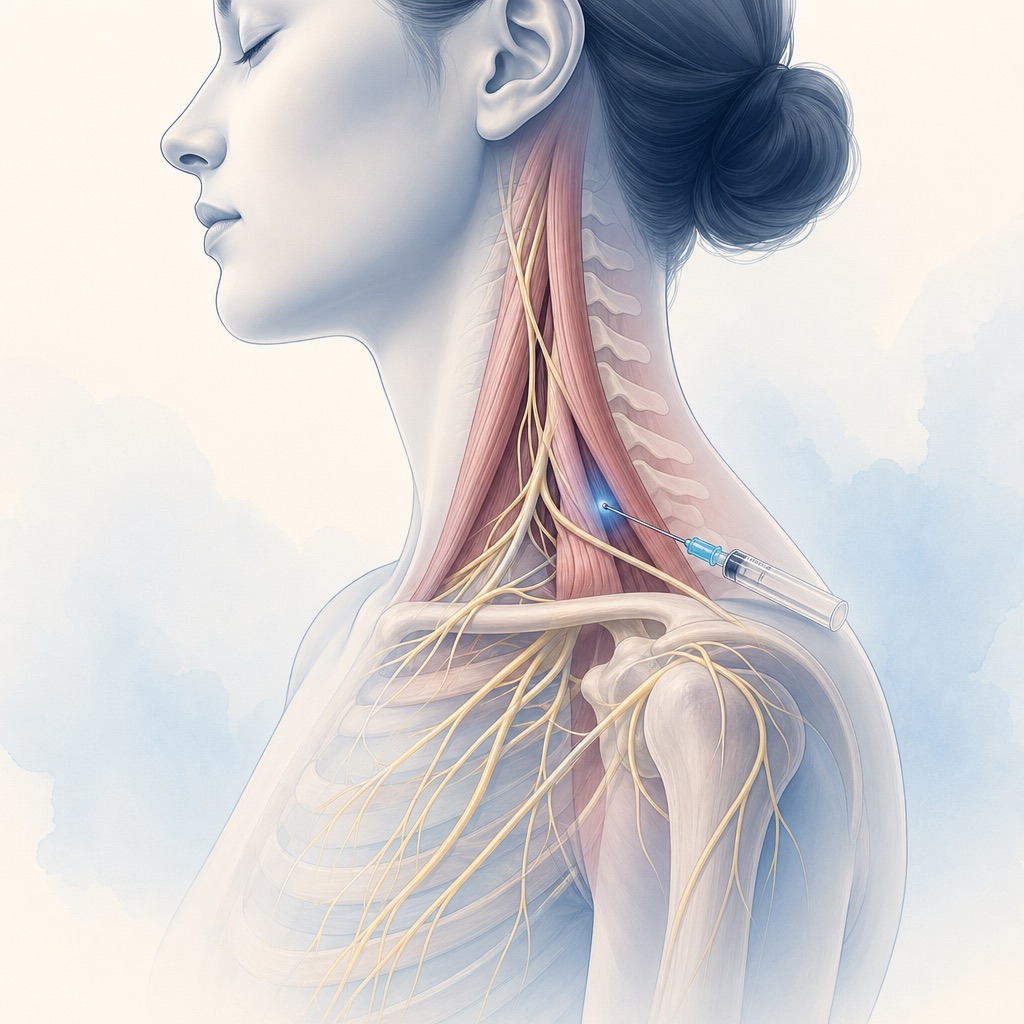
A suprascapular nerve block is an ultrasound-guided injection of local anesthetic, with or without steroid, around the nerve that carries most of the pain signal from the shoulder joint. Sometimes the axillary nerve is blocked as well. It is used for chronic shoulder pain from arthritis, rotator cuff disease, frozen shoulder or a shoulder that still hurts after surgery. It can be a test (anesthetic only: if the shoulder stops hurting for a few hours, these nerves are the source) or a treatment (with steroid, for weeks of relief). A positive block is the step before radiofrequency ablation or a peripheral nerve stimulator for the same nerves.
Key facts
| Treats | Chronic shoulder pain from glenohumeral osteoarthritis, rotator cuff tears or arthropathy, adhesive capsulitis (frozen shoulder), and persistent pain after shoulder surgery or replacement |
|---|---|
| Test or treatment? | Both. Anesthetic alone is a test that wears off in 2–8 hours by design. Anesthetic plus steroid is a treatment. A positive test qualifies you for suprascapular RFA or peripheral nerve stimulation. |
| Procedure time | 10–15 minutes; about 45 minutes in the office |
| Anesthesia | Local anesthetic at the skin; no sedation needed |
| Downtime | None beyond the numb hours. Drive yourself unless the arm is weak; return to work the same or next day. |
| When relief starts | Within 10–20 minutes from the anesthetic; steroid over 3–7 days |
| How long relief lasts | Test: hours. With steroid: typically 4–12 weeks in trials. RFA after a positive block: typically 6–12 months. PNS: months to years. |
| How often it can be repeated | Steroid blocks: typically no more than 3–4 per year for the shoulder. Diagnostic blocks: once or twice. |
| Insurance | Covered for chronic shoulder pain with documented exam and prior conservative care; a positive diagnostic block is generally required before RFA or PNS |
Who it is for
- A shoulder that is hot, red and swollen or accompanied by fever (possible joint infection): this needs urgent evaluation, not a block
- An acute full-thickness rotator cuff tear after an injury in a younger or active patient, which is time-sensitive for surgical repair; a block would only mask it
- Pain that is really coming from the neck (cervical radiculopathy), which a shoulder block cannot test; a neck exam comes first
- Skin infection over the shoulder blade
- Uncontrolled diabetes if a steroid is planned
- Bleeding disorders, though this is a superficial block and most blood thinners can continue
Why two small nerves can switch off a whole shoulder
The shoulder joint gets its pain supply from a few nerves. The suprascapular nerve (from C5–C6) carries roughly 70% of it: the back and top of the joint capsule, the acromioclavicular joint and the bursa under the acromion. It runs across the top of the shoulder blade through a small notch. The axillary nerve supplies most of the rest, the front and lower capsule, as it wraps around the back of the humerus. Blocking one or both interrupts the pain signal from the joint without numbing the whole arm.
Ultrasound guidance. We place the probe over the top of the shoulder blade and follow the nerve into the supraspinous fossa or the suprascapular notch, where it lies beside its artery under a ligament. A fine needle is advanced in view, and 5–10 mL of anesthetic (with steroid, for a treatment block) is placed around the nerve. The axillary nerve is found at the back of the shoulder next to the posterior circumflex humeral artery and blocked with 5 mL. Seeing the needle the whole way keeps it away from the lung, which sits below the notch, and lets us use a small volume so the anesthetic does not spread to the brachial plexus and weaken the arm.
Test or treatment. An anesthetic-only block is a test. If your shoulder pain drops by at least 50% for the hours the drug works, and you can lift and reach in ways that normally hurt, these nerves are carrying your pain and you qualify for a longer-lasting procedure on them. A block with steroid is a treatment; in randomized trials it gave 4–12 weeks of reduced pain and better movement in chronic shoulder pain and frozen shoulder.
Why not an interscalene block? The interscalene block, which numbs the whole brachial plexus in the neck, is a surgical anesthesia block used for shoulder operations. It paralyzes the phrenic nerve on that side in nearly 100% of patients, taking half of the diaphragm out of action for hours, and it numbs and weakens the entire arm. That is acceptable for one operation with an anesthesiologist present; it is not a repeatable outpatient treatment for chronic pain, and we do not use it for that purpose. The suprascapular block gives the pain relief without the arm weakness or the breathing effect.
What happens on procedure day
- Check-in and a short review: your pain score today, which movements hurt most, your blood-thinner list and, if diabetic, your morning glucose. We examine the shoulder and the neck so we know the pain is not radiating from a cervical nerve.
- You sit with your arm relaxed in your lap, or lie on your side. The skin over the top and back of the shoulder blade is cleaned with chlorhexidine.
- Ultrasound locates the suprascapular nerve and artery in the notch or fossa. A small lidocaine wheal numbs the skin.
- With the needle in view, we advance to the nerve and inject 5–10 mL of anesthetic, with steroid if this is a treatment block. You feel pressure and sometimes a brief ache deep in the shoulder. If the axillary nerve is included, we repeat at the back of the shoulder with about 5 mL.
- A bandage goes on. Within 10–20 minutes the deep shoulder ache typically fades. For a diagnostic block we ask you to reach overhead, behind your back and across your chest, then rate your pain.
- You are observed for 15–20 minutes and go home with a pain diary. Most people drive themselves; if your arm feels heavy or weak, wait until it recovers or have a driver.
After the procedure
Day 0. The shoulder feels lighter and less painful for 2–8 hours. Mild weakness of the muscles that turn the arm outward (supraspinatus and infraspinatus) can occur for the same period; do not lift anything heavy overhead until it passes. Rate your pain every hour on the diary while doing normal activities. Ice the injection site for 15 minutes if it aches.
Days 1–3. After a diagnostic block your usual pain returns; the hours of relief are the result we needed. After a steroid block, soreness at the site and a brief flare are common before relief builds. Diabetics should check glucose twice daily for three days.
Week 1–2. Steroid benefit is usually clear by day 7. This is the window to work on motion: for frozen shoulder, do the stretching program daily while the pain is down; for arthritis or cuff disease, resume the strengthening exercises from physical therapy. Relief lasts longer in patients who use it to move.
When we judge the response. The same day for a diagnostic block, from your diary. At 2–3 weeks for a steroid block. Call the same day for fever over 100.4°F, spreading redness, new shortness of breath (very rare), or arm weakness lasting beyond 24 hours.
What the evidence shows
Suprascapular nerve block has better trial evidence than most peripheral blocks for chronic pain. A randomized, placebo-controlled trial in patients with chronic shoulder pain from arthritis and rotator cuff disease found significant improvements in pain, disability and range of motion for 12 weeks after a single steroid block. Randomized trials in adhesive capsulitis show faster pain relief and better motion than physical therapy alone, and results comparable to injection into the joint. Systematic reviews rate the block as safe, with serious complications rare when ultrasound is used. The evidence for what comes next is newer: case series and small trials of pulsed and conventional radiofrequency of the suprascapular nerve report relief of 6–12 months in patients who responded to a diagnostic block, and peripheral nerve stimulation of the suprascapular and axillary nerves has early trial data showing sustained relief. These are options for patients who cannot or do not want to have shoulder surgery; they do not repair a torn cuff or replace a worn joint. Gulf Coast Pain & Spine performs these blocks under ultrasound in Houston and Webster, and in Pearland when that office opens in November 2026.
Alternatives and what comes next
Before a nerve block: most shoulders should have had 6–12 weeks of physical therapy, activity modification, anti-inflammatory medication and an ultrasound-guided steroid injection into the joint or bursa; for frozen shoulder, an intra-articular steroid injection plus stretching is the standard first step. If the pain comes from the neck, a selective nerve root block is the right test instead.
After a positive suprascapular block that keeps wearing off, the longer-lasting options are radiofrequency ablation of the suprascapular (and sometimes axillary) nerve, which typically gives 6–12 months and can be repeated, and peripheral nerve stimulation, a thin lead placed next to the nerve for 60 days or permanently, for patients who need more durable relief. Surgical options (arthroscopic repair, shoulder replacement) remain the definitive treatment for a repairable tear or advanced arthritis in patients fit for surgery, and a nerve block does not change that. If a well-placed block gives no relief, the shoulder joint nerves are not the source, and we look at the neck, the acromioclavicular joint or a muscular cause. Ask which approach we recommend for your shoulder.
Safety and preparation
- Blood thinners: this is a superficial, ultrasound-guided block classified as low risk under ASRA guidance, so aspirin, clopidogrel, warfarin and DOACs can usually continue. Tell us what you take; if your INR is high or you take two antiplatelet drugs, we may adjust. Never stop a blood thinner on your own.
- Diabetes: a steroid block raises blood sugar for 1–7 days. We do the block with anesthetic only, or postpone the steroid, if your morning glucose is above roughly 200–250 mg/dL.
- Infection or fever: fever above 100.4°F or skin infection over the shoulder postpones the block. A hot, swollen shoulder needs joint infection ruled out first.
- Allergies (contrast, steroid, local anesthetic): no contrast dye is used. Tell us about any reaction to lidocaine, bupivacaine or a steroid injection so we can substitute.
- Pregnancy: no X-ray is used and an anesthetic-only block is considered safe; we avoid steroid unless clearly needed. Tell us if you are or could be pregnant.
- Sedation and driving: no sedation is needed and most patients drive themselves. If your arm feels weak or heavy afterward, wait until it recovers before driving.
- Planned shoulder surgery: tell us if a replacement or repair is scheduled; most surgeons want no steroid injection within about 3 months of surgery because of infection risk.
Risks and side effects
- Soreness or bruising at the needle site on the shoulder blade for 1–3 days
- Temporary weakness of outward rotation of the arm for 2–8 hours from anesthetic on the motor branches (expected)
- A short flare of shoulder pain for 1–3 days after a steroid block
- Blood sugar rise for several days and facial flushing after steroid
- Anesthetic spread to the brachial plexus, making the whole arm numb or weak for several hours; more likely with the higher (supraclavicular) approach or larger volumes
- Vasovagal reaction during the injection
- Bleeding from the suprascapular artery, which runs beside the nerve
- Prolonged numbness or tingling over the shoulder lasting days
- Pneumothorax (punctured lung): the lung lies below the suprascapular notch, and this was the classic risk of landmark technique; with ultrasound and a lateral needle path it is very rare
- Infection at the site or into the joint
- Nerve injury from direct needle trauma, with lasting weakness of the rotator cuff muscles; very rare with ultrasound
- Local anesthetic toxicity from injection into the artery: dizziness, ringing ears, and at worst seizure; we draw back before injecting
Frequently asked questions
Is a suprascapular nerve block the same as an interscalene block?
No. An interscalene block numbs the whole brachial plexus for shoulder surgery and paralyzes the diaphragm on that side in almost every patient for hours; it is done by anesthesiologists for operations, not repeated for chronic pain. A suprascapular block targets only the pain nerves of the joint, leaves your arm working and your breathing untouched, and can be repeated or turned into ablation or a stimulator.
Is this a test or a treatment?
Either. Anesthetic alone is a test: hours of relief mean these nerves carry your shoulder pain and you qualify for radiofrequency ablation or a peripheral nerve stimulator. Anesthetic plus steroid is a treatment that gave 4–12 weeks of relief in trials. We tell you which before you schedule.
Will my arm be numb or weak?
Usually not. The block numbs the joint, not the skin of the arm. Some patients notice mild weakness turning the arm outward for a few hours. Whole-arm numbness means the anesthetic spread to the brachial plexus, which is uncommon with small volumes under ultrasound and wears off in hours.
Can it fix my rotator cuff tear?
No. It reduces the pain from a torn cuff or a worn joint; it does not repair anything. It is most useful for patients who are not surgical candidates or who want to delay surgery. An acute full-thickness tear in an active person is time-sensitive for repair and should see a surgeon first.
How is it different from a cortisone shot into the shoulder?
A joint injection treats the inflamed joint or bursa directly and is usually tried first. A suprascapular block treats the nerve carrying the pain, which works even when the joint is too worn for a joint injection to help, and it can lead to ablation or stimulation, which a joint injection cannot.
What if the block wears off after a few weeks?
That is the expected pattern with steroid and a positive result for planning. The next step is radiofrequency ablation of the suprascapular nerve (typically 6–12 months of relief, repeatable) or a peripheral nerve stimulator for longer-lasting control.
Can I drive home?
Yes, in most cases. No sedation is used. If your arm feels weak or heavy after the block, wait in the office until it recovers or bring a driver.
Sources
- Suprascapular nerve block (using bupivacaine and methylprednisolone acetate) in chronic shoulder pain: a randomised, double-blind, placebo-controlled trial (opens in new tab) — Annals of the Rheumatic Diseases (BMJ)
- Interventional Spine and Pain Procedures in Patients on Antiplatelet and Anticoagulant Medications (Second Edition) (opens in new tab) — American Society of Regional Anesthesia and Pain Medicine (ASRA)
- Management of Glenohumeral Joint Osteoarthritis: Evidence-Based Clinical Practice Guideline (opens in new tab) — American Academy of Orthopaedic Surgeons (AAOS)
- Diaphragm-sparing nerve blocks for shoulder surgery (review of phrenic nerve palsy after interscalene block) (opens in new tab) — Anesthesiology (American Society of Anesthesiologists)
- Shoulder Pain: Overview (opens in new tab) — National Institute of Arthritis and Musculoskeletal and Skin Diseases (NIAMS)
Next step
Request an appointment
Call (832) 916-2075 or request an appointment online. New patients are welcome; the team confirms insurance and referral requirements before scheduling.