
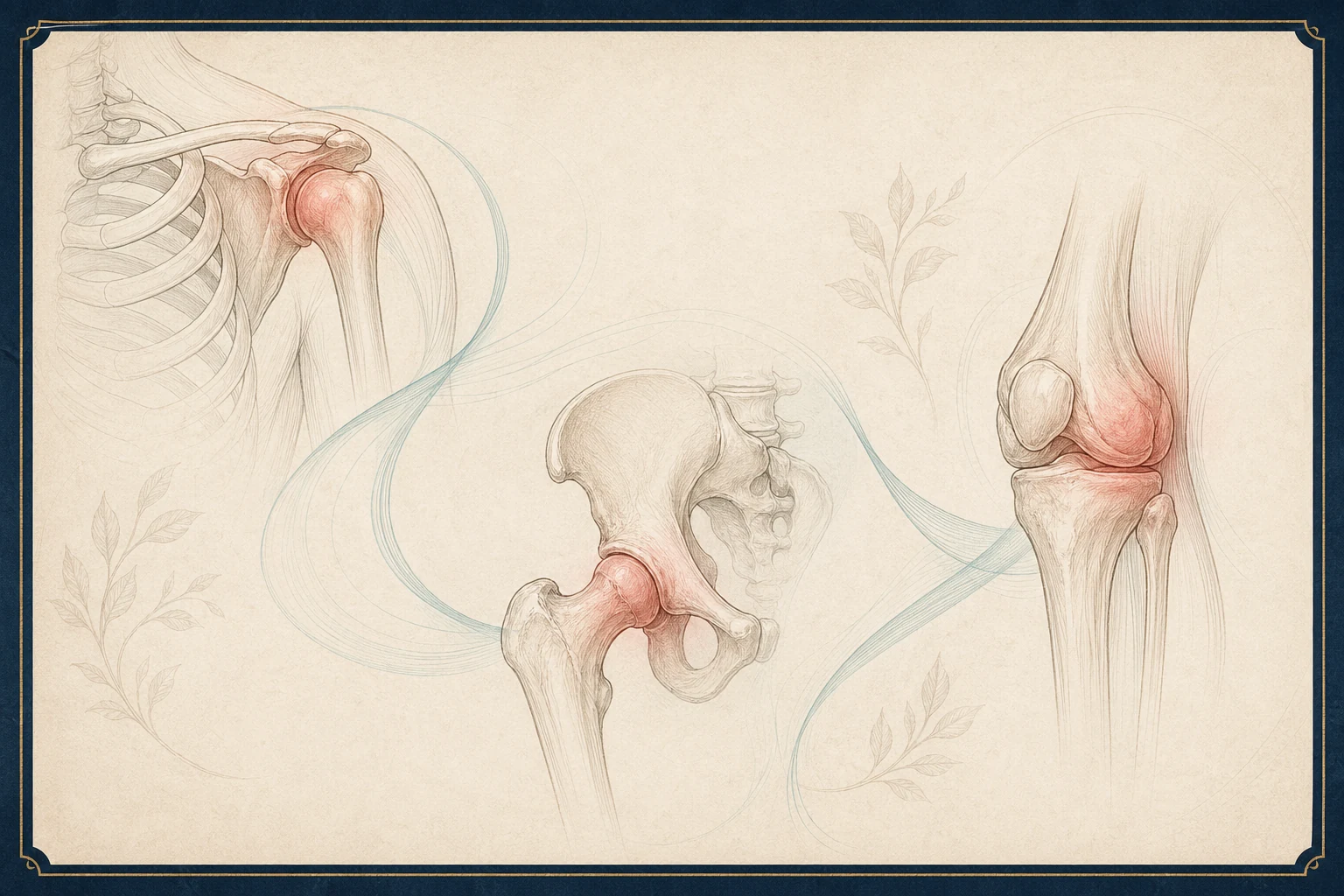
Joints
Joint Pain: Which Joint, and Where to Start
Knee, shoulder, hip or SI joint pain? Houston pain specialists explain which joint problems we treat, which signs need urgent care, and where to start.
Joint pain is a symptom, not a diagnosis, and the right care depends on which joint hurts and why. This page sorts the four joints we treat most often, points you to the detailed page for each, and lists the handful of situations where joint pain needs an emergency room or a rheumatologist rather than a pain specialist. Most joint pain we see comes from osteoarthritis, tendon problems around the joint, or pain referred from the spine.
Key facts
| What it is | Pain in or around a joint from the joint surface (arthritis), the tendons and bursae beside it, the nerves that supply it, or a structure elsewhere that refers pain to it. |
|---|---|
| Most common causes | Osteoarthritis, tendinopathy, bursitis, old injury, and referred pain from the neck, low back or sacroiliac joint. |
| Typical course | Overuse and mild arthritis flares settle in 2 to 6 weeks with activity changes. Pain that persists past 6 weeks, or keeps returning, deserves a diagnosis. |
| See a specialist when | Pain limits walking, sleep or work for more than 6 weeks, injections from your primary care physician or orthopedist have stopped working, or you are not a candidate for joint replacement. |
| Treatments we offer | Image-guided joint injections, genicular and suprascapular nerve blocks, radiofrequency ablation, peripheral nerve stimulation, and physical therapy coordination. |
When to get emergency care
Go to an emergency room or call 911 if you have:
- A single joint that is hot, red, swollen and too painful to move, especially with fever or chills; this is septic arthritis or acute gout until proven otherwise and needs the joint fluid tested the same day
- A joint that is visibly deformed or will not bear weight after a fall or injury (possible fracture or dislocation)
- Left shoulder or arm pain with chest pressure, shortness of breath, sweating or nausea (possible heart attack)
- A swollen, painful calf with knee or hip pain, particularly after surgery, travel or immobility (possible blood clot)
See a rheumatologist, not a pain specialist, first if you have pain and swelling in several joints at once, morning stiffness lasting more than 30 to 60 minutes, or joint pain with rash, fever, mouth sores or unexplained fatigue. That pattern suggests rheumatoid arthritis, psoriatic arthritis, lupus or another inflammatory disease, which is treated with medication that we do not prescribe.
Find your joint
Each page below covers causes, red flags, diagnosis and a step-by-step treatment ladder for that joint.
- Knee pain: arthritis, meniscus wear, pain after knee replacement. Steroid and PRP injections compared honestly; genicular nerve block and radiofrequency ablation for knees that are not ready for, or still hurt after, replacement.
- Shoulder pain: rotator cuff tears and tendinopathy, frozen shoulder, arthritis, and pain that is really coming from the neck. Includes the suprascapular nerve block.
- Hip pain: why most pain on the outside of the hip is gluteal tendinopathy rather than bursitis, how groin pain points to the hip joint itself, and image-guided hip injections.
- Osteoarthritis: the joint-by-joint guide to what works (and what does not) for wear-and-tear arthritis, with a table of what we offer for each joint.
- SI joint pain: the joint between the spine and pelvis, often mistaken for hip or low back pain.
We do not treat hand, wrist, elbow, ankle and foot joints as a primary focus; for those, an orthopedic or hand surgeon is usually the right first stop. Carpal tunnel syndrome is the exception, because it is a nerve problem rather than a joint problem.
Is it the joint, the tendon or the nerve?
Three quick distinctions help you and your physician start in the right place.
- Joint pain is deep, worsens with weight-bearing or moving the joint through its range, and often comes with stiffness after rest and swelling inside the joint. Arthritis is the usual cause.
- Tendon and bursa pain is on the surface, tender to direct pressure at one spot, and worse with specific loaded movements: the outer hip when lying on it, the front of the shoulder when reaching overhead, the inner knee just below the joint line.
- Referred or nerve pain does not change much with moving the joint itself. Shoulder blade and upper arm pain that changes with neck position is usually the neck; buttock and hip pain that changes with back position is usually the spine or SI joint; knee pain with a normal knee exam can come from the hip.
A careful exam sorts these in minutes. Imaging comes second, because X-rays and MRI show arthritis and tendon changes in many people who have no pain at all.
How treatment generally progresses
Whichever joint is involved, the order is similar and each step is explained on the joint-specific page.
- Activity changes, exercise and weight management
Guideline-recommended first-line care for every arthritic joint. Physical therapy and a home program do more for long-term function than any injection. See how we coordinate physical therapy. Learn more →
- Medication
Topical anti-inflammatories for knees and hands, oral NSAIDs when safe, acetaminophen, and duloxetine for widespread arthritis pain. Opioids are not recommended for chronic joint pain.
- Image-guided injections
Steroid injections give weeks to months of relief and are limited to about 3 or 4 per year per joint. PRP has mixed evidence and is usually not covered by insurance. Hyaluronic acid (gel) injections are another option some clinics offer; we do not perform them, and the evidence for them is mixed (AAOS 2021 recommends against routine use). Learn more →
- Nerve blocks and radiofrequency ablation
For knees and shoulders that no longer respond to injections, a diagnostic nerve block (a test) followed by radiofrequency ablation (a treatment) can give 6 to 12 months of relief without surgery. Learn more →
- Peripheral nerve stimulation or surgical referral
For persistent pain after joint replacement or when surgery is not an option, and orthopedic referral when a structural repair or replacement is the right answer. Learn more →
What you can do now
- Note where the pain is worst and what movement provokes it; one finger on the spot tells us a lot.
- Bring X-rays or MRI on disc, injection dates, and any orthopedic notes.
- Keep moving within tolerance. Rest beyond a few days stiffens a joint and weakens the muscles around it.
Gulf Coast Pain & Spine treats joint pain at our Houston and Webster offices, with Pearland opening in November 2026.
Frequently asked questions
Should I see a pain specialist, an orthopedist or a rheumatologist for joint pain?
Orthopedics for a recent injury, a locked or unstable joint, or when you want to discuss replacement. Rheumatology for several swollen joints, long morning stiffness or joint pain with rash or fever. A pain specialist for arthritis or tendon pain that persists despite conservative care, especially when surgery is not planned or has already been done.
How do I know if a swollen joint is an emergency?
A single joint that is hot, red, very swollen and too painful to move needs same-day evaluation, particularly with fever. Septic arthritis destroys cartilage within days and gout is intensely painful but treatable; both are diagnosed by testing fluid from the joint.
Is joint pain always arthritis?
No. Tendinopathy and bursitis around the joint, referred pain from the spine, and nerve entrapment cause a large share of what patients call joint pain, and each is treated differently. That is why the exam matters more than the X-ray.
Can you treat pain in a joint that has already been replaced?
Yes, once the surgeon has confirmed the implant is not infected, loose or malpositioned. Persistent pain after knee replacement, in particular, responds to genicular nerve radiofrequency ablation or peripheral nerve stimulation. See the knee pain page.
Do you offer PRP or stem cell injections?
We discuss PRP for specific tendon and knee arthritis cases with an honest account of the evidence, which is mixed, and the cost, which insurance rarely covers. We do not offer stem cell injections; major guidelines recommend against them for arthritis.
Sources
- 2019 American College of Rheumatology/Arthritis Foundation Guideline for the Management of Osteoarthritis of the Hand, Hip, and Knee (opens in new tab) — American College of Rheumatology
- Arthritis: overview of types and symptoms (opens in new tab) — National Institute of Arthritis and Musculoskeletal and Skin Diseases (NIAMS)
- Septic Arthritis (Joint Infection) (opens in new tab) — American Academy of Orthopaedic Surgeons, OrthoInfo
Request an appointment
Call (832) 916-2075 or request an appointment online. New patients are welcome; the team confirms insurance and referral requirements before scheduling.