
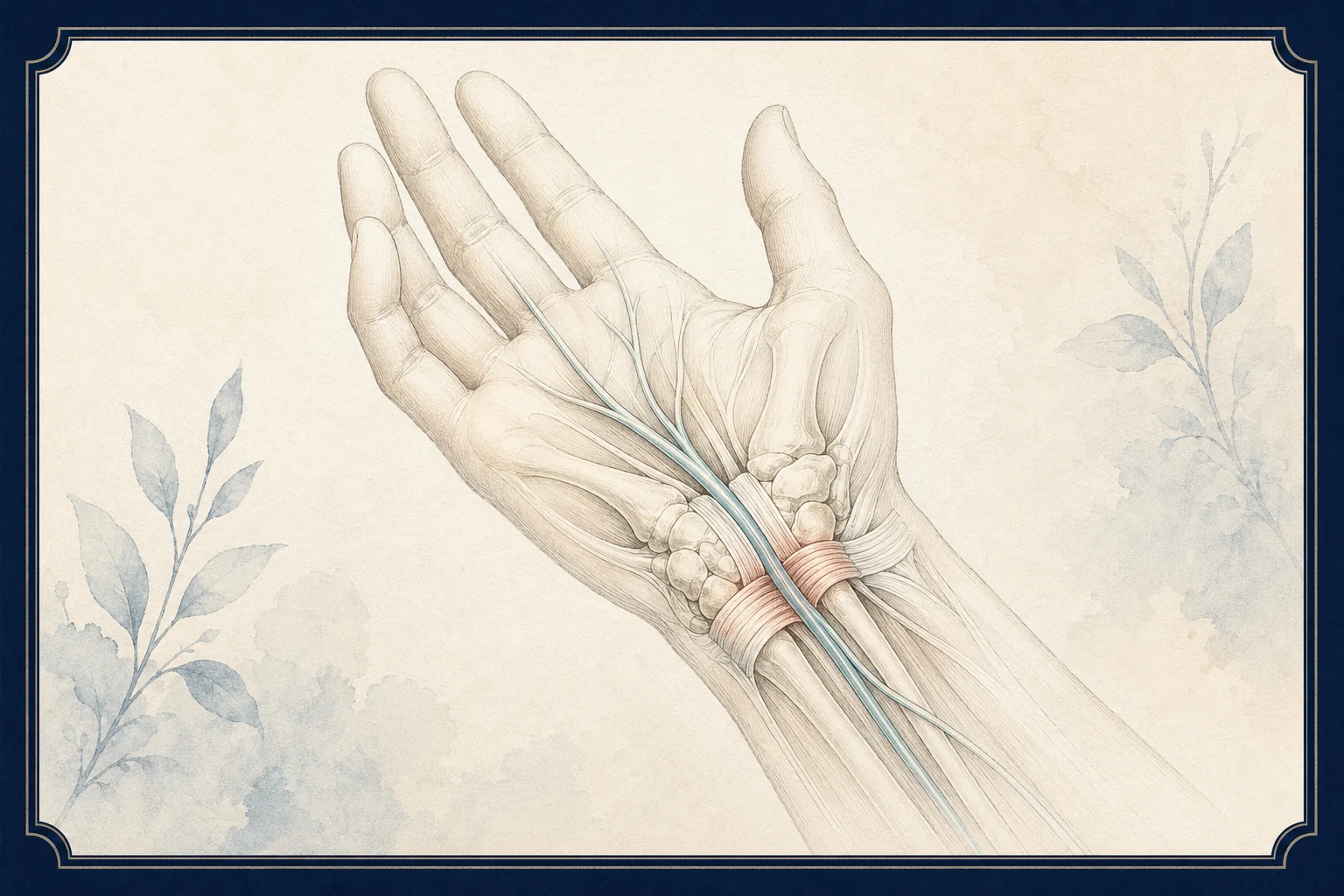
Nerve entrapment
Carpal Tunnel Syndrome
Numb, tingling hands at night? Houston pain specialists on carpal tunnel syndrome: splint, steroid injection, when to see a surgeon, and the neck link.
Carpal tunnel syndrome is pressure on the median nerve where it passes through a narrow tunnel at the wrist. It causes numbness and tingling in the thumb, index and middle fingers, worst at night, and affects roughly 3 to 6 percent of adults. Mild cases respond to a night splint; moderate cases to a steroid injection into the tunnel; and cases with constant numbness, weakness or wasting of the thumb muscles need a surgeon, because nerve damage at that stage can become permanent. Our particular role is sorting out when hand symptoms are coming from the wrist, from a pinched nerve in the neck, or from both at once.
Key facts
| What it is | Compression of the median nerve inside the carpal tunnel at the wrist, under the transverse carpal ligament. |
|---|---|
| Most common causes | Repetitive wrist flexion and vibration, fluid retention (pregnancy, hypothyroidism), diabetes, obesity, rheumatoid arthritis, wrist fracture; often no single cause. |
| Typical course | Intermittent night symptoms can stay stable for years or progress to daytime numbness, then constant numbness and weakness over months to years. Pregnancy-related cases usually resolve within weeks of delivery. |
| See a specialist when | Night splinting for 4 to 6 weeks has not controlled symptoms, numbness is present during the day, you drop objects, or your symptoms also involve the neck, shoulder or the outer fingers. |
| Treatments we offer | Clinical diagnosis and nerve-study coordination, splinting and activity guidance, carpal tunnel steroid injection, evaluation for a coexisting cervical radiculopathy, and prompt hand-surgery referral when needed. |
When to get emergency care
See a hand surgeon within 1 to 2 weeks, not a pain specialist, if you have:
- Visible flattening or wasting of the fleshy muscle at the base of the thumb (thenar atrophy); this means the nerve is already losing motor fibers and surgery should not wait
- Constant numbness in the thumb, index and middle fingers that no longer comes and goes, or loss of the ability to feel the difference between sharp and dull
- Weakness pinching or gripping, or dropping objects, that is getting worse over weeks
- Sudden hand numbness and weakness after a wrist fracture or a crush injury, or a wrist that is swollen, hot and very painful (acute carpal tunnel syndrome or infection; go to an emergency room)
Go to an emergency room or call 911 for sudden numbness or weakness of one whole arm or hand together with facial droop, trouble speaking or a severe headache; that is a possible stroke, not carpal tunnel.
What carpal tunnel syndrome is
The carpal tunnel is a passage at the base of the palm, floored by the wrist bones and roofed by a thick ligament. Nine tendons and the median nerve share it. Anything that swells the tendon linings or narrows the tunnel squeezes the nerve, and the nerve responds first with tingling and numbness, later with pain and weakness. The median nerve supplies feeling to the thumb, index, middle and half of the ring finger, and power to the muscles that bring the thumb across the palm, which is why those are the areas affected.
It is the most common nerve entrapment in the body, roughly three times more common in women, and peaks between 40 and 60. Nighttime symptoms come from sleeping with the wrist bent, which raises pressure inside the tunnel; shaking the hand to get feeling back on waking is such a consistent story that it has a name, the flick sign.
Common causes and the neck connection
- Wrist position and use. Sustained or repetitive flexion and extension, forceful gripping, and vibrating tools. Keyboard work is a weaker risk factor than most people assume, but wrist posture at the keyboard matters.
- Medical conditions. Diabetes, hypothyroidism, rheumatoid arthritis, kidney failure and obesity all raise the risk. In diabetics, carpal tunnel syndrome is often layered on top of diabetic neuropathy, and both need to be recognized.
- Pregnancy. Fluid retention in the third trimester causes carpal tunnel symptoms in a large share of pregnancies; most resolve within weeks of delivery, so splinting is the usual treatment and surgery is almost never needed.
- Anatomy and injury. A small tunnel, a prior wrist fracture, a ganglion cyst or a mass inside the tunnel.
Double crush. A nerve that is already irritated at one point is more vulnerable to compression at another. A pinched C6 or C7 nerve root in the neck (cervical radiculopathy) and carpal tunnel syndrome coexist far more often than chance would predict, and treating only the wrist in that situation leaves symptoms behind. Neck pain, symptoms that reach above the elbow, tingling that changes with neck position, or a nerve study that shows only mild wrist findings despite significant symptoms all raise the question. This overlap is where a pain practice adds the most value, and our cervical radiculopathy page covers the neck side of it.
Symptoms and how it differs from look-alikes
Classic carpal tunnel syndrome: tingling and numbness in the thumb, index and middle fingers, sparing the little finger; worse at night and when holding a phone, steering wheel or book; relieved by shaking the hand; later, clumsiness and dropping things, aching into the forearm, and finally constant numbness.
- Versus cervical radiculopathy: neck and shoulder-blade pain, symptoms reaching above the elbow, tingling in a pattern that follows one nerve root (C6: thumb and index; C7: middle finger; C8: ring and little fingers), changes with neck position, and sometimes reflex changes.
- Versus cubital tunnel syndrome (ulnar nerve at the elbow): numbness in the ring and little fingers, worse with the elbow bent, weakness spreading the fingers.
- Versus peripheral neuropathy: numbness in all fingers of both hands and in the feet, in a glove-and-stocking pattern, usually with diabetes or another systemic cause. See peripheral neuropathy.
- Versus thumb arthritis or tendinitis: pain at the base of the thumb with pinching and gripping, without numbness.
- Versus Raynaud's or vascular problems: color change of the fingers with cold, rather than numbness at night.
How we diagnose it
History and examination. The pattern above is often enough for a clinical diagnosis. On exam we map exactly which fingers are numb, test thumb strength and look for thenar wasting, and perform provocation tests: tapping over the nerve at the wrist (Tinel's sign), holding the wrists flexed for 60 seconds (Phalen's test) and pressing directly over the tunnel for 30 seconds (Durkan's compression test), which is the most accurate of the three. We also examine the neck, shoulder and elbow and test reflexes to look for a second site of compression.
Nerve conduction studies and EMG. These measure how fast signals travel across the wrist and whether the thumb muscles show nerve damage. They confirm the diagnosis, grade it as mild, moderate or severe, and detect a coexisting cervical radiculopathy or neuropathy. We recommend them before any injection or surgical referral, and surgeons generally require them. Grade guides treatment: mild disease is splinted, moderate is injected, and severe disease (absent sensory response or motor involvement) goes to a surgeon.
Ultrasound of the median nerve at the wrist, where a swollen cross-sectional area supports the diagnosis and can reveal a cyst or mass, and guides injections. Cervical MRI only when the exam or nerve study suggests the neck is contributing.
Treatment options, in order
The sequence is splint, then injection, then surgery, and the American Academy of Orthopaedic Surgeons guideline supports each step. How fast you move through it depends on severity.
- Night splint and activity changes (mild disease; first 4 to 6 weeks)
A wrist splint that holds the wrist straight (neutral, not cocked back), worn every night and during provoking activities, relieves symptoms in most mild cases within 4 to 6 weeks and is the treatment of choice in pregnancy. Adjust keyboard and tool grip so the wrist stays neutral, take short breaks from repetitive gripping, and treat any underlying thyroid disease or diabetes. Oral NSAIDs, diuretics and vitamin B6 have not been shown to work and are not recommended.
- Carpal tunnel steroid injection (moderate disease, or mild disease not controlled by splinting)
A small dose of corticosteroid injected into the tunnel beside the nerve, ideally under ultrasound guidance to avoid the nerve. In randomized trials it relieves symptoms in the majority of patients at one month, with relief typically lasting 2 to 6 months and sometimes far longer; about a third of patients get durable relief from one injection. A good response also confirms the wrist, not the neck, as the source. We generally give no more than 2 injections in a wrist before recommending surgical evaluation, because repeated steroid can weaken tendons and delaying surgery in progressive disease risks permanent numbness. This is a treatment.
- Treat the neck when it is contributing
When nerve studies and exam show cervical radiculopathy alongside carpal tunnel syndrome, we treat both: physical therapy, medication and, for the neck, a cervical epidural steroid injection or selective nerve root block, described on the cervical radiculopathy page. Treating the wrist alone in a double-crush patient often disappoints. Learn more →
- Hand surgery referral (severe disease, or failure of the steps above)
Carpal tunnel release cuts the ligament roofing the tunnel to take pressure off the nerve. It is a 15- to 20-minute outpatient operation, open or endoscopic, with success rates around 90 percent and a low complication rate. We refer promptly for thenar atrophy, constant numbness, weakness, severe nerve studies, or symptoms that return after two injections. Numbness that has been constant for many months may improve only partially even after surgery, which is why we do not delay that referral.
What you can do now
- Buy an over-the-counter wrist splint that keeps the wrist straight and wear it every night for 4 to 6 weeks; most drugstore splints angle the wrist back and should be flattened or replaced.
- Keep the wrist neutral at the keyboard: elbows at 90 degrees, forearms supported, keyboard flat.
- Loosen your grip on the steering wheel, phone and tools, and take a 1-minute break from repetitive gripping every 20 to 30 minutes.
- Nerve-gliding exercises (fingers straight, wrist back, then relax) a few times a day may reduce symptoms in mild cases.
- Look at the base of your thumb in a mirror: if the muscle pad looks flatter than the other side, do not wait for an appointment with us; see a hand surgeon.
- Bring any nerve study report, prior injection dates and neck imaging.
Gulf Coast Pain & Spine evaluates carpal tunnel syndrome and its neck look-alikes at our Houston and Webster offices, and in Pearland once that office opens in November 2026.
Frequently asked questions
How do I know if my hand numbness is carpal tunnel or my neck?
Carpal tunnel numbness stays in the thumb, index and middle fingers, is worst at night and improves with shaking the hand. Neck-related numbness follows one nerve root, often reaches above the elbow, comes with neck or shoulder-blade pain and changes with neck position. Both together is common. A nerve study and a careful exam of both sites settle it.
Does carpal tunnel syndrome go away on its own?
Mild, intermittent symptoms sometimes settle, especially with a night splint and changes to wrist use, and pregnancy-related cases usually resolve after delivery. Symptoms that have progressed to daytime numbness rarely go away without treatment, and constant numbness can become permanent.
How long does a carpal tunnel steroid injection last?
Most patients improve within a week and relief typically lasts 2 to 6 months; about one in three gets long-lasting relief from a single injection. If symptoms return quickly, or after a second injection, surgical release is usually the better next step than a third injection.
Do I need a nerve conduction study?
We recommend it before injection or surgical referral. It confirms the diagnosis, grades severity, which decides the treatment, and detects a coexisting neck or peripheral nerve problem that would change the plan. Surgeons generally require it.
When is surgery necessary for carpal tunnel?
When there is thenar muscle wasting, constant numbness, weakness, a severe nerve study, or symptoms that persist after splinting and one or two injections. Carpal tunnel release succeeds in about 90 percent of patients and takes minutes to perform. Waiting too long with constant numbness risks incomplete recovery.
Can I have carpal tunnel syndrome in both hands?
Yes; it is bilateral in more than half of patients, though usually worse in the dominant hand. Numbness in both hands and both feet, however, suggests peripheral neuropathy rather than carpal tunnel, and the nerve study distinguishes them.
Does typing cause carpal tunnel syndrome?
Less than commonly believed. Studies link forceful, repetitive gripping and vibration more strongly than keyboard use. Wrist posture at the keyboard still matters: a bent wrist raises pressure inside the tunnel, so keep it flat and supported.
Sources
- Management of Carpal Tunnel Syndrome, Evidence-Based Clinical Practice Guideline (2016) (opens in new tab) — American Academy of Orthopaedic Surgeons
- Carpal Tunnel Syndrome (opens in new tab) — National Institute of Neurological Disorders and Stroke (NINDS)
- Carpal Tunnel Syndrome (opens in new tab) — American Academy of Orthopaedic Surgeons, OrthoInfo
- Local corticosteroid injection for carpal tunnel syndrome (Cochrane review) (opens in new tab) — Cochrane Database of Systematic Reviews
Request an appointment
Call (832) 916-2075 or request an appointment online. New patients are welcome; the team confirms insurance and referral requirements before scheduling.