
Joints
Knee Pain
Knee arthritis or pain after knee replacement? Houston pain specialists compare steroid and PRP injections, genicular nerve ablation and nerve stimulation.
Knee pain in adults over 45 is most often osteoarthritis, the gradual wearing of the cartilage that cushions the joint. About 14 million Americans have symptomatic knee arthritis, and it is the leading reason for knee replacement. Most knees improve with exercise, weight management and occasional injections, but a group of patients need more: those whose injections have stopped working, those who cannot or do not want to have a replacement, and the 10 to 20 percent who still hurt after one. For them we offer genicular nerve blocks and radiofrequency ablation, which treat the nerves that carry pain from the knee, and peripheral nerve stimulation for the most persistent cases.
Key facts
| What it is | Pain inside or around the knee joint, most often from osteoarthritis, and also from meniscus wear, tendon and bursa irritation, or nerves left sensitive after surgery. |
|---|---|
| Most common causes | Osteoarthritis, degenerative meniscus tears, patellofemoral (kneecap) pain, pes anserine bursitis, and persistent pain after total knee replacement. |
| Typical course | Arthritis flares settle over 2 to 6 weeks; the underlying arthritis progresses slowly over years. Post-replacement pain that persists beyond 6 to 12 months is unlikely to resolve without treatment. |
| See a specialist when | Pain limits walking or sleep despite 6 weeks of exercise and medication, steroid injections last less than a month, or you have pain a year after a knee replacement that your surgeon has cleared. |
| Treatments we offer | Image-guided knee joint injections (steroid, PRP with caveats), genicular nerve block, genicular radiofrequency ablation, and peripheral nerve stimulation. |
When to get emergency care
Go to an emergency room or call 911 if you have:
- A hot, red, swollen knee with fever or chills, or any new swelling and warmth in a replaced knee (possible joint infection; a replaced knee that becomes infected is an emergency for the implant)
- Inability to bear weight after a fall or twist, or a knee that gives way and cannot straighten (possible fracture, ligament rupture or dislocation)
- A knee that is locked and cannot fully straighten or bend after a twist (a displaced meniscus fragment; needs orthopedics within days)
- Calf pain, swelling or warmth with knee pain, especially after surgery, travel or immobility (possible blood clot)
- Sudden severe pain with a pop and an obvious deformity or gap above or below the kneecap (possible tendon rupture)
Gout can also make a knee hot, swollen and exquisitely painful without injury. It is treatable, but it looks identical to infection and the fluid must be tested the same day.
What causes knee pain
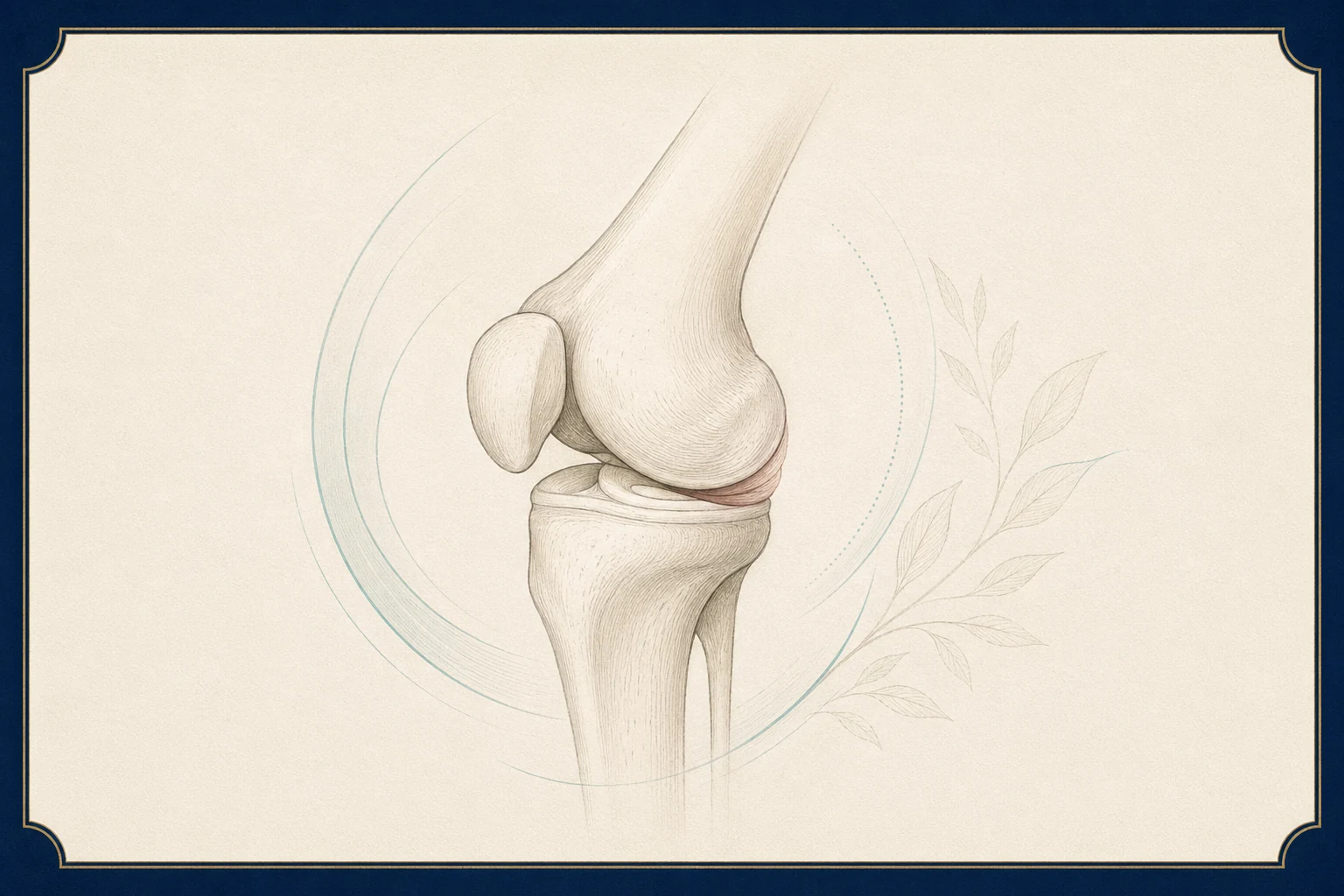
The knee is a hinge between the thigh bone and shin bone, covered by the kneecap, cushioned by two crescent-shaped menisci and a layer of cartilage, and held together by four main ligaments. Pain can come from any of these, or from the tendons and bursae that lie just outside the joint.
- Osteoarthritis. Cartilage thins, the bone underneath responds by forming spurs, and the lining of the joint becomes inflamed. Risk rises with age, prior injury, obesity (each extra pound adds about 4 pounds of force across the knee with each step) and family history. See our osteoarthritis page for the joint-by-joint guide.
- Degenerative meniscus tears. After 40, the menisci fray and tear with ordinary use. Most are part of arthritis rather than a separate injury, and randomized trials show arthroscopic trimming works no better than physical therapy for these tears unless the knee is locking.
- Patellofemoral pain. Pain behind or around the kneecap with stairs, squatting and prolonged sitting, from tracking and load problems rather than cartilage loss. Common in younger, active people.
- Pes anserine bursitis and tendinopathy. Tenderness on the inner shin just below the joint line, worse with stairs and at night, often alongside arthritis.
- Referred pain. Hip arthritis and lumbar nerve root irritation (L3, L4) can present as knee pain with a normal knee exam.
Knee pain after knee replacement
Total knee replacement is one of the most successful operations in medicine, yet 10 to 20 percent of patients report persistent pain a year later. The first job belongs to your surgeon: infection, loosening of the implant, instability, malalignment and a fractured or unresurfaced kneecap all have surgical answers, and X-rays, blood tests (ESR, CRP) and sometimes a joint aspiration are needed to rule them out. If those are normal, the pain is usually coming from sensitized nerves around the joint, scar tissue, or the small nerves cut during surgery.
That group is exactly who genicular nerve treatments were developed for. The genicular nerves run along the bone just above and below the joint line, outside the implant, so they can be blocked and ablated regardless of the hardware. Patients who are good candidates typically have pain a year or more after surgery, a surgeon's confirmation that the implant is sound, and pain that is worse with weight-bearing than at rest. For pain that is burning, constant and sensitive to touch, peripheral nerve stimulation of the saphenous or genicular nerves is an option, and a temporary 60-day system lets you test it first.
Symptoms and how it differs from look-alikes
- Arthritis: deep ache worse with walking, stairs and standing from a chair; stiffness for a few minutes after rest; swelling that comes and goes; grinding. Pain often on the inner side of the knee.
- Meniscus tear: pain at the joint line with twisting and squatting, sometimes catching. True locking suggests a displaced fragment.
- Kneecap pain: pain in front, worse going downstairs and after sitting through a movie.
- Bursitis or tendinopathy: one tender spot you can press on, just outside the joint.
- Referred from the hip: knee pain that gets worse when the hip is rotated, with a knee that examines normally.
- Referred from the spine: pain that runs down the front of the thigh into the knee and changes with back position, sometimes with numbness. See sciatica and spinal stenosis.
How we diagnose it
Examination comes first: where the knee is tender, whether there is fluid, range of motion, ligament stability, kneecap tracking, and a check of the hip and lumbar spine to catch referred pain.
Weight-bearing X-rays are the standard test for arthritis. They show joint-space narrowing, spurs and alignment. Grade matters less than symptoms; many people with severe X-ray changes have little pain, and the reverse.
MRI is ordered when we suspect a meniscus tear that is locking the knee, a ligament injury, or an unexplained effusion. It is not needed to diagnose arthritis and often shows meniscus tears that are incidental.
Genicular nerve block. This is a test. Before radiofrequency ablation, we numb the three main genicular nerves (superior medial, superior lateral, inferior medial) under fluoroscopy or ultrasound and ask you to walk and climb stairs while the anesthetic is working. At least 50 percent relief for the duration of the anesthetic, recorded in a pain diary, confirms these nerves carry your pain and predicts a good response to ablation. Insurers require this step.
Treatment options, in order
The ladder below follows the American Academy of Orthopaedic Surgeons and American College of Rheumatology guidelines, with the nerve-based options that pain medicine adds at the end.
- Exercise, weight management and physical therapy
Strengthening the quadriceps and hips, low-impact aerobic exercise (cycling, pool walking), and losing weight if you carry extra all reduce pain as much as many medications and are the only measures that slow the arthritis. A structured program takes 6 to 12 weeks to show its effect. See how we coordinate physical therapy. Learn more →
- Medication and bracing
Topical diclofenac gel is first-line for the knee and nearly as effective as oral NSAIDs with fewer side effects. Oral NSAIDs when your kidneys, heart and stomach allow. Acetaminophen has a small effect. Duloxetine helps some patients with widespread arthritis pain. An unloader brace and a cane in the opposite hand reduce load on the painful compartment. Opioids are not recommended for chronic knee arthritis.
- Knee joint injections
Corticosteroid: the best-studied option. Relief usually begins within 1 to 3 days and lasts 4 to 8 weeks, sometimes longer. We limit them to about 3 or 4 per year in a knee; a trial that injected steroid every 3 months for 2 years found more cartilage loss and no pain advantage. PRP (platelet-rich plasma): some trials show benefit at 6 to 12 months in mild to moderate arthritis, others show none; preparations vary widely, insurance almost never covers it, and it is cash-pay. We will tell you which we recommend for your knee and why. Learn more →
- Genicular nerve block (test), then radiofrequency ablation (treatment)
For knees that respond only briefly to injections, are not ready for replacement, or still hurt after replacement. After a positive diagnostic block, a radiofrequency probe heats the same three nerves to interrupt pain signals. In a randomized trial of cooled radiofrequency versus steroid injection, 74 percent of ablation patients had at least 50 percent relief at 6 months compared with 16 percent for steroid. Relief typically lasts 6 to 12 months and the procedure can be repeated when the nerves regrow. It does not change the arthritis and does not interfere with a later replacement. Learn more →
- Peripheral nerve stimulation
A thin lead placed beside the saphenous or genicular nerves delivers gentle electrical pulses that block pain signals. Used for persistent post-replacement pain and for patients who cannot have surgery. A 60-day temporary system tests the response before any permanent lead is considered. Learn more →
- Orthopedic referral
For a locked knee, unstable ligaments, bone-on-bone arthritis in a patient who wants and can safely have a replacement, or any concern about an existing implant. We coordinate rather than delay.
What you can do now
- Walk or cycle daily at a pace that leaves the knee no worse the next morning; consistency matters more than intensity.
- Do straight-leg raises and wall sits, 2 sets of 10, twice a day; a stronger quadriceps unloads the joint.
- Use a cane in the hand opposite the painful knee for long walks.
- Apply diclofenac gel four times daily for flares rather than reaching for oral pills first.
- Sleep with a pillow between the knees if the inner knee is tender.
- Bring weight-bearing knee X-rays, any MRI, injection dates and, if you have had a replacement, your surgeon's most recent notes.
We treat knee pain at our Houston and Webster offices, and in Pearland once that office opens in November 2026.
Frequently asked questions
How long does a knee steroid injection last?
Relief typically starts within 1 to 3 days and lasts 4 to 8 weeks, occasionally several months. It varies with how inflamed the joint is. If relief lasts under a month, repeating steroids is not the right plan; a genicular nerve block to test for radiofrequency ablation usually is.
Are gel (hyaluronic acid) injections worth it?
Hyaluronic acid (gel) injections are another option some clinics offer; we do not perform them, and the evidence for them is mixed (AAOS 2021 recommends against routine use). If a knee has stopped responding to steroid, the genicular nerve block and ablation pathway has stronger evidence and is covered by insurance.
Does PRP work for knee arthritis?
Trials are split: some show pain improvement at 6 to 12 months in mild to moderate arthritis, others show no benefit over saline. Preparations differ from clinic to clinic, which is part of the problem. Insurance does not cover it and it is paid out of pocket. It is not a substitute for a replacement in advanced arthritis.
I still have knee pain a year after my knee replacement. What can be done?
First your surgeon should confirm the implant is not infected, loose or malaligned. If it is sound, the pain is usually from sensitized nerves around the joint, and genicular nerve radiofrequency ablation or peripheral nerve stimulation can help. Both work around the implant, not through it.
What is genicular nerve radiofrequency ablation and does it hurt?
It is a needle procedure done under local anesthesia and light sedation if you prefer. Radiofrequency heat interrupts the three small nerves that carry pain from the knee. The knee is sore for a few days; relief builds over 1 to 3 weeks and typically lasts 6 to 12 months. The nerves regrow, so it can be repeated.
Can I avoid a knee replacement?
Many people delay it for years with exercise, weight management, injections and genicular ablation, and some never need it. Replacement is the right answer when bone-on-bone arthritis limits daily life despite those measures and you are healthy enough for surgery. Nothing we do closes that door.
Should I get an MRI for my knee?
Usually not for arthritis; weight-bearing X-rays show it better and MRI often finds meniscus fraying that is not the source of pain. MRI is worth ordering for a locked knee, a suspected ligament injury, or unexplained swelling.
Sources
- Management of Osteoarthritis of the Knee (Non-Arthroplasty), Evidence-Based Clinical Practice Guideline, 3rd edition (2021) (opens in new tab) — American Academy of Orthopaedic Surgeons
- 2019 ACR/Arthritis Foundation Guideline for the Management of Osteoarthritis of the Hand, Hip, and Knee (opens in new tab) — American College of Rheumatology
- Effect of intra-articular triamcinolone vs saline on knee cartilage volume and pain in patients with knee osteoarthritis (McAlindon TE et al., 2017) (opens in new tab) — JAMA / PubMed
- Prospective, multicenter, randomized, crossover clinical trial comparing cooled radiofrequency ablation to intra-articular steroid for knee osteoarthritis pain (Davis T et al., 2018) (opens in new tab) — Regional Anesthesia and Pain Medicine / PubMed
- Arthritis of the Knee (opens in new tab) — American Academy of Orthopaedic Surgeons, OrthoInfo
Request an appointment
Call (832) 916-2075 or request an appointment online. New patients are welcome; the team confirms insurance and referral requirements before scheduling.