
Joints
Hip Pain: Bursitis, Tendinopathy and Arthritis
Outer hip pain is usually gluteal tendinopathy, not bursitis; groin pain points to the joint. Houston pain specialists explain the difference and fixes.
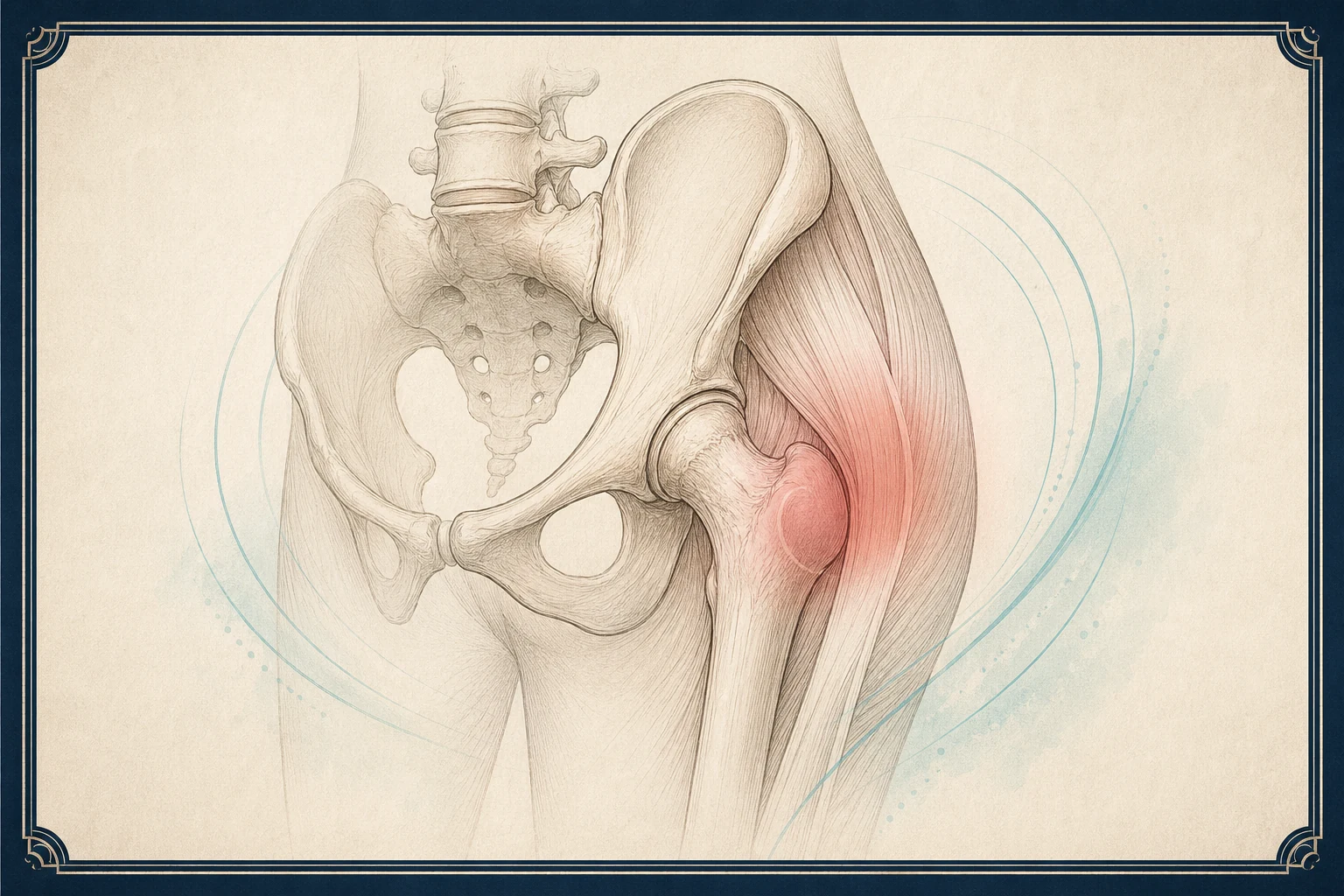
Where your hip hurts tells us most of what we need to know. Pain on the outside of the hip, the spot you lie on in bed, is almost always greater trochanteric pain syndrome, which used to be called hip bursitis but is really a problem of the gluteal tendons. Pain in the groin and front of the thigh comes from the hip joint itself, usually arthritis. Pain in the buttock is often not the hip at all but the sacroiliac joint or lumbar spine. We sort those out on exam, confirm with imaging or an image-guided injection when needed, and treat each differently.
Key facts
| What it is | Pain from the tendons and bursa on the outside of the hip (greater trochanteric pain syndrome), from the ball-and-socket joint (arthritis, labral tears), or referred from the spine or SI joint. |
|---|---|
| Most common causes | Gluteus medius and minimus tendinopathy, hip osteoarthritis, sacroiliac joint pain, lumbar nerve root irritation, and, less often, true bursitis, labral tears or stress fracture. |
| Typical course | Tendinopathy improves over 8 to 12 weeks with a loading program; flares recur without it. Hip arthritis progresses slowly over years and flares settle in weeks. |
| See a specialist when | Lateral hip pain has lasted more than 6 to 8 weeks despite exercise, you cannot lie on that side to sleep, groin pain limits walking, or steroid injections have stopped working. |
| Treatments we offer | Ultrasound-guided tendon and bursa injections, fluoroscopy- or ultrasound-guided hip joint injections, other joint injections, SI joint and lumbar evaluation, and physical therapy coordination. |
When to get emergency care
Go to an emergency room or call 911 if you have:
- Hip or groin pain after a fall and you cannot bear weight, or the leg looks shorter or turned outward (hip fracture; common in adults over 65 even after a minor fall)
- A hot, swollen, painful hip with fever or chills, or a child or teenager who will not walk on one leg (possible joint infection)
- Sudden severe groin pain in a young person after a twist or sprint with inability to walk (possible avulsion fracture or slipped growth plate in adolescents)
- Hip pain with new numbness in the groin, loss of bladder or bowel control, or leg weakness (possible cauda equina syndrome from the spine)
- Deep thigh or groin pain with swelling of the whole leg (possible blood clot)
See your primary care physician or an orthopedist within a week for groin pain that started without injury in a runner or a person on long-term steroids or with heavy alcohol use (possible stress fracture or avascular necrosis); both are missed on early X-rays and need MRI.
Lateral hip pain: why it is usually the tendon, not the bursa
For decades pain over the bony point on the outside of the hip (the greater trochanter) was labeled trochanteric bursitis and treated with a bursa injection. MRI and ultrasound studies changed that picture: in most patients the bursa is normal and the problem is the gluteus medius and minimus tendons, which attach to that bone and act like the rotator cuff of the hip. They fray, thicken and sometimes partially tear, and the bursa becomes inflamed only secondarily, in perhaps one in five cases. The current name is greater trochanteric pain syndrome (GTPS), and the treatment that works best is strengthening those tendons, not just quieting the bursa.
GTPS affects roughly one in four women over 50 at some point, and it is common in runners and in people whose walking pattern has changed because of knee or back pain. It also shows up after hip replacement, when the tendons have been stretched or the leg length changed.
Common causes by location
- Outside of the hip (lateral): gluteal tendinopathy and GTPS; less often true bursitis, a snapping iliotibial band, or referred pain from the L4-L5 level of the spine.
- Groin and front of thigh (anterior): hip osteoarthritis; labral tears and femoroacetabular impingement in younger adults; stress fracture in runners; avascular necrosis in people on steroids or with heavy alcohol use; hip flexor tendinopathy; hernia.
- Buttock (posterior): sacroiliac joint pain, lumbar facet or disc problems, piriformis syndrome, hamstring tendinopathy, and sciatica.
- Pain that radiates below the knee is rarely from the hip and usually from the spine.
Hip osteoarthritis deserves its own note. It affects about one in four people by age 85, causes groin pain and stiffness that make putting on socks and shoes difficult, and is confirmed on a standing pelvis X-ray. Our osteoarthritis page covers it in detail alongside the knee and shoulder.
Symptoms and how it differs from look-alikes
Groin versus lateral is the single most useful distinction. Patients with joint pain tend to cup the groin or point to the front; patients with tendon pain press the bony point on the side. Beyond that:
- Gluteal tendinopathy / GTPS: pain lying on that side at night, standing on one leg, climbing stairs, and after sitting with legs crossed; sharp tenderness when the trochanter is pressed; walking on flat ground is often fine at first.
- Hip arthritis: groin ache with walking and stiffness after sitting; pain when the hip is rotated inward; reduced range of motion; knee pain in some patients with a normal knee.
- Labral tear or impingement: sharp catching groin pain with deep hip flexion or pivoting, often in people under 45.
- SI joint: one-sided pain just inside the back of the pelvis, worse rolling in bed and standing from a chair.
- Lumbar spine: pain that changes with back position, may include numbness or tingling, and can reach below the knee.
How we diagnose it
Examination. Direct palpation of the trochanter, single-leg stance for 30 seconds (pain reproduced within that time is a reliable sign of gluteal tendinopathy), resisted hip abduction, hip range of motion with attention to internal rotation and the FADIR impingement test, SI joint provocation tests, and a lumbar and neurologic screen.
Imaging. A standing pelvis X-ray is the first test for groin pain and shows arthritis, dysplasia and gross impingement. Ultrasound in the office shows the gluteal tendons, bursa fluid and guides injections. MRI is reserved for suspected labral tears, stress fractures, avascular necrosis and tendon tears being considered for surgery.
Diagnostic injection. When groin pain could be the hip joint or the spine, an image-guided injection of local anesthetic into the hip joint answers it: if the pain goes away while the anesthetic works, the joint is the source. That short window is the test; steroid added to the same injection is the treatment. Hip joint injections must be done under fluoroscopy or ultrasound; the joint is too deep to reach reliably by feel.
Treatment options, in order
The order differs by diagnosis, so it is given for the two most common problems.
- Gluteal tendinopathy, step 1: load management and a strengthening program
In a randomized trial (LEAP, 2018), education plus a progressive gluteal strengthening program produced improvement in 77 percent of patients at 8 weeks versus 58 percent for a steroid injection and 29 percent for wait-and-see, and the exercise advantage held at one year. Avoid crossing the legs, lying on the painful side, and hanging on one hip when standing; sleep with a pillow between the knees. See how we coordinate physical therapy. Learn more →
- Gluteal tendinopathy, step 2: ultrasound-guided injection
A steroid injection around the tendons and bursa gives relief within a few days that typically lasts 4 to 12 weeks, enough to make the exercise program tolerable. We limit steroid injections here to 2 or 3 per year because repeated steroid weakens tendon. PRP is offered in some clinics for tendinopathy with mixed trial evidence, no guideline recommendation and no insurance coverage; we discuss it honestly rather than promote it. Learn more →
- Gluteal tendinopathy, step 3: surgical referral
Rarely needed. A full-thickness gluteal tendon tear with weakness and a limp that has not responded to 6 months of care can be repaired by an orthopedic surgeon.
- Hip arthritis, step 1: exercise, weight management and medication
Walking, cycling and pool exercise, hip and core strengthening, weight loss if needed, a cane in the opposite hand, and oral NSAIDs or acetaminophen when safe. These are the guideline-recommended first steps and slow progression.
- Hip arthritis, step 2: image-guided hip joint injection
Corticosteroid injected into the joint under fluoroscopy or ultrasound. Relief typically starts within 2 to 7 days and lasts 6 to 12 weeks; it also serves as the diagnostic test described above. Limited to about 3 per year. Hyaluronic acid (gel) injections are another option some clinics offer; we do not perform them, and the ACR recommends against them in the hip. Learn more →
- Hip arthritis, step 3: joint replacement referral
When groin pain limits walking and sleep despite the above and X-rays show advanced arthritis, hip replacement is one of the most reliable operations in medicine. We refer rather than continue injections past their usefulness, and we avoid steroid injections in the 3 months before a planned replacement because of infection risk.
What you can do now
- For outer hip pain: sleep on the other side with a pillow between your knees, stop crossing your legs, and stand with weight on both feet.
- Start side-lying leg raises and bridges, 2 sets of 10 daily, progressing slowly; expect 8 to 12 weeks for tendon pain to improve.
- For groin pain: keep walking on level ground, use a cane opposite the painful hip for longer distances, and avoid deep squats and low chairs.
- Note whether your pain is worst on the side, in the groin, or in the buttock, and what movements bring it on.
- Bring a standing pelvis X-ray if you have one, any MRI, and injection dates.
Gulf Coast Pain & Spine evaluates hip pain at our Houston and Webster offices, and in Pearland once that office opens in November 2026.
Frequently asked questions
Is hip bursitis the same as greater trochanteric pain syndrome?
They describe the same pain on the outside of the hip, but the newer name is more accurate. Imaging shows the gluteal tendons, not the bursa, are the problem in most patients, and only about one in five has true bursitis. The treatment that works best, a tendon-strengthening program, follows from that.
How can I tell if my hip pain is arthritis?
Arthritis pain is in the groin and front of the thigh, worse with walking and after sitting, with stiffness that makes socks and shoes hard to put on and pain when the hip is rotated inward. A standing pelvis X-ray confirms it. Pain on the outside of the hip is usually tendon, not arthritis.
Do steroid injections cure hip bursitis?
No. They reduce pain for 4 to 12 weeks, and in the LEAP trial their benefit faded by one year while an exercise program kept working. The injection is best used to make strengthening tolerable, not as the treatment on its own.
Why does my hip hurt when I lie on it at night?
Lying on the side compresses the gluteal tendons against the trochanter, which is the hallmark of gluteal tendinopathy. Sleeping on the other side with a pillow between the knees usually helps within days; a strengthening program addresses the cause.
Can back problems cause hip pain?
Yes. Irritation of the L4-L5 nerve roots refers pain to the outside of the hip, and the sacroiliac joint refers pain to the buttock and upper hip. Pain that changes with back position or reaches below the knee points to the spine, and the exam includes both.
How long does a hip joint injection last and how many can I have?
Steroid relief in the hip joint usually begins within 2 to 7 days and lasts 6 to 12 weeks, sometimes longer. We limit them to about 3 per year and avoid them in the 3 months before a planned hip replacement. If relief is short, it is time to discuss replacement rather than repeat injections.
Sources
- Hip Bursitis (opens in new tab) — American Academy of Orthopaedic Surgeons, OrthoInfo
- Education plus exercise versus corticosteroid injection use versus a wait and see approach on global outcome and pain from gluteal tendinopathy: the LEAP randomised trial (Mellor R et al., 2018) (opens in new tab) — The BMJ
- Osteoarthritis of the Hip (opens in new tab) — American Academy of Orthopaedic Surgeons, OrthoInfo
- 2019 ACR/Arthritis Foundation Guideline for the Management of Osteoarthritis of the Hand, Hip, and Knee (opens in new tab) — American College of Rheumatology
- Hip Fractures (opens in new tab) — American Academy of Orthopaedic Surgeons, OrthoInfo
Request an appointment
Call (832) 916-2075 or request an appointment online. New patients are welcome; the team confirms insurance and referral requirements before scheduling.