
Spine pain
Neck Pain
Neck pain that stays in the neck is usually facet or disc; pain down the arm is a nerve. Myelopathy warning signs and how Houston specialists treat both.
Neck pain comes in two broad types: axial pain that stays in the neck, upper back and shoulder blade region, usually from the cervical facet joints or discs, and radicular pain that shoots down the arm from a compressed nerve root. They are evaluated and treated differently. Gulf Coast Pain & Spine identifies which type you have, screens for the small number of people whose spinal cord is being compressed, and treats the source with targeted injections and radiofrequency ablation at its Houston and Webster offices and, from November 2026, in Pearland.
Key facts
| What it is | Pain from the base of the skull to the top of the shoulder blades. About two-thirds of adults have it at some point; for most it settles within weeks, but it recurs in roughly half. |
|---|---|
| Most common causes | Cervical facet joint arthritis (the leading cause of chronic axial neck pain, and of neck pain after whiplash), disc degeneration or herniation, muscle strain, and nerve root compression producing arm pain. |
| Typical course | Acute mechanical neck pain improves within 2–6 weeks in most people. Neck pain lasting more than 3 months is chronic and usually has a facet or disc source that can be confirmed. |
| See a specialist when | Pain has lasted more than 6 weeks, shoots into the arm, causes numbness or weakness, followed a car accident, or comes with headaches at the back of the head. |
| Treatments we offer | Cervical medial branch blocks and radiofrequency ablation, cervical epidural steroid injections, selective nerve root blocks, occipital nerve blocks, trigger point injections, and coordinated therapy. |
When to get emergency care
Seek emergency care or call 911 if you have neck pain with any of these:
- Clumsy hands: new trouble buttoning a shirt, writing, typing or picking up small objects, or a change in your walking or balance. These are signs of cervical myelopathy (spinal cord compression), which can become permanent and needs prompt surgical evaluation.
- Weakness in an arm or leg that is getting worse, or an electric shock down the spine when you bend your neck forward.
- New trouble controlling your bladder or bowel.
- Neck pain after a fall, car accident or diving injury, especially if you are over 65 or have osteoporosis, until a fracture is ruled out.
- Fever or chills with neck pain, or a stiff neck with headache and sensitivity to light (possible meningitis).
- Sudden severe neck pain with a severe headache, drooping eyelid, vision change or trouble speaking (possible artery dissection or stroke).
Myelopathy often has little or no neck pain. If you have any hand clumsiness or balance change, mention it at your first visit even if it seems unrelated.
Axial neck pain versus radicular pain
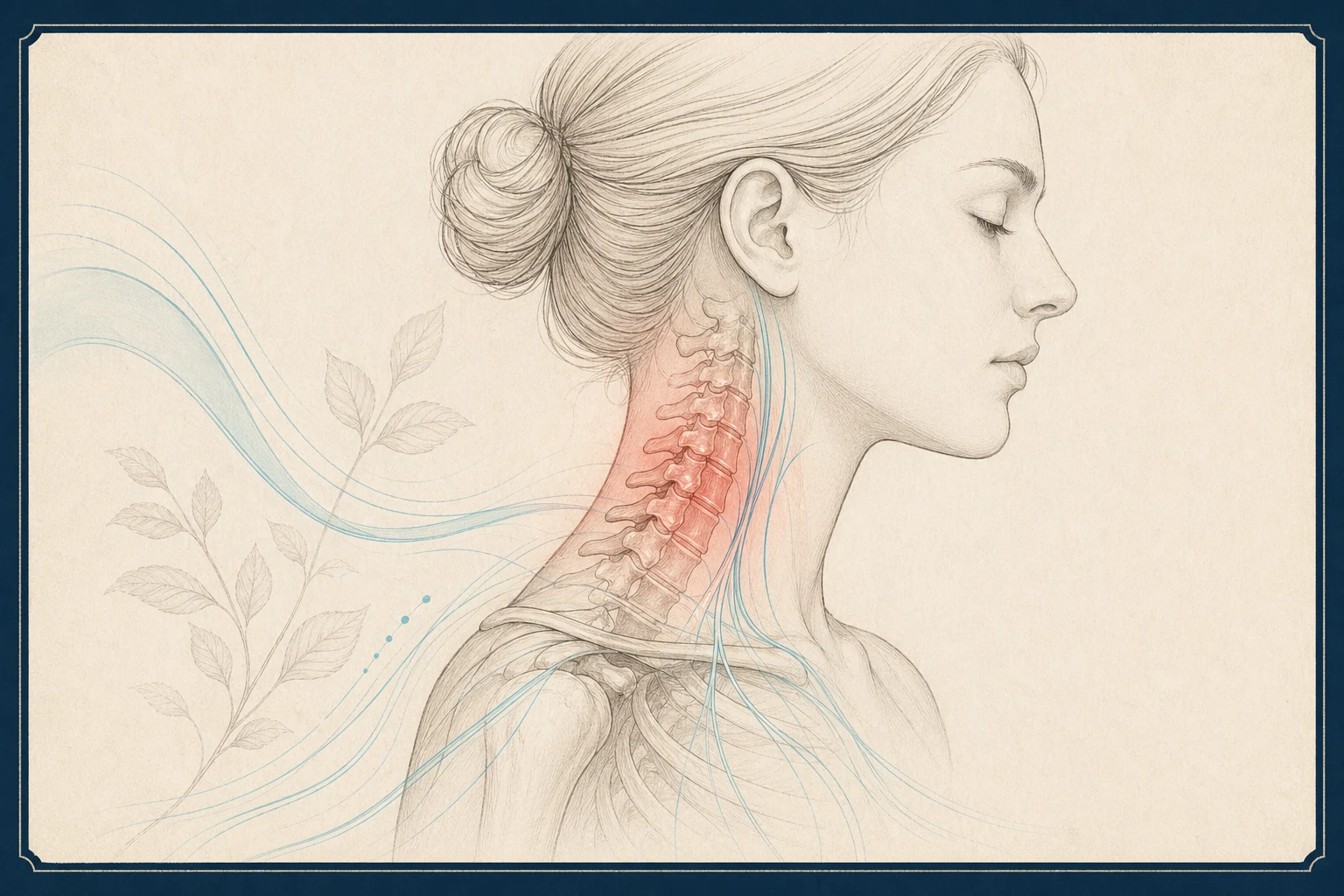
The cervical spine has seven vertebrae, six discs and fourteen facet joints, and it carries the weight of the head through a range of motion larger than any other part of the spine. That mobility is why it wears, and why neck pain is so common.
Axial neck pain stays in the neck and its immediate neighborhood: the base of the skull, the tops of the shoulders, and the area between the shoulder blades. It is a deep ache, often with stiffness, and it comes from the facet joints, the discs, or the muscles. It does not cause numbness or weakness in the arm. The cervical facet joints are the single most common source of chronic axial neck pain; each joint refers pain to a predictable spot, so the location of your pain points to the joint. The upper joints (C2–3, C3–4) refer to the back of the head, the middle joints (C4–5, C5–6) to the side of the neck and top of the shoulder, and the lower joints (C6–7, C7–T1) to the shoulder blade.
Radicular pain is different. A nerve root is compressed or inflamed as it leaves the spine, and pain shoots down the arm along that nerve's territory, often with tingling, numbness or weakness in a specific part of the hand. Many people with radicular pain have relatively little neck pain. This is cervical radiculopathy, and it has its own page because its course and treatment differ.
Myelopathy is the third and most serious pattern. Narrowing of the spinal canal presses on the spinal cord itself. It causes clumsy hands, unsteady walking and sometimes leg stiffness, often with surprisingly little neck pain. Myelopathy is not treated with injections; it is a surgical problem, and the earlier it is recognized the better the recovery. See spinal stenosis.
Causes
- Cervical facet joint pain. Wear of the small joints at the back of the neck. Responsible for roughly 40–55% of chronic neck pain, and for over half of persistent neck pain after whiplash. Worse with looking up, turning the head, and holding one position; often stiff in the morning. See facet joint syndrome.
- Disc degeneration and herniation. Disc drying and bulging with age (cervical spondylosis) can cause axial pain, and a herniation can compress a nerve root. See herniated disc and degenerative disc disease.
- Muscle strain and myofascial pain. The upper trapezius and levator scapulae muscles tighten with desk work, screen use, stress and poor sleep, producing tender knots that refer pain to the head and shoulder.
- Whiplash. Rapid acceleration-deceleration in a car accident strains the facet joint capsules and ligaments. Most people recover within weeks; those with persistent pain at 3 months usually have facet pain that can be confirmed and treated. See whiplash and auto injury.
- Cervicogenic headache and occipital neuralgia. Pain that starts at the base of the skull and spreads over the back and side of the head, triggered by neck movement, comes from the upper cervical joints or the occipital nerves. See occipital neuralgia and cervicogenic headache.
- Spinal stenosis. Narrowing of the canal or foramina, which can produce radiculopathy or myelopathy. See spinal stenosis.
Symptoms and how to tell them apart
- Ache and stiffness in the neck, worse looking up or turning, referring to the shoulder blade or back of the head, no arm numbness: facet joint pain.
- Central neck pain worse with looking down and prolonged sitting, sometimes with a grinding sensation: disc.
- Tight, tender bands in the trapezius, worse at the end of a workday, sometimes with a headache: muscle and myofascial pain.
- Pain shooting down the arm to specific fingers, with tingling, numbness or weakness; often eased by resting the hand on top of the head: cervical radiculopathy.
- Clumsy hands, dropping objects, unsteady gait, with or without neck pain: myelopathy. This needs prompt evaluation.
- Headache starting at the base of the skull, spreading forward on one side, triggered by neck movement or pressure: cervicogenic headache or occipital neuralgia.
Shoulder problems can imitate neck pain and vice versa. Pain that worsens when you move the shoulder rather than the neck, or with reaching overhead, is more likely the rotator cuff. See shoulder pain.
How we diagnose it
The exam separates the three patterns. We check neck range of motion and which directions provoke pain (extension and rotation point to the facets), press over each facet joint and the occipital nerves, test strength and reflexes in the arms and legs, and check sensation in each nerve root territory. Spurling's test (tilting and pressing the head toward the painful side) reproduces arm pain when a nerve root is involved. For myelopathy we look for brisk reflexes, a positive Hoffmann sign in the fingers, difficulty with rapid finger tapping, and gait changes; anyone with those findings gets an MRI promptly.
Imaging. X-rays are used after trauma or in older adults to look for fracture, instability and alignment. MRI is ordered for arm symptoms lasting more than 4–6 weeks, any weakness, any myelopathy signs, or before an epidural injection. MRI is not helpful for diagnosing facet pain: degenerative facet changes are present in most adults over 50 with or without pain, so the image cannot tell which joint hurts.
Diagnostic blocks confirm facet pain. A cervical medial branch block numbs the tiny nerves that carry pain from one or two facet joints. This is a test, not a treatment. If your pain drops by 80% or more while the anesthetic is working, on two separate occasions, the joint is confirmed and radiofrequency ablation is the next step. For cervicogenic headache, the same block at C2–3, or an occipital nerve block, sorts out the source.
Treatment options, in order
Axial neck pain and radicular pain follow different ladders. Both start with activity, posture and therapy; the procedure step depends on the source.
- Weeks 1–6: activity, heat, short medication course
Keep the neck moving; collars beyond a few days weaken the muscles. NSAIDs for 1–2 weeks if safe for you, heat, and a short course of a muscle relaxant for sleep if needed. Learn more →
- Physical therapy and workstation changes
Deep neck flexor and scapular strengthening, mobility work, and a screen at eye level. Strengthening has the best long-term evidence of any nonprocedural treatment for chronic neck pain. Learn more →
- Trigger point injections
For a clear myofascial component in the trapezius or levator scapulae, done in the office and paired with stretching. Learn more →
- Cervical medial branch blocks, then radiofrequency ablation
For confirmed facet pain. Ablation uses heat to quiet the medial branch nerves; in the landmark trial for whiplash-related neck pain, relief lasted a median of 263 days and could be repeated when pain returned. Typical relief is 6–12 months or longer. Learn more →
- Cervical epidural steroid injection or selective nerve root block
For radicular arm pain from a disc herniation or foraminal stenosis, not for axial pain alone. Performed with specific safety measures described on the cervical radiculopathy page. Learn more →
- Occipital nerve block
For occipital neuralgia and cervicogenic headache arising from the upper neck. Learn more →
- Surgical referral
For myelopathy, progressive weakness, or radiculopathy that has not responded to 6–12 weeks of treatment with a matching MRI. Axial neck pain alone is rarely a surgical problem. Learn more →
What you can do now
- Raise your screen to eye level and bring your phone up rather than your head down. Forward head posture loads the lower cervical facets and discs.
- Move every 30 minutes. Gentle chin tucks, shoulder rolls and slow rotations, a few times each.
- Use heat on the neck and upper trapezius for 15–20 minutes; it eases the muscle guarding that makes joint pain worse.
- Fix the pillow. One pillow that keeps the neck in line with the spine; side sleepers need a thicker pillow than back sleepers. Avoid sleeping on your stomach.
- Skip the collar unless a physician has fitted one for a specific reason.
- Note what provokes the pain (looking up, turning to check a blind spot, end of the workday) and where it refers. That pattern tells us which structure to test.
Frequently asked questions
Why does my neck pain go into my shoulder blade?
The lower cervical facet joints (C6–7 and C7–T1) and lower cervical discs refer pain to the shoulder blade region. It is one of the most common patterns of axial neck pain and does not mean anything is wrong with the shoulder blade itself. A medial branch block at those levels confirms the source.
Can neck pain cause headaches?
Yes. The upper cervical facet joints (C2–3 especially) and the occipital nerves refer pain to the back and side of the head. This is called cervicogenic headache. It is usually one-sided, starts at the base of the skull, and is triggered by neck movement or pressure. It responds to blocks and ablation aimed at the upper neck rather than to migraine medication.
What is cervical myelopathy and why is it urgent?
Myelopathy is compression of the spinal cord in the neck, usually from stenosis. It shows up as clumsy hands, dropping things, trouble with buttons or handwriting, and unsteady walking, often with little neck pain. Damage to the cord can become permanent, so it is treated surgically rather than with injections, and sooner is better.
How do I know if my neck pain is a pinched nerve?
A pinched nerve (cervical radiculopathy) sends pain, tingling or numbness down the arm to specific fingers and can cause weakness. Pain that stays in the neck, shoulder top or shoulder blade without arm symptoms is almost always from a joint, disc or muscle rather than a nerve.
Is radiofrequency ablation safe in the neck?
Yes, when done under X-ray guidance by a physician trained in the technique. The target nerves are small sensory branches that carry pain from the facet joints; they do not control arm strength. The most common side effect is a few days to two weeks of soreness or a sunburn-like feeling over the treated area. The nerves regrow, so relief typically lasts 6–12 months or longer and the procedure can be repeated.
My neck pain started after a car accident months ago. Can it still be treated?
Yes. Neck pain that persists more than 3 months after whiplash is most often cervical facet pain, which can be confirmed with medial branch blocks and treated with radiofrequency ablation. This was the population in which cervical ablation was first proven. See our whiplash page for how we document and coordinate auto-injury care.
Do I need an MRI for neck pain?
Not for neck pain alone in the first 6 weeks without red flags. An MRI is ordered when there is arm pain, numbness or weakness, any sign of myelopathy, a history of cancer or trauma, or when a procedure is being planned. Degenerative findings are normal after 50 and do not by themselves explain pain.
Sources
- Neck Pain (opens in new tab) — American Academy of Orthopaedic Surgeons, OrthoInfo
- Cervical Spondylotic Myelopathy (Spinal Cord Compression) (opens in new tab) — American Academy of Orthopaedic Surgeons, OrthoInfo
- Percutaneous radio-frequency neurotomy for chronic cervical zygapophyseal-joint pain (opens in new tab) — New England Journal of Medicine, 1996
- Comprehensive Evidence-Based Guidelines for Facet Joint Interventions in the Management of Chronic Spinal Pain (2020) (opens in new tab) — American Society of Interventional Pain Physicians
- Neck Pain: Revision 2017 Clinical Practice Guidelines (opens in new tab) — Journal of Orthopaedic & Sports Physical Therapy / APTA
Request an appointment
Call (832) 916-2075 or request an appointment online. New patients are welcome; the team confirms insurance and referral requirements before scheduling.