
- Pain that starts at the base of the skull on one or both sides and shoots, stabs or aches over the back of the head toward the crown, sometimes behind the eye
- Tenderness when we press on the nerve where it exits, about an inch below and an inch to the side of the bump at the back of the skull, that reproduces your pain
- Headache that begins in the neck and is triggered by neck movement or posture (cervicogenic headache), especially after whiplash
- Cluster headache bouts or frequent migraine, when your neurologist asks us to add a block to your plan
- Patients who want to confirm the occipital nerve is the pain source before considering occipital peripheral nerve stimulation
Nerve blocks & ablation
Occipital Nerve Block
Occipital nerve block in Houston for occipital neuralgia and cervicogenic headache: GON vs LON, steroid vs anesthetic, relief and risks.
In short
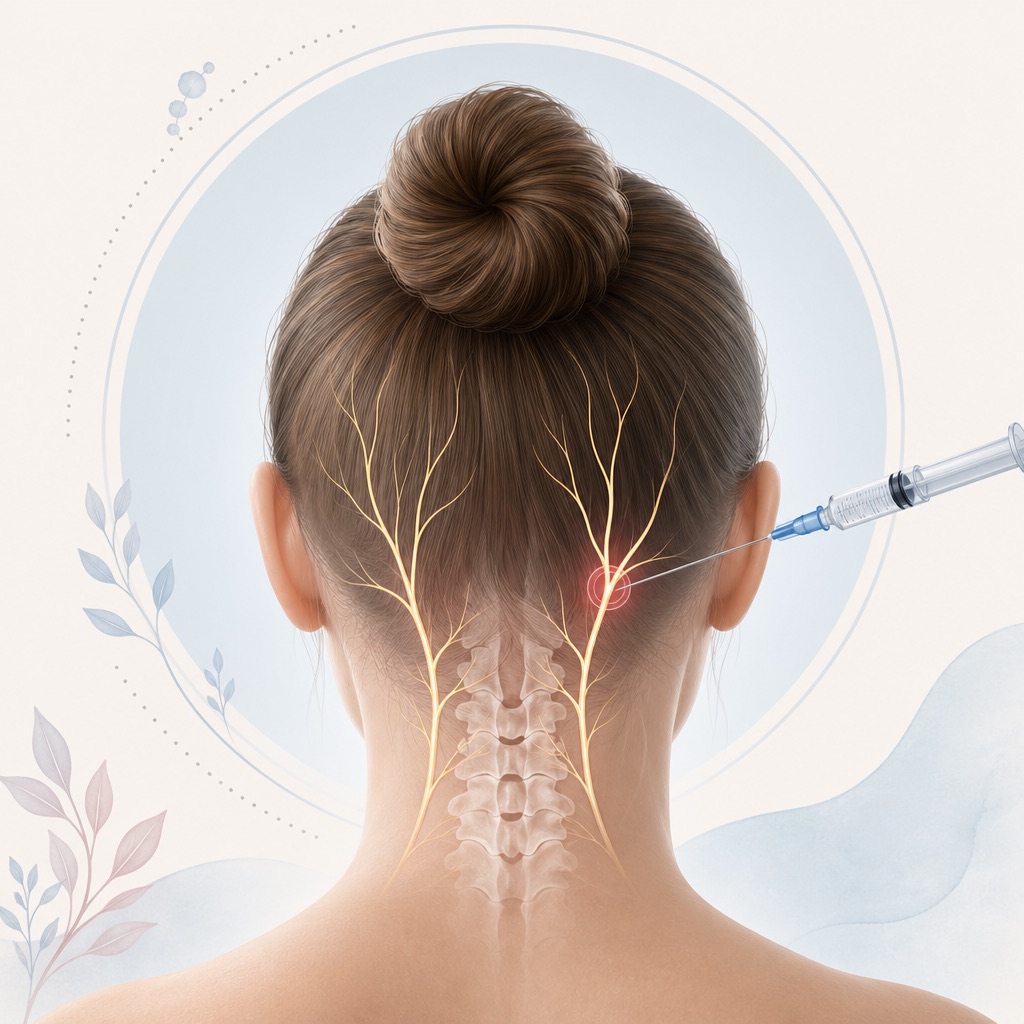
An occipital nerve block is an injection of local anesthetic, with or without a steroid, around the greater and lesser occipital nerves where they cross the back of the skull. It is used for occipital neuralgia and cervicogenic headache: pain that starts at the base of the skull and shoots or spreads over the back of the head. It can be a test (anesthetic only, to confirm the nerve is the source) or a treatment (anesthetic plus steroid, for days to weeks of relief). It takes about 5 minutes and is done awake, in the office.
Key facts
| Treats | Occipital neuralgia; cervicogenic headache (headache driven by the upper neck); cluster headache and some migraine, co-managed with your neurologist |
|---|---|
| Test or treatment? | Both. Anesthetic alone is a test: if the pain vanishes for 1–4 hours, the occipital nerve is the source. Anesthetic plus steroid is a treatment. |
| Procedure time | About 5 minutes; 30–45 minutes in the office |
| Anesthesia | None needed beyond the local anesthetic in the injection; no sedation |
| Downtime | None. You can drive yourself home and return to work the same day. |
| When relief starts | Within 5–15 minutes from the anesthetic; steroid benefit builds over 3–7 days |
| How long relief lasts | Typically days to weeks; a minority of patients get months. Cluster headache: a steroid block can shorten a bout by weeks. |
| How often it can be repeated | Anesthetic-only blocks: as often as every 2–4 weeks. Steroid blocks: typically no more than 3–4 per year to protect the scalp skin. |
| Insurance | Generally covered for occipital neuralgia and cervicogenic headache with a documented exam; some plans want a trial of medication first |
Who it is for
- New or changed headache with fever, stiff neck, vision loss, weakness, confusion or the worst headache of your life: these need emergency evaluation, not a block
- Headache from a source we cannot treat with a block (medication overuse, sinus disease, high pressure in the head, tumor), which is why an exam and often imaging come first
- A skull defect or prior surgery at the back of the head (craniotomy), where an injection could enter the skull
- Skin infection or an open wound on the scalp
- Uncontrolled diabetes if a steroid is planned
- Migraine without any occipital component, where blocks add little and neurology-led preventive treatment is the better plan
Greater and lesser occipital nerves, and why numbing them stops the headache
Two nerves carry sensation from the back of your scalp. The greater occipital nerve (GON) comes from the C2 spinal nerve, passes through the neck muscles and surfaces about 2–3 cm to the side of the midline at the base of the skull, right next to the occipital artery, which is how we find it by feel. It supplies most of the back of the head up to the crown. The lesser occipital nerve (LON) comes from C2–C3 and runs farther out, supplying the scalp behind the ear. Most blocks treat the greater nerve; we add the lesser nerve when your pain wraps toward the ear.
In occipital neuralgia the nerve is irritated or compressed, usually where it pierces tight neck muscle or after a whiplash injury. In cervicogenic headache the upper neck joints and muscles refer pain along the same nerves. Either way, bathing the nerve in local anesthetic stops the pain signal within minutes. Because the C2 nerve also connects with the trigeminal system in the brainstem, quieting it can also settle a migraine or cluster attack, which is why neurologists use these blocks too.
Landmark or ultrasound. The classic block is done by landmark: we feel for the artery and tender nerve below the skull and inject beside it. Ultrasound guidance lets us see the nerve higher up, where it crosses the obliquus capitis inferior muscle at the C2 level, and place a smaller volume more precisely. We use ultrasound when the landmark block has failed, when anatomy is hard to feel, or for a diagnostic block where precision matters.
Steroid or not. Anesthetic alone (2–3 mL of lidocaine or bupivacaine) is the test and, for cluster headache and some migraine, often the treatment. Adding a small steroid dose (for example 20–40 mg of methylprednisolone or 4 mg of dexamethasone) can extend relief from days to weeks when the nerve is inflamed, at the cost of a small risk of thinning or hair loss in the scalp skin at the site. We use the lowest steroid dose that works and do not repeat steroid blocks more than 3–4 times a year.
What happens on procedure day
- You sit in a chair leaning forward, or lie face down, with your forehead supported. Tell us your pain score and where the pain is right now; a block done during a headache gives the clearest answer.
- We find the tender point below the base of the skull, feel for the occipital artery pulse beside it, and mark the spot. No shaving is needed. The skin is cleaned with alcohol or chlorhexidine.
- A fine needle goes in to about half an inch. You may feel a brief electric tingle over the back of your head, which tells us we are next to the nerve. We draw back to be sure we are not in the artery, then inject 2–3 mL in a fan around the nerve. The lesser occipital nerve, if included, is injected a couple of inches farther out.
- Firm pressure for 1–2 minutes to limit bruising. The whole injection takes under 5 minutes per side.
- Within 5–15 minutes the back of your scalp goes numb. We ask you to rate your headache again before you leave and, for a diagnostic block, every hour for the rest of the day.
- You can drive yourself home. Scalp numbness typically lasts 2–6 hours.
After the procedure
Day 0. The back of your head feels numb and heavy for a few hours; some people feel lightheaded for a few minutes after the injection, so sit for 10 minutes before standing. A small bruise or tender lump at the site is normal. Ice for 10–15 minutes if it aches. Shower normally; avoid rubbing the site for a day.
Days 1–3. If you received anesthetic only, the headache may return as the numbness wears off; for a diagnostic block that return is the expected pattern and your diary tells us the nerve is the source. Some patients get relief that outlasts the anesthetic by days, which is common in occipital neuralgia. If a steroid was included, benefit builds over 3–7 days.
Week 1–2. This is when we judge a steroid block. Keep a simple headache log: days with pain, intensity, and medication used. Reduce acute pain medication where you can; using triptans or over-the-counter painkillers more than 10–15 days a month can cause a rebound headache that no block will fix.
Call the same day for fever, spreading redness or pus at the site, a new severe headache unlike your usual one, or numbness that lasts beyond 24 hours.
What the evidence shows
For occipital neuralgia, greater occipital nerve block is the standard first intervention and a positive block is part of the International Classification of Headache Disorders diagnostic criteria. Randomized trials are small, but reported relief rates are high, with relief that often lasts days to weeks beyond the anesthetic.
For cluster headache, the evidence is stronger: two randomized, placebo-controlled trials showed that a single greater occipital nerve block with steroid reduced attack frequency and shortened the bout, and the American Headache Society lists it as a recommended transitional (bridging) treatment while a preventive medication takes effect.
For migraine, results are mixed. Small randomized trials show short-term benefit for chronic migraine and for aborting an attack, but the effect is modest and not consistent across studies, so blocks are an add-on to neurology-led treatment, not a replacement for it.
For cervicogenic headache, blocks help many patients for days to weeks and can identify who will benefit from treating the upper neck joints (C2–C3 medial branch blocks and radiofrequency ablation).
Gulf Coast Pain & Spine offers occipital nerve blocks in Houston and Webster, and in Pearland when that office opens in November 2026; we do not manage primary headache disorders such as migraine as a practice, so migraine and cluster patients are treated together with their neurologist.
Alternatives and what comes next
Before a block: physical therapy for the upper neck, posture correction, and a trial of a nerve-pain medication such as gabapentin or a tricyclic often help occipital neuralgia and cervicogenic headache and are worth 4–6 weeks. If blocks work but keep wearing off, the next steps are: pulsed radiofrequency of the occipital nerve, which can extend relief to several months without damaging the nerve; treating the upper cervical facet joints (C2–C3) with medial branch blocks and radiofrequency ablation when the headache is coming from the neck; or occipital peripheral nerve stimulation, a small lead placed under the skin over the nerve, for occipital neuralgia that responds to blocks but returns. If a well-placed block gives no relief at all, the occipital nerve is not your pain source and we look at the upper neck joints, the trigeminal system or a primary headache disorder with your neurologist.
Safety and preparation
- Blood thinners: this is a superficial block, so under ASRA guidance it can usually be done without stopping aspirin, clopidogrel, warfarin or DOACs; we apply longer pressure afterward. Tell us what you take so we can decide, and never stop a blood thinner on your own.
- Diabetes: the small steroid dose still raises blood sugar for 1–5 days. If your morning glucose is above roughly 200–250 mg/dL we do the block with anesthetic only or postpone the steroid.
- Infection or fever: a scalp infection, open skin, or fever above 100.4°F postpones the block.
- Allergies (contrast, steroid, local anesthetic): no contrast dye is used. Tell us about any prior reaction to lidocaine, bupivacaine, or a steroid injection so we can substitute.
- Pregnancy: no X-ray is involved and anesthetic-only blocks are considered safe in pregnancy; we avoid steroid unless clearly needed. Tell us if you are or could be pregnant.
- Sedation and driving: no sedation is used and you may drive yourself. Eat a normal meal beforehand to reduce the chance of lightheadedness.
- Prior skull surgery: tell us about any craniotomy, skull fracture or shunt at the back of the head; we will check imaging before deciding whether the block is safe.
Risks and side effects
- Scalp numbness for 2–6 hours (expected) and a tender lump or bruise at the site for a few days
- Brief lightheadedness or a vasovagal reaction right after the injection, more common if you are anxious or have not eaten
- A short worsening of the headache for a day before relief begins, especially with steroid
- Hematoma (a larger bruise) from the occipital artery, which runs beside the nerve; firm pressure prevents most of these
- Alopecia (a small patch of hair loss) or thinning, pale skin at the injection site when a steroid is used; this can take months to recover and is occasionally permanent, which is why we limit steroid dose and frequency
- Numbness that lasts a day or more from anesthetic spread
- Steroid side effects: flushing, insomnia, blood sugar rise for several days
- Infection at the site or, very rarely, deeper
- Injection into the occipital artery, causing brief dizziness, ringing in the ears or, at most, a short seizure; drawing back before injecting and using small volumes prevents this
- Injection through a skull defect (prior craniotomy) into the space around the brain, with sudden loss of consciousness; we screen for skull surgery before every block
- Persistent nerve irritation (neuritis) from needle contact, usually resolving over weeks
Frequently asked questions
Does an occipital nerve block hurt?
It is a quick sting and pressure at the base of the skull, then a brief tingle over the back of the head, lasting under a minute per side. Most people rate it as less painful than the headache itself. Numbness follows within minutes.
How long does an occipital nerve block last?
The anesthetic numbs the scalp for 2–6 hours. Pain relief typically lasts days to weeks, and some patients get months. For cluster headache, a steroid block can shorten a bout by several weeks. If relief is under a week twice in a row, we discuss pulsed radiofrequency or a peripheral nerve stimulator rather than repeating blocks.
Is it a test or a treatment?
Both, depending on what we inject. Anesthetic only is a test: if your pain stops for the 1–4 hours the drug works, the occipital nerve is the source. Anesthetic plus steroid is a treatment aimed at weeks of relief. We tell you which one we are doing before we start.
Will it help my migraine?
Sometimes. Blocks can abort an attack and reduce frequency for a few weeks in some people with migraine, but the trial evidence is mixed, and we do not manage migraine as a practice. We provide blocks as an add-on when your neurologist requests them; the neurologist stays in charge of your preventive plan.
How often can I have one?
Anesthetic-only blocks can be repeated every 2–4 weeks if they are helping. Steroid blocks are limited to about 3–4 per year to protect the scalp skin from thinning and hair loss at the site.
Can I drive home afterward?
Yes. No sedation is used, and scalp numbness does not affect driving. Sit for 10 minutes before leaving in case of lightheadedness.
What if the block does nothing?
That is a useful answer. A well-placed block with no relief means the occipital nerve is not the generator. We then look at the C2–C3 facet joints (cervicogenic headache), the trigeminal system or a primary headache disorder, usually with your neurologist.
Sources
- Expert Consensus Recommendations for the Performance of Peripheral Nerve Blocks for Headaches – A Narrative Review (opens in new tab) — American Headache Society (Headache journal)
- Occipital Neuralgia Information Page (opens in new tab) — National Institute of Neurological Disorders and Stroke (NINDS)
- Suboccipital steroid injections for transitional treatment of episodic cluster headache: a randomized, placebo-controlled trial (opens in new tab) — The Lancet Neurology
- The International Classification of Headache Disorders, 3rd edition: 13.4 Occipital neuralgia (opens in new tab) — International Headache Society
- Interventional Spine and Pain Procedures in Patients on Antiplatelet and Anticoagulant Medications (Second Edition) (opens in new tab) — American Society of Regional Anesthesia and Pain Medicine (ASRA)
Next step
Request an appointment
Call (832) 916-2075 or request an appointment online. New patients are welcome; the team confirms insurance and referral requirements before scheduling.