
- CRPS of the hand or arm after a fracture, surgery or crush injury, with burning pain, swelling, color and temperature change or abnormal sweating, ideally within the first months
- Burning arm or hand pain after a nerve injury with sympathetic features
- Painful Raynaud's phenomenon, vasospasm, frostbite or arm ischemia that cannot be corrected surgically
- Facial pain with sympathetic features, or early severe shingles pain of the face or arm that medication controls poorly
- Phantom pain or stump pain after an arm amputation
Nerve blocks & ablation
Stellate Ganglion Block
Stellate ganglion block in Houston for CRPS of the arm and hand: why a droopy eyelid means it worked, the real risks, and what a series involves.
In short
A stellate ganglion block is an injection of local anesthetic around the stellate ganglion, a cluster of sympathetic nerves at the base of the neck that controls blood flow and sweating in the arm, hand and face. It is used for complex regional pain syndrome (CRPS) of the arm or hand, arm pain from poor circulation, and sympathetically maintained facial pain. It is both a test and a treatment: the first block shows whether your pain is sympathetically driven, and a series of blocks paired with therapy is the treatment. A droopy eyelid and red eye on that side afterward are the sign it worked, not a complication. It is not a treatment for neck pain.
Key facts
| Treats | CRPS of the hand, arm or shoulder; upper-extremity vascular pain (Raynaud's, vasospasm, frostbite, some ischemia); sympathetically maintained facial pain; early shingles pain of the face or arm; phantom arm pain |
|---|---|
| Test or treatment? | Both. The first block is a test: Horner's syndrome plus a warm hand plus pain relief means the pain is sympathetically maintained. A series of blocks with physical therapy is the treatment. |
| Sign of success | Horner's syndrome on the injected side: droopy eyelid, small pupil, red eye, stuffy nose, and a hand that warms by 1.5°C or more within 10–20 minutes. All of these are temporary. |
| Procedure time | 10–15 minutes; about 60–75 minutes in the office including monitoring |
| Anesthesia | Local at the skin; sedation minimal or none so you can report symptoms immediately |
| Downtime | Same-day discharge with a driver. No eating or drinking until hoarseness and swallowing return to normal (usually 1–3 hours). Therapy the next day. |
| When relief starts | Within 10–30 minutes if the pain is sympathetically maintained |
| How long relief lasts | Hours to days after the first block; typically longer after each block in a series. Varies widely. |
| How often it can be repeated | In a CRPS series, every 1–2 weeks for 3–6 blocks; never both sides on the same day |
| Insurance | Covered for CRPS and the vascular and neuropathic diagnoses above; PTSD and long-COVID uses are off-label and typically not covered |
Who it is for
- Neck pain, cervical arthritis or a pinched nerve in the neck: the stellate ganglion block does nothing for these, and the risks are not worth taking for them
- Recent heart attack, an unstable heart rhythm or a slow heart rate, because the block affects heart rate on that side
- Severe emphysema or a single lung, because a pneumothorax would be dangerous
- Blood thinners that cannot be held, or a bleeding disorder: a neck hematoma can compress the airway
- Glaucoma, because the block changes pupil size (relative; we discuss it with your eye doctor)
- Contralateral vocal cord paralysis or phrenic nerve palsy, since the block can temporarily affect the same nerves on the injected side
- Active infection or skin infection at the neck
What the stellate ganglion does and why a droopy eyelid means success
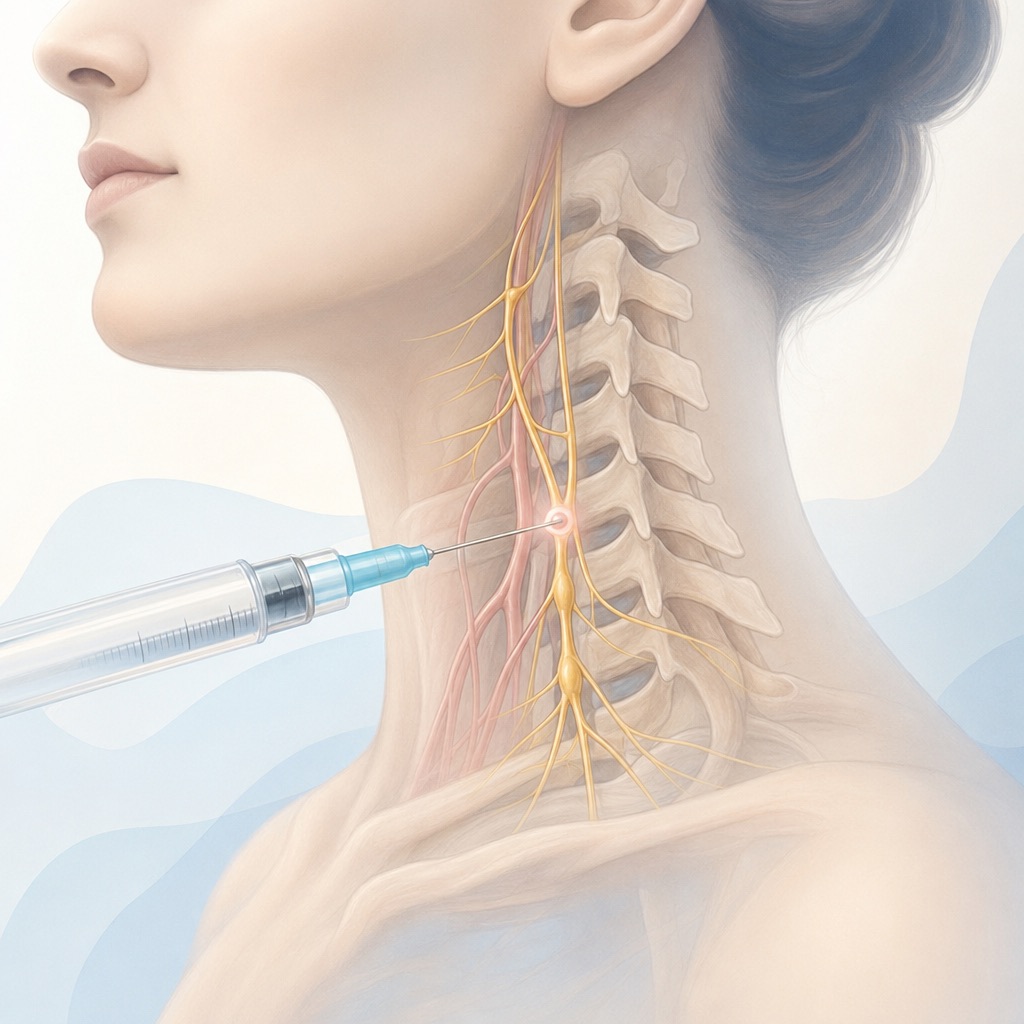
The stellate ganglion sits in front of the C7 vertebra and the first rib, just behind the carotid artery. It is the relay station for all the sympathetic nerves to the arm, hand, face and eye on that side: the nerves that narrow blood vessels, trigger sweating and fine-tune the eye. In CRPS and other sympathetically maintained pain these fibers become cross-wired with pain fibers, so every sympathetic signal fuels the pain and the limb turns cold, blotchy and swollen.
Placing 5–10 mL of local anesthetic on the ganglion, or on the sympathetic chain at C6 just above it, interrupts that output for several hours. The hand warms as its blood vessels open, and if the pain is sympathetically maintained it drops within minutes. The block does not numb the skin or weaken the arm, which is what makes the result easy to read.
Horner's syndrome is the expected sign. Because the same ganglion supplies the eye and face, a successful block always produces, on the injected side, a droopy upper eyelid, a smaller pupil, a red eye, a stuffy nose and a dry, warm face. This is called Horner's syndrome. It looks alarming and it is exactly what we want to see: without it, the block did not reach the ganglion and the pain result cannot be trusted. It resolves as the anesthetic wears off, usually within 4–8 hours. The same anesthetic spread commonly reaches the recurrent laryngeal nerve beside the ganglion, causing a hoarse voice and a feeling of a lump in the throat or difficulty swallowing for a few hours; that is why you cannot eat or drink until it passes and why we never block both sides on the same day.
Test, then series. We treat the first block as a test. If your hand warms by at least 1.5°C, Horner's appears and your pain drops by 50% or more, your pain is sympathetically maintained and we schedule a series: typically 3–6 blocks, 1–2 weeks apart, each the day before an occupational or physical therapy session so the therapist can work the hand while it is pain-free. If the hand warms and Horner's appears but the pain does not budge, the pain is sympathetically independent and we move to other treatments, most often spinal cord or DRG stimulation.
Ultrasound or fluoroscopy. We use ultrasound at the C6 level, which shows the carotid artery, the vertebral artery, the thyroid and the esophagus, so the needle can be steered around them; fluoroscopy at C7 is an alternative. Either way, a small test dose goes in first and we watch you for the signs of anesthetic in an artery before giving the rest.
What happens on procedure day
- Check-in with an empty stomach (no food for 4–6 hours). We review your pain score, blood-thinner list, heart and lung history, and confirm the side. A skin temperature probe is taped to both hands and an IV line placed as a precaution.
- You lie on your back with a small roll under the shoulders and the chin slightly up, mouth open a little so you do not swallow or talk during the injection. Blood pressure, heart rhythm and oxygen level are monitored continuously.
- The front of the neck is cleaned with chlorhexidine. Under ultrasound we identify the C6 vertebra, the carotid artery, the vertebral artery and the longus colli muscle; the target lies on the surface of that muscle. A tiny lidocaine wheal numbs the skin.
- A thin needle is advanced under live ultrasound to the target, avoiding the vessels. We draw back to check for blood and inject a 0.5–1 mL test dose, then wait 30–60 seconds while asking you to report any ringing in the ears, metallic taste, dizziness or numb lips.
- The remaining 5–10 mL is injected slowly, in increments, with you reporting how you feel after each. Total needle time is under 5 minutes. Pressure and a brief ache in the neck are normal.
- You sit up slowly. Over the next 10–20 minutes the eyelid droops, the eye reddens, the voice may go hoarse and the hand warms; we record the temperature on both sides and ask you to move the hand and rate your pain.
- You are observed for 30–45 minutes, mainly watching the neck for any swelling and confirming you can swallow water. You go home with a driver, a diary, and a therapy appointment for the next day.
After the procedure
Day 0. Expect Horner's syndrome (droopy lid, small pupil, red eye, blocked nostril) for 4–8 hours, a hoarse voice and a lump-in-the-throat feeling for 1–3 hours, and a warm, flushed hand. Do not eat or drink until your voice is normal and you can swallow water without coughing; start with sips of cold water. Do not drive. Use the pain-free hours to move the hand and arm gently. A sore neck and a small bruise are normal.
Days 1–3. Therapy the next day is the point of the block. Pain usually returns over one to several days; note in your diary how long the relief lasted and what you could do. A dull ache in the neck for 2–3 days is common.
Week 1–2. Bring the diary to the next block; the interval is set by how long relief lasted. If relief is lengthening with each block, the series continues.
When we judge the response. The test block is judged the same day from the temperature record, Horner's and your diary. The series is judged after 2–3 blocks. Call 911 for a swelling neck, trouble breathing, or a seizure. Call us the same day for hoarseness lasting more than 24 hours, a droopy eyelid lasting more than 24 hours, fever, chest pain, or new arm weakness.
What the evidence shows
Stellate ganglion block has been part of CRPS care for more than 70 years and is recommended in ASIPP and international CRPS guidelines as an early adjunct to physical therapy and medication. The randomized trial base is small: a Cochrane review of local anesthetic sympathetic blockade found low-quality evidence and could not confirm long-term pain reduction from blocks alone. Observational series and the guidelines agree on short-term relief that enables rehabilitation, with better outcomes when treatment starts early. For upper-extremity vascular pain and early herpes zoster pain, evidence comes from case series. Ultrasound guidance has been shown to reduce the volume needed and the rate of hoarseness and vascular puncture compared with the blind landmark technique.
PTSD and long COVID. Stellate ganglion block has been studied for post-traumatic stress disorder, with one randomized sham-controlled trial in active-duty service members showing a modest improvement in symptom scores at 8 weeks after two blocks, and for long-COVID symptoms such as smell loss and fatigue in small case series. These uses are off-label, not endorsed by psychiatric or infectious-disease guidelines, and typically not covered by insurance. We do not present them as established treatments; if you are asking about them, we will tell you honestly whether we offer the block for that purpose and what the evidence supports. Gulf Coast Pain & Spine performs stellate ganglion blocks under ultrasound in Houston and Webster, and in Pearland when that office opens in November 2026.
Alternatives and what comes next
For CRPS of the arm the block is one part of a plan that includes occupational and physical therapy, a nerve-pain medication, and sometimes a short course of oral steroid early on. The sympathetic block hub explains the whole family; for the leg the equivalent is the lumbar sympathetic block. If a series of blocks helps but does not hold, or the pain is sympathetically independent, spinal cord stimulation and dorsal root ganglion stimulation are the next step and have stronger trial evidence for CRPS than repeated blocks. Pulsed radiofrequency of the stellate ganglion is used in some centers to extend relief; chemical neurolysis of the stellate ganglion is avoided because of the risk of permanent Horner's and vocal cord weakness. For facial pain, the sphenopalatine ganglion block is often the better-matched target. If a well-performed block with Horner's gives no relief, sympathetic treatment is not your answer, and that result saves you further blocks.
Safety and preparation
- Blood thinners: this is a high-risk site for bleeding under ASRA guidance because a hematoma can compress the airway. Warfarin, DOACs (apixaban, rivaroxaban, dabigatran, edoxaban), clopidogrel, prasugrel and ticagrelor are held for 2–7 days depending on the drug, arranged with the prescriber; we will tell you whether aspirin needs to stop. Never stop a blood thinner on your own.
- Diabetes: the block uses anesthetic only, so blood sugar is unaffected. Tell us if you take insulin, since you will be fasting beforehand.
- Infection or fever: any fever above 100.4°F, a throat or neck infection, or skin infection on the neck postpones the block.
- Allergies (contrast, steroid, local anesthetic): ultrasound blocks use no contrast dye; fluoroscopic blocks use a small amount. Tell us about any reaction to lidocaine, bupivacaine or ropivacaine so we can substitute.
- Pregnancy: an ultrasound-guided block avoids X-ray and can be done when clearly needed; tell us if you are or could be pregnant.
- Sedation and driving: sedation is minimal or none so you can report symptoms instantly. You still need a driver and must not drive for 24 hours because of the eye and throat effects.
- Fasting: no solid food for 4–6 hours before the block and clear liquids up to 2 hours before, because swallowing is temporarily affected afterward.
- Heart, lung and eye: tell us about heart rhythm problems, a slow pulse, a pacemaker, recent heart attack, COPD, prior lung surgery, glaucoma, or any prior vocal cord or diaphragm problem; each can change whether or how we do the block.
Risks and side effects
- Horner's syndrome on the injected side (droopy eyelid, small pupil, red eye, stuffy nose) for 4–8 hours: expected, and the sign the block worked
- Hoarse voice and a lump-in-the-throat or difficulty swallowing for 1–3 hours from anesthetic reaching the recurrent laryngeal nerve
- Warm, flushed, dry hand and face on that side for several hours (expected)
- Sore neck and a small bruise for 2–3 days; brief lightheadedness or slow pulse during the block
- Numbness or weakness of the arm for a few hours from anesthetic spreading to the brachial plexus or cervical nerve roots
- Temporary phrenic nerve block, with mild shortness of breath on exertion for a few hours; this is why we never block both sides on one day
- Vasovagal reaction; a rise or drop in blood pressure
- Bruising or a small hematoma in the neck
- Injection into the vertebral or carotid artery: even 0.5 mL can cause a seizure or loss of consciousness within seconds. Ultrasound, a test dose, and incremental injection are the safeguards, and we are prepared to treat it.
- Spread into the spinal fluid or epidural space (intrathecal or high epidural block), causing weakness, difficulty breathing and a drop in blood pressure that needs supported breathing until it wears off
- Pneumothorax (punctured lung), more likely with the lower C7 approach; symptoms are chest pain and shortness of breath within 24 hours
- Retropharyngeal hematoma: bleeding behind the throat that can swell and block the airway over minutes to hours; a swelling neck or trouble breathing after you leave is a 911 call
- Esophageal puncture, infection or abscess in the neck, permanent hoarseness or Horner's syndrome (reported after neurolytic blocks, very rare with anesthetic)
Frequently asked questions
Why is my eyelid drooping after the block?
Because the block worked. The stellate ganglion also supplies the eye, so a successful block causes Horner's syndrome on that side: droopy lid, small pupil, red eye and stuffy nose. It wears off with the anesthetic, usually within 4–8 hours. A droopy lid that lasts more than 24 hours should be reported.
Is a stellate ganglion block a test or a treatment?
Both. The first block tests whether your arm or facial pain is sympathetically maintained: a warm hand, Horner's syndrome and at least 50% pain relief is a positive test. A series of 3–6 blocks paired with therapy is the treatment for CRPS.
Does it treat neck pain?
No. It has no effect on neck arthritis, muscle pain or a pinched nerve in the neck. The needle goes into the neck only because that is where the ganglion for the arm and face lives. Neck pain is evaluated and treated with different procedures.
Why can't I eat or drink afterward?
The anesthetic often reaches the nerve to the voice box, making your voice hoarse and swallowing unreliable for 1–3 hours. Eating during that window risks food going down the wrong way. Start with sips of cold water once your voice is normal.
Do you do stellate ganglion blocks for PTSD or long COVID?
These uses are off-label. One randomized sham-controlled trial in PTSD showed modest symptom improvement, and long-COVID evidence is limited to small case series; neither is endorsed by guidelines or typically covered by insurance. Ask us directly whether we offer the block for these reasons and we will tell you where the evidence stands.
How dangerous is it?
Serious complications are rare with ultrasound guidance and a test dose, but they are real: a seizure from anesthetic entering an artery, spread into the spinal fluid, a punctured lung, or bleeding behind the throat that can affect breathing. That is why the block is done with monitoring, an IV in place, a 30–45 minute observation period, and never on both sides in one day.
How many blocks will I need?
For CRPS, typically 3–6 over 4–8 weeks, 1–2 weeks apart, each timed before therapy. If relief lengthens with each block we continue; if two or three blocks give nothing lasting, we stop and discuss spinal cord or DRG stimulation.
Can I drive home?
No. Even without sedation, the eye effects, hoarseness and a warm heavy arm make driving unsafe for the rest of the day. Bring a driver.
Sources
- Complex Regional Pain Syndrome: Information Page (opens in new tab) — National Institute of Neurological Disorders and Stroke (NINDS)
- Local anaesthetic sympathetic blockade for complex regional pain syndrome (Cochrane Review) (opens in new tab) — Cochrane Library
- Interventional Spine and Pain Procedures in Patients on Antiplatelet and Anticoagulant Medications (Second Edition) (opens in new tab) — American Society of Regional Anesthesia and Pain Medicine (ASRA)
- Effect of Stellate Ganglion Block Treatment on Posttraumatic Stress Disorder Symptoms: A Randomized Clinical Trial (opens in new tab) — JAMA Psychiatry
- Complex regional pain syndrome: practical diagnostic and treatment guidelines, 5th edition (opens in new tab) — Pain Medicine (Oxford Academic)
Next step
Request an appointment
Call (832) 916-2075 or request an appointment online. New patients are welcome; the team confirms insurance and referral requirements before scheduling.