
- CRPS of the foot, ankle or leg after a fracture, sprain, surgery or cast, with burning pain, swelling, color or temperature change, or a foot too sensitive to bear a sock
- Burning leg pain after a nerve injury or surgery with sympathetic features
- Rest pain, night pain or a non-healing ulcer in a leg with peripheral artery disease that a vascular surgeon has judged unsuitable for bypass or stenting
- Phantom limb pain or stump pain after a leg amputation, especially with a cold or discolored stump
- Postherpetic neuralgia of the leg in its early months
- Patients whose lumbar sympathetic test block was positive and who are being considered for neurolysis
Nerve blocks & ablation
Lumbar Sympathetic Block
Lumbar sympathetic block in Houston for CRPS of the leg, ischemic leg pain and phantom limb pain: L2–L4 technique, warm-foot sign, risks.
In short
A lumbar sympathetic block is an X-ray-guided injection of local anesthetic around the sympathetic nerve chain that runs in front of the L2–L4 vertebrae and controls blood flow and sweating in the leg and foot. It is used for complex regional pain syndrome (CRPS) of the leg, rest pain from poor circulation, and phantom limb pain. It is both a test and a treatment: the first block shows whether your leg pain is sympathetically maintained (the foot warms and the pain drops), and a series of blocks paired with physical therapy is the treatment.
Key facts
| Treats | CRPS of the leg, foot or knee; sympathetically maintained pain after leg nerve injury or surgery; rest pain and non-healing ulcers from peripheral artery disease that cannot be revascularized; phantom limb and stump pain; shingles pain of the leg; some cases of leg hyperhidrosis |
|---|---|
| Test or treatment? | Both. The first block is a test: the foot warms by 1.5–2°C or more and the pain drops by 50% or more. A series of 3–6 blocks with physical therapy is the treatment. For ischemic pain, a positive test can lead to radiofrequency or chemical neurolysis lasting months. |
| Sign of success | A rise in skin temperature of the foot of at least 1.5–2°C within 10–20 minutes, measured with a probe on both feet |
| Procedure time | 15–25 minutes; 60–90 minutes in the office with temperature monitoring |
| Anesthesia | Local at the skin plus light sedation if wanted; deep enough to be comfortable, light enough that you can rate your pain afterward |
| Downtime | Same-day discharge with a driver. Walk with care the first evening; physical therapy the next day when part of a CRPS series. |
| When relief starts | Within 10–30 minutes if the pain is sympathetically maintained |
| How long relief lasts | Hours to days after the first block, typically lengthening through a series; neurolysis for ischemic pain: typically 3–6 months or longer |
| How often it can be repeated | In a CRPS series, every 1–2 weeks for 3–6 blocks, stretching the interval as relief lasts longer |
| Insurance | Covered for CRPS, peripheral vascular disease pain and phantom limb pain with documentation; the temperature record supports the claim |
Who it is for
- Low back pain, sciatica, or hip and knee arthritis: the block does not treat any of these
- Pain that proved sympathetically independent on a properly performed block (foot warmed, pain unchanged); further blocks will not help
- Blood thinners that cannot be held, or a bleeding disorder: this is a deep block near the aorta and the lumbar arteries
- Active infection, or a skin infection on the flank
- An abdominal aortic aneurysm, a horseshoe or transplanted kidney, or prior retroperitoneal surgery at the target level, which change the safe path
- Pregnancy, because fluoroscopy is required
The sympathetic chain at L2–L4 and why a warm foot is the result we look for
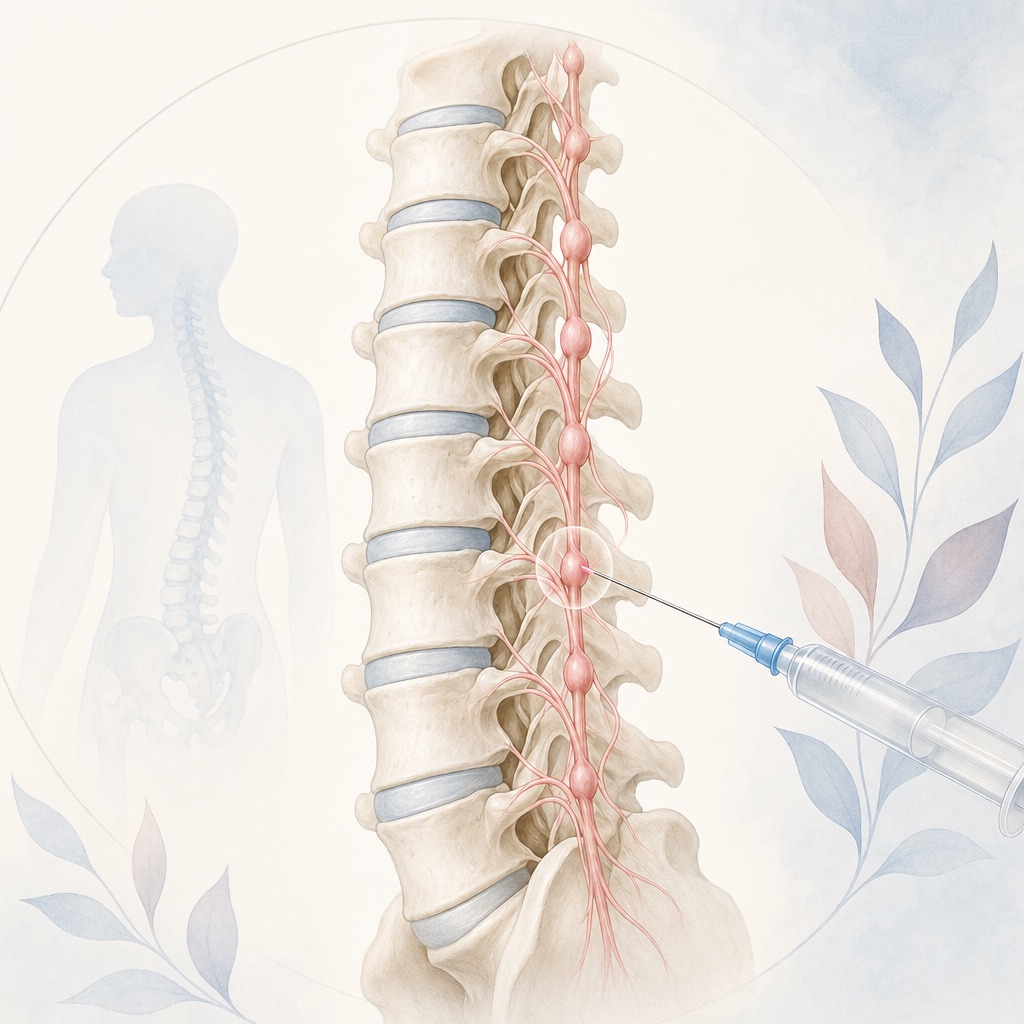
The sympathetic chain for the leg is a cord of nerve tissue that lies on the front-side surface of the lumbar vertebral bodies, just in front of the psoas muscle and just behind the great vessels. The fibers that control the leg's blood vessels and sweat glands leave the spinal cord at L1–L3 and relay through the ganglia at the L2, L3 and L4 levels. From there they travel with the leg's arteries and nerves down to the toes.
After some injuries these fibers become cross-wired with pain fibers. Each sympathetic signal that should just narrow a blood vessel instead fires the pain pathway, and pain drives more sympathetic output. The leg is cold, mottled, swollen or sweaty, and burns. That is sympathetically maintained pain, and CRPS is the classic example. In peripheral artery disease the same fibers keep vessels clamped down; blocking them opens what circulation remains, which is why the block can relieve ischemic rest pain and help ulcers heal.
The technique. With you lying face down under fluoroscopy, a needle is placed from the flank, about 3–4 inches from the midline, and steered to the front-side edge of the L2, L3 or L4 vertebral body, in front of the psoas muscle. Contrast dye must spread in a thin line up and down the front of the vertebrae; if it stays in the psoas muscle or heads toward a vessel, the needle is repositioned. We block one to three levels with a total of 10–20 mL of local anesthetic. Because the target is deep, we use light sedation, but not so much that you cannot rate your pain afterward.
Expected leg warmth. A skin temperature probe on each foot is the proof of a good block. Within 10–20 minutes the treated foot should warm by at least 1.5–2°C and often more, and feel flushed and heavy. If the foot does not warm, the block missed and the pain response cannot be judged. If the foot warms and the pain drops by 50% or more, the test is positive and a series begins. If the foot warms and the pain is unchanged, your pain is sympathetically independent, and we spare you further blocks and move to other options such as DRG stimulation, which has the strongest device evidence for CRPS of the leg.
Series-of-blocks logic. For CRPS a typical series is 3–6 blocks, 1–2 weeks apart, each the day before physical therapy so the therapist can load and desensitize the foot while the pain is down. For ischemic pain or a positive test in a patient who cannot come back repeatedly, a longer-lasting radiofrequency or chemical (phenol) neurolysis of the chain can follow.
What happens on procedure day
- Check-in with no solid food for 4–6 hours if you are having sedation. We review your pain score, blood-thinner list and kidney history, confirm the side, and tape a temperature probe to each foot. An IV is placed.
- You lie face down on the fluoroscopy table with a pillow under your hips. Blood pressure, heart rate and oxygen are monitored throughout; light sedation is given if you want it.
- The skin on the flank is cleaned with chlorhexidine and numbed with lidocaine.
- Under fluoroscopy the needle is advanced to the front-side edge of the L2, L3 or L4 vertebral body, in front of the psoas muscle. You feel pressure deep in the back; a brief ache into the groin or thigh is possible and tells us the needle is passing near the genitofemoral nerve, which we then move away from.
- Contrast dye confirms a thin spread along the front of the spine and away from vessels, the psoas and the kidney. The anesthetic, 5–10 mL per level, is injected slowly after a test dose.
- We turn you onto your back and watch the temperature probes for 20–30 minutes. When the treated foot has warmed, we ask you to move it, stand with help, and rate your pain.
- You go home with a driver, a pain and temperature diary, and a physical therapy appointment for the next day when the block is part of a CRPS series.
After the procedure
Day 0. The treated leg is warm, flushed and often feels heavy for several hours. Blood pressure can drop on standing for a few hours, so stand slowly and drink fluids. If the anesthetic spread to the nerves in the psoas muscle, the thigh may be numb or weak until it wears off; do not walk unassisted until it does. A sore flank is normal. Use the pain-free hours to move the foot and put weight on it as far as you can.
Days 1–3. Physical therapy the day after the block is the core of CRPS treatment. Pain returns over a day to several days; write down how long it stayed down and what you could do. Flank or back ache for 2–3 days is common. Groin pain or burning on the front of the thigh that starts in the first days is genitofemoral neuritis; it is uncommon after an anesthetic block, usually mild, and settles over weeks.
Week 1–2. Bring the diary; the interval to the next block is set by how long relief lasted. For ischemic pain, note whether rest pain and night pain improved and whether an ulcer started to change.
When we judge the response. The test block is judged the same day from the temperature record and the diary. A series is judged after 2–3 blocks. Call the same day for fever, blood in the urine, severe flank pain, leg weakness lasting more than 24 hours, or new numbness in the groin or thigh that is getting worse.
What the evidence shows
Lumbar sympathetic block is recommended by ASIPP and by international CRPS guidelines as part of early, multimodal treatment for CRPS of the lower limb, alongside physical therapy and medication. The controlled-trial evidence is small: a Cochrane review of local anesthetic sympathetic blockade for CRPS found only low-quality randomized trials and could not confirm long-term benefit from blocks alone, while observational series and guideline panels consistently describe short-term relief that enables rehabilitation and better results when started early. A randomized trial comparing radiofrequency to chemical neurolysis of the lumbar chain found both gave meaningful relief in CRPS patients who had responded to test blocks. For peripheral artery disease, older trials and a large registry show that chemical lumbar sympathectomy reduces rest pain and can help ulcer healing in patients who cannot be revascularized, with relief typically lasting months. For phantom limb pain, the evidence is limited to case series. Gulf Coast Pain & Spine performs lumbar sympathetic blocks in Houston and Webster, and in Pearland when that office opens in November 2026.
Alternatives and what comes next
For CRPS of the leg the block is one part of a plan built around physical therapy (graded loading, desensitization, mirror therapy), a nerve-pain medication and, early on, sometimes a short oral steroid course or a bisphosphonate. The sympathetic block hub compares the whole family; the arm equivalent is the stellate ganglion block. When blocks help but do not hold, or when the test shows sympathetically independent pain, dorsal root ganglion stimulation is the device with the best randomized evidence for CRPS of the leg, and spinal cord stimulation is the alternative for wider or bilateral pain. For ischemic pain or a patient who cannot return for a series, radiofrequency or phenol neurolysis of the chain extends relief to months; for phantom limb pain, a positive block is also a good sign for stimulation and for referral to a surgeon about targeted muscle reinnervation. If a block with a properly warmed foot gives no relief, sympathetic treatment is not your answer, and that result spares you further blocks. Ask which approach we recommend for your leg.
Safety and preparation
- Blood thinners: this is a deep block near the aorta and lumbar arteries, treated as intermediate-to-high risk under ASRA guidance. Warfarin, DOACs (apixaban, rivaroxaban, dabigatran, edoxaban), clopidogrel, prasugrel and ticagrelor are held for 2–7 days depending on the drug, arranged with the prescriber. Never stop a blood thinner on your own.
- Diabetes: the block uses anesthetic only, so blood sugar is unaffected. If you take insulin, tell us because you will be fasting before sedation.
- Infection or fever: fever above 100.4°F, a urinary or kidney infection, or skin infection on the flank postpones the block; a leg ulcer that is infected rather than ischemic needs treatment first.
- Allergies (contrast, steroid, local anesthetic): contrast dye is essential to confirm safe spread. Tell us about a contrast allergy so we can pre-treat with steroid and antihistamine.
- Pregnancy: the block requires fluoroscopy and is deferred; tell us if you are or could be pregnant.
- Sedation and driving: with or without sedation you need a driver, because a warm, heavy or weak leg and low blood pressure are expected for hours. No driving for 24 hours.
- Fasting: no solid food for 4–6 hours and clear liquids up to 2 hours before if you are having sedation.
- Kidneys and vessels: tell us about a single kidney, kidney transplant, horseshoe kidney, prior kidney or aortic surgery, or an aortic aneurysm; these change the needle path or the decision to proceed.
Risks and side effects
- Warm, flushed, heavy leg for several hours (expected)
- Low blood pressure and lightheadedness on standing for a few hours
- Flank or back soreness for 2–5 days from the needle path through the muscles
- Brief ache into the groin or thigh during the procedure as the needle passes the genitofemoral nerve
- Genitofemoral neuralgia: burning or numbness in the groin and upper inner thigh, starting within days; uncommon after an anesthetic block (more common after neurolysis, in roughly 5–10%), usually resolving over weeks to months
- Anesthetic spread into the psoas muscle, numbing or weakening the thigh for several hours; walking needs assistance until it clears
- Bleeding into the muscle or the space behind the abdomen (retroperitoneal hematoma), more likely on blood thinners
- Vasovagal reaction; nausea from sedation
- Kidney or ureter puncture from a needle placed too far to the side; rare, usually shown by blood in the urine or flank pain, and almost always heals without surgery
- Injection into a lumbar artery or the aorta, or spread into the spinal fluid or epidural space causing a temporary spinal block with leg weakness and low blood pressure
- Discitis (infection of the disc) if the needle passes through a disc, abscess, or infection of the psoas muscle
- Ejaculatory dysfunction or persistent groin numbness after bilateral or neurolytic blocks; permanent nerve injury to the lumbar plexus is very rare
Frequently asked questions
How do you know the block reached the right place?
By the temperature of your foot. We tape a probe to each foot; a rise of at least 1.5–2°C on the treated side within 10–20 minutes means the sympathetic chain was blocked. Contrast dye on the X-ray showing spread along the front of the spine confirms the needle position before we inject.
Is this a test or a treatment?
Both. The first block tests whether your leg pain is sympathetically maintained: a warm foot plus at least 50% relief is positive. A series of 3–6 blocks with physical therapy is the treatment for CRPS. For ischemic pain, a positive test can lead to a longer-lasting neurolysis.
Will it help my back pain or sciatica?
No. The block affects only the sympathetic nerves to the leg, not the joints or nerve roots that cause back pain and sciatica. Those are evaluated and treated with different procedures.
Why does my groin hurt afterward?
The genitofemoral nerve runs on the front of the psoas muscle near the needle path. A brief ache during the block is common; a burning groin or inner thigh that starts over the next days is genitofemoral neuritis, uncommon after an anesthetic block and usually settling over weeks. Tell us if it appears so we can treat it and adjust the next block.
How many blocks will I need?
For CRPS, typically 3–6 over 4–8 weeks, 1–2 weeks apart, each timed before physical therapy. If relief grows with each block we continue and stretch the interval; if two or three blocks give nothing lasting, we stop and discuss DRG or spinal cord stimulation.
What if the foot warms but the pain does not change?
That is a useful answer: your pain is sympathetically independent, and repeating blocks will not help. The next step for CRPS is usually dorsal root ganglion stimulation, which has the strongest trial evidence for leg CRPS, or spinal cord stimulation.
Can I walk afterward?
With help at first. The leg feels warm and heavy, and if the anesthetic spread into the psoas muscle the thigh can be numb or weak for a few hours. Once it clears you can walk normally, and light activity that evening is encouraged. You need a driver either way.
Sources
- Complex Regional Pain Syndrome: Information Page (opens in new tab) — National Institute of Neurological Disorders and Stroke (NINDS)
- Local anaesthetic sympathetic blockade for complex regional pain syndrome (Cochrane Review) (opens in new tab) — Cochrane Library
- Complex regional pain syndrome: practical diagnostic and treatment guidelines, 5th edition (opens in new tab) — Pain Medicine (Oxford Academic)
- Interventional Spine and Pain Procedures in Patients on Antiplatelet and Anticoagulant Medications (Second Edition) (opens in new tab) — American Society of Regional Anesthesia and Pain Medicine (ASRA)
- Management of lower limb complex regional pain syndrome type 1: radiofrequency thermal lumbar sympathectomy versus phenol lumbar sympathetic neurolysis (pilot randomized study) (opens in new tab) — Anesthesia & Analgesia (PubMed)
Next step
Request an appointment
Call (832) 916-2075 or request an appointment online. New patients are welcome; the team confirms insurance and referral requirements before scheduling.