
- Burning, stabbing or band-like pain that follows one or two ribs from the spine toward the front of the chest, lasting more than 6–8 weeks
- Pain after thoracotomy, thoracoscopic (VATS) surgery, chest-tube placement, mastectomy or open-heart surgery that has not settled by 2–3 months
- Persistent pain at a healed rib fracture site, or from a rib that healed with a callus that traps the nerve
- Postherpetic neuralgia on the trunk (shingles pain lasting more than 3 months) that medication controls poorly
- Chest-wall pain in which a cardiologist or pulmonologist has already excluded heart and lung disease
- Patients being considered for intercostal radiofrequency ablation or cryoneurolysis, who need a positive diagnostic block first
Nerve blocks & ablation
Intercostal Nerve Block
Intercostal nerve block in Houston for chest-wall pain after surgery, rib fracture or shingles: technique, pneumothorax risk, relief, next steps.
In short
An intercostal nerve block is an injection of local anesthetic, with or without a steroid, around the nerve that runs along the underside of a rib. It treats chest-wall pain that follows one or more ribs: pain after chest surgery, after rib fractures, from shingles on the trunk, or from an irritated intercostal nerve. It can be a test (anesthetic only, to prove the nerve is the source) or a treatment (with steroid, for weeks of relief), and a positive block can lead to radiofrequency ablation or cryoneurolysis of the same nerve. The block is done under ultrasound or X-ray guidance; the one risk specific to it is a punctured lung, which imaging makes uncommon.
Key facts
| Treats | Post-thoracotomy pain syndrome (pain lasting more than 2 months after chest surgery); chronic pain after rib fractures; postherpetic neuralgia on the trunk; intercostal neuralgia; chest-wall pain after heart and lung causes have been ruled out |
|---|---|
| Test or treatment? | Both. Anesthetic alone is a test: relief for 2–8 hours that follows the rib line confirms the nerve. Anesthetic plus steroid is a treatment. A positive test can lead to RFA or cryoneurolysis. |
| Procedure time | 10–20 minutes for 1–3 levels; about an hour in the office |
| Anesthesia | Local anesthetic at the skin; light sedation is optional |
| Downtime | Same-day discharge. No driving for 24 hours if sedated. Avoid heavy lifting for 2–3 days. |
| When relief starts | Anesthetic within 10–20 minutes; steroid over 3–7 days |
| How long relief lasts | Test: hours. With steroid: typically 2–8 weeks. RFA or cryoneurolysis after a positive block: typically 3–6 months or longer. |
| How often it can be repeated | Steroid blocks: typically no more than 3–4 per year. A block that helps but wears off in under a month twice is the cue to move to ablation. |
| Insurance | Covered for the diagnoses above with documentation; diagnostic block usually required before RFA or cryo |
Who it is for
- Chest pain that has not been evaluated for heart, lung, aortic or gallbladder causes; new chest pain with shortness of breath, sweating or pressure needs emergency care, not a block
- Severe COPD, emphysema, or a single functioning lung, where even a small pneumothorax would be dangerous
- Bleeding disorders or blood thinners that cannot be held (for the fluoroscopic or multi-level approach)
- Active infection, or shingles blisters still present at the injection site (blocks during active shingles are possible but done differently)
- Uncontrolled diabetes if a steroid is planned
- Pain that is widespread across the chest and back rather than along a rib line, which a block cannot test
Where the nerve runs and why the lung is the main concern
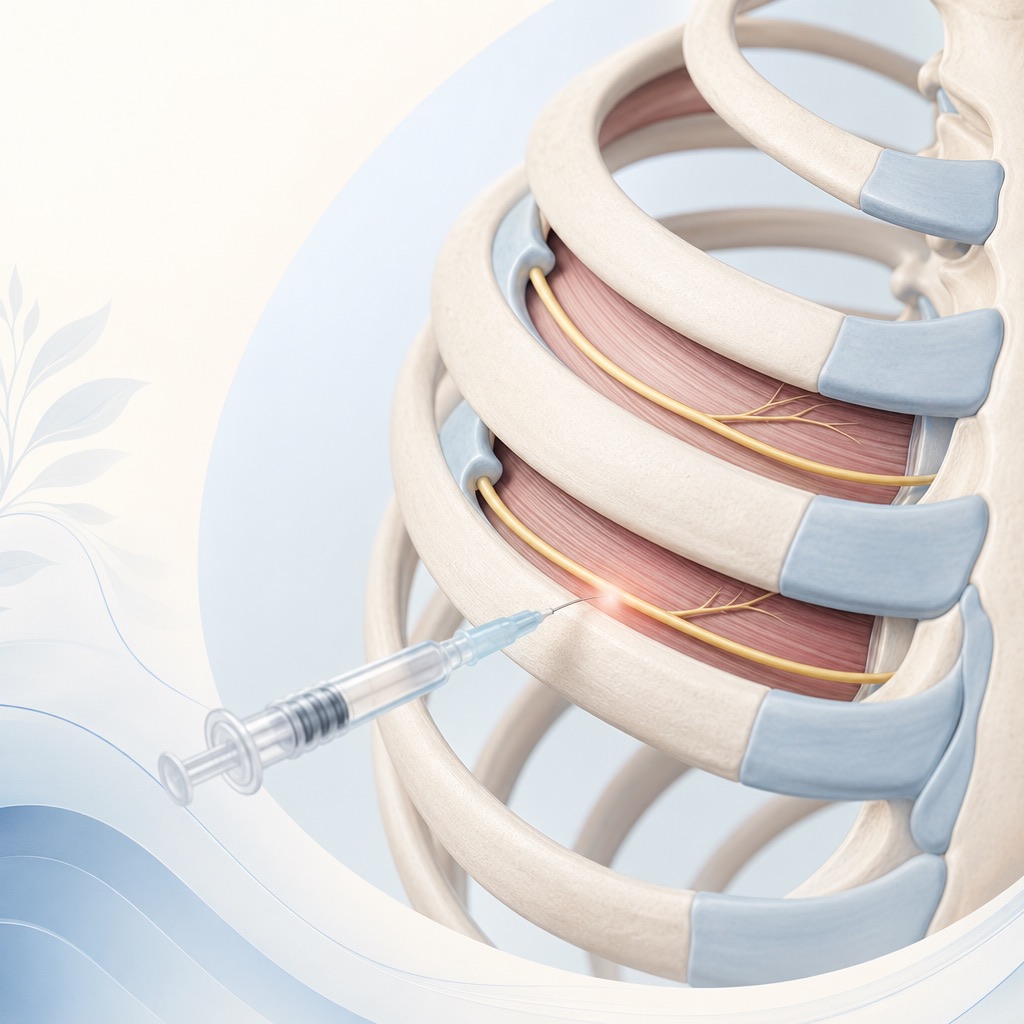
Each intercostal nerve leaves the thoracic spine and runs forward in a groove on the underside of its rib, tucked between the rib and the lung lining with its vein and artery. It supplies the skin, muscle and rib lining in a band from the spine to the breastbone. Surgery, a fracture callus, a chest tube or the shingles virus can injure the nerve at one point, and the whole band then hurts.
Bathing the nerve in local anesthetic where it runs under the rib interrupts the signal for the entire band downstream. Because neighboring nerves overlap, we usually block the rib above and below the painful one as well: 3 levels for one rib's territory, occasionally up to 5. We inject 2–4 mL per level, as small a volume as works, for a reason explained below.
Why pneumothorax is the first risk we discuss. The lung lining (pleura) lies a few millimeters deep to the nerve. If the needle passes too deep it can puncture the lung, letting air into the chest (pneumothorax). With landmark technique this happened in roughly 1 in 100 to 1 in 1,000 blocks in older series, more often with multiple levels; with ultrasound, which shows the pleura moving with each breath, or fluoroscopy, which shows the rib edge, the rate is far lower. Most pneumothoraces after a block are small and seal on their own; a few need a chest tube. We watch you for 30 minutes and tell you exactly what symptoms to report.
Why we keep the dose small. The intercostal space is so well supplied with blood that local anesthetic is absorbed into the bloodstream faster from here than from any other common block site. That means the total dose matters, especially when several levels are blocked. We calculate the maximum safe dose for your weight before we start and keep each level's volume low, which is why we ask about your weight and any liver disease.
Test or treatment. With anesthetic alone, the block is a test: if pain along that rib drops by 50% or more for as long as the drug lasts, we have found the source and you qualify for a longer-lasting procedure. With a steroid added, it is a treatment that can quiet an inflamed nerve for weeks. The choice depends on what we are trying to learn.
What happens on procedure day
- Check-in and a review of your pain score, blood-thinner status, breathing history and weight (for the anesthetic dose). We mark the painful rib or ribs while you point to the band of pain.
- You lie face down or on your side with the painful side up, arm forward to move the shoulder blade out of the way. Blood pressure, pulse and oxygen level are monitored throughout.
- The skin over the back of the ribs, about 3 inches from the spine, is cleaned with chlorhexidine and numbed with lidocaine.
- Under ultrasound we see the rib, the intercostal muscles and the bright line of the pleura moving with your breathing; under fluoroscopy we see the rib edge. The needle is walked off the lower edge of the rib and advanced 2–3 mm, no deeper. You feel pressure; a brief zing around the chest wall is common.
- After drawing back to confirm no blood, 2–4 mL of anesthetic (with steroid, for a treatment block) is injected at each level. We repeat for the rib above and below. Total needle time is usually 10–20 minutes.
- You sit up and we watch you for 30 minutes, checking your breathing and oxygen level. For a diagnostic block we ask you to take a deep breath, twist and press on the chest wall, then rate your pain.
- You go home with a pain diary and instructions on what breathing symptoms to call about. A driver is needed if you were sedated.
After the procedure
Day 0. The band of skin along the blocked ribs is numb for 3–8 hours. Breathe normally; the block does not weaken your breathing muscles in any meaningful way at these volumes. Some soreness at the needle sites is expected. Rate your pain every hour for the diary. Call immediately or go to an emergency room if you develop sudden sharp chest pain, new shortness of breath, a dry cough, or a fast heartbeat within the first 24 hours; these can signal a slow pneumothorax and need a chest X-ray.
Days 1–3. After a diagnostic block, pain returns as the anesthetic wears off, and the diary is what we read. After a steroid block a short flare is possible before relief builds. Avoid heavy lifting, but walk and breathe deeply; lying still after chest-wall procedures is worse for the lungs than moving.
Week 1–2. Steroid benefit is usually clear by day 7. Use the relief window to restore full deep breathing, shoulder motion and posture, which post-surgical chest-wall pain tends to restrict.
When we judge the response. Same day for a diagnostic block; at 2–3 weeks for a steroid block. If relief was good but short, that is a positive result for planning radiofrequency ablation or cryoneurolysis.
What the evidence shows
Intercostal blocks are long established for acute pain: randomized trials show they reduce pain and opioid use after thoracic surgery and rib fractures, and they remain a standard tool in that setting. For chronic chest-wall pain the evidence is thinner and comes mainly from case series and small trials. In post-thoracotomy pain syndrome, which affects roughly 30–50% of patients after open chest surgery, blocks reliably give short-term relief and identify who benefits from cryoneurolysis or radiofrequency treatment of the same nerves, which extend relief to months in reported series. For postherpetic neuralgia on the trunk, blocks with local anesthetic and steroid can reduce pain for weeks and are a reasonable option when first-line medications (gabapentinoids, tricyclics, topical lidocaine) fall short; they do not cure the condition. Guidelines from ASIPP and the American Society of Regional Anesthesia support the block's safety with image guidance and its use as a diagnostic step before ablation. Gulf Coast Pain & Spine performs intercostal blocks in Houston and Webster, and in Pearland when that office opens in November 2026.
Alternatives and what comes next
Before a block: 4–8 weeks of a nerve-pain medication, topical lidocaine or capsaicin, and physical therapy for the shoulder and trunk are the standard first steps, and for postherpetic neuralgia they remain the foundation. Other injections for the same region include the thoracic paravertebral block (closer to the spine, covers more levels), the erector spinae plane block (a newer ultrasound block with less pneumothorax risk but less precise targeting), and trigger point injections when the pain is muscular rather than along a nerve.
After a positive diagnostic block, the longer-lasting options are: intercostal radiofrequency ablation, usually pulsed radiofrequency to avoid the post-ablation neuritis that conventional heat lesions can cause on these nerves; cryoneurolysis, freezing the nerve so it stops signaling for 3–6 months while it regrows, which is well suited to post-thoracotomy pain; or, for pain that keeps returning, peripheral nerve stimulation or, for widespread post-surgical or shingles pain, spinal cord stimulation. If a well-placed block gives no relief, the pain is not intercostal and we look at the thoracic facet joints, the spine, or a visceral cause with your other physicians. Ask which approach we recommend for your pain pattern.
Safety and preparation
- Blood thinners: with ultrasound guidance a single-level block is treated as low-to-intermediate risk under ASRA guidance and can sometimes proceed on aspirin or a DOAC; multi-level or fluoroscopic blocks near the spine usually require holding warfarin, DOACs, clopidogrel or ticagrelor for 2–7 days. Bring your exact list; we coordinate with the prescriber. Do not stop a blood thinner on your own.
- Diabetes: a steroid block raises blood sugar for 1–7 days; we postpone the steroid, or do the block with anesthetic only, if your morning glucose is above roughly 200–250 mg/dL.
- Infection or fever: fever above 100.4°F, a chest infection, or a skin infection at the site postpones the block. Active shingles blisters change the plan; tell us if the rash is still present.
- Allergies (contrast, steroid, local anesthetic): fluoroscopic blocks use a small amount of contrast dye; ultrasound blocks use none. Tell us about any reaction to contrast, lidocaine, bupivacaine or a steroid.
- Pregnancy: we use ultrasound (no X-ray) and anesthetic only; tell us if you are or could be pregnant.
- Sedation and driving: sedation is optional and light; if you have it, you need a driver and should not drive for 24 hours. Without sedation you may drive yourself.
- Lung disease: tell us about COPD, emphysema, prior lung surgery, a single lung or home oxygen. A pneumothorax is more dangerous with limited lung reserve and may change the choice of block.
- Weight and liver disease: we calculate the maximum local anesthetic dose from your weight; liver disease slows clearance and lowers the safe dose.
Risks and side effects
- Pneumothorax (a punctured lung) is the risk specific to this block; with ultrasound or fluoroscopy it is uncommon, roughly 1 in several hundred blocks or fewer, and most are small and heal without treatment. Symptoms are sudden chest pain, shortness of breath or a dry cough within 24 hours; some need a chest tube.
- Soreness and bruising at the needle sites for 2–5 days
- Numbness of the skin band along the blocked ribs for 3–8 hours (expected)
- A short flare of pain for 1–3 days after a steroid block; blood sugar rise for several days in diabetics
- Local anesthetic toxicity from rapid absorption in the intercostal space: ringing in the ears, metallic taste, numb lips, dizziness or, at higher doses, seizure or heart rhythm problems. We keep total dose low and monitor you for 30 minutes.
- Bleeding from the intercostal artery, more likely on blood thinners
- Vasovagal reaction during the procedure
- Prolonged numbness or a patch of altered sensation lasting days to weeks
- Large or tension pneumothorax requiring a chest tube and hospital admission
- Spread of anesthetic to the epidural or spinal space when the block is done close to the spine, causing temporary leg numbness or low blood pressure
- Infection, including empyema (infection of the chest cavity) or abscess
- Nerve injury with lasting neuritis, more associated with conventional radiofrequency than with the block itself
Frequently asked questions
What are the chances of a collapsed lung?
Low with image guidance: roughly 1 in several hundred blocks or fewer, and most are small and resolve on their own. Landmark technique without imaging carried higher rates in older reports, which is why we always use ultrasound or fluoroscopy. Sudden chest pain, breathlessness or a dry cough in the first 24 hours needs a same-day chest X-ray.
Is this a test or a treatment?
Either, depending on what we inject. Anesthetic alone is a test: relief along the rib for the hours the drug works confirms the nerve. Anesthetic plus steroid is a treatment meant to last weeks. We tell you which before you schedule, and a positive test is what qualifies you for ablation or cryoneurolysis.
How many ribs will you block?
Usually three: the painful rib plus the one above and below, because neighboring nerves overlap. For post-surgical pain along a long incision it can be four or five, and the total anesthetic dose is adjusted so it stays safe.
Will it make it hard to breathe?
No. The block numbs skin and a thin layer of muscle along a few ribs; it does not weaken your diaphragm. Trouble breathing after the block is not expected and should be reported right away.
Can it help my shingles pain?
For postherpetic neuralgia on the trunk, a block with anesthetic and steroid can reduce pain for weeks and helps some patients cut back on medication. It does not cure the condition, and medication and topical treatments stay the foundation. Very persistent cases may benefit from pulsed radiofrequency or a stimulator.
What comes after the block if it works but wears off?
That is the pattern that points to a longer-lasting procedure on the same nerve: pulsed radiofrequency ablation or cryoneurolysis, which typically give 3–6 months or more, or a peripheral nerve stimulator for pain that keeps returning.
Can I have it if I am on a blood thinner?
Sometimes, for a single-level ultrasound block. Multi-level or X-ray-guided blocks near the spine usually require a 2–7 day hold, arranged with your prescribing doctor. Bring your exact medication list.
Sources
- Interventional Spine and Pain Procedures in Patients on Antiplatelet and Anticoagulant Medications (Second Edition) (opens in new tab) — American Society of Regional Anesthesia and Pain Medicine (ASRA)
- Checklist for Treatment of Local Anesthetic Systemic Toxicity (opens in new tab) — American Society of Regional Anesthesia and Pain Medicine (ASRA)
- Shingles (Herpes Zoster) and Postherpetic Neuralgia: Information Page (opens in new tab) — National Institute of Neurological Disorders and Stroke (NINDS)
- Practice Guidelines for Chronic Pain Management (opens in new tab) — American Society of Anesthesiologists (Anesthesiology)
- Interventional Techniques: Evidence-based Practice Guidelines in the Management of Chronic Spinal Pain (opens in new tab) — American Society of Interventional Pain Physicians (ASIPP)
Next step
Request an appointment
Call (832) 916-2075 or request an appointment online. New patients are welcome; the team confirms insurance and referral requirements before scheduling.