
Spine pain
Back Pain
Back pain by region and pattern: upper, mid and low back, nerve pain, fractures. Find the guide that fits your symptoms. Houston pain specialists.
"Back pain" covers everything from a pulled muscle to a compressed nerve, and the right treatment depends on where it is and how it behaves. This page sorts back pain by region and by pattern and sends you to the detailed guide for each. Gulf Coast Pain & Spine treats the full range of spine pain at its Houston and Webster offices and, from November 2026, in Pearland.
Key facts
| What it is | Pain anywhere along the spine, from the base of the neck to the tailbone. Low back pain is by far the most common; thoracic (mid-back) pain is the least common and the most likely to have a non-spinal cause. |
|---|---|
| Most common causes | Muscle strain, disc problems, facet joint arthritis, sacroiliac joint dysfunction, spinal stenosis, and compression fractures. Nerve compression adds shooting pain into an arm or leg. |
| Typical course | Most acute episodes improve within 6 weeks. Pain lasting past 12 weeks usually has an identifiable source and rarely resolves without targeting it. |
| See a specialist when | Pain lasts more than 6 weeks, keeps returning, travels into a limb, or follows a fall in someone with osteoporosis. |
| Treatments we offer | Epidural steroid injections, medial branch blocks and radiofrequency ablation, SI joint injections, trigger point injections, kyphoplasty, spinal cord stimulation, and coordinated therapy and medication plans. |
When to get emergency care
Go to an emergency room or call 911 if your back pain comes with any of these:
- Numbness in the groin or inner thighs, trouble urinating, or loss of bowel or bladder control (possible cauda equina syndrome).
- New or worsening weakness in a leg or arm, a dragging foot, or trouble with balance or hand coordination.
- Fever or chills with back pain, especially with diabetes, a recent infection, or a recent spine procedure.
- Back pain after a fall or accident, or a minor fall if you are over 65 or have osteoporosis.
- Cancer history, unexplained weight loss, or pain that is worst at night and does not ease with rest.
- Sudden severe mid-back pain with chest pain, shortness of breath, or a tearing sensation (heart or aortic causes).
Back pain by region
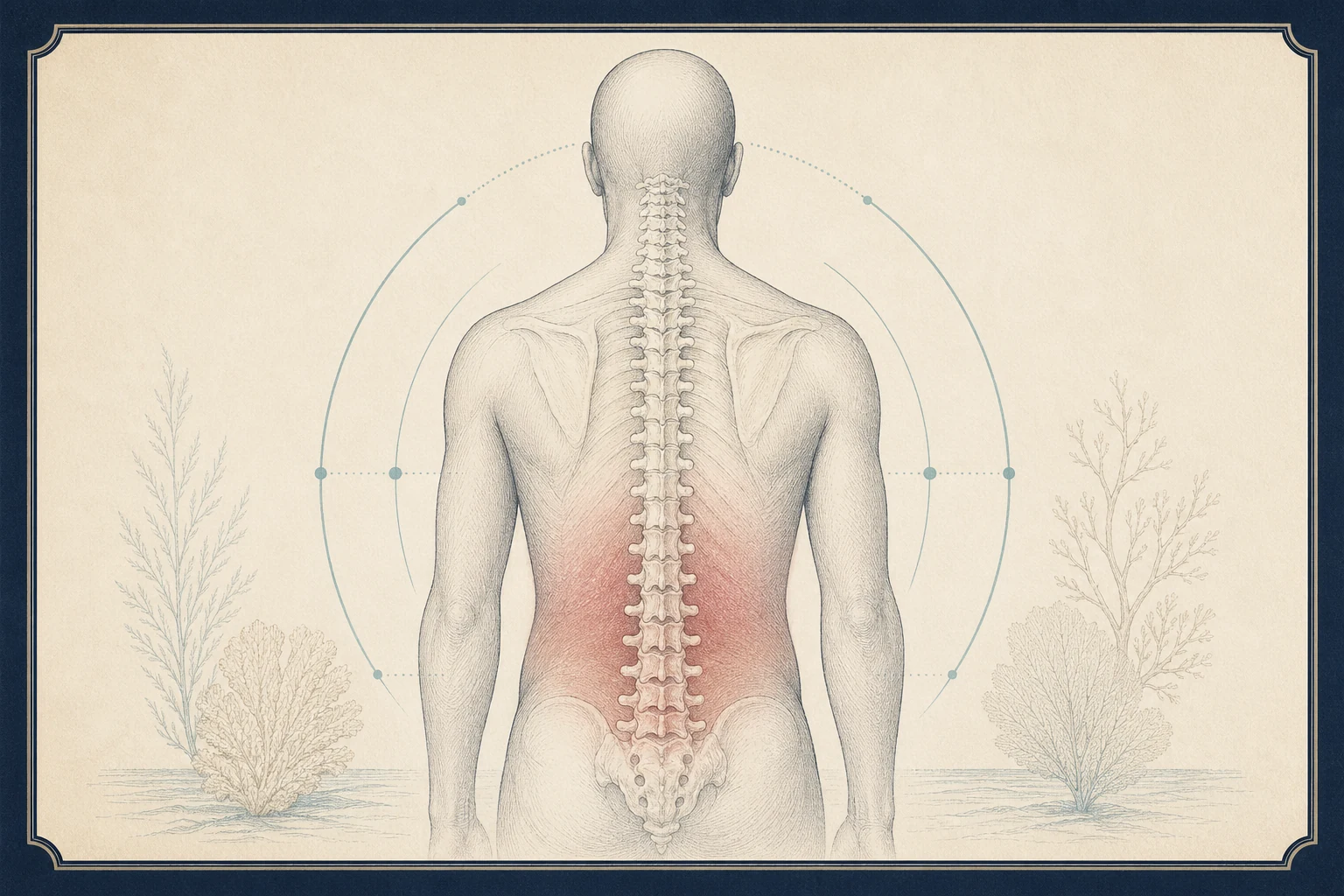
Low back (lumbar). The bottom five vertebrae carry most of the body's load and account for the large majority of back pain. Sources are the disc, the facet joints, the sacroiliac joint and the muscles, each with its own pattern. Start with lower back pain.
Mid back (thoracic). The twelve vertebrae attached to the ribs. This region is stiff by design and rarely herniates, so persistent mid-back pain deserves a wider look: thoracic facet joints, rib joints, muscle strain from posture, and, in older adults or people with osteoporosis, a vertebral compression fracture. Mid-back pain that comes with chest symptoms, shortness of breath, or abdominal pain can be referred from the heart, lungs, gallbladder or pancreas and needs medical evaluation first.
Upper back and neck (cervical). Pain between the shoulder blades and at the base of the neck is most often referred from the cervical facet joints or discs. Start with neck pain; if pain shoots down an arm, see cervical radiculopathy.
Back pain by pattern
- Pain that shoots down a leg below the knee, with tingling or numbness: nerve root irritation. See sciatica and herniated disc.
- Pain worse arching backward, twisting or standing, stiff in the morning: facet joints. See facet joint syndrome.
- Pain worse sitting and bending forward, better standing: disc. See degenerative disc disease.
- Low, one-sided pain at the top of the buttock, worse rising from a chair: SI joint pain.
- Leg heaviness or cramping after walking, relieved by sitting or leaning on a cart: spinal stenosis.
- Sudden severe pain in an older adult or after a minor fall: vertebral compression fracture.
- Back pain that continues or returns after spine surgery: post-laminectomy syndrome.
- Neck and upper back pain after a car accident: whiplash.
How we diagnose it
The pattern above is the starting point. A physical exam tests which movements reproduce the pain, checks strength, reflexes and sensation in the limbs, and includes provocation tests for the SI joint. Imaging is ordered when pain has lasted more than 6 weeks, when there are nerve symptoms or red flags, or to plan a procedure; it is not routine for a first episode because degenerative findings are present in most adults without pain. Facet and SI joint pain are confirmed with diagnostic numbing blocks, not imaging.
Treatment options, in order
Every path starts with activity, a short course of anti-inflammatory medication and physical therapy. Procedures are matched to the confirmed source.
- Physical therapy and medication review
Structured exercise and a short medication plan for the first 6 weeks. Learn more →
- Epidural steroid injection
For disc or stenosis pain with nerve irritation. Learn more →
- Medial branch block, then radiofrequency ablation
For confirmed facet joint pain in the neck, mid or low back. Learn more →
- SI joint injection or fusion
For confirmed sacroiliac joint pain. Learn more →
- Kyphoplasty
For a painful compression fracture not improving within a few weeks. Learn more →
- Spinal cord stimulation
For pain that persists after spine surgery. Learn more →
What you can do now
Keep moving; walking is the best first treatment for most back pain. Avoid bed rest beyond a day. Use heat or ice, whichever feels better. Take ibuprofen or naproxen for a few days if your doctor has said they are safe for you. Note which positions and activities make it worse; that pattern is the most useful thing you can bring to your first visit.
Frequently asked questions
What causes upper back pain between the shoulder blades?
Most often the cervical facet joints or discs at the base of the neck, which refer pain to the area between the shoulder blades, or muscle strain from posture. Less commonly thoracic facet joints or rib joints. If it comes with chest pain or shortness of breath, seek medical care first.
Is mid-back pain more serious than low back pain?
Not usually, but it deserves a broader evaluation because the thoracic spine rarely causes pain on its own. Compression fractures, rib joint problems, and referred pain from internal organs are more likely in the mid back than in the low back.
When does back pain become chronic?
After 12 weeks. About 90% of acute episodes improve within 6 weeks. Pain that persists beyond 12 weeks usually has an identifiable source (disc, facet, SI joint, stenosis, fracture) that responds to targeted treatment.
How do I know if my back pain is a nerve problem?
Nerve pain travels: down a leg below the knee, or down an arm to the hand, often with tingling, numbness or weakness. Pain that stays in the back or spreads only to the buttock or shoulder blade is usually from a joint, disc or muscle rather than a nerve.
Should I see a pain specialist or a spine surgeon?
Most back pain does not need surgery. A pain specialist can identify the source and treat it with injections, ablation and coordinated therapy. We refer to a surgeon when there is progressive weakness, cauda equina symptoms, an unstable fracture, or nerve compression that has not responded to treatment.
Sources
- Low Back Pain Fact Sheet (opens in new tab) — National Institute of Neurological Disorders and Stroke (NIH)
- Noninvasive Treatments for Acute, Subacute, and Chronic Low Back Pain: A Clinical Practice Guideline (2017) (opens in new tab) — American College of Physicians
- Low Back Pain (opens in new tab) — American Academy of Orthopaedic Surgeons, OrthoInfo
Request an appointment
Call (832) 916-2075 or request an appointment online. New patients are welcome; the team confirms insurance and referral requirements before scheduling.