
- A compression fracture confirmed on X-ray or CT, with MRI showing bone marrow edema (an unhealed fracture), that lines up with the painful level on exam
- Severe pain (typically 7 out of 10 or worse) that limits standing and walking, despite 2–6 weeks of medication, bracing and activity modification, or sooner if the person is bed-bound or hospitalized
- Fracture from osteoporosis, a fall, multiple myeloma or metastatic cancer
- Height loss on serial X-rays or progressive kyphosis at the fracture level
- People who cannot tolerate opioid pain medication, or whose immobility is causing pneumonia, clots or deconditioning
Neuromodulation & implants
Kyphoplasty and Vertebroplasty for Spinal Compression Fractures
Kyphoplasty and vertebroplasty stabilize painful spinal compression fractures with bone cement. Timing window, evidence, risks, same-day walking. Houston.
In short
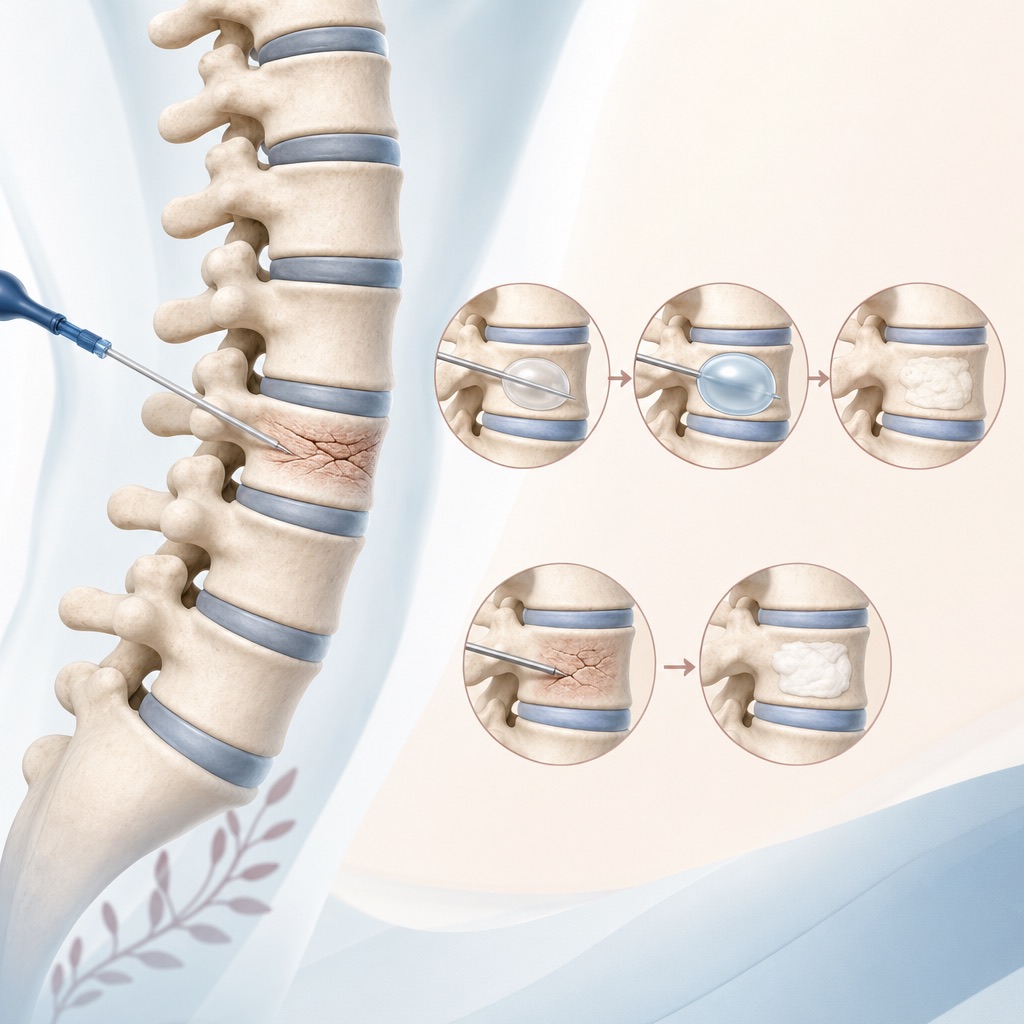
Kyphoplasty and vertebroplasty are outpatient procedures that stabilize a painful vertebral compression fracture by injecting bone cement into the broken vertebra through a needle. Kyphoplasty first inflates a small balloon to create a cavity and partly restore the bone's height; vertebroplasty injects cement directly. Both are treatments for fractures that are still fresh on MRI, usually less than 6–8 weeks old, when pain is severe enough to limit walking despite bracing and medication. Most people walk the same day.
Key facts
| Treats | Painful osteoporotic vertebral compression fractures; fractures from multiple myeloma or spinal metastases; some traumatic fractures without instability |
|---|---|
| Test or treatment? | Treatment |
| Timing | Best within 6–8 weeks of the fracture, with bone edema still visible on MRI (STIR sequence); older fractures with persistent edema are considered case by case |
| Procedure time | 30–60 minutes per level |
| Anesthesia | Monitored sedation (MAC) with local anesthetic for most; general anesthesia for multiple levels, prone-position intolerance or cancer cases |
| Downtime | Walking within 1–2 hours; light activity for 1–2 weeks |
| When relief starts | Often within 24–72 hours |
| How long relief lasts | Fracture pain relief is permanent once the bone is stabilized; new fractures at other levels remain possible |
| Insurance | Covered by Medicare and most commercial plans for acute or subacute painful fractures after a short course of conservative care |
Who it is for
- A fracture that has healed (no edema on MRI) or that is no longer the pain source
- A burst fracture with fragments pushed into the spinal canal, a fracture with nerve compression, or spinal instability: these need surgical evaluation
- Active spine or systemic infection (osteomyelitis, discitis, bacteremia)
- Blood thinners that cannot be held, or an uncorrectable bleeding disorder
- Allergy to bone cement components or contrast that cannot be managed
- Vertebrae collapsed to less than about a third of their height (vertebra plana), where cement cannot be placed safely
- Pain that is improving steadily on its own
How kyphoplasty works, and how vertebroplasty differs
A compression fracture is a collapse of the front part of a vertebra, most often from osteoporosis, sometimes from a fall, cancer or multiple myeloma. The broken bone moves microscopically with every step, which is why the pain is so sharp on standing and eased by lying down. Cement augmentation stops that movement.
Kyphoplasty is done through one or two needles placed into the vertebral body from the back, under X-ray. A balloon is inflated inside the fractured bone, pushing the endplates apart to create a cavity and, in fresh fractures, restoring some of the lost height. The balloon is removed and the cavity filled with thick, low-pressure bone cement that hardens in about 10 minutes. Vertebroplasty skips the balloon: thinner cement is injected directly into the fractured bone under higher pressure. It is faster and cheaper, does not restore height, and has a somewhat higher rate of cement leaking outside the bone, although most leaks cause no symptoms. In practice, kyphoplasty is the more common choice for recent fractures with height loss, and vertebroplasty for fractures where there is no cavity to create. Both are done for Houston, Webster and Pearland (opening November 2026) patients in an outpatient setting.
Timing matters. Bone marrow edema on an MRI STIR sequence shows the fracture is still unhealed and still capable of hurting; that is the fracture we treat. Most fractures heal on their own in 8–12 weeks, so a fracture more than 6–8 weeks old with fading pain usually does not need cement. A fracture months old that still shows edema and still hurts can still be treated. If MRI is not possible, a bone scan or CT can substitute.
What happens on procedure day
- Arrive with a driver, having held blood thinners as agreed and fasted for sedation. An IV is placed; antibiotics are given.
- You lie face down on a padded table. Under monitored sedation (or general anesthesia if planned), the skin over the fracture is numbed.
- Under X-ray from two angles, the physician passes a needle through the pedicle (the bony bridge at the back of the vertebra) into the fractured body, one or both sides.
- Kyphoplasty: a balloon is inflated with contrast to create a cavity, then removed. Cement is then injected slowly under continuous X-ray, stopping if any approaches the edge of the bone. Vertebroplasty: cement is injected directly.
- The cement hardens in about 10 minutes. The needles are removed, a bandage is placed (no stitches), and you rest for 1–2 hours before standing and walking with staff. Home the same day; total visit about 2–4 hours.
After the procedure
Day 0: walk before you leave. Soreness at the needle sites is expected for a few days; ice and acetaminophen usually cover it. Many people notice the sharp fracture pain is already better by evening.
Days 1–3: walk daily, no lifting more than about 10 pounds, no bending or twisting. The bandage can come off after 48 hours; shower after that.
Weeks 1–2: most people are back to normal daily activity and, if they were using one, out of the brace. Call for fever, new leg weakness or numbness, chest pain or shortness of breath, or pain that is worse rather than better.
Weeks 2–6: gradual return to full activity; physical therapy for posture and back-extensor strength helps prevent the next fracture. Judge the result at 2 weeks: most people who were treated within the window have a large drop in pain by then.
After that: treat the bone. A first fracture predicts more. Every patient should leave with a plan for a DEXA scan (if none in the last 2 years), calcium and vitamin D, fall prevention, and a discussion with their primary physician or endocrinologist about bone medication (a bisphosphonate, denosumab, or an anabolic agent such as teriparatide or romosozumab for severe cases). For fractures from cancer or myeloma, we coordinate with oncology on radiation and systemic treatment.
What the evidence shows: a contested history, stated plainly
The evidence for cement augmentation has been argued about for 15 years, and you should know why. In 2009, two randomized trials in the New England Journal of Medicine (Buchbinder and colleagues, and Kallmes and colleagues) compared vertebroplasty with a sham procedure in which the needle was placed but no cement injected. Neither found a meaningful difference in pain at 1 or 6 months. These trials enrolled people with fractures up to a year old and, in the Kallmes trial, only moderate pain, and they led several professional societies to advise against routine vertebroplasty.
Later trials chose patients more carefully. The VAPOUR trial (2016) enrolled only people with fractures under 6 weeks old and pain of 7 out of 10 or worse: at 14 days, 44% of the vertebroplasty group had pain below 4 out of 10 versus 21% with sham, and the benefit held at 6 months, with fewer hospital days. The VERTOS IV trial (2018), which enrolled fractures up to 9 weeks old with a similar pain threshold, again found no significant difference from sham at 12 months, though both groups improved substantially. For kyphoplasty, there is no sham-controlled trial; the FREE trial (2009) compared it with non-surgical care and found better function and pain at 1 month that narrowed by 12 months. In cancer, the CAFE trial (2011) showed kyphoplasty improved function and pain within a month compared with non-surgical management for fractures from myeloma or metastases.
Our reading: cement augmentation reliably helps a specific patient, one with a recent fracture, marrow edema on MRI, severe pain that matches the level, and failure of a short course of conservative care. It is not for old fractures or mild pain. Large registry studies also suggest lower mortality and fewer hospital days in treated patients, but those are observational and can reflect who gets selected for treatment.
Alternatives and what comes next
Most compression fractures heal without a procedure: 2–6 weeks of pain medication, a brace for comfort, short rest periods and early walking, then physical therapy. Cement augmentation is for people whose pain is too severe to do that safely. For fractures with nerve compression, canal fragments or instability, a spine surgeon evaluates for decompression or fusion. For pain that persists after a fracture has healed, the source is often the facet joints above and below; medial branch blocks and radiofrequency ablation address that. Whatever the procedure decision, osteoporosis treatment is the part that prevents the next fracture; read Vertebral Compression Fractures for the full picture, and see Procedure Day for preparation.
Safety and preparation
- Blood thinners: warfarin, apixaban, rivaroxaban, clopidogrel and similar drugs are held before the procedure on a schedule agreed with your cardiologist or prescriber; the needle passes through bone and muscle and a bleed near the spinal canal is the concern. Never stop them on your own.
- Infection/fever: any active infection, including urinary or dental infections, postpones the procedure; blood tests for inflammation are checked if infection is suspected in the bone.
- Diabetes: bring recent glucose numbers; sedation and fasting instructions are adjusted around your medications.
- Cancer/myeloma: bring recent imaging and your oncologist's contact; we coordinate timing with radiation and chemotherapy and check blood counts before the procedure.
- Heart and lung disease: monitored sedation is safe for most people, but tell us about sleep apnea, heart failure or difficulty lying flat, which may shift the plan to general anesthesia.
- Allergies (contrast, bone cement or acrylics, local anesthetic, antibiotics): tell us in advance.
- Pacemaker/ICD: no interaction with the procedure itself; tell us so the anesthesia team can plan monitoring.
- MRI: bone cement is MRI-safe and does not affect future scans.
- Sedation and driving: fast as instructed, bring a driver, and do not drive for 24 hours after sedation.
- Pregnancy: X-ray guidance means the procedure is deferred in pregnancy; tell us if you may be pregnant.
Risks and side effects
- Soreness at the needle sites for several days
- Cement leak seen on X-ray or CT that causes no symptoms (common with vertebroplasty, less so with kyphoplasty)
- Temporary muscle spasm from lying face down
- Nausea or grogginess from sedation for a few hours
- New compression fracture at an adjacent or other level in the following year (reported in roughly 10–20% of treated patients; the untreated fracture rate in the same population is also high, so how much cement contributes is debated)
- Cement leak into the disc space or veins with local pain
- Rib or pedicle fracture from positioning or needle placement in very fragile bone
- Infection at the needle site
- Bleeding or hematoma in the back muscles, more likely if blood thinners were not fully held
- Pain that does not improve because the fracture was not the main pain source
- Cement leak into the spinal canal or foramen causing nerve root or spinal cord compression (new leg weakness, numbness, bladder or bowel changes), which may need emergency surgery; continuous X-ray during injection is the safeguard
- Pulmonary cement embolism: cement entering the veins and traveling to the lungs, usually silent, occasionally causing chest pain or shortness of breath
- Allergic or cardiovascular reaction to cement or contrast
- Vertebral osteomyelitis (bone infection) requiring prolonged antibiotics and sometimes surgery
- Death, reported in well under 1 in 1,000 cases, mostly in frail patients from embolism or cardiac events
Frequently asked questions
What is the difference between kyphoplasty and vertebroplasty?
Kyphoplasty inflates a balloon inside the fractured vertebra first, creating a cavity and often restoring some height, then fills the cavity with thick cement at low pressure. Vertebroplasty injects thinner cement directly without a balloon. Kyphoplasty is usually chosen for recent fractures with height loss; vertebroplasty for fractures without room for a balloon. Both stabilize the fracture and relieve pain similarly.
How soon after a fracture should this be done?
Within about 6–8 weeks is ideal, while the MRI still shows bone edema and pain is severe despite 2–6 weeks of medication and bracing. A fracture that still shows edema and still hurts months later can still be treated; a healed fracture without edema cannot.
Does it actually work? I read the trials were negative.
Two 2009 sham-controlled trials of vertebroplasty found no benefit, but they included older fractures and milder pain. The 2016 VAPOUR trial, limited to fractures under 6 weeks old with severe pain, found a clear benefit; VERTOS IV in 2018 did not. The honest summary is that cement augmentation helps a specific patient with a recent, edematous, severely painful fracture, and not the average person with back pain and an old fracture on X-ray.
Will I be asleep?
Most procedures use monitored sedation with local anesthetic: you are relaxed and comfortable but breathing on your own. General anesthesia is used for multiple levels, people who cannot lie face down comfortably, or some cancer cases.
When can I walk?
Within 1–2 hours, before you leave. Walking is encouraged from day one; the restrictions are on lifting, bending and twisting for the first week or two.
What are the main risks?
Cement leaking outside the bone is common on imaging but rarely causes symptoms; a leak into the spinal canal that compresses a nerve is rare and is why the injection is watched continuously on X-ray. New fractures at nearby levels happen in roughly 10–20% of people in the following year, which is a reason to treat the underlying osteoporosis.
What happens about my osteoporosis afterward?
The fracture is a sign the bone needs treatment. You should have a DEXA scan if you have not had one in 2 years, start calcium and vitamin D, review fall risks, and talk with your primary physician or endocrinologist about a bisphosphonate, denosumab or an anabolic medication. We include this in the discharge plan and the letter to your referring physician.
Can it be done for cancer or myeloma fractures?
Yes. Kyphoplasty is well studied for painful fractures from multiple myeloma and metastases and can be combined with radiation. Timing is coordinated with your oncologist.
Sources
- A Randomized Trial of Vertebroplasty for Painful Osteoporotic Vertebral Fractures (Buchbinder et al., 2009) (opens in new tab) — New England Journal of Medicine
- Safety and efficacy of vertebroplasty for acute painful osteoporotic fractures (VAPOUR): a multicentre, randomised, double-blind, placebo-controlled trial (opens in new tab) — The Lancet
- Vertebroplasty versus sham procedure for painful acute osteoporotic vertebral compression fractures (VERTOS IV): randomised sham controlled clinical trial (opens in new tab) — BMJ
- Efficacy and safety of balloon kyphoplasty compared with non-surgical care for vertebral compression fracture (FREE): a randomised controlled trial (opens in new tab) — The Lancet
- Balloon kyphoplasty versus non-surgical fracture management for treatment of painful vertebral body compression fractures in patients with cancer (CAFE): a multicentre, randomised controlled trial (opens in new tab) — The Lancet Oncology
Next step
Request an appointment
Call (832) 916-2075 or request an appointment online. New patients are welcome; the team confirms insurance and referral requirements before scheduling.