
- A flare of facet-pattern back or neck pain (worse with arching, twisting or standing, no leg or arm nerve pain) where a few weeks of relief would let you return to therapy or work
- A synovial cyst arising from a facet joint, where the injection can shrink the cyst and settle nerve irritation
- Patients who do not want, or are not ready for, the two-block-then-ablation pathway, and understand that a facet injection does not qualify them for ablation
- Facet pain after a whiplash-type injury or a new fracture of the joint's small bones, when inflammation is the main driver
- Older patients with inflammatory facet arthritis on MRI (joint fluid, bone edema) who have responded well to a facet injection before
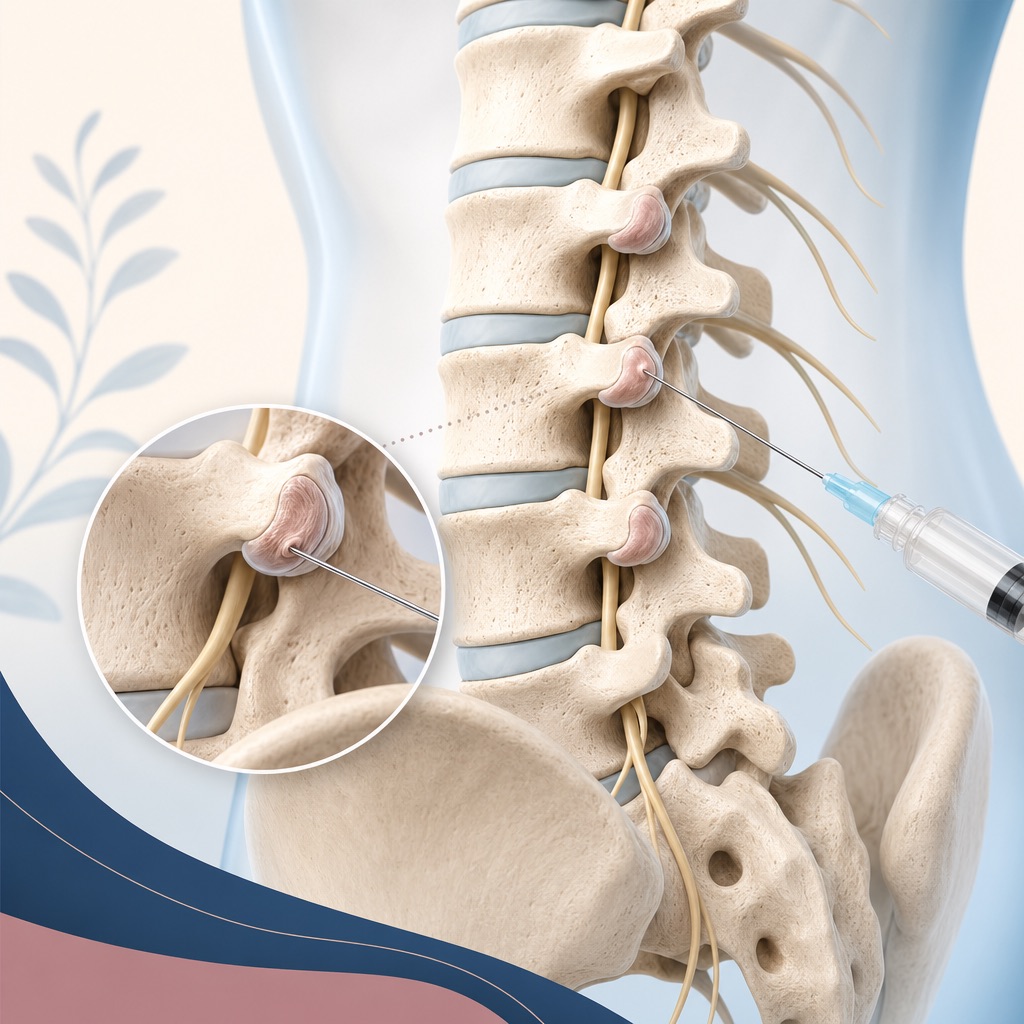
Spine injection
Facet Joint Injections
Facet joint injections in Houston: steroid placed inside the small spine joints to treat a painful flare. A treatment, not the test, and when we use it.
In short
A facet joint injection places a small dose of corticosteroid and local anesthetic directly inside one or more of the facet joints, the paired joints at the back of each spinal level, under X-ray guidance. It is a treatment for a painful, inflamed facet joint, not the diagnostic test for facet pain; that job belongs to the medial branch block. Relief from a facet injection is real but often short, typically weeks to a few months, and the evidence supporting it is weaker than for medial branch blocks followed by radiofrequency ablation, which is why we use it in specific situations rather than as a first step.
Key facts
| Treats | Pain from an inflamed or arthritic facet joint in the low back or neck, including a synovial cyst or an acute facet flare after injury |
|---|---|
| Test or treatment? | Treatment. Insurers do not accept relief from a facet injection as the diagnostic test for radiofrequency ablation |
| Procedure time | 10–20 minutes for 1–3 joints; about 60 minutes at the office |
| Anesthesia | Local anesthetic in the skin; light sedation optional |
| Downtime | Rest the day of the injection; normal activity the next day |
| When relief starts | Anesthetic effect within 30 minutes for a few hours; steroid effect at 2–7 days |
| How long relief lasts | Typically weeks to 3 months; sometimes longer, sometimes days |
| How often it can be repeated | Typically no more than 3–4 steroid injections per spine region per year, at least 2 weeks apart, and only if the previous one helped; Medicare limits all facet injection sessions combined |
| Insurance | Covered by Medicare and most plans for documented facet-pattern pain after conservative care, within session limits |
Who it is for
- Patients whose goal is radiofrequency ablation: two medial branch blocks are the required test, and a facet injection will delay that pathway rather than advance it
- Leg or arm pain that dominates, with a matching disc herniation or stenosis; an epidural is the better match
- Facet joints so arthritic or fused that a needle cannot enter the joint space (a medial branch block or ablation is used instead)
- Active infection, fever, uncontrolled diabetes, a steroid injection within the past 2 weeks, blood thinners that cannot be paused, or pregnancy
How a facet joint injection works
Facet joints are true joints, with cartilage, a capsule and a lining that makes lubricating fluid. Like a knee, a facet joint can become arthritic, swell, and hurt, particularly with the backward-bending and twisting movements that load it. Facet joint syndrome is the clinical name for that pattern.
A facet injection treats the joint the way a steroid injection treats an arthritic knee. Under fluoroscopy, a thin needle is guided into the joint space (which holds only about 1–1.5 mL), a drop of contrast confirms it is inside the capsule, and a mixture of corticosteroid and local anesthetic is injected. The anesthetic gives a few hours of relief; the steroid reduces inflammation in the joint lining over the following days and can settle a flare for weeks to a few months. It does not reverse arthritis or stabilize the joint.
Why this is not the test for facet pain. A facet injection can seem to answer the diagnostic question (the joint was numbed, the pain went away), but steroid inside the joint spreads out of the capsule and reaches the medial branch nerves and nearby muscle, so a positive response is less specific than a small-volume medial branch block. Medicare and nearly all commercial payers therefore require medial branch blocks, not facet injections, before approving radiofrequency ablation. If ablation is the likely destination, we start with the blocks.
When we choose a facet injection over medial branch blocks
- A short-term flare that needs settling now. Blocks-then-ablation takes 4–8 weeks and gives no lasting relief until the ablation. If someone has an acute facet flare that is keeping them from therapy or work, one steroid injection can bridge that gap.
- Synovial cyst. Cysts that grow out of a facet joint can press on a nerve root and cause sciatica. Injecting the joint (sometimes with cyst rupture) is a recognized non-surgical option, and it is a treatment, not a test.
- Inflammatory arthritis of the joint. When MRI shows joint fluid or bone marrow edema around the facet, the inflammatory component is high and steroid inside the joint tends to work better than average.
- Patients who prefer not to pursue ablation and want a simpler option, knowing that relief is usually temporary and repeats are limited.
We do not use facet injections as a routine first step for chronic facet pain, and we do not repeat an injection that gave little relief. Facet injections are performed at our Houston and Webster offices, and in Pearland when that office opens in November 2026.
What happens on procedure day
- Check-in: we confirm your blood-thinner hold, glucose if diabetic, allergies and driver, and you sign consent.
- Positioning: face down on the fluoroscopy table for lumbar joints, or face down with a forehead rest for cervical joints, with the X-ray angled to open the joint line. The skin is cleaned and draped.
- Numbing: lidocaine in the skin over each joint.
- Needle placement: under live X-ray, a thin needle is walked into the joint space and its position confirmed with a small amount of contrast that outlines the joint capsule.
- Injection: about 1 mL of steroid and local anesthetic per joint, injected slowly; joints that are tight may hold less. Pressure over the joint during the injection is normal.
- Recovery: 15–30 minutes of observation, then home. With sedation, a driver takes you; without it, many people drive themselves.
After the procedure
Day 0. Rest; the anesthetic may give a few hours of relief that then fades. Ice the sites 15 minutes at a time. No heavy lifting or twisting.
Days 1–3. Soreness at the sites and sometimes a temporary flare of back pain are common while the steroid takes effect. Flushing, poor sleep and higher blood sugar can occur for a few days.
Week 1–2. Steroid relief is usually apparent. Resume physical therapy, especially core and hip strengthening, which is what makes the relief last.
Judging the response. At 2 weeks we ask how much your pain has changed. Meaningful relief means we repeat only when it wears off, within the yearly limit. Little relief means we do not repeat it and turn to medial branch blocks or another source.
Call us for fever over 100.4 °F, redness or drainage at the sites, or new numbness or weakness in a leg or arm.
What the evidence shows
We tell patients plainly that the evidence for intra-articular facet steroid injections is weak. In the best-known randomized trial (Carette and colleagues, New England Journal of Medicine, 1991), patients whose pain responded to a diagnostic facet block were randomized to steroid or saline injected into the joint. At one and three months there was no difference between the groups. At six months, about 1 in 5 patients in the steroid group reported sustained marked relief versus 1 in 10 with saline, a difference that was statistically significant but small, and the authors concluded the injection had little value. Later trials and systematic reviews reached similar conclusions; the ASIPP 2020 facet guidelines rate the evidence for lumbar intra-articular injections as Level III (limited) and cervical as Level IV, versus Level II for medial branch blocks and radiofrequency ablation. The 2020 multispecialty facet consensus guidelines likewise recommend against intra-articular injections as a routine treatment or as a diagnostic test for ablation, while acknowledging a role in patients with inflammatory features or synovial cysts.
That is the reason facet injections sit where they do in our care pathway: useful for a specific flare, a cyst or an inflamed joint, and not the main tool for chronic facet pain.
Alternatives and what comes next
For most chronic facet pain the better-supported path is two medial branch blocks followed, if positive, by radiofrequency ablation, which typically gives 6–12 months or more of relief. If a facet injection helps and then wears off, that response is encouraging but still not accepted as a qualifying test, so the next step is usually the blocks. If the pain pattern turns out to involve the disc or a nerve root, an epidural steroid injection is the match; if it is the SI joint, an SI injection. Exercise-based care remains the foundation regardless of injection; see lower back pain and neck pain.
Safety and preparation
- Blood thinners: facet joint injections are treated as low-to-intermediate bleeding-risk procedures. Tell us about warfarin, apixaban, rivaroxaban, dabigatran, clopidogrel, ticagrelor, enoxaparin and aspirin; we decide with your prescriber whether a short hold is needed. Never stop a blood thinner on your own.
- Diabetes: the steroid can raise blood sugar for 1–3 days, sometimes up to a week. Check more often, keep taking your medication, and call if readings stay above 300.
- Infection or fever: we reschedule if you have a fever, an active infection or a current antibiotic course; a facet joint infection is rare but serious.
- Allergies (contrast, steroid, local anesthetic): tell us about reactions to X-ray dye, cortisone products, lidocaine or dental numbing.
- Pregnancy: the procedure uses X-ray; tell us if you are or could be pregnant.
- Sedation and driving: sedation is optional. With sedation, nothing to eat for 6 hours or drink for 2 hours beforehand and an adult driver is required; without it, most people can drive themselves.
- Recent steroids: a steroid injection anywhere in the body within 2 weeks, or a course of oral prednisone, usually means we wait.
- Planned ablation: if radiofrequency ablation is your goal, tell us; medial branch blocks, not a facet injection, are the required first step.
Risks and side effects
- Soreness at the injection sites for 1–3 days
- Temporary flare of back or neck pain for 24–72 hours
- Flushing, trouble sleeping or a rise in blood sugar for a few days
- Light-headedness or a vasovagal reaction during the procedure
- No benefit, or relief lasting only days
- Bleeding or bruising at the site
- Allergic reaction to contrast, steroid or local anesthetic
- Temporary numbness or weakness in a leg or arm if anesthetic tracks toward a nerve root; resolves within hours
- Joint capsule rupture from injection volume (usually harmless; occasionally the intent with a cyst)
- Menstrual irregularity, mood change or blood pressure rise from the steroid
- Septic arthritis of the facet joint or epidural abscess
- Epidural hematoma if the needle or medication enters the epidural space
- Nerve root injury
- Dural puncture with spinal headache, or spinal anesthesia if anesthetic enters the spinal fluid (very unlikely with contrast confirmation)
- For cervical joints: vertebral artery injury, avoided by imaging in two planes
- Bone density loss with frequent repeated steroid over years
Frequently asked questions
What is the difference between a facet injection and a medial branch block?
A facet injection puts steroid inside the joint to treat inflammation and is a treatment. A medial branch block numbs the small nerves outside the joint with a tiny dose of anesthetic and is a test that determines whether radiofrequency ablation will help. Insurers require medial branch blocks, not facet injections, before ablation.
How long does a facet joint injection last?
Typically weeks to about three months, with wide variation. The anesthetic gives a few hours of relief on the day, and the steroid effect builds over 2–7 days. If the first injection gave little relief, a repeat is unlikely to do better.
Will a facet injection qualify me for radiofrequency ablation?
No. Medicare and nearly all commercial insurers require two positive medial branch blocks, each with at least 80% relief, before approving ablation, and specifically do not accept a facet injection response. If you have had a facet injection that helped, you will still need the blocks.
How many facet injections can I have in a year?
Typically no more than 3–4 steroid injections in one spine region per year, at least 2 weeks apart, and only when the previous one helped. Medicare counts all facet procedures (injections and diagnostic blocks) toward a combined yearly session limit, so a facet injection can use up a session that would otherwise go toward the blocks-and-ablation pathway.
Why is my doctor recommending medial branch blocks instead of a facet injection?
Because the evidence for lasting relief from steroid inside the joint is weak, while the blocks-then-ablation pathway has better evidence and gives 6–12 months or more of relief. A facet injection makes sense for an acute flare, a synovial cyst or an inflamed joint, and for patients who do not want ablation.
Does a facet injection hurt?
The skin numbing stings briefly; entering the joint feels like pressure, and injecting into a tight joint can be briefly uncomfortable. It takes a few minutes per joint. Light sedation is available.
Sources
- A Controlled Trial of Corticosteroid Injections into Facet Joints for Chronic Low Back Pain (Carette S, et al., 1991) (opens in new tab) — New England Journal of Medicine
- Consensus practice guidelines on interventions for lumbar facet joint pain from a multispecialty, international working group (2020) (opens in new tab) — Regional Anesthesia & Pain Medicine (Cohen SP, et al.)
- Comprehensive Evidence-Based Guidelines for Facet Joint Interventions in the Management of Chronic Spinal Pain (2020) (opens in new tab) — American Society of Interventional Pain Physicians (ASIPP)
- Facet Joint Interventions for Pain Management: Local Coverage Determination (opens in new tab) — Centers for Medicare & Medicaid Services (Medicare Coverage Database)
Next step
Request an appointment
Call (832) 916-2075 or request an appointment online. New patients are welcome; the team confirms insurance and referral requirements before scheduling.