
- Low back pain (not mainly leg pain) lasting more than 6 months, worse with sitting, bending and loading, that has not improved with physical therapy, medication and time
- MRI showing moderate disc degeneration (dark, narrowed disc) at one or two lumbar levels that match the pain, with at least about half of the disc height preserved
- No significant disc herniation, spinal stenosis, spondylolisthesis or instability at the target level
- Facet and sacroiliac joints ruled out as the main pain source, usually by exam and diagnostic blocks
- Adults under about 70 with a body mass index in a range that allows safe needle access, and no active smoking (which impairs disc healing)
- Willingness to pay out of pocket and to accept uncertain benefit
Neuromodulation & implants
VIA Disc NP (Allograft Disc Injection): What It Is and What the Evidence Shows
VIA Disc NP injects donor disc tissue into a degenerated disc. How it is regulated, the VAST trial results, self-pay reality, risks and candidacy. Houston.
In short
VIA Disc NP is an injection of processed donor (allograft) disc tissue into a degenerated lumbar disc, intended to supplement the disc's inner core in people with chronic discogenic low back pain at one or two levels. It is a treatment, not a test. It is regulated as a human tissue product rather than an approved drug, is not covered by Medicare or most commercial insurers, and its evidence comes mainly from one industry-sponsored randomized trial that showed a modest benefit. This page lays out those facts so you can decide with clear eyes.
Key facts
| Treats | Chronic low back pain from degenerative disc disease at one or two lumbar levels, after at least 6 months of conservative care |
|---|---|
| Test or treatment? | Treatment |
| What is injected | Micronized, processed nucleus pulposus tissue from screened human donors, mixed with saline, delivered by needle into the center of the disc |
| Regulatory status | Marketed as a human cell and tissue product (HCT/P, section 361). It has not gone through FDA drug or device approval, and the FDA has not evaluated it for effectiveness in disc pain. |
| Evidence | One industry-sponsored randomized trial (VAST, 218 patients) with modest improvement over non-surgical care and a smaller, inconsistent difference from a saline injection |
| Procedure time | 30–45 minutes, outpatient, X-ray guided |
| Anesthesia | Local anesthetic with light sedation |
| When to judge results | Improvement, when it occurs, develops over 3–6 months and is measured at 6 and 12 months |
| Insurance | Typically not covered; self-pay. Ask the office for current pricing before scheduling. |
Who it is for
- Leg pain from a herniated disc or nerve compression, which needs different treatment
- Severe degeneration with a collapsed disc, large Modic changes or endplate damage, where there is nothing to supplement
- More than two painful levels, prior fusion at the level, or spinal instability
- Active infection, uncontrolled diabetes, or immune suppression, which raise the risk of disc infection
- Blood thinners that cannot be held
- Pregnancy
- Someone who expects a definitive fix or who cannot afford an uncertain self-pay procedure
What VIA Disc NP is, and what it is not
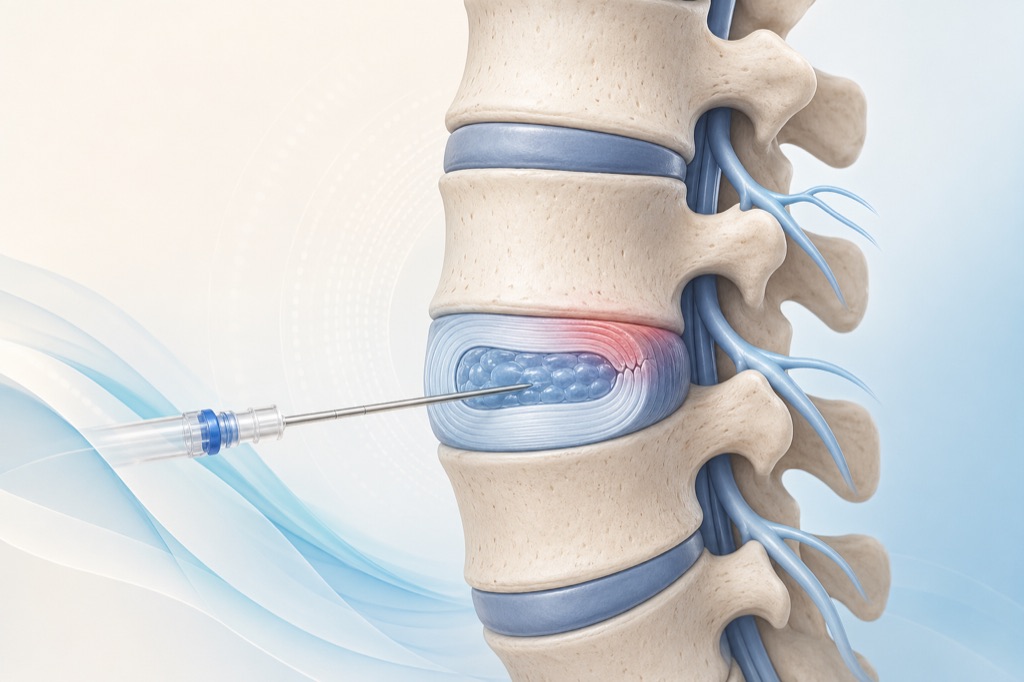
The nucleus pulposus is the soft, water-rich center of a spinal disc. As discs degenerate, they lose that water and the cells that maintain it, and in some people the disc itself becomes the pain source. VIA Disc NP is made from nucleus pulposus tissue recovered from screened deceased donors, processed into a fine particulate, and supplied as a dry product that is mixed with saline and injected through a needle into the center of the degenerated disc under X-ray. The idea is that the donor matrix supplements what the disc has lost and provides an environment in which the remaining disc cells function better. It is not stem cells, it is not a drug, and it does not regrow a disc.
Regulatory status, plainly. The product is marketed under the FDA's rules for minimally manipulated human tissue (section 361 HCT/Ps). That pathway does not require the manufacturer to prove safety or effectiveness for a specific use the way drug or device approval does. So when a website or advertisement says a disc allograft is "FDA-registered" or "FDA-regulated," that is true, but it is not the same as FDA-approved for treating disc pain. The FDA has not evaluated it for that.
Coverage, plainly. Medicare and nearly all commercial plans consider intradiscal allograft injection investigational and do not pay for it. Patients pay the practice directly for the procedure and the product; we will give you the current figure in writing before anything is scheduled. Gulf Coast Pain & Spine sees patients in Houston, Webster and Pearland (opening November 2026); ask at your visit whether this procedure is currently offered and whether your imaging fits.
What happens on procedure day
- Arrive with a driver, having held blood thinners as agreed. An IV is placed for light sedation and a dose of antibiotics, because any needle entering a disc carries a small risk of disc infection.
- You lie face down. Under X-ray, the physician numbs the skin and advances a needle from the side into the center of the target disc, avoiding the nerve root that passes nearby. A small amount of contrast may be used to confirm position.
- The allograft is reconstituted with saline and injected slowly into the disc; a typical volume is a few milliliters. You may feel pressure or a brief reproduction of your usual back pain.
- The needle is removed and a bandage placed. For two levels, the steps are repeated. You rest 30–60 minutes and go home the same day.
After the procedure
Days 0–3: a flare of back pain is common because the disc has been pressurized; ice, acetaminophen or a short course of anti-inflammatory medication is typical. Walking is encouraged; avoid bending, twisting and lifting more than about 10 pounds.
Weeks 1–2: return to desk work and light activity. Call immediately for fever, chills, or back pain that steadily worsens after the first few days: these can be signs of disc infection, which is rare but serious and needs prompt imaging and antibiotics.
Weeks 2–6: gradual return to normal activity and a physical therapy or home exercise program. Do not expect much change in pain yet.
Months 3–6: this is when any benefit becomes apparent. We check pain and function scores at 3, 6 and 12 months.
Judging the result: in the trial, responders were defined by at least a 50% drop in pain or a large drop in disability at 12 months. If you have not improved by 6 months, further benefit is unlikely, and we do not recommend repeating the injection at the same level. Keep the exercise program going either way; it is the one intervention that helps every group in every disc-pain trial.
What the evidence shows
The main evidence is the VAST trial, a manufacturer-sponsored randomized study of 218 adults with single- or two-level discogenic low back pain that compared allograft injection, saline injection into the disc, and non-surgical management. At 12 months, the allograft group had greater improvement in pain and disability than non-surgical management, and a higher share of patients reached a 50% pain reduction than in the non-surgical group. The comparison that matters most, allograft versus saline injected into the same disc, showed a smaller difference that was not consistently statistically significant across endpoints, in part because the saline group also improved. Follow-up reports to 36 months describe sustained improvement in the treated groups without a new control arm. There were no serious product-related adverse events reported, and infection rates were low. Independent replication has not been published. Our summary: this is a low-risk procedure with a modest average benefit in a carefully selected patient, supported by one sponsored trial, and it should be weighed against its out-of-pocket cost and against alternatives with stronger evidence.
Alternatives and what comes next
For chronic discogenic back pain, the evidence-backed options are a structured exercise program and active physical therapy, weight and smoking management, and pain-coping strategies; see Degenerative Disc Disease. If your MRI shows Modic changes at the vertebral endplates, basivertebral nerve ablation has randomized-trial evidence and Medicare coverage and may fit better than a disc injection. If facet joints are contributing, medial branch blocks and radiofrequency ablation come first. Other biologic injections such as PRP share the same evidence and coverage caveats. Fusion or disc replacement is the surgical end of the road and is reserved for people whose pain is severe and clearly single-level. If a VIA Disc injection does not help by 6 months, we return to that list rather than repeat it.
Safety and preparation
- Blood thinners: held before the procedure on a schedule agreed with your prescriber; never stop them on your own.
- Infection/fever: any active infection postpones the procedure. Because the needle enters the disc, we give IV antibiotics beforehand and ask you to report fever or worsening pain in the weeks after.
- Diabetes: uncontrolled glucose raises disc infection risk; bring recent numbers, and expect the procedure to be deferred if control is poor.
- Smoking: nicotine impairs disc healing; we ask you to stop before and after the procedure.
- Allergies (contrast, local anesthetic, antibiotics, and any known reaction to human tissue products): tell us in advance.
- Pacemaker/ICD and MRI: no device interaction; the allograft does not affect future MRI.
- Sedation and driving: bring a driver and do not drive for 24 hours after sedation.
- Pregnancy: X-ray guidance means the procedure is deferred if you may be pregnant.
- Cost: this is a self-pay procedure. Ask for the written cost and the refund policy for cancellation before scheduling.
Risks and side effects
- A flare of back pain for several days from pressurizing the disc
- Soreness and bruising at the needle site
- No meaningful improvement (a substantial share of treated patients in the trial did not reach the responder threshold)
- Nerve root irritation from the needle path with temporary leg pain or numbness
- Small disc herniation or worsening of a tear at the needle entry point
- Allergic or inflammatory reaction to the allograft or contrast
- Vasovagal fainting during the injection
- Discitis (disc infection) or vertebral osteomyelitis, presenting days to weeks later with fever and escalating back pain; needs urgent MRI, cultures and weeks of IV antibiotics, occasionally surgery. Antibiotic prophylaxis and sterile technique are the safeguards.
- Transmission of infection from donor tissue: donors are screened and the tissue processed under FDA tissue rules, but the risk is not zero
- Nerve root injury with lasting weakness or numbness
- Epidural bleeding if blood thinners were not held
Frequently asked questions
Is VIA Disc FDA-approved?
No. It is marketed as a minimally manipulated human tissue product under section 361 of the Public Health Service Act, a pathway that does not require proof of effectiveness for a specific use. That is different from FDA approval of a drug or device. The FDA has not evaluated it for treating disc pain.
Does insurance cover it?
Medicare and nearly all commercial plans consider intradiscal allograft injection investigational and do not pay for it. It is a self-pay procedure; we provide the current cost in writing before scheduling.
What are the chances it works?
In the VAST trial, more allograft patients than non-surgical patients reached a 50% pain reduction at 12 months, but a substantial share did not, and the difference from a saline injection into the disc was small and inconsistent. Expect a modest average benefit, not a cure, and expect a meaningful chance of no benefit.
Is it stem cells?
No. It is processed donor disc matrix, not a living cell therapy. Claims that any disc injection regrows a disc are not supported by evidence.
How long before I know if it helped?
Improvement, when it happens, develops over 3–6 months. We measure pain and function at 3, 6 and 12 months. If nothing has changed by 6 months, more benefit is unlikely.
What is the biggest risk?
Disc infection (discitis). It is rare, but it is serious, which is why we give antibiotics beforehand and want to hear about any fever or steadily worsening back pain in the weeks after.
Who is a candidate?
Someone with chronic low back pain from one or two moderately degenerated lumbar discs that match the pain on exam and imaging, no significant herniation, stenosis or instability, other pain sources ruled out, at least 6 months of conservative care, and a clear understanding of the cost and the uncertainty.
Sources
- VAST Clinical Trial: Safely Supplementing Tissue Lost to Degenerative Disc Disease (opens in new tab) — International Journal of Spine Surgery
- Regulatory Considerations for Human Cells, Tissues, and Cellular and Tissue-Based Products: Minimal Manipulation and Homologous Use (Guidance) (opens in new tab) — U.S. Food and Drug Administration
- Diagnosis and Treatment of Low Back Pain: Evidence-Based Clinical Guidelines (opens in new tab) — North American Spine Society
- Low Back Pain Fact Sheet (opens in new tab) — National Institute of Neurological Disorders and Stroke
Next step
Request an appointment
Call (832) 916-2075 or request an appointment online. New patients are welcome; the team confirms insurance and referral requirements before scheduling.