
- Low back pain in the middle of the back, worse with sitting, bending and lifting, present for more than 6 months and not improved by at least 6 months of physical therapy, exercise and medication
- For BVN ablation: MRI showing Modic type 1 (inflammatory) or type 2 (fatty) changes at one to three levels between L3 and S1 that match the painful area
- For intradiscal thermal procedures: a contained annular tear or mild degeneration at one level with preserved disc height, no Modic changes, and a positive provocation discogram, in a patient who understands the procedure is usually self-pay
- No leg-dominant pain, no significant spinal stenosis or nerve compression, and no spondylolisthesis beyond a small slip
- Facet joints and sacroiliac joints excluded as the main pain source by exam and, where needed, diagnostic blocks
- Body weight and bone quality that allow safe needle access (severe osteoporosis or very high BMI can rule out BVN ablation)
Neuromodulation & implants
Basivertebral Nerve Ablation and Intradiscal Procedures for Disc-Related Back Pain
Basivertebral nerve ablation (Intracept) vs intradiscal thermal procedures (IDET, biacuplasty): evidence, Medicare coverage, MRI candidacy, risks. Houston.
In short
These are procedures for chronic low back pain that comes from the disc and the bone next to it, rather than from a nerve root or facet joint. They are treatments, and they belong to two different families with two different stories: basivertebral nerve ablation, which heats the nerve inside the vertebra that carries pain from a damaged endplate, has randomized-trial evidence and Medicare coverage; intradiscal thermal procedures (IDET, biacuplasty), which heat the disc wall itself, have weaker evidence and are considered investigational by most insurers. Ask which option, if any, fits your imaging.
Key facts
| Treats | Chronic axial (central) low back pain of more than 6 months that comes from the vertebral endplates or the disc itself, not from a pinched nerve |
|---|---|
| Test or treatment? | Treatment. Candidacy is set by MRI findings and exam, not by a diagnostic block. |
| Two families | Basivertebral nerve (BVN) ablation for vertebrogenic pain with Modic changes; intradiscal thermal procedures (IDET, biacuplasty) for discogenic pain from an annular tear |
| Evidence | BVN ablation: two randomized trials (one sham-controlled) with 5-year follow-up. IDET/biacuplasty: small trials with mixed results. |
| Insurance | BVN ablation: covered by Medicare and a growing number of commercial plans for Modic type 1 or 2 changes at L3–S1. IDET and biacuplasty: investigational for most payers; usually not covered. |
| Procedure time | 60–90 minutes, outpatient, X-ray guided |
| Anesthesia | Monitored sedation with local anesthetic; general anesthesia in some settings for BVN ablation |
| When relief starts | BVN ablation: over 2–6 weeks. Intradiscal thermal: over 6–12 weeks. |
| How long relief lasts | BVN ablation: the nerve does not regrow through bone; trial data show relief holding at 5 years for most responders. Intradiscal thermal: varies. |
Who it is for
- Radicular (leg) pain, a symptomatic disc herniation, or stenosis with neurogenic claudication
- Prior fusion or hardware at the target level, or a compression fracture there
- Severe osteoporosis or a vertebral body that cannot safely accept the cannula
- Active infection, or blood thinners that cannot be held
- Pregnancy
- More than three painful levels, or MRI without the endplate changes BVN ablation requires
- A pain pattern that has not been worked up for facet, SI joint or hip sources
Two procedures, two very different stories
Not all disc-related back pain is the same, and the imaging tells us which kind you have.
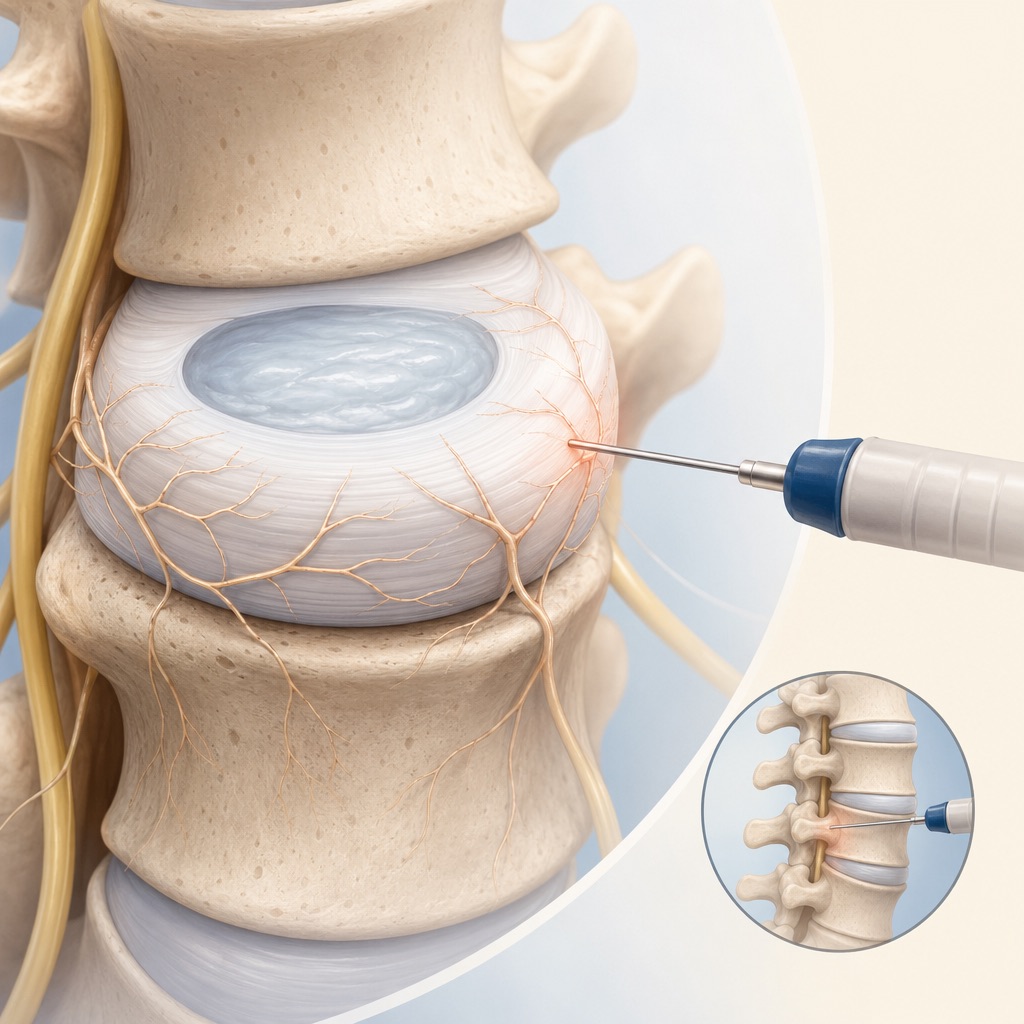
Vertebrogenic pain and basivertebral nerve ablation. The endplates are the thin layers of bone that cap each vertebra above and below the disc. When a disc degenerates, the endplates can crack and become inflamed, which shows on MRI as Modic changes (a bright or fatty band in the bone next to the disc). Pain from a damaged endplate travels through the basivertebral nerve, which enters the back of each vertebra and branches inside the bone. BVN ablation places a probe through the pedicle into the vertebral body under X-ray and heats the nerve trunk with radiofrequency energy for about 15 minutes, which stops it from carrying pain. Because the nerve lies inside bone, it does not regrow the way facet nerves do after standard radiofrequency ablation; relief in the trials has held for at least 5 years. The disc itself is not entered. The commercial system for this procedure is called Intracept.
Discogenic pain and intradiscal thermal procedures. When the pain comes from a tear in the disc's outer wall (annulus) rather than the endplate, a different set of procedures heats the disc wall itself. In IDET (intradiscal electrothermal therapy), a flexible heating wire is coiled inside the annulus; in biacuplasty, two cooled radiofrequency probes are placed on either side of the disc and heat the back wall between them. The goal is to shrink collagen and destroy small nerve fibers that have grown into the tear. These procedures require a needle inside the disc, need a provocation discogram beforehand, and have not shown consistent benefit in trials; nearly all insurers classify them as investigational.
Which one fits depends on your MRI: Modic changes point to BVN ablation; an annular tear without endplate change points, if anything, to an intradiscal procedure or to non-procedural care. Both are performed on an outpatient basis for Houston, Webster and Pearland (opening November 2026) patients; ask which option, if any, fits your imaging.
What happens on procedure day
- Arrive with a driver, blood thinners held as agreed and fasting for sedation. An IV is placed; antibiotics are given (routine for any intradiscal procedure and standard practice for BVN ablation because bone is entered).
- You lie face down. Under monitored sedation or general anesthesia, the skin over each target level is numbed.
- BVN ablation: under X-ray from two angles, a cannula is advanced through the pedicle into the vertebral body, and a curved channel is created to the center of the bone where the nerve trunk runs. A radiofrequency probe is placed and heats the nerve for about 15 minutes at each level; typically two vertebrae (above and below the painful disc) are treated in one session.
- Intradiscal thermal procedure: a needle enters the disc from the side, avoiding the nerve root; the heating element is positioned within the annulus and the disc wall is heated gradually over 15–20 minutes while you report any leg symptoms.
- Instruments are removed, bandages placed (no stitches), and you rest for 30–60 minutes before going home the same day. Total visit is typically 2–3 hours.
After the procedure
Days 0–3: soreness at the entry sites and, with BVN ablation, a deep ache in the back for several days from entering the bone; ice and acetaminophen or a short course of prescribed medication are typical. Walk daily; avoid lifting more than about 10 pounds, bending and twisting.
Weeks 1–2: return to desk work. After an intradiscal procedure, restrictions are stricter: no sitting for more than 30–45 minutes at a stretch, no lifting, and a brace for some patients, because the heated disc wall is weak while it heals. Call for fever, chills, or back pain that worsens rather than improves after the first week; these are signs of possible disc or bone infection.
Weeks 2–6: gradual return to activity and a physical therapy program. BVN ablation benefit usually appears in this window. Intradiscal procedures take longer, 6–12 weeks, with lifting and sport restricted until then.
Months 3–6: judge the result. Trials measured BVN outcomes at 3 months and found them stable afterward.
What the evidence shows
Basivertebral nerve ablation. The SMART trial (2018) randomized 225 patients with Modic type 1 or 2 changes to BVN ablation or a sham procedure: at 3 months the ablation group had greater improvement in disability (about a 20-point drop on the 100-point Oswestry scale versus 15 points for sham), with the difference larger in patients who met the full imaging criteria. The INTRACEPT trial (2019) randomized 140 patients to ablation or continued standard care and found a mean disability improvement of about 25 points versus 4 points at 3 months; more than 70% of treated patients had at least a 50% drop in pain. The 5-year follow-up of the SMART cohort reported that most responders kept their relief, with about two-thirds still reporting at least 50% pain reduction and no late device-related complications. Both trials were manufacturer-sponsored, and the sham trial's primary result depended on how the analysis population was defined, which critics have noted. Medicare contractors have covered the procedure since 2021 for patients meeting the trial criteria, and the North American Spine Society issued a coverage recommendation supporting it.
Intradiscal thermal procedures. IDET was tested in two small sham-controlled trials in the mid-2000s: one found a modest benefit, the other found none. Biacuplasty showed a benefit over sham at 6 months in a 2013 trial of 59 patients, with follow-up to 12 months, but no larger confirmation has followed. Systematic reviews rate the evidence as low quality, and nearly all payers, including Medicare, classify these procedures as investigational. We describe them here so you understand the difference, not because we recommend them for most patients.
Alternatives and what comes next
Before either procedure, the work-up should have excluded the facet joints (medial branch blocks, then radiofrequency ablation if positive) and the sacroiliac joint (SI joint injection). Structured exercise and physical therapy remain the foundation for all disc-related pain; see Degenerative Disc Disease. If your MRI shows disc degeneration without Modic changes and you are considering a biologic injection, read the VIA Disc page for its evidence and cost picture before deciding. If pain persists after BVN ablation, the next questions are whether a different level or source is responsible and whether surgical consultation for fusion makes sense; a failed ablation does not preclude surgery. Referring physicians can send MRI reports through Refer a Patient; we can tell you from the images whether the Modic criteria are met.
Safety and preparation
- Blood thinners: held before the procedure on a schedule agreed with your prescriber; a bleed near the spinal canal is the concern. Never stop them on your own.
- Infection/fever: any active infection postpones the procedure. Because these procedures enter bone or disc, IV antibiotic prophylaxis is given, and you should report fever or worsening pain in the weeks after.
- Diabetes: poor glucose control raises the risk of disc and bone infection; bring recent numbers and expect deferral if control is poor.
- Osteoporosis: tell us about any prior fracture or DEXA result; fragile bone can rule out BVN ablation or change the approach.
- Allergies (contrast, local anesthetic, antibiotics): tell us in advance.
- Pacemaker/ICD: radiofrequency energy can interfere with cardiac devices; tell us before scheduling so the device can be checked or set appropriately and monitoring arranged.
- MRI: nothing is implanted, so future MRI is unaffected.
- Sedation and driving: fast as instructed, bring a driver, and do not drive for 24 hours after sedation.
- Pregnancy: X-ray guidance means the procedure is deferred if you may be pregnant.
Risks and side effects
- Deep back ache for several days after BVN ablation from entering the vertebral body
- Soreness and bruising at the needle sites
- A temporary flare of back pain after an intradiscal procedure while the heated disc wall heals
- Grogginess from sedation for a few hours
- Nerve root irritation from the needle path, with temporary leg pain or numbness
- Disc herniation or a new annular tear after an intradiscal procedure, occasionally causing new leg pain
- Bleeding into the back muscles, more likely if blood thinners were not fully held
- Pedicle fracture or a fracture through the vertebral body during BVN cannula placement, mainly in osteoporotic bone
- No meaningful improvement, either because the pain source was misjudged or the lesion did not reach the nerve
- Discitis (disc infection) or vertebral osteomyelitis, presenting days to weeks later with fever and escalating back pain, requiring MRI, cultures and prolonged IV antibiotics, sometimes surgery. The risk is highest when a needle enters the disc; antibiotic prophylaxis and sterile technique are the safeguards, and BVN ablation avoids the disc entirely.
- Thermal injury to a nerve root or the spinal cord if a heating element is placed too close to the canal, with lasting weakness or numbness; live X-ray and patient feedback during heating are the safeguards
- Epidural hematoma with nerve compression, an emergency requiring urgent surgery
- Vertebral body necrosis or delayed collapse after ablation (reported very rarely)
Frequently asked questions
What is vertebrogenic pain, and how is it different from disc pain?
Vertebrogenic pain comes from damaged, inflamed endplates, the bone surfaces on either side of a disc, and shows up on MRI as Modic changes. Discogenic pain comes from tears in the disc wall itself. They feel similar (central low back pain, worse with sitting and bending), which is why the MRI decides which procedure, if any, fits.
Is basivertebral nerve ablation covered by insurance?
Medicare has covered it since 2021 for patients with chronic low back pain of at least 6 months, failed conservative care, and Modic type 1 or 2 changes at L3 to S1 on MRI, and many commercial plans now follow similar criteria. We verify coverage before scheduling.
Are IDET and biacuplasty covered?
Almost never. Medicare and most commercial plans classify intradiscal thermal procedures as investigational because the trial evidence is small and mixed. If one is offered, expect it to be self-pay and ask for the cost in writing.
How long does relief last after basivertebral nerve ablation?
The nerve runs inside bone and has not been shown to regrow after ablation. In the SMART trial cohort, most responders still had relief at 5 years, with about two-thirds reporting at least a 50% reduction in pain. That is a trial population; individual results vary.
Does it involve a needle in my disc?
Basivertebral nerve ablation does not; the probe goes through the pedicle into the vertebral body and never enters the disc, which is why its infection risk is lower. IDET and biacuplasty do place instruments inside the disc, which is the main reason for their discitis risk.
How do I know if my MRI qualifies?
The radiology report should mention Modic type 1 or type 2 changes (sometimes worded as endplate edema or fatty endplate change) at one or more levels from L3 to S1, without a large herniation, significant stenosis or spondylolisthesis. Bring the images, not just the report; we review them at the visit and tell you whether the criteria are met.
What is the biggest risk?
Infection of the disc or bone. It is rare, but it is serious, which is why antibiotics are given beforehand and why fever or worsening pain in the weeks afterward needs a same-day call.
Which of these does the practice do?
Ask at your visit which option, if any, fits your imaging. Basivertebral nerve ablation is the one with trial evidence and coverage; intradiscal thermal procedures are described here so you can recognize the difference when you see them advertised.
Sources
- Intraosseous Basivertebral Nerve Ablation for the Treatment of Chronic Low Back Pain: a Prospective Randomized Double-Blind Sham-Controlled Multi-Center Study (SMART) (opens in new tab) — European Spine Journal
- A prospective, randomized, multicenter study of intraosseous basivertebral nerve ablation for the treatment of chronic low back pain (INTRACEPT) (opens in new tab) — The Spine Journal
- Long-term outcomes following intraosseous basivertebral nerve ablation for chronic low back pain: 5-year treatment arm results (opens in new tab) — European Spine Journal
- Coverage Policy Recommendations: Basivertebral Nerve Ablation (opens in new tab) — North American Spine Society
- A Randomized, Placebo-Controlled Trial of Transdiscal Radiofrequency, Biacuplasty for Treatment of Discogenic Lower Back Pain (opens in new tab) — Pain Medicine
Next step
Request an appointment
Call (832) 916-2075 or request an appointment online. New patients are welcome; the team confirms insurance and referral requirements before scheduling.